Category: Habits and addictions

We are what we do repeatedly. Understanding and mastering habits will help you overcome obstacles and achieve goals.

  • ‘Why am I obsessed with someone I barely know?’

    ‘Why am I obsessed with someone I barely know?’

    Becoming obsessed with someone involves devoting a lot of resources to that person. Be it mental, emotional, financial, or temporal resources. You:

    • can’t stop thinking about them
    • stalk them on the internet and/or in real life
    • crave their attention and yearn to talk to them.
    • keep talking about them to your friends.

    They’ve taken over your mind and life.

    Many of these behaviors make sense if you’re in the early connection or honeymoon phase of a romantic relationship. You’re assessing your partner’s suitability for a long-term, committed relationship.1Fletcher, G. J., Simpson, J. A., Campbell, L., & Overall, N. C. (2015). Pair-bonding, romantic love, and evolution: The curious case of Homo sapiens. Perspectives on psychological science, 10(1), 20-36. But what explains being obsessed with someone you barely know?

    Reasons for being obsessed with a stranger

    1. Attraction

    Why did that one person out of so many people catch your eye? They’re probably very physically attractive. Often, your brain has to decide whether or not someone is a potential partner based on limited visual information about that person. At this point, you can’t deeply understand their personality.

    Once you lock in on a person and think of them as a potential partner, you start to become obsessed with that person.2Fisher, H. E. (1998). Lust, attraction, and attachment in mammalian reproduction. Human nature, 9, 23-52. You’re motivated to approach them, spend time with them, and get to know them better. Initiating, building, and maintaining relationships is costly- a significant drain on your resources. That’s why it’s hard to be obsessed with multiple people. You may find numerous people attractive, but you’ll not be obsessed with them all in the same way.3Feygin, D. L., Swain, J. E., & Leckman, J. F. (2006). The normalcy of neurosis: Evolutionary origins of obsessive–compulsive disorder and related behaviors. Progress in Neuro-Psychopharmacology and Biological Psychiatry, 30(5), 854-864. Your mind has a hierarchy of potential partners. You’re likely to obsess over someone who occupies the topmost position in that hierarchy.

    Once you decide, based on limited information, that a person is a potential partner, your mind starts projecting its fantasies onto that person. People naturally have fantasies of what their ideal partner will be like. You idealize that person and attribute positive qualities to them that they may not necessarily have. Evolution has wired us to reproduce at all costs. It doesn’t care about reality if it gets in the way of pursuing potential mates.

    This is also observed in the halo effect. Because a person has one good quality (physical attractiveness), you think they have multiple good qualities in other areas of life. You think they’re smart, wise, hard-working, caring, charismatic, funny, etc., despite there being no evidence of the same.

    2. Sense of purpose

    Our relationships shape a considerable portion of our identities. For many, their romantic relationship provides a significant chunk of who they are. So, people with a weak sense of identity find meaning and a sense of purpose in pursuing and establishing a romantic relationship. Without it, their life lacks meaning. They don’t know who they are. Their self-worth is tied to being in a relationship.4Spitzberg, B. H., & Cupach, W. R. (2007). The state of the art of stalking: Taking stock of the emerging literature. Aggression and violent Behavior, 12(1), 64-86. So, in getting obsessed with someone they barely know, they’re getting obsessed with getting a self-esteem boost.

    3. Curiosity

    Humans are naturally curious, some more than others. We had to be because it motivates us to understand our environments, master them, and enhance survival and reproduction. If something piques our curiosity, we want to know more. We beome obsessed with it. This explains why you may become obsessed with a person who is a question mark. That person doesn’t seem to fit any stereotypes. They seem to have contradictory traits. You want to make sense of the contradiction that they are. 

    Curiosity can not only get triggered by contradictory information but also by limited information. The mind is designed to ‘fill in the gaps’ of missing information. Also, the mind is designed to believe that scarcity equals value. What is scarce is valuable; what is abundant is cheap. To your mind, the person you barely know is more valuable than those you know. So you become obsessed with them. 

    This is why many dating gurus emphasize being mysterious. People don’t obsess over what they have figured out. They put them on the shelf and move on to the next mystery.

    4. Familiarity

    Every day, we encounter strangers. People we barely look at and don’t even greet. Some of these people move from being strangers to being people we know. What leads to this transition? The answer: Familiarity. 

    If you see someone repeatedly, keeping them in the ‘strangers’ zone is hard. Over time, they become familiar. You look at them and greet them. You may even like them. It’s called the mere exposure effect. You certainly like them more than the strangers you don’t even look at or greet.

    We’re likely to become obsessed with these familiar people because they are in this weird land between the ‘land of strangers’ and the ‘land of familiars’. Based on your subsequent interactions with them, your mind will have to decide whether to put them in the land of strangers or familiars or keep them in the middle zone. They present a social problem you must solve, so you keep thinking about them. 

    Then, there’s a thing called subconscious familiarity. You may meet a person who is familiar to you but on a subconscious level. They probably remind you of an ex, a friend, or a family member. They may be similar to this person you encountered in the past in their appearance, gait, mannerisms, dressing sense, etc. Your subconscious thinks that this new person is the same as the person from your past. It’s called stimulus generalization.

    You may have observed that the people you’re attracted to resemble those you were attracted to in the past. Your mind developed positive emotional associations with the person from your past. So, any new person similar to that older person makes you associate the same positive emotions with the former.

    5. Negative emotions

    If you’re experiencing stress, anxiety, loneliness, or depression, you may be looking for an escape from these emotions. You’re more likely to obsess over someone you barely know when you’re in an emotionally vulnerable state. It’s common for people to find themselves getting obsessed with someone soon after a breakup. The loss of a romantic partner is stressful and creates waves of loneliness. The memories that brought joy once become painful. Your self-worth takes a hit. To escape this pain, your mind craves a new source of pleasure. This new person you’re obsessed with provides you with that much-needed dose of pleasure and a boost of self-worth. 

    6. Low mate value

    If you believe you have a low mate value, you will likely be obsessed with the first person you find attractive. Mate value is simply a 1-10 number indicating your attractiveness. If you believe you’re a 4, you’ll likely be obsessed with someone you perceive as an 8. This explains why people become obsessed with celebrities and not vice versa. 

    Because you think you’re a 4 and will probably never be able to attract an 8 again, you hold on to that person like your life depends on it. You never want to let them go. Ironically, this makes you more anxious and nervous around them because you’ve put them on a pedestal. You don’t want to ruin your chances with them. If you believed you were an 8 or a 9, you’d have a more abundant and detached mindset. You’d think that you can attract anyone you want. You wouldn’t become obsessed with anyone.5Duntley, J. D., & Buss, D. M. (2012). The evolution of stalking. Sex roles, 66, 311-327.

    This explains why, although obsessing over someone can feel good temporarily, your self-esteem drops over time as the obsession grows. When obsessed, you’re communicating to your mind:

    “This person I’m obsessed with is more important than me. They are the prize.”

    You reduce your value. Think about a person you admire. How would you feel about them if you learned they were obsessed with someone and had been stalking them?

    7. Limerence 

    Limerence is one of the most difficult emotional states to get out of. It’s when you become overly attached to someone you’re already in a relationship with or someone you barely know. It leads to obsessive thoughts and compulsive behaviors like stalking.6Bradbury, P., Short, E., & Bleakley, P. (2024). Limerence, hidden obsession, fixation, and rumination: a scoping review of human behaviour. Journal of Police and Criminal Psychology, 1-10.

    Those with attachment trauma who develop insecure attachment styles tend to overly attach to their romantic partners. From a psychoanalytic perspective, they have a morbid attachment to the ‘missing’ object of infancy.7Mitchell, L. (2000). Attachment to the missing object: Infidelity and obsessive love. Journal of Applied Psychoanalytic Studies, 2(4), 383-395. In simple terms, they’re hungry for love because they’ve had very little of it when they should’ve unconditionally had a lot of it.

    In contrast, those with secure attachment styles are more chill about their relationships. They don’t get overly attached to their potential or actual partners.


    References

  • How to stop scrolling mindlessly and endlessly

    How to stop scrolling mindlessly and endlessly

    Scrolling media is not a recent phenomenon, as many would think. Scrolling behavior appeared when remote controls for TVs were invented. Before that, people had to get up and physically change the TV channel.

    I remember when my dad used to scroll channels on the TV, constantly pressing the button on his remote control, and how angry it made my mom. “Why don’t you stop at some channel and let us watch anything properly?” she said. Like many people today, my dad was probably unaware of what he was doing. He was probably stuck in the same hypnotic, zombie state that many people find themselves today when they’re on their social media apps.1Sinha, S., Sharma, M. K., Tadpatrikar, A., Anand, N., & Kumar, R. (2023). Scrolling Mindlessly: Emerging Mental Health Implications of Social Networking Sites. Journal of Public Health and Primary Care, 4(3), 179-181.

    What causes scrolling behavior?

    Our brains are wired to pay attention to shifts in our environment. In ancestral times, often, these shifts meant opportunities for enhancing survival and/or reproduction or threats to the same. We can’t help but notice novelty. Our brains are constantly asking:

    “What’s new? What’s shiny?”

    Information about opportunities and threats in our ancestral environments was mainly socially relevant.2Lim, A. J., & Tan, E. (2024). Social media ills and evolutionary mismatches: a conceptual framework. Evolutionary Psychological Science, 10(3), 212-235. Opportunities to form alliances with others and pursue potential mates. Threats to survival and resources from neighbors or neighboring tribes. As a social species, humans strongly emphasize seeking socially relevant information.

    Given that we’re wired to seek and monitor social information, what do you expect would happen when we’re bombarded with unprecedented levels of such information? Of course, we’d get addicted to it. We’d spend a lot of time taking in that information because that’s what we’re designed to do. We focus on the benefits of such behavior and ignore the costs because evolution wants us to survive and reproduce at all costs.

    Any app that constantly throws novel, socially relevant information at you has the potential to be addictive. The infinite scroll feature of the various social media apps makes the addiction worse. It traps you in a state of mindless scrolling. It’s mindless because how much mind can you apply to a 30-second reel?

    Social media algorithms are designed to increase engagement by showing you more of the content you’re engaging with. More often than not, they exploit your current emotional state. For instance, if you’ve been through a breakup and watched some sad content, you’ll be shown more similar sad content.

    The upsides and downsides of social media

    Social media apps have upsides, or people wouldn’t use them. That’s precisely why social media addiction is a tricky topic. If you’re addicted, you have to decide for yourself how you’re going to manage your use—how you can maximize the upsides and minimize the downsides. I argue that there are more downsides to social media use than upsides, providing lists for both.

    Upsides

    These upsides are enjoyable when you spend limited time on social media. These days, thanks to the algorithms hell-bent on making you spend more time on the platforms, doing that has become nearly impossible. This is why many can’t seem to adhere to the time limits they set on these apps and press ’10 more minutes’.

    Downsides

    Vulnerable groups

    While some people are more vulnerable to social media addiction, social media is generally addictive because it taps into how humans are wired to seek and stay on top of socially relevant information.

    Narcissists love social media because it allows them to present themselves in the best light to gain admiration.10Jin, S. V., & Ryu, E. (2018). “The Paradox of Narcissus and Echo in the Instagram Pond” in light of the selfie culture from Freudian evolutionary psychology: self-loving and confident but lonely. Journal of Broadcasting & Electronic Media, 62(4), 554-577. The anxiously attached get hooked to social media because they have high love and connection needs.11Liu, C., & Ma, J. L. (2019). Adult attachment style, emotion regulation, and social networking sites addiction. Frontiers in psychology, 10, 2352. Those with an addictive personality may rush to social media when they’re unable to cope with their negative emotions.

    How to stop scrolling

    You know whether or not you’re addicted to scrolling social media. You don’t even have to look at your screen time. You don’t have to take any assessment. If your social media use feels chaotic, out of control, puts you in a bad mood, and fills you with regret for wasting your time, you are addicted. 

    1. Delete your apps and accounts

    I know this is not an option for many. You might use social media for business or have made good friends there. But if it is an option, go for it. It’s the best way to remove the apps from your mind permanently. Of course, your mind will want to relapse. Because you were once addicted, you’ve taught your mind that scrolling these apps is rewarding. Therefore, social media companies always provide an option to come back. They know you’ll be tempted to come back. Resist that temptation.

    2. Use them only from your computer

    Ease of access is a huge factor that makes social media apps addictive. The brain wants the rewards of socially-relevant information as easily and quickly as possible. When you introduce friction in your access to these apps, you can significantly decrease the addiction. If you only use social media from your computer, you have to open your computer, wait for the screen to load, open your browser, find the app icon, and then click it—too much work. 

    Also, thanks to ease of access, having social media apps on your phone is having them on the front of your mind. When you have something on the front of your mind, you’re preoccupied with it. When you only use social media sites from your computer, they get moved from the front of your mind to the back of your mind. You find you don’t think about using them so much. The difference is huge.

    You can still get addicted to scrolling on your computer. Scrolling is scrolling, no matter what device it's done on. You can hide newsfeeds from your social media sites when browsing them on your computer to create more friction. News Feed Eradicator, a Chrome extension, is perfect for this.

    3. Systematize your social media use

    You may have noticed that your social media use tends to be random and chaotic. A notification here and a comment there, bouncing from one app to another. There is no order, no process or system to follow. When you have no system to follow, you’re likely to get addicted because you don’t know when you’ll get the next notification or comment. Random and variable rewards are known to be addictive. 

    To make your social media use more intentional and systematic, use a timer that rings loudly to avoid exceeding the time limit. List the social media tasks you need to do in order from start to finish. When you finish the last task, close all the apps and don’t open them again until the next session.

    4. Identify your core values

    When you’ve identified your top 3-5 core values, see how your social media use contributes to those values. If it doesn’t, you should drastically cut your social media use. You can’t go wrong in making decisions that align with your core values. Most of your time, energy, and resources should be spent on activities that align with your core values.

    Final words

    Once you see what it’s like getting off social media, it’ll be hard to get back on it. You’ll see how idiotic it is to be caught in the endless scrolling trap. What’s happened has happened. Forgive yourself for your past mistakes and move on. It’s time to evolve. Ditch the herd mentality. You don’t have to do what everyone else is doing. What you have to do is maximize your subjective well-being.

    References

  • How to get rid of a fetish: A psychological guide

    How to get rid of a fetish: A psychological guide

    The word ‘fetish’ comes from the Portuguese feitico, meaning ‘spell’, which in turn comes from the Latin facticius, meaning ‘artificial’ or ‘made up’. Someone with a fetish has sexual interests so deviant that they seem artificial or made up.

    Fetishism is indulging in a fetish, and a fetishist is a person having a fetish. Fetishism belongs to a category of sexual behaviors termed paraphilia, from the Greek para, meaning ‘beside, aside’, and philos, meaning ‘loving’. Paraphiliacs indulge in sexual behavior that is beside the norm. Fetishism is a type of paraphilia where the fetishist derives sexual arousal and pleasure from objects, non-sexual body parts, or particular behaviors and situations.

  • How to get rid of a fetish
  • Common fetish objects

    Anything that can get fetishized is referred to as a fetish object. Although one can have a fetish for any object or a non-sexual body part, clothing items are the most common type of fetish object.1Wiederman, M. W. (2003). Paraphilia and fetishism. The Family Journal, 11(3), 315-321.

    Common fetish objects include:

    Fetishes are not limited to inanimate objects and body parts. Any stimulus (information) that can be sensed or thought about can develop into a fetish. Besides things and non-sexual body parts, activities, images, concepts, or situations can also get fetishized.

    For example, it turns out that many adults who have a fetish for diapers really have a fetish for being treated like babies. It’s a situation fetish.

    Sexual preferences vs. fetishes

    A sexual preference is not the same as a fetish. Sexual preferences are specific ways individuals seek to gratify themselves, usually with a sexual partner. A fetish may or may not involve another partner.

    Fetishes tend to be stronger and more deviant than sexual preferences.

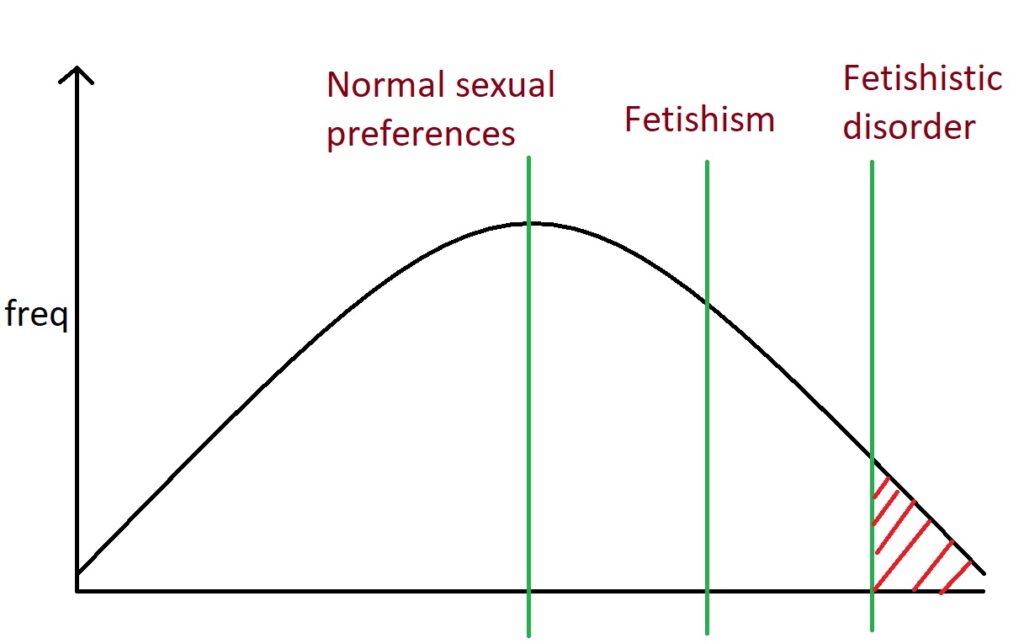
    Most people have standard sexual preferences. Some have specific fetishes. Very few have a fetishistic disorder where their fetish overtakes their sexual preferences and causes them significant distress.

    Most people who have fetishes tend to have harmless fetishes that don’t interfere with other areas of their lives. They do not require indulging in their fetish to get sexually aroused. Though they report fetish sex as more satisfying than non-fetish sexual activity.3Rees, G., & Garcia, J. R. (2017). All I need is shoe: An investigation into the obligatory aspect of sexual object fetishism. International Journal of Sexual Health, 29(4), 303-312.

    On the other hand, people with fetishistic disorder need fetishism to get sexually aroused. They may not be able to experience sexual arousal in the absence of the fetish object.

    fetishistic disorder curve
    Very few fetishists harm themselves or others.

    Harms of fetishism

    It’s not hard to see how over-reliance on a fetish object for sexual gratification can create problems for an individual.

    What causes fetishism?

    Many explanations have been put forth to explain fetishism. Let’s dive into a few that make the most sense:

    1. Learned response

    If people are not biologically wired to find objects sexually arousing, then it must be a learned response. Learning by classical conditioning is the best and most widely accepted explanation of fetishism.

    If you’re new to classical conditioning, here’s a one-paragraph summary of how it works:

    When two events occur together, our brains link them. This is because our brains are associating machines. We associate co-occurring things to learn their relationship.

    Pavlov’s dogs and cartoons

    You must have heard of Pavlov’s dogs. Pavlov’s dogs salivated (biological response) when presented with food. When he rang a bell and presented the food simultaneously a few times, the dogs associated salivation with the bell. Learning by association is strengthened by repetition.

    So, when he rang the bell without food, the dogs salivated. Salivation (a biological response) was paired with something that doesn’t typically cause salivation (ringing a bell).

    Sexual arousal is a biological response, too. If something causes sexual arousal that doesn’t typically cause sexual arousal (e.g, a fetish), we can reasonably assume there’s classical conditioning going on.

    Fetishes tend to develop in childhood and adolescence when people first explore sex and sexual arousal.4Wise, T. N. (1985). Fetishism—Etiology and treatment: A review from multiple perspectives. Comprehensive psychiatry, 26(3), 249-257. Many people can trace the development of their fetishes and fantasies to their earliest intense sexual arousal experiences.

    When they first experienced sexual arousal, something in the environment got paired with the biological response and developed into a fetish. Such that exposure to the fetish object led to sexual arousal subsequently.5Larva, M. A., & Rantala, M. J. (2024). An evolutionary psychological approach toward BDSM interest and behavior. Archives of sexual behavior, 53(6), 2253-2267.

    Many fetishes stem from cartoon characters, which isn’t all that surprising since children spend a lot of time watching cartoons.

    Our brains are highly impressionable during childhood and early adolescence. Any learning through classical conditioning occurring during this time may become deeply ingrained in the psyche.

    Fetishes tend to be specific

    Classical conditioning explains how almost any stimulus can become a fetish. The fact that fetishes tend to be specific rather than generic lends strong support to the conditioning theory. Instead of fetishizing shoes in general, the fetishist fetishizes a particular brand, shape, color, size, or texture of shoes that got linked to arousal thanks to their specific experience.

    Behavior that gets rewarded gets repeated. If a fetishist indulges in their fetish and gets aroused (reward), the fetish feeds itself. So, fetishes are a lot like habits and addictions in this regard.

    2. Past unmet needs

    Adolescents find themselves in many situations where they get sexually aroused but can’t achieve sexual satisfaction. This creates psychological tension in them that can persist into adulthood.

    For instance, if a boy liked a girl with ginger hair in school but couldn’t pursue her, this desire may get stuck in his psyche (Zeigarnik effect) and develop into an unmet need in adulthood. In adult relationships, he may prefer ginger-haired women or ask his partners to paint their hair ginger.

    Sometimes a fetish may help the fetishist satisfy a non-sexual unmet need.6Munroe, R. L., & Gauvain, M. (2001). Why the paraphilias? Domesticating strange sex. Cross-cultural research, 35(1), 44-64. There’s this guy who liked being tied to a leash. Upon introspection, he realized that it helped him feel cared for. His parents physically abandoned him as a child.

    3. Re-enacting trauma

    Traumatic experiences make people feel powerless. They think they can’t control the source of their trauma.

    This feeling of a loss of control over their source of trauma can force them to try to regain control over it later in life. They may do this by re-enacting the trauma in safer situations, such as having sex with a trusted partner.

    For example, if someone was physically abused as a child, they might like getting physically abused during sex. They’re re-creating their childhood trauma in a safe space so they can get a chance to process it.

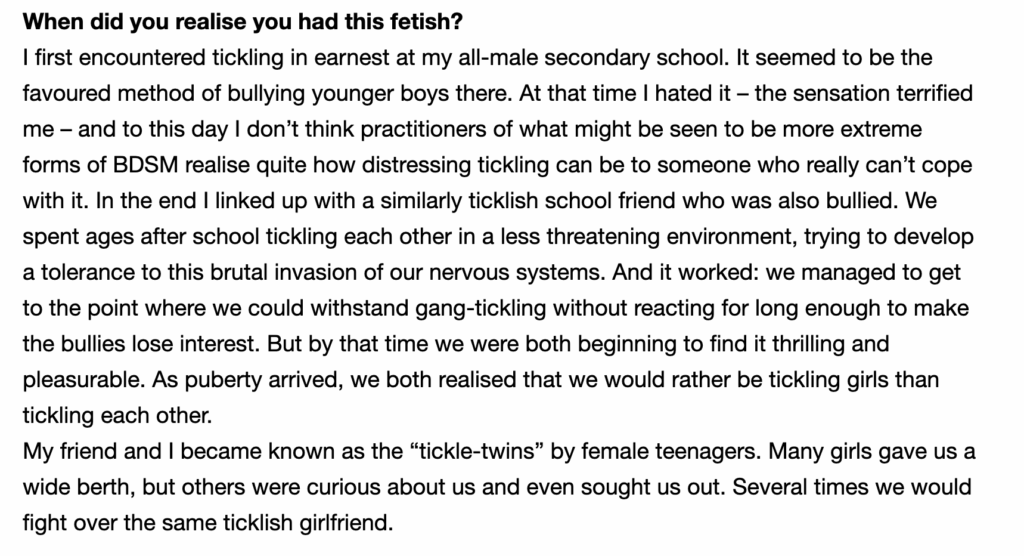
    I searched a few forums for examples like this, and here’s what people had to say:

    Real-life example 1

    fetish example 1

    Example 2

    fetish example

    It seems that both classical conditioning and trauma re-enaction were at work here.

    Example 3

    fetish example 3

    A good example of a behavior fetish. This excerpt was taken from this Vice article.

    4. Sexual imprinting

    Konrad Lorenz found that when ducklings and geese hatch, the first thing they see they think is their mother. He had them following him wherever he went, like they would their actual mother. This phenomenon is called imprinting. What many people don’t know is that those baby birds also made sexual advances towards Lorenz when they grew up.

    This behavior was labelled sexual imprinting. Sexual imprinting is a well-established phenomenon in animals. It can be defined as a process by which sexual preferences are acquired through early experience with parents and siblings.7Aronsson, H. (2011). Sexual imprinting and fetishism: An evolutionary hypothesis.

    In other words, the early contact an animal has with parents and siblings teaches it what its future potential mates should look like. This could explain why so many people are attracted to potential mates who look or behave like their parents.

    Where does fetish come in all this?

    You must have noticed that almost all common fetishes involve the human body in some way. It could be that during their early contact with caregivers, the fetishist thought that the footwear, clothing, or accessory of the caregiver they sexually imprinted on was part of their body.

    For example, a fetishist may fetishize a particular type of sock simply because their mother always wore that sock. His developing infant brain thought the sock was part of her mother, her body.

    How to get rid of a fetish

    If you feel your fetish is harming you or those around you, you might want to minimize its hold on your life, if not get rid of it completely.

    1. Unlinking

    If your fetish is a classical conditioning response, you can unlink your fetish object from sexual arousal. To do that, you can resist the urge to indulge in your fetish the next time you’re exposed to your fetish object. When you don’t give in to the desire, you’ll make the urge weaker over time.

    Eventually, thinking about or getting exposed to the fetish object may no longer produce the unwanted biological response.

    You can also reverse it and try to pair sexual arousal with normal sexual stimuli. Through fantasizing, you can train your mind to get aroused by normal sexual stimuli.8Wong Sarver, N., & Gros, D. F. (2014). A modern behavioral treatment to address fetishism and associated functional impairment. Clinical Case Studies, 13(4), 336-351.

    2. Aversion training

    You pair your fetish object with something disgusting or fear-inducing. It’s recommended that you do this in a controlled environment with a counselor or a therapist. This method is not for everyone, but it can work.

    3. Cognitive approach

    The cognitive approach to overcoming fetishism involves using your own thoughts of shame and guilt. If you’re ashamed of your fetish, you can think things like:

    “What will my colleagues think when they get to know about my fetish?”

    “What will my spouse or children think?”

    Shame is a powerful emotion that prevents many people from doing harmful things. Get realistic about your fetish’s time, energy, and relational costs, and you’ll see that the costs outweigh the benefits. You’ll consciously choose not to engage in fetishistic behaviors.

    4. Alternate processing

    If your fetish stems from childhood trauma, you can find alternative ways to process your trauma. For instance, reliving your trauma in the safe space of a therapeutic setting can help you process it. So can talking about it to a trusted romantic partner or a friend.

    5. Counter-intuitive approach

    If your fetish stems from a past unmet sexual need, you may be able to get over it by indulging in it more. The Zeigarnik effect seems to play a role in the development of fetishes. It states that we keep thinking about unfinished business.

    Part of the appeal of fetishes may come from how difficult it can be to indulge in them. Many fetishes remain in the realm of fantasy and never materialize. So, fetishes tend to have this ‘out of reach’ quality that makes fetishists obsess over them.

    If you indulge in a fetish easily and often, the unfinished business in your mind becomes a finished business. You may find that your fetish no longer holds the same charm after you’ve normalized it. Also, once rewards are obtained, they tend to lose value. A fetish is also a reward.

    If your fetish is the result of sexual imprinting, there might be nothing you can do about it. Sexual imprinting is irreversible. While the desire will remain, you can control behavior.

    Disclaimer: This article is for informational purposes only and is not a substitute for professional help. If you’re struggling, consider reaching out to a qualified mental health professional.

    References

  • The power of habit and the story of Pepsodent

    I recently came across a mind-blowing story about how Pepsodent was launched in the market and how brushing teeth became a worldwide habit. I came across the story in a book titled The Power Of Habit by Charles Duhigg.

    To those of you who have read the book, this post will serve as a nice little reminder and those of you who haven’t or don’t have the time to, I suggest you go through this eye-opening story that encapsulates the very essence of how habits work and further solidify your understanding.

    The story of Pepsodent

    Before you continue, make sure you’ve read my articles about habits especially the one about the science behind how habits work. In that article, I described how habits are governed by Triggers, Routines, and Rewards and the story of Pepsodent illustrates the same principles in a lucid manner.

    the power of habit

    Claude Hopkins was a prominent advertiser who lived in America around the time of World War 1. He had a unique ability to advertise products in such a way that they became instant hits in the marketplace. He had turned many previously unknown products into household names. His secret was habit.

    He knew how to align the products with the daily habits of people by making sure that the use of the product is triggered by some activity that people do daily.

    For instance, he made Quaker Oats famous by telling people that ‘eating it in the morning as a breakfast cereal will provide you with energy for the whole day’. So he connected the product (oats) with an activity that people do every day (breakfast) and promised a reward (energy for the whole day).

    Claude Hopkins, the genius, now faced a predicament. He was approached by an old friend who said that he had experimented with some chemicals and had made the ultimate dental cleaning concoction that he called Pepsodent.

    Though his friend was convinced that the product was amazing and would be a hit, Hopkins knew that it was a huge risk.

    He essentially had to develop a whole new habit of brushing teeth among the consumers. There was already an army of door-to-door salesmen hawking tooth powders and elixirs, most of them going broke. However, after his friend’s persistent insistence, Hopkins finally designed a national level ad campaign.

    To sell Pepsodent, Hopkins needed a trigger- something that people could relate with or something that they did every day. Then he had to connect that product to that trigger so that the use of the product (routine) led to a reward.

    While going through dental books, he came across a piece of info about mucin plaques on teeth which he later called “the film”.

    He had an interesting idea- he decided to advertise the Pepsodent toothpaste as a creator of beauty, something that could help people get rid of that cloudy film. The film is actually a naturally occurring membrane that builds up on teeth regardless of what you eat or how often you brush.

    It can be removed by eating an apple, running fingers on the teeth or vigorously swirling the liquid around the mouth. But people didn’t know that because they had paid little attention to it. Hopkins plastered the walls of cities with many ads including this one:

    Just run your tongue across your teeth. You’ll feel a film- that’s what makes your teeth look ‘off-color’ and invites decay. Pepsodent removes the film.

    Hopkins used a trigger that was easy to notice (chances are high you also ran your tongue across your teeth after reading the previous line), created a routine that could help people satisfy a non-existent need and fitted his product into the routine.

    Brushing teeth was important, of course, for maintaining dental hygiene. But Hopkins couldn’t convince people by just saying, “Brush every day”. No one cares. He had to create a new need, even if it was just a figment of his imagination!

    In the coming years, the sale of Pepsodent skyrocketed, brushing teeth using Pepsodent became almost a worldwide habit and Hopkins made millions in profit. 

    Do you know why mint and other refreshing substances are added to toothpastes?

    No, they’ve got nothing to do with dental cleaning. They are added so that you feel that tingling sensation on your gums and tongue after brushing. That cool tingling sensation is a reward that convinces your mind that using the toothpaste has worked.

    People who make toothpastes deliberately add such chemicals so that you get some sort of a signal that the product is working and feel ‘rewarded’ after a brushing session.

  • What causes bad habits?

    Sheena was an over-eater. One day she finally realized that she was indulging in her bad habit only to lift her mood. This awareness increased her determination to quit and she did.

    For two weeks, she didn’t eat more than necessary and was happy that she had finally gotten hold of her habit. However, after two weeks on a bright Monday morning when she was alone at her home, she found herself running to the kitchen again to get a good dose of sugary carbs.

    “What was that?” she thought. “I was feeling fine and my mood wasn’t down in any way. Why did I return to my habit? Maybe all this eating-to-lift-moods theory is hogwash!”

    An incident of a similar nature happened to Jeremy. Jeremy was a smoker who had now quit for about a month after he realized that he only smoked to get relief from stress. Also, he had read somewhere that smoking only increases stress in the long-term and does nothing to alleviate it. So he decided that he’d quit.

    One day he was waiting for a friend who didn’t show up and after five minutes or so he felt an urge to smoke. He went to a nearby store, opened the door and had almost bought a cigarette when he realized that he had given the habit up.

    So he came out, without a cigarette, and wondered, “Gosh! What was I doing?! I wasn’t really stressed or anxious. Why then did I feel the urge to smoke?”In this post, we answer their questions…

    One habit, many triggers

    In my post about why we hold on to our bad habits, I pointed out that bad habits are often extremely pleasurable. There is always some kind of a reward that we get when we do a bad habit.

    Whether it is the dopamine rush that you get by eating or a sense of control that you feel when you smoke, rewards make your brain happy and it tries to ensure that it receives them again and again.

    To achieve that end, your mind tries to connect a reward-generating habit with as many triggers as possible and not just one. This increases the odds of you encountering one of the triggers and consequently carrying out the habit.

    The more triggers your mind attaches to a habit, the harder it will be for you to quit your habit but once you identify all the triggers, no matter how subtle, then you’ll be able to conquer your habits. 

    To make things clear, let me explain what actually happened in Sheena and Jeremy’s story…

    When Sheena rewarded her brain with her bad habit, her mind was carefully examining the environment so that it could attach as many triggers as possible to this habit.

    Over a period of time, Sheena’s mind learned that she often indulged in her habit when she was alone at home!

    Note that bad moods were already the strong triggers behind Sheena’s habit (as she already knew) but her mind kept searching for additional triggers so that the probability of her repeating the habit could be increased.

    So when Sheena’s mind noticed that she was alone at home, it urged her to return to the habit. Weird as it may seem, it was the situation of ‘being alone at home’ itself that became a trigger!

    The same thing happened to Jeremy. His mind turned the situation of ‘waiting for someone’ into a trigger in itself so that it didn’t have to wait for Jeremy to feel anxious before it could attain the reward.

    Chances are high that he often had to wait for people for prolonged periods of time in the past, the anxiety of which made him go for a smoke.

    Otherwise, his mind could never have associated ‘waiting’ with ‘smoking’ like it did. So when his subconscious mind found him ‘waiting for someone’, it urged him to smoke!

    Conclusion

    The mind wants rewards. It’ll do whatever it can to make sure you return to your habits. Identify the subtle triggers that may still be triggering your bad habits, bring them into your awareness and don’t give in to these triggers next time.

    It all starts with awareness. The higher you climb the ladder of awareness, the more self-control you will develop.

  • How to start new habits that actually stick

    This article will teach you not only how to create new habits but also- and this is very important- how to make them stick.

    Many people think that in order to successfully establish and stick to new habits, you need motivation and willpower. That’s true, but only partially. Willpower and motivation can force you to start a new habit but they won’t ensure that you’ll stick to it.

    The reason is that motivation and willpower don’t remain constant all the time but fluctuate with moods, emotional states, and changing life events. Since habits are something you’d like to establish in a more permanent fashion, relying on motivation or willpower alone is not a great idea.

    The core idea behind developing new habits

    Habits are automatic subconscious responses that you act out without much conscious thought because your subconscious mind is convinced they’re important activities that don’t need conscious interference.

    create new habits

    When it comes to developing new habits that you know consciously are beneficial to you, the greatest challenge is convincing your subconscious mind of their importance so that they become automatic behavioural responses, too.

    Here are some useful strategies to develop new habits and stick to them:

    1) It all starts with a burning desire

    Like I said before, to start a new habit you need motivation. Whether this motivation comes from being fed up with not being able to stick to your habits up until now or thinking about how much your life will improve once you develop new habits doesn’t matter.

    What matters is whether or not you have a burning desire to develop new habits. Remember, the inception of new habits is always a conscious choice.

    2) Visualization

    Imagine the rewards you’ll gain when you develop the habits that you want or the rewards that you’ll miss if you don’t develop them.

    Do a mental time travel and see yourself basking in the glory of the great life that you created thanks to your habits or try to imagine how bad your life will be if you never manage to change your habits.

    Visualization, whether positive or negative, if done frequently, can strongly motivate you.

    3) A jug fills drop by drop

    So you’re done with the motivation part, you decide to develop a new set of habits and even follow your routine for a couple of days. But what will make you stick to your new routine a few days later when your motivation fades away? Nothing. This is why it’s important to start small and make incremental progress when you set out to develop new habits.

    When you take small, baby steps to change your habits you won’t need a great amount of motivation to keep doing them. That’s a good thing because mustering a good amount of motivation day after day can become an encumbering task.

    Say you wanted to develop the habit of running 5 miles a day. If you don’t do any running now and decide to run 5 miles from tomorrow, you’ll never stick to the habit. The sudden change will be too overwhelming.

    Instead, running 1 mile in the first week will be a more achievable goal. Then you may gradually add a mile every week, and by the end of the month, you’ll have developed the habit of running every day, and you won’t find any problems with running 5 miles.

    Rome was not built in a day!

    Use triggers 

    When it comes to forming new habits, the perfect triggers would be the things that you already do on a daily basis. Triggers are an important initial step that reminds us about our habits and programs us to act them out.

    If you go to the gym at the same time every day, then that time will become a trigger to remind you of your habit.

    Similarly, if you want to jog every morning, placing your jogging clothes next to your bed is a good idea because when you wake up, they will remind you to jog. Use whatever trigger you can to remind yourself of a habit that you need to carry out.

    Repeat the habit till you start to crave it

    When you act out your new habit enough times, your subconscious mind will start to believe that this new habit is a useful behavior that needs to be triggered automatically.

    At that point, you’ll have successfully established the new habit and you’ll notice that you now crave the reward that is associated with your habit. 

    For instance, it doesn’t take a lot of time for gym addicts to crave the feeling that they get after exercising. So whenever it’s time to hit the gym, the anticipation of the reward (good feeling) becomes too overpowering.

    Similarly, when you practice your new habit enough times, the trigger will make you crave the reward, and your subconscious mind will help you carry out the habit.

  • 3-Step habit formation model (TRR)

    The quality of our life is largely determined by the quality of our habits. Therefore, understanding the habit formation model is of prime importance. This article will discuss the mechanics of habit formation.

    Habits are routine behaviours that we do without much conscious thought. In this article, we’ll be exploring the anatomy of a habit.

    Thankfully, neurological research over the past couple of decades has reached very conclusive results about how habits work in the brain.

    Once you understand the mechanics of habit formation, you can then fiddle with the gears the way you want.

    Habit formation model (TRR)

    Habit is essentially a three-step process as outlined in the book The Power of Habit. First, there is an external trigger that reminds you of the habit you have associated with that trigger. That trigger instantly activates your subconscious behavioral pattern meaning that from now on your subconscious mind takes charge of your behavior.

    The external trigger is like a button the pressing of which sets the whole pattern of behavior into action. That pattern of behavior is what we call routine, the second step in the habit process.

    This routine can be physical or mental, which means that it can either be some sort of an action that you do or just some kind of a thinking pattern that you engage in. Thinking, after all, is also a type of action. 

    Finally, the routine always leads to some reward– the third step in the habit process. I’ve repeatedly said here on PsychMechanics that behind every human action there is a reward, conscious or unconscious.

    If you remember just this one fact, you’ll gain tremendous insight into human behaviour.

    Anyway, that’s the mechanics of habit formation- trigger, routine, and reward. The more you do the habit, the more intertwined trigger and reward become and you just seem to glide through the routine subconsciously.

    So when you encounter a trigger, your subconscious mind is like 

    “I know what to do to get the reward this trigger can give you. Don’t bother thinking about it, pal! The reward is there, I’m sure of it, I’ve been there many times and now I’m taking you to it”

    And before you know it, you already have arrived at the reward, wondering (if you’re anything like me) who was controlling you up until now.

    The reward motivates your mind to repeat the routine more and more automatically the next time you encounter the trigger.

    This happens because your mind becomes surer and surer of the reward every time you do the habit since a habit always leads to a reward. That’s why doing the habit again and again only solidifies it and doing it less often tends to weaken it.

    An example

    Let’s say that you developed a habit of checking your mail or instant messages first thing in the morning. So, when you wake up you find yourself reaching for the phone and checking it pretty much automatically.

    In this case, the phone (trigger) reminds you of the fact that there might be some unread messages (reward) to check and so you engage in the behaviour of checking your phone (routine) every morning.

    habit formation model

    Habits don’t go away

    Once a habit pattern is encoded in your mind, it stays there forever. Everything that we do forms its own specific neural network in the brain. This network strengthens when you repeat the activity and weakens if you discontinue the activity but it never really disappears.

    That’s why people who had given up their bad habits for a long time thinking that they’ve overcome them find themselves returning to those habits whenever the external triggers overpower them.

    The only way to change habits is to form new habits and make them strong enough so that they can override the previous habit patterns.

  • Why do we form habits?

    Why do we form habits?

    A habit is a behaviour that is repeated again and again. Based on the type of consequences that we face, habits are of two types- good habits and bad habits. Good habits that have positive effects on our lives and bad habits that negatively impact our lives. Human beings are creatures of habit.

    Our habits determine the bulk of the actions that we do and therefore how our life turns out is largely the reflection of the habits that we develop.

    Why habits get formed in the first place

    Almost all the actions that we do are learned behaviours. When we are learning a new behaviour, it requires conscious effort and expenditure of energy.

    Once we successfully learn the behaviour and repeat it, the degree of conscious effort required decreases and the behaviour becomes an automatic subconscious response.

    It would be a tremendous waste of mental effort and energy constantly having to learn everything all over again, every time we need to repeat an already-learned activity.

    So our conscious mind decides to hand down tasks to the subconscious mind in which patterns of behavior get ingrained that are triggered automatically. That’s the reason we feel habits are automatic and that we have little or no control over them.

    When we learn to do a task it gets stored in our subconscious memory database so that we don’t have to learn it all over again every time we need to do it. This is the very mechanics of habits.

    First, you learn to do something, then when you repeat the activity enough number of times, your conscious mind decides to not bother about the task anymore and hand it over to your subconscious mind so that it becomes an automatic behavioural response.

    Imagine how burdened your mind would become if, one day, you woke up and realized that you’ve lost your automatic behavioural responses.

    You go to the washroom only to find that you have to learn washing your face and brushing again. When you have breakfast you realize that you can’t really talk to anyone or think about anything without forgetting to swallow your food!

    While dressing up for the office, you find that you have to struggle for at least 20 minutes to button your shirt…..and so on.

    You can imagine what kind of a horrible and stressful day it will turn out to be. But, thankfully it isn’t so. Providence has bestowed upon you the gift of habit so that you only have to learn things once.

    what is a habit

    Habits always start consciously

    No matter how automatic your current habits might have become, initially it was your conscious mind that learned the behaviour and then decided to transfer it to the subconscious mind when it was required to be done again and again.

    If a pattern of behaviour can be learned consciously, it can be unlearned consciously too.

    Any pattern of behaviour strengthens if we repeat it and weakens if we don’t repeat it. Repetition is food for the habits.

    When you repeat a habit, you are convincing your subconscious mind that the habit is a beneficial behavioural response and should be triggered as automatically as possible.

    However, when you cease to repeat behaviour, your mind comes to think that it is no longer needed. It’s worthwhile here to mention that research has confirmed the fact that when our habits change, our neural networks also change.

    The point I’m trying to make is that habits are not rigid behavioural patterns that you can’t change.

    Though habits have a sticky nature, we are not stuck with our habits. They can be changed but first, you need to convince your mind that they are not needed. Habits always serve a need even if the need was not so apparent.