Category: Career and productivity

Applying psychology to be make better career choices and boosting productivity.

  • Answering multiple choice questions (using psychology)

    This article will discuss how to answer multiple choice questions using psychology-related concepts.

    I have appeared in numerous multiple-choice type tests over the course of my educational career. When you do the same thing over and over you understand new things about it or at least look at it in a different way. 

    I noticed that there are some patterns in these types of questions- patterns that, if you knew them, could increase the chances of you selecting the right option.

    First off, it’s always best to actually know things. The methods that I’ll be discussing in this article should be applied only when you have absolutely no idea about the correct option and can’t figure it out even with the use of elimination.

    Say you’re stuck on a multiple choice type question in a test. If you don’t know the answer you start applying your reasoning. You’re like, “If this and this is true then that must also be true.” If your reasoning is correct you’ll solve the question accurately.

    However, accurate reasoning will depend on your knowledge level of the topic on which the question is based. 

    If you don’t know much about the topic you’re very likely to choose the wrong option no matter how elaborate your reasoning.

    When I came across questions that I had no idea about, I thought, “How can I figure out the right answer using psychology- the thing I do know a little something about instead of engaging in false reasoning?”         

    I went further with the thought:

    “Okay, this question was formulated by a human and humans have certain ways of thinking. Is there anything in human psychology that I can use to increase my chances of figuring out the right option?”

    After much hit and trial, I came to the conclusion that there are two techniques that can be helpful in improving the chances of selecting the right option:

    Odd one out

    In a test that I appeared in recently, I came across a question that went something like this:

    Q. Increase in the economic development of one sector can lead to a decline in other sectors. What is this phenomenon called?

    1) British disease
    2) French disease
    3) Dutch disease
    4) Italian disease

    I had absolutely no idea about it and I knew all too well the perils of engaging in knowledge-deprived reasoning. So, I decided to do some out-of-the-box thinking.

    I used two psychology-related concepts to try and arrive at the correct answer- perceptual grouping and evoked set (used in Consumer Behaviour). Perceptual grouping means that when we group things together we tend to do so on the basis of similarity and proximity. 

    Evoked set, on the other hand, is a related concept from Marketing that refers to the list of products we strongly associate with a product category. 

    For example, when you read or hear the phrase ‘soft drinks’ (product category) you’re likely to think of Coca-Cola and Pepsi (which comprise the evoked set). Coca-Cola and Pepsi come to your mind more readily than all those other little known soft drinks that you may or may not have consumed.

    What has all this got to do with the above multiple-choice question?

    Well, notice that the countries mentioned are all European and fairly close to each other, geographically. The questioner has indeed grouped the options on the basis of similarity, and to a fair degree, proximity. 

    Next, we need to figure out the option around which the other options were grouped. Think about what options you would use if you were the questioner in this situation. 

    Say you knew that the correct option was British disease. In trying to think of other options to place in the question, you’d probably recall countries similar and near to Britain, according to the concepts of perceptual grouping and evoked set.

    The same would be the case if the correct option (around which you group other options) was any other option in the question except…Dutch disease! 

    Why on earth would you put the word ‘Dutch’ in the options? It’s not the name of some country but refers to people and things belonging to The Netherlands which, on top of it, has another name- Holland. 

    See how different Dutch is from the other options? There’s no way the questioner’s mind would have thought of it if, say, British disease was the right answer and he was trying to group together countries similar to British. I’m not saying it’s impossible but the chances are ridiculously low. The same is true for French and Italian.

    If ‘Dutch’ had no business being there it means the questioner was forced to put it there. And why would the questioner put it there? Because it’s the correct option. 

    While formulating this question, the questioner probably had this statement before him from a book or something: Increase in the economic development of one sector leads to a decline in other sectors is called Dutch disease.

    With Dutch in hand, the questioner thought of countries to group together with Dutch. He probably knew that The Netherlands is a European country and so his mind, working on the default mode, evoked a set of other European countries.

    I later found out that ‘Dutch disease’ was indeed the correct option and I had figured out one more correct answer using similar logic.

    In a similar manner, if you have number-based options like this:

    Q. Blah Blah Blah… What is the required quantity?

    1) 88
    2) 73
    3) 68
    4) 64.67

    The probability of 64.67 being the correct option is way more because this is hardly a number that you randomly think of when you know that 88, 73 or 68 is the correct option. 

    multiple-choice questions psychology
    When teachers don’t care about their subjects and students, the students are forced to look for alternative ways to get through college.

    Law of length

    This technique applies to questions where the options are statements. The statement that is long and detailed compared to the other statements is likely to be the correct option.

    This is because lying is not easy. It’s hard to fabricate a long-winded and articulate statement if it’s not based on facts, especially if you have loads of questions to formulate. It requires time and effort. 

    Conversely, you can dive into the details of truth with ease, even if you have less time. This holds true for day-to-day conversations as well.

    Final words

    I have cleared some complex Engineering papers with the help of these techniques and I’m sure, no matter what field you’re in, these techniques and this way of thinking can be beneficial for you.

    There’s no substitute for actual subject-related learning but a few hacks that may help you squeeze out those few additional points in exams where sometimes even a single point can make all the difference.

    Remember that your examiner is human. Start from there and think of ways to make use of the biases in their thinking.
  • How to achieve long-term goals

    If you’ve been struggling to achieve your long-term goals, you’re not alone. Most people are like this because it’s the default way our brains are wired. All it takes to understand how to achieve long-term goals is a simple shift in mindset.

    With the help of this article, I hope to create that shift in your mindset which will enable you to persist until you accomplish your important long-term goals.

    We’re wired for short-term rewards

    For the most part of our evolutionary history, our ancestors hunted and gathered food. These were activities that provided instant gratification. The ability to think long-term and plan ahead is fairly recent in our evolutionary history.

    This is why it’s easy to indulge in an activity that promises a reward now and difficult to delay gratification. It takes some mental effort to delay gratification and think long-term.

    When you’re doing a task, your brain’s default wiring makes it ask, “Is this activity giving me what I want?” This is because you’re inclined to think that rewards are to be attained as soon as possible, that either your activity is taking you towards your goal or away from it.

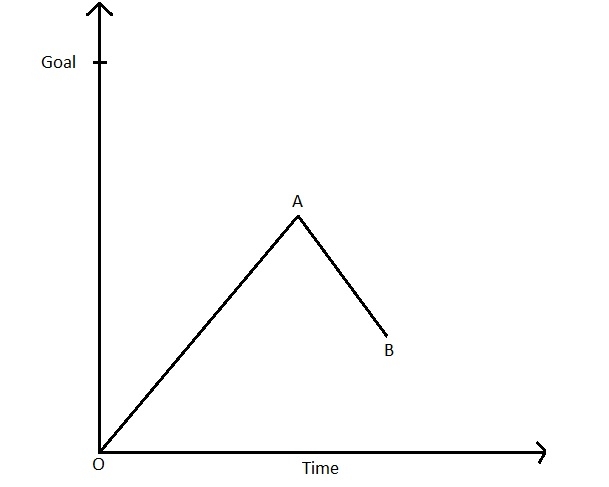
    Figure A below shows what usually happens when you start out with a goal:

    graph 1
    Figure A

    When you reach A starting from O, you see yourself making progress and are highly motivated as a result. 

    Soon, something goes terribly wrong and you hit a low point B. At B, the goal seems too far away and you’re motivated to quit because you don’t see your efforts yielding any fruits.

    Most people quit at this point because, remember, our mind is constantly asking us, “Is this activity giving me what I want?”

    If the answer to that question is “No” there’s no point in motivating you to continue pursuing your goal and you’re in a state of demotivation. So you quit because that’s the sane thing to do in such a situation.

    A task that eats away your time, energy, and resources without providing you with any benefit is perceived as costly by your mind. 

    You could devote your time, energy, and resources to something else that’s probably more promising- such as tasks that provide you with instant gratification. (see Why do we do the things we do)

    It’s not over yet

    What if you hijack the way your mind works to prevent yourself from quitting when things don’t go your way?

    The figure A shown above tells us that when we do things that take us closer to our goals we’re motivated to continue and when we do things that take us away from our goal, we’re de-motivated and likely to quit.

    What if I told you that figure A is not the whole story?

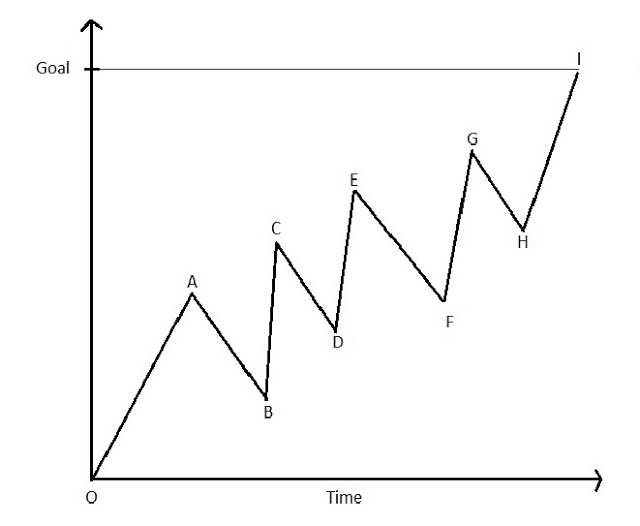
    Yes, figure A is actually a part of a larger figure B shown below:

    long-term goals- graph2
    Figure B

    The obstacle you faced at B that motivated you to quit was just one of the many obstacles that you were going to face on the journey towards reaching your goal.

    Most people quit at B, others do so at D, yet others at F, and some at H. When people are at A, C, E, and G they’re highly motivated because their mind is telling them, “Yes, what I’m doing now has taken me closer to my goal.”

    The key message that figure B is sending you is that no matter how many low points and high points you hit on the road to accomplishing your goal, the general trend of the graph is akin to a straight line going upward.

    long-term goals graph3
    Figure C (representing the general trend of figure B)

    When you remember this you can trick your mind into thinking that what you’re currently doing is, after, all taking you closer toward your goal over time. You hack your short-term brain wiring to apply it to long-term thinking.

    The low point that you may be currently experiencing is but a temporary inconvenience, an insignificant dip in the general upward trend of your efforts.

    Whether you’re trying to lose weight, build muscle, start a business, or write a book, and have hit a low point, remind yourself that if you persist you’ll eventually get there. 

  • How to stop making silly mistakes in math

    This article will focus on why we make silly mistakes in math. Once you understand what’s going on with your mind, you won’t have a hard time figuring out how to avoid silly mistakes in maths.

    Once, I was solving a math problem while preparing for an exam. Although the concept was clear to me and I knew what formulae I had to use when I finished the problem I got the answer wrong.

    I was surprised because I’d solved almost a dozen other similar problems earlier correctly. So I scanned my notebook to find out where I’d committed the error. During the first scan, I found nothing wrong with my method. But since I’d arrived at a wrong answer something had to be.

    So I scanned again and realized that I had, at one step, multiplied 13 with 267 instead of 31 with 267. I had written 31 on the paper but misread it as 13!

    Such silly mistakes are common among students. Not just students but people from all walks of life commit similar errors in perception from time to time.

    When I finished lamenting my silliness and beating my forehead, a thought flashed across my mind… Why did I misperceive 31 as 13 only and not as 11, 12 or 10 or any other number for that matter?

    It was evident that 31 looked similar to 13. But why do our minds perceive similar objects as the same? 

    Hold that thought right there. We’ll come back to it later. First, let’s look at some other perception distortions of the human mind.

    Evolution and perception distortion

    Do you know that some animals don’t see the world as we do? For example, some snakes see the world as we would if we were looking through an infra-red or thermal sensing camera. Similarly, a housefly is unable to figure out the shape, size, and depth of objects as we do.

    When the snake notices something warm (such as a warm-blooded rat) in its field of vision, it knows it’s time to eat. Similarly, the housefly is able to feed and reproduce despite its limited ability to perceive reality.

    Greater ability to perceive reality accurately demands a greater number of mental calculations and hence a larger and advanced brain. It seems that we humans do possess a brain advanced enough to perceive reality as it is, don’t we?

    Not really.

    Compared to other animals, we might have the most advanced brain but we don’t always see reality as it is. Our thoughts and emotions distort the way we perceive reality in order to maximize our evolutionary fitness i.e. the ability to survive and reproduce.

    The very fact that all of us commit errors in perception means that these errors must have some evolutionary advantage. Otherwise, they just wouldn’t exist in our psychological repertoire.

    You sometimes mistake a piece of rope lying on the ground for a snake because snakes have been deadly to us throughout our evolutionary history. You mistake a bundle of thread for a spider because spiders have been dangerous to us throughout our evolutionary history.

    By letting you mistake a piece of rope for a snake, your mind is actually increasing your chances of safety and survival. It’s much safer to perceive something safe as deadly and take immediate action to protect oneself than to misperceive something deadly as safe and fail to protect oneself.

    So your mind errs on the side of safety to give you enough time to protect yourself in case the danger was real.

    Statistically, we’re more likely to die in a car crash than falling from a tall building. But fear of heights is much more prevalent and stronger in humans than fear of driving. It’s because, in our evolutionary history, we regularly encountered situations where we had to protect ourselves from falling.

    Experiments have shown that we perceive changes in approaching sounds as greater than changes in receding sounds. Also, approaching sounds are perceived as starting and stopping closer to us than equivalent receding sounds.

    In other words, if I blindfold you and take you to a forest you’ll hear a rumbling in the bushes coming from 10 meters when in fact it may be coming from 20 or 30 meters away.

    This auditory distortion must have provided our ancestors with a margin of safety to better protect themselves from approaching dangers such as predators. When it’s a matter of life and death, every millisecond counts. By perceiving reality in a distorted fashion, we can make the best use of the additional time that is made available to us.

    Making silly mistakes in math

    Coming back to the mystery of the silly mistake that I committed in a math problem, the most likely explanation is that in some situations it was beneficial for our ancestors to perceive similar-looking objects as the same.

    For example, when a predator approached a bunch of our ancestors, it didn’t really matter if it approached from the right or from the left.

    Our ancestors were wise enough to realize that it made no difference whether a predator approached from the right or from the left. It was still a predator and they had to run

    So, we can say that their minds were programmed to view similar things as the same, no matter what their orientation.

    making silly mistakes
    To my subconscious mind, there’s no difference between 13 and 31. The difference is known only to my conscious mind.

    Today, on an unconscious level, we still perceive some similar objects as being one and the same.

    Many of our cognitive biases may be nothing more than behaviours that were advantageous to us in the context of our ancestral environment.

    My conscious mind was probably distracted while solving that problem and my unconscious mind took over and worked as it normally does, without bothering much about logic and just trying to maximize my evolutionary fitness.

    The only way to avoid such silly mistakes is to concentrate so that you don’t let your conscious mind wander off and rely on your subconscious, which may have been helpful for our ancestors but is kind of unreliable in today’s environment.

  • 3 Ways to get into flow while working

    This article will introduce the concept of flow state and suggest ways to get into the flow state while you’re working.

    Ever had that experience where you were so engrossed in a task that nothing else seemed to matter and you lost track of time? And even though to an outsider it appeared that you were expending a lot of effort but to you, it all seemed effortless.

    In Taoist philosophy, this ‘effortless effort’ is known as ‘doing without doing’. Poets have described this state as the one in which they feel they’re ‘part of something bigger that moves their hands as they compose verses.’

    Similarly, musicians claim that during their peak performances it doesn’t feel like they’re playing the music but rather it is the music that plays through them. Spooky, right?

    In psychological terms, this mental state is known as the ‘flow state’.

    When you’re in the flow state, you’re totally immersed in what you’re doing and time seems to fly by, even if you’ve been engaged in the activity for hours. It is an optimal psychological state in that it often results in deep learning, high productivity, and immense satisfaction.

    Writers, poets, philosophers, musicians, artists – all sorts of creative people have claimed they produced their best work while they were in the flow state. But this state is not limited to the creative types. In fact, flow can be experienced in any type of work, even ordinary activities like cleaning, cooking, reading or spending time with children.

    How to enter the flow state

    Imagine how great it would be to experience flow on a daily basis. It would give a great boost to your productivity and overall happiness levels. Usually, people enter flow unwittingly but this doesn’t mean there aren’t certain rules that govern the inducement of this pleasant mental state. 

    By understanding those rules you can experience flow whenever you want and even make it a part of your daily routine.

    Following are the most important factors on which entering the flow state depends:

    1) Clear goals and rules

    You tend to enter the flow state much more easily when the task that you’re doing has a clear set of rules for you to follow so that there’s a little conflict with regards to what should or shouldn’t be done.

    This is why it’s easy to experience flow when you’re doing something that requires repetitive actions governed by pre-set rules such as playing a musical instrument, playing a game, writing a computer program, solving a math problem, performing a ritual, etc. 

    2) Pursuing your passion

    Although flow can be experienced whilst performing any activity, it is most easily experienced when you’re doing something that you enjoy doing. Why exactly this happens is unclear. One explanation might be that the things that we enjoy doing are usually in line with our core needs and therefore make us happy.

    The tasks that make us happy wire us to perform those tasks, again and again, the by-product of which is that we become good at these over time. When we’ve mastered something, we experience flow because we’re clear about what we’re supposed to do and there’s no inner conflict whatsoever.

    3) Concentration

    Concentration is the most essential condition for experiencing the flow state. In fact, the flow state may be nothing more than a psychological state of extreme, monomaniacal concentration. When you’re doing something you love, you automatically reach this level of concentration and so it’s easier to experience flow.

    If you want to experience flow in work that you’re not so passionate about, then increasing your focus deliberately is a logical and effective way to experience flow.

    For example, a student who has to study may not initially feel like studying but once he starts and reaches a high level of concentration, he’s likely to find himself in the flow state.

    So by increasing concentration and eliminating distractions you can trick yourself to enjoy activities that you may not like but are required to do.

    how to be more productive flow cartoon

    Conclusion

    If you’re doing something that you love on a daily basis, then you probably experience flow every day. However, there are certain activities that all of us have to do that we’re not particularly passionate about. Still, these activities can be made enjoyable by deliberately inducing flow.

    Flow-producing activities usually require an initial investment of attention before one can experience flow. This means that even if you don’t feel like doing something in the beginning, you may experience flow when you get the ball rolling.

  • The ‘Start from tomorrow’ trap

    How many times have you heard someone, or even yourself, say, “I’ll start from tomorrow” or “I’ll start from Monday” or “I’ll start from next month” when there’s some new habit to form or a new project to work on? What is behind this common human tendency?

    I’m not talking here about procrastination which is a general term implying a delay of action but I’m talking about delaying action and then promising yourself that you’ll do it at some perfect time in the near future. So, procrastination is only a part of this phenomenon.

    Behind every human action or decision or promise, there is some kind of a reward. So what are the payoffs that we get by delaying important actions and promising ourselves that we’ll do them at an ideal time in the future?

    The illusion of perfect beginnings

    In nature, we see perfect beginnings and endings everywhere. Everything seems to have a start and an end. Living beings are born, grow old and then die in that very order every time. Many natural processes are cyclic.

    Each point of time on a cycle can be considered a beginning or an end. Sun rises, sets and then rises again. Trees shed their leaves in winter, blossom in summer and then go naked again in the winter. You get the idea.

    This perfect pattern of almost all the natural processes has led us to believe, at a very deep level, that if we begin something perfectly, it will run its course perfectly and will also end perfectly. It does seem to happen in natural processes but when it comes to human activities, nothing can be further from the truth.

    A perfect human being who does everything perfectly can only be a fictional character. Yet, this fact does not deter most of us from believing that if we start something at a perfect time, we’ll be able to do it perfectly. 

    This is, I believe, the main reason why people make New Year’s resolutions and think that if they start their habits from the 1st of the next month, things are more likely to pan out perfectly. Gym memberships are usually much higher in January than they are in December. 

    Even right now if you decide to do something, let’s say read a book, you’ll most likely choose a time that represents a perfect beginning, e.g. 8:00 or 10:00. or 3:30. It’ll rarely be something like 8:35 or 10:45 or 2:20.

    These timings just seem odd, not suited to begin great endeavours. Great endeavours need perfect beginnings and perfect beginnings must lead to perfect endings.

    I'll start from tomorrow

    This is the first, though subtle, payoff that we get by delaying our work and deciding to do it at some perfect time in the near future. The second payoff is not only subtler but also more insidious, a classic example of human self-deception that can keep us mired in our bad habits.

    ‘You have my permission’

    To throw light on this covert and insidious payoff, I’ll need to first explain what really goes on in your mind when you delay actions and promise yourself to do them in the future. It has a lot to do, like almost all other human behaviors, with psychological stability.

    Let’s say you have four days to prepare for an exam. Today is the first day and you don’t feel like studying at all. You’d rather do something pleasurable, like watch movies or play video games.

    In ordinary circumstances, your mind won’t just let you forget about studying and start having fun. It will keep warning you that there’s something important coming up and that you need to prepare for it.

    Let’s say you ignore the warning and start smashing aliens on your PlayStation. After some time, the warning comes again and perhaps a bit strongly so that it makes you psychologically unstable.

    You pause the game and think for a moment, “I have an exam coming up. When am I going to study for it?” Your mind has succeeded in seriously warning you.

    Today, all you want to do is to have fun. But your mind keeps nudging you, saying, “Dude, Exam! Exam!”

    You need to quieten your mind so that you can play your game in peace. So you come up with an ingenious plan. You tell yourself something like this

    “I’ll start from tomorrow and three days should be sufficient for preparation.”

    What a lie! You have no idea if three days are sufficient or not. That’s why you use “should” and not “will”. But your mind is now satisfied. You’ve managed to convince it.

    You’ve managed to quieten it. “You have my permission son, enjoy!” it says to you. And when your mind doesn’t bother you, you become psychologically stable. 

    That’s what this whole thing was all about- regaining psychological stability.

    This is not true only for exams. Take any good habit or any important project that people want to start and you’ll see them following the same pattern. It serves only two purposes- quietening the mind and giving oneself permission to indulge in one’s pleasures. What really happens in the future doesn’t matter.

    Tom: “I want to eat another pizza.”

    Tom’s mind: “No! One’s enough! Your body weight is far from ideal.”

    Tom: “I promise, I’ll start running from next week.”

    Tom’s mind: “Okay, you have my permission. You can have it.”   

    Does he seriously plan to run from next week? Doesn’t really matter. He managed to quieten his mind for the time being.

    Amir: “I’m in the mood to watch an action movie.”

    Amir’s mind: “But what about that book you need to finish today?”

    Amir: “I can finish it tomorrow. Hell won’t break loose if I delay it one day”

    Amir’s mind: “Okay dear, you have my permission. Go watch!”

    I’m not saying that every time we postpone something, we do it to indulge in our unwanted habitual behaviour. Sometimes the postponement can be very reasonable and rational.

    In fact, it may be the best decision that you could possibly make at that moment. Also, I don’t consider pleasurable activities as bad- only when they interfere with our important goals or when they turn into addictive behaviours.

    The purpose of this post was to show you what mind games we play to convince ourselves that we are doing the right thing, even when we know deep down that it is not the right thing to do.

    When we become aware of what we’re really doing, we are bound to change our behaviour. You can’t change that which you’re not conscious of.

  • Procrastinate more to end procrastination

    Procrastinate more to end procrastination

    To learn how to stop procrastinating, you need to procrastinate a lot.

    I’ll explain this paradox later. First, let’s try to understand procrastination…

    Procrastination means avoiding or delaying the important tasks that you know you should be doing.

    It is a common feature of human behavior, and we all procrastinate from time to time. There is not a single human being on earth who can claim that he never procrastinates or have never procrastinated.

    My aim in writing this post is to help you look at procrastination from every possible psychological angle so that you can get a better understanding of it. When you understand how procrastination works, you can then develop the insights needed to avoid falling into the same traps again and again.

    Why we procrastinate

    All the different reasons why we procrastinate can be grouped under one heading- pain avoidance. Avoiding pain is a great reward for the human mind, and it’ll do what it can to achieve that end.

    If I were a god and had to send down one revelation that people could inscribe in stone tablets and remember forever, it would be this:

    “Behind every human action, there is some kind of a reward, conscious or unconscious, perceived or real”.

    Procrastination, no matter how wasteful an activity it seems and no matter how guilty it ultimately makes you feel, is seen by your mind as some sort of reward-generating behavior. Otherwise, there’s no way you would be doing it in the first place. 

    Since you do it and perhaps do it regularly, it means there is some reward that is linked to it.

    As I said, this reward is pain-avoidance. We procrastinate on the things that have the potential of causing us psychological or physical pain. Procrastination is essentially a defense mechanism of the mind to protect you from perceived pain.

    We always procrastinate when we’ve got something difficult to do- a big project to work on, study, exercise, etc. Compare this to the activities that are easy and hardly cause any emotional or physical pain- eating, watching TV, relaxing, listening to music, and so on. We never procrastinate on these things.

    “I had to watch a movie, but I procrastinated”, said no one ever.

    Another big reason why we procrastinate on certain tasks is a complete lack of interest in those tasks. Study after study has shown that college students are the biggest procrastinators.

    The reason is simple- the courses that they study suck, and they only take them because some Uncle Fred told them it would make them financially secure.

    Students who study the courses of their choice and interest seldom procrastinate. When I chose engineering at the time of my college admission, I was very much interested in it. But formal education in our area is rotten to the core, and so I quickly lost interest. 

    The result was that college turned me into a giant procrastinating machine, to the extent that I only studied for exams the morning they were scheduled to be held, something I could never even dream of doing in high school.

    On the contrary, I rarely procrastinate when I’m studying human behaviour and researching for this blog. I could go on doing it for days and nights continuously without a halt had it not been for the mental exhaustion that it causes over time and the need to handle other responsibilities of life.

    how to stop procrastination

    Yet another major reason for procrastination is a fear of failure. You can never fail if you never try. Some people are so afraid of failing that it paralyzes them, and so they keep on procrastinating on the things that they know in their hearts they should be doing. 

    This gives them an illusion of control over their lives. After all, if you remain in the comfort zone and in the realm of the known, you remain calm and in control.

    When you break out of your comfort zone and step into the unknown, it creates chaos and a loss of control. Being in control is a core human need.

    What if things don’t work out? What if I don’t cut it? What if I fall face down onto the ground?

    I’m better off not attempting such a risky thing. Even though I want to do it, chances are high that I’ll fail. I don’t want to look bad; I want everything to be under control. I want everything to be perfect and in order.

    Know that all growth is the result of creation after destruction, order after chaos, assembly after disassembly.

    The mechanics of procrastination 

    In order to overcome procrastination, you have to first know what it looks like. When you’re procrastinating, you’ll usually find yourself doing mindless activities and indulging in bad habits. Things that you normally love doing in your leisure time will seem dull, boring, and bland when you can’t stop procrastinating.

    This is because your mind is preoccupied with the worry of the task that you’re avoiding. On one hand, you know that doing the task is important, but on the other hand, you also know that it’s difficult or painful.

    This inner conflict is overwhelming, and so you have to soothe your mind by doing something pleasurable, like indulging in bad habits.

    Almost always, the result is that you feel worse at the end of this cycle because you become overwhelmed, not only by the worry of not doing the task but also because of the guilt of indulging in bad habits and other unproductive behaviours. 

    Ending procrastination

    I researched the topic of procrastination a lot, but didn’t find anything effective and powerful. People just keep repeating the same ‘snap out of it’ advice, and all the techniques they suggest can be summarized in one phrase: Don’t procrastinate. 

    After understanding the human mind better, I devised my own technique to overcome procrastination, which is rather counterintuitive. You don’t have to do much, except play some mind games with yourself.

    Here’s what you need to do:

    Observe the mechanics of procrastination that I illustrated above as it happens to you very carefully as it happens to you. I’m talking deep self-awareness and self-reflection here, not a passing I-won’t-do-it-again kind of thinking. 

    To overcome procrastination, you need to train your mind to see it as a painful activity. 

    We procrastinate because our minds focus on the short-term pleasure that we gain while procrastinating, while completely missing the bigger picture. 

    When you feel crappy after a bout of procrastination, tell yourself something like, “See, this is what happens when you procrastinate” and recreate the actions that you just did in your mind again and again and feel the pain that they ultimately caused.

    By visualizing and recreating in your mind what happens during procrastination, you close the gap between procrastination and the pain it causes so that your mind associates pain with procrastination.

    When you do this again and again, a time will come when your mind will succeed in associating pain with procrastination, which will supersede the short-term bursts of pleasure that result from procrastination and indulging in bad habits. 

    You’ll teach your mind that procrastination always leads to pain, and as a result, you’ll become leerier and leerier of indulging in it.

    So, to overcome procrastination, you have to procrastinate enough number of times till you associate pain with it.

    Next time you procrastinate, see it as an opportunity to prove to your mind that procrastination is a painful activity, and you will move one step closer to overcoming procrastination. 

  • How to wake up early without an alarm

    How to wake up early without an alarm

    This article will teach you how to wake up early without an alarm. Yes, you heard that right. In order to successfully develop the habit of waking up early, you need to figure out why your mind hasn’t already adopted this useful behavior already.

    You know consciously that waking up early is important, otherwise, you wouldn’t be reading this article, but is your subconscious mind convinced?

    Our subconscious mind is much more powerful in controlling our behavior. No matter how important we consciously think waking up early is, we won’t be able to do it till our subconscious mind is also convinced.

    The key, therefore, is convincing your subconscious mind that waking up early is important.

    Recall the days you woke up early

    I want you to do a quick recall of the days when you woke up early. What was different about those days?

    You’ll realize that whenever you woke up early, you had something exciting to do that day. You were looking forward to something that was so important to you that you couldn’t wait.

    In other words, you were subconsciously convinced that waking up early was important. The excitement and the anticipation kept your subconscious on its toes. You didn’t need to rationally explain to yourself why waking up early was important.

    The main reason you failed to wake up early on other days was that your subconscious mind didn’t consider ‘waking up early’ important enough.

    What if we could deliberately convince our subconscious mind that ‘waking up early’ is important? Won’t it make waking up early a lot easier than to bang your alarm clock and move around the room half-asleep like a zombie?

    how to wake up early

    Steps to wake up early without an alarm

    1) First, find something important to do

    If you have nothing important to do, there’s no point in waking up early. You could wake up at midday and still not feel guilty about wasting your time, because there was nothing to do with the time.

    The first and foremost step is to find something important and a bit exciting to do. Even if the task isn’t that exciting, it should be at least important enough for you. It’s recommended that you choose a task that you have to do at a specific time in the morning. If the task cannot be done at any other time of the day, your subconscious will have added incentive to wake you up early.

    2) Convince your subconscious mind

    Before you sleep, remind yourself of the important task that you have to do tomorrow morning. You can say to yourself something like, “I have to wake up early at 6 a.m. in order to…….” or “Wake me up at 5 a.m. tomorrow because……”

    The line you add after ‘in order to’ and ‘because’ is crucial and it won’t be enough to say “Wake me up at 5 a.m. or 6 a.m.”

    Your mind wants a reason, so you better give it one. The reason should be compelling and important enough for you. Something like this:

    “I have to wake up at 6 a.m. in order to go for a run.”

    Or:

    Wake me up at 5 a.m. because I have to study for the test.”

    It’s surprising how your mind exactly wakes you up at the mentioned time or even earlier. People who’ve used this technique have revealed that sometimes they wake up 1 second before the stipulated time. Others wake up minutes or even hours earlier.

    Whatever command you use is up to you, but make sure it contains a specific time and an activity or thing you consider important. Saying the command once to yourself should be enough, but you can repeat it as many times as you want. The goal is to convince your mind about the importance and urgency of the task.

    There’s another technique you can use that can also act as a reminder. Before you sleep, go through your to-do list for the next day and pay special attention to the important task you have to do in the morning. The subconscious mind takes written information seriously. It’ll do the best it can to wake you up early.

    3) Turn it into a habit

    Repeat the above two steps for 2 or 3 weeks till your subconscious mind learns that waking up early is an important daily activity.

    When your subconscious sees you waking up early every day for a few weeks, it’ll believe waking up early is important for you. It’ll consider waking up early an important part of your daily routine. It’ll start triggering this behavior automatically.

    A day will come when you’ll find yourself waking up early, even if you have nothing important to do. But you don’t want to risk un-learning your new habit, so it’s a good idea to always have something useful to do. Motivation is driven by rewards.

    The only time this technique might not work is when, at the assigned time, you’re in the middle of a dream your mind considers more important than waking up. Since that happens rarely, you can safely count on this technique.

  • How to turn a bad day into a good day

    In this article, I’ve tried to explain the factors that determine our current mood by using the analogy of a weighing scale. Once you get the hang of it, you’ll know exactly what you need to do in order to turn a bad day into a good day.

    The two sides of this scale represent good and bad mood. We keep fluctuating from one side to the other all our life but I want to explain to you how this process happens so that you acquire some degree of control over it.

    What side our scale goes depends on what life experiences we encounter and (more importantly) how we deal with them. While you may have no control over what life throws at you, you have full control over how you respond.

    Story of Jason

    Before I tell you the story of Jason I want to throw light on one very important fact about moods in general:

    Your current mood is the resultant mood of the sum total of all the life experiences that you’ve been through up until this moment.

    Life experiences can either make you feel good or bad and of course, that depends on how you interpret them. Individual life experiences usually don’t have much power to swing your mood (unless they’re big) but it is their combined and cumulative effect that causes your mood to swing.

    Here’s a list of Jason’s recent life experiences, starting from the major ones to minor ones- he got fired from his job and had a big fight with his wife. He had gained a few pounds ever since he stopped exercising, he was fed up with his smoking habit and worried about the consequences of not quitting it.

    Last night, while driving home his car broke down and he didn’t get it fixed yet. Earlier this morning he had decided to clean up his apartment but it’s almost noon now and he hasn’t done anything.

    No wonder, he’s feeling like crap right now. His mood has hit an all-time low. Let’s say he won a baseball game last week but that single positive event won’t be helpful in improving his mood.

    I'm having a bad day

    In all this doom and gloom, Jason suddenly had a moment of insight. He remembered the time when his life was perfect and he hardly faced any problem.

    How wonderful he felt then! He finally realized that unless he solves his problems he isn’t going to feel any better. So he started to solve his problems one by one starting with the easy ones.

    First, he cleaned up his messy apartment. His bad mood became less intense. Once he was done with that, he immediately called a mechanic and got his car fixed. His bad mood lessened further.

    After that, he read a few articles on the internet about how to quit smoking and wrote down a month-long plan to quit smoking. At this point, his bad mood greatly reduced to the point that he was almost feeling neutral- neither good nor bad.

    I'm having a bad day equal

    His gaze suddenly fell on the mirror and he remembered the extra pounds that he had recently gained. He went for a half-an-hour run immediately. When he returned home, boy he felt good.

    He was surprised at how he had gone from feeling broken earlier during the day to feeling so much better now.

    I'm having a bad day slight

    “I have set so many things straight today”, he thought, “why not patch up with my wife too?” He replayed the fight in his mind and realized that it was entirely his own fault.

    He had lost his temper way too quickly because of getting fired from the job. He was just releasing his frustration onto his wife. He decided that he would apologize and sort it out with her as soon she returned from work.

    He then made a plan to find another job- a task that he was procrastinating on for too long because of believing that his previous company would call him back. By now, he was feeling like a million bucks!

    feeling good

    Bad mood is just a warning

    What I described above is just one example of a person who learned how to overcome his moods by understanding them.

    Every day, millions of people suffer terrible mood swings and they have no idea know what to do about them because they don’t understand what’s going on.

    A very important thing to note in this whole scenario is this- you don’t necessarily have to solve all your problems immediately in order to feel good.

    Note that Jason didn’t get a new job yet nor did he patch-up with his wife yet. Also, he had only figured out a possible solution to his smoking habit that he planned to apply but didn’t apply yet.

    Still, he felt great because he planned to solve these problems in the near future. So his mind felt re-assured and considered it unimportant to warn Jason any more by making him feel bad.

    What side is your scale tipped to right now?