
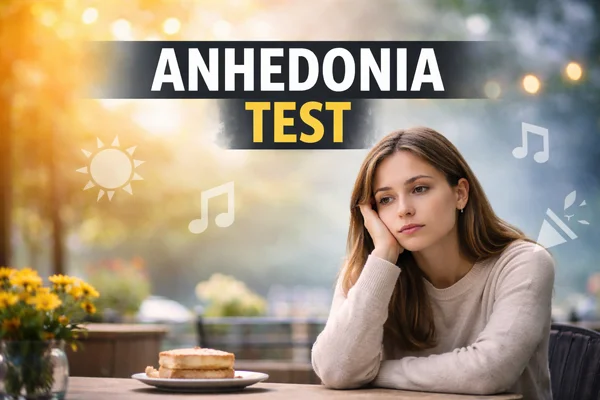
Anhedonia comes from the Greek an-, meaning ‘not, without’, and hedone, meaning ‘pleasure.’ Hence, a person with anhedonia experiences a reduced ability to experience pleasure. Alternatively, it can be defined as ‘a decreased sensitivity to pleasurable stimuli’.1Bevins, R. A., & Besheer, J. (2005). Novelty reward as a measure of anhedonia. Neuroscience & Biobehavioral Reviews, 29(4-5), 707-714.
When you're in an anhedonic state, the activities that you previously enjoyed now feel 'blah'.
Anhedonia is not the same as emotional blunting or numbness. The latter is a state of emotional paralysis in which you experience a decrease in both positive and negative feelings. Whereas in anhedonia, you only experience a decrease in positive feelings. You can still experience negative feelings.
Related: Anhedonia vs Apathy: 5 Key differences
Test
This is a 24-item anonymous self-assessment to measure the severity of anhedonia symptoms across the following dimensions:
- Anticipation (Wanting pleasure)
- Enjoyment (Liking pleasure)
- Connection (Social pleasure)
- Engagement (Pleasure from motivation and effort)
- Activation (Feeling positive feelings and energy)
- Awareness (Awareness and expression of positive feelings)
Disclaimer: This quiz is for informational and self-reflection purposes only. It is not a diagnostic tool. If you’re experiencing distress or have concerns about your mental health, consult a licensed mental health professional.




Interpretation of dimension scores
1. Anticipation
Anticipation is the trait that lets you look ahead, relish planned activities, and feel excitement for what you will be doing soon.
If your score is higher
You might notice that planning activities or events lacks enthusiasm and even feels like a chore to you. That could also lead you to avoid activities, or you could feel pessimistic about the future. Even activities that once brought you joy no longer spark enthusiasm.
If your score is lower
You can think about future events and feel excitement and motivation for them, even if the present is challenging.
2. Enjoyment
Enjoyment captures your ability to feel pleasure in the moment while something positive is happening.
If your score is higher
You may notice that activities feel emotionally flat even when, logically, they should feel enjoyable. You might go through pleasant experiences without feeling much pleasure, warmth, or satisfaction while they’re happening.
If your score is lower
You’re generally able to feel pleasure and emotional reward during positive moments, even if your overall mood isn’t always high.
3. Connection
Connection refers to how emotionally rewarding relationships and social interactions feel to you.
If your score is higher
Spending time with others may feel draining, empty, or emotionally distant rather than comforting or fulfilling. You might still socialize, but without feeling truly connected or emotionally engaged.
If your score is lower
Relationships generally feel meaningful and fulfilling, even if you sometimes need space or solitude.
4. Engagement
Engagement refers to your motivation to invest effort in activities, goals, work, or hobbies, and the satisfaction obtained from doing so.
If your score is higher
You may struggle to initiate or follow through on activities, even ones you care about. Tasks can feel pointless or unrewarding, and effort may feel disproportionate to any emotional payoff.
If your score is lower
You’re able to stay involved in activities and feel a sense of purpose or reward from effort.
5. Activation
Activation reflects your level of positive emotional activation, that is, feeling interested, energized, emotionally responsive, or mentally alive.
If your score is higher
Your positive feelings may feel diminished, flat, or dulled, even without intense sadness. Energy and enthusiasm may feel noticeably reduced, making life feel muted or colorless.
If your score is lower
You’re able to experience positive emotional energy even during challenging periods.
6. Awareness
Awareness refers to your ability to recognize, experience, and express positive emotions clearly.
If your score is higher
You may struggle to identify what you’re feeling, feel disconnected from your positive feelings, or have difficulty expressing them to others.
If your score is lower
You’re able to notice and understand your positive emotional states and communicate them when needed.
What this quiz is based on
While anhedonia can occur independently, it is also a core symptom of many mental health issues, including depression, schizophrenia, eating disorders, bipolar disorder, PTSD, and substance use disorders.2Trøstheim, M., Eikemo, M., Meir, R., Hansen, I., Paul, E., Kroll, S. L., … & Leknes, S. (2020). Assessment of anhedonia in adults with and without mental illness: a systematic review and meta-analysis. JAMA network open, 3(8), e2013233-e2013233. It’s a complex topic that has been studied for decades from multiple disciplinary angles.
As a result, multiple scales have been developed that capture aspects of this psychological phenomenon. No one scale captures it completely. Therefore, basing a quiz for anhedonia on one or two scales doesn’t do justice to the complexity and multidimensional nature of the phenomenon.
Scales used
This quiz is based on the following validated scales of anhedonia:
- Snaith-Hamilton Pleasure Scale (SHAPS)3Snaith, R. P., Hamilton, M., Morley, S., Humayan, A., Hargreaves, D., & Trigwell, P. (1995). A scale for the assessment of hedonic tone the Snaith–Hamilton Pleasure Scale. The British Journal of Psychiatry, 167(1), 99-103.
- Dimensional Anhedonia Rating Scale (DARS)4Rizvi, S. J., Quilty, L. C., Sproule, B. A., Cyriac, A., Bagby, R. M., & Kennedy, S. H. (2015). Development and validation of the Dimensional Anhedonia Rating Scale (DARS) in a community sample and individuals with major depression. Psychiatry research, 229(1-2), 109-119.
- Hedonic Deficit and Interference Scale (HDIS)5Frewen, P. A., Dean, J. A., & Lanius, R. A. (2012). Assessment of anhedonia in psychological trauma: Development of the Hedonic Deficit and Interference Scale. European Journal of Psychotraumatology, 3(1), 8585.
- Temporal Experience of Pleasure Scale (TEPS)6Chan, R. C., Shi, Y. F., Lai, M. K., Wang, Y. N., Wang, Y., & Kring, A. M. (2012). The Temporal Experience of Pleasure Scale (TEPS): exploration and confirmation of factor structure in a healthy Chinese sample. PloS one, 7(4), e35352.
- Positive and Negative Affect Schedule-Expanded (PANAS-X)7Watson, D., & Clark, L. A. (1994). The PANAS-X: Manual for the positive and negative affect schedule-expanded form.
- Self-Perceived Anhedonia Scale-Adults (SPAS-A)8Apostol, O. A., Cioca, I. E., Morcov, M. V., Sporea, C., Morcov, C. G., Pellegrini, A., & Bordea, E. N. (2025). Development and Validation of the Self-Perceived Anhedonia Scale for Adults: A Novel Tool for Assessing Pleasure Deficits. Psychiatry International, 6(2), 43.
- Positive Valence Systems Scale (PVSS)9Khazanov, G. K., Ruscio, A. M., & Forbes, C. N. (2020). The positive valence systems scale: development and validation. Assessment, 27(5), 1045-1069.
- Motivation And Pleasure Scale-Self-Report (MAP-SR)10Engel, M., & Lincoln, T. M. (2016). Motivation and Pleasure Scale-Self-Report (MAP-SR): Validation of the German version of a self-report measure for screening negative symptoms in schizophrenia. Comprehensive Psychiatry, 65, 110-115.
- Specific Loss of Interest and Pleasure (SLIPS)11Winer, E. S., Veilleux, J. C., & Ginger, E. J. (2014). Development and validation of the Specific Loss of Interest and Pleasure Scale (SLIPS). Journal of Affective Disorders, 152, 193-201.