Category: Social skills

Improve your relationships with people in your inner and outer circles.

Agreeing = bonding

Humans generally want other humans to be similar to them. That includes similarity of opinions and beliefs. This gives us the reassurance that we are right in holding the opinions we hold. It also helps us bond with those who think as we do. So opinions and beliefs are not just opinions. They are a way for humans to bond and form groups. Those who think as we do are “Us” and those who don’t are “Them”.

This is why disagreements can quickly turn into arguments and conflict. When you disagree with someone, you’re not just attacking their position even if that was your sole intent. Since people identify with their positions, you’re also attacking them. You’re declaring:

“I don’t like and accept you. I’m not part of your tribe.”

When you see them as “Them”, they see you that way too and feel attacked. So they attack back to defend themselves. Thus begins the attack-defend cycle that is typical of so many ‘discussions’, arguments, and debates. Not to mention that attacking someone’s position also implies they are less intelligent, which is another blow to their ego after being declared an outcast.

Unhealthy arguing

People will do anything to win an argument, especially if there’s an audience to the argument. Their social image is at stake. After all, winning an argument shows that you are intelligent and wise. It’s a status boost. Losing an argument is a status loss. This is why, once they have taken a stance about something, people are resistant to changing it.

Unfortunately, this strong desire to win an argument makes people argue in unhealthy and unproductive ways. They become prone to all kinds of mental laziness and biases. The goal is to dominate the other party, not to reach an understanding. This kind of arguing usually goes nowhere and puts a strain on relationships. There’s a lot of anger, yelling, and personal attacks. Verbal aggression and abuse. In some scenarios, it can lead to physical altercations.

In short, unproductive arguments are costly. They waste a lot of time for no or negative return. They lead to emotional chaos and reduced well-being.2Paglieri, F., & Castelfranchi, C. (2010). Why argue? Towards a cost–benefit analysis of argumentation. Argument and Computation, 1(1), 71-91. So the key is to adopt a strategy of selective arguing and only argue when you think the benefits of doing so have a good chance of outweighing the substantive costs.

Arguing effectively: Healthy arguing

Because arguments are costly and draining, some people vow to never argue. I wouldn’t recommend that because you don’t want to miss out on the benefits of healthy arguing. What does that look like?

Valid arguments

First, both parties have a basic respect for truth and reason. They don’t want to win as much as they’re trying to seek the truth. Not that there’s anything wrong with wanting to win arguments. It’s natural to want to win an argument. But how you go about doing that matters. You want to win an argument by making valid or sound arguments. You want to provide reasons for your arguments that are better than the reasons the opponent provides for their position. Not better because you think they’re better, but because they’re objectively better.3Mercier, H., Bonnier, P., & Trouche, E. (2016). Why don’t people produce better arguments?.

Also, just because you have some ulterior motive of self-interest doesn’t automatically make your argument invalid. Usually invalid arguments have ulterior motives but an argument can be valid with or without an ulterior motive. This is a common bias people have. Proving an ulterior motive has nothing to do with the soundness of an argument.

For example, if someone believes that consuming meat is bad, you may dismiss them by saying that they’re trying to convert people to veganism. That may or may not be their motive. We’re not concerned with that. What matters are the factual truths and logical validity of their reasoning.

Related: 10 Ways people deflect in arguments

Attack the problem, not the person

Second, both parties have basic respect for each other. That means no personal attacks. Sometimes questioning the character of an opponent is relevant to the argument.4Zarefsky, D., Bizzarri, N., & Rodriguez, S. (2005). Argumentation: The study of effective reasoning. Teaching Company.

For example, if you’re claiming that a medical research center’s vaccine can’t be trusted, then questioning the trustworthiness of the center’s owner matters. If they have been dishonest in the past, there’s a good chance they’re being dishonest again. But in most cases, personal attacks are not relevant or productive. It’s just one party trying to unfairly undermine the credibility of another.

Being for the solution

Lastly, both parties want to resolve the argument. If your opponent keeps arguing endlessly, despite your myriad efforts to resolve it, that could mean they have more to gain from the argument itself than its resolution. You’ve probably come across that person who will engage in endless unproductive discussions. They may have no interest in resolving the argument. Their goal might be to prove they are smart and that they can use big words in long sentences. Or they might just enjoy the thrill of drama.

Argument structure

Arguing effectively is all about making valid arguments. Let’s get clear about some of the basics of argumentation:

Argument: A position or stance you have about something that you’re expected to support with good reasons.5Innocenti, B. (2021). Constructing effective arguments.

Claim: An inference that you make based on evidence.

Inference: Accepting the claim on the basis of evidence.

Evidence: A clue that supports a claim. It can be weak or strong.

Proof: Conclusive evidence for a claim.

Simply put, arguments are essentially “If A is true, then B is also true” statements. A is evidence, and B is a claim. You have to demonstrate how they logically link together if it’s not apparent.6Iordanou, K., & Rapanta, C. (2021). “Argue with me”: A method for developing argument skills. Frontiers in Psychology, 12, 631203. You can’t take huge leaps from evidence to claim or from claim to evidence. That would make your argument invalid. The more evidence you collect for your claim, the stronger your argument becomes.
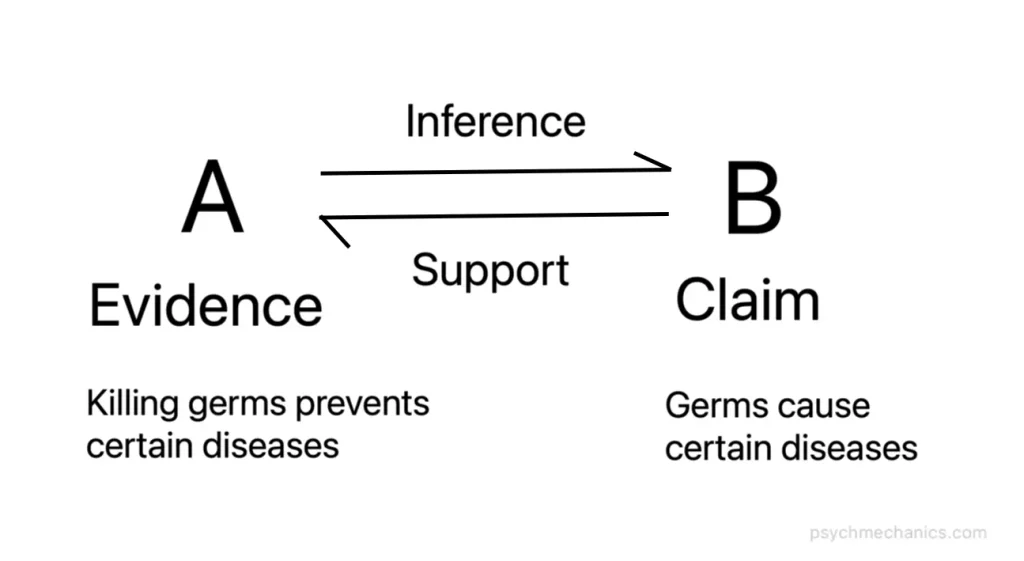
argument structure

Arguments are formed to persuade.7Mercier, H., & Sperber, D. (2011). Why do humans reason? Arguments for an argumentative theory. Behavioral and brain sciences, 34(2), 57-74. It is but natural to seek only evidence that supports your claims. But in doing so, you can get caught in confirmation bias. Hence it’s important, when you’re making arguments, that you take all the relevant evidence into consideration- the assumptions, exceptions, alternate explanations, and evidence to the contrary.8Walton, D. (2010). Why fallacies appear to be better arguments than they are. Informal logic, 30(2), 159-184.

The art of de-escalation

Part of selective arguing is knowing when to de-escalate. If you sense that an argument is going in the wrong direction or becoming worse, you can choose to de-escalate. I’ll give you a mental model that should help you pull yourself out of such situations:

When you sense a loaded moment in a discussion, i.e., the point where you sense the conversation is going downhill, stop. Don’t say anything. Imagine you two are on a video on some giant screen. The screen splits between you two. Then someone hits the rewind button, and your side of the screen starts playing your life backwards. You see all the experiences you’ve been through. The books you’ve read, the people you’ve talked to, and the media you have consumed. By looking at all that, you get a sense of why you have the position you have today.

With healthy arguers, even intense arguments might be worth it because they don't go off-track.

The same thing now happens with their side of the screen. Of course, you don’t know what they have been through. But you can extrapolate based on their current thinking, words and behaviors. You can guess what might have led them to how they are now. They might have told you about their experiences, how they live their days, etc. As their screen rewinds, you realize they have been through very different experiences than you. You realize that it’s pointless to keep arguing with them. They’re walking their own path.

This should make it easier for you to withdraw from arguing and trying to change your mind. Of course, if they’re an open-minded person, they’d be willing to change paths. The same applies to you. But when people have given you enough proof about their closed-mindedness, you can’t force the horse to drink.

This analogy was inspired by Black Mirror episode (S4E3).

References

  • How to de-escalate a situation

    How to de-escalate a situation

    To learn how to de-escalate situations, we first need to understand why they escalate in the first place. Conflict between two parties occurs when there’s a clash of interests. The parties’ needs and wants differ; one party’s needs and wants interfere with the other’s. 

    Escalation means that a conflict has intensified or is beginning to intensify. De-escalation strategies, therefore, are techniques that reduce the intensity of the conflict. These strategies minimize or eliminate the potential costs and risks associated with escalated conflicts where both parties are likely to face negative outcomes.

    The attack-defend frame

    When people feel slighted, harmed, or taken advantage of, they experience anger. Anger motivates them to right the wrong that’s been inflicted on them. People will likely attack the person who wronged them when they get angry. The person attacked feels compelled to counterattack, thus creating a cycle of aggression.

    If you look at it from a power dynamics perspective, the person who’s wronged thinks they’ve been rendered powerless. The wrongdoer took away some of their power by harming or stepping over their boundaries. The powerless victim seeks to regain power by attacking the wrongdoer. When attacked, the wrongdoer loses power and tries to regain it by counterattacking.

    Thus, at the root of most conflicts is this attack-defend frame that gets reinforced with each attack and each defensive action. ‘Frame’ here has the typical meaning of how you view a social situation—its context. Weakening this social frame is at the heart of de-escalation.

    Awareness of escalation

    Before you can de-escalate a situation, you must know it has escalated. Many people lack the social/emotional skills to see when a situation has escalated, so they cannot stop the cycle of aggression from perpetuating. With de-escalation, nipping the evil in the bud is much easier than cleaning up the mess of escalation later.

    You have to be aware when a situation is starting to escalate. A big part of it is noticing the verbal and nonverbal signals of escalation that others give off. Verbal signs of escalation are often clear, like making a personal attack and talking over or interrupting you.

    Key non-verbal signs of escalation include:

    A surefire sign that things have escalated and the attack-defend frame is being reinforced is when your conversation becomes back-and-forth like ping-pong. If you find yourself in the middle of a ping-pong interaction, things are heating up. This is a good time to implement the de-escalation strategies discussed in the next section.

    Not all ping-pong interactions are unproductive. When both parties don't adhere to logic and the conversation doesn't move forward, they likely are.

    Step-by-step de-escalating strategies

    1. Meet their needs

    If conflicts arise from a clash of interests, they should diffuse when interests and needs are met.1Mavandadi, V., Bieling, P. J., & Madsen, V. (2016). Effective ingredients of verbal de‐escalation: validating an English modified version of the ‘De‐Escalating Aggressive Behaviour Scale’. Journal of psychiatric and mental health nursing, 23(6-7), 357-368. When you find yourself in a conflict or an argument with someone, ask yourself:

    “What do they need?”

    If you can’t figure out what they need, ask them. When you figure out what they want, give it to them. Plain and simple. Not all battles are worth fighting. Sometimes, you have to set your ego aside. You have to resist the temptation to attack and defend yourself. While this may seem like a submissive move, power isn’t all about dominance. It’s about getting the outcomes you want. Giving them what they want now often has lower costs for you than letting the situation escalate. 

    Example

    Say you post something on social media, and someone replies with a hateful comment. While giving them a befitting reply is tempting, ask yourself what you will achieve by doing that. They’re probably not going to back off. They’ll attack you back, reinforcing the attack-defend frame. One hour later, you are still arguing and going nowhere. You could’ve spent that one hour doing something productive. Your opponent wants to win, to have the last word. Let them win. Let them have the last word. Let them think they’re right.

    Resist the temptation to correct them. They’re in this thing to win, not to see logic. Social media interactions are loaded with this sense that there’s an audience watching you. So, the desire to be right and win gets magnified. And logic gets thrown out of the window in the process.

    Agreeing with people who attack you is one of the best ways to give them what they want. You can’t argue with someone who’s agreeing with you. It’s always easier to work with someone’s perception, knowledge level, and beliefs than trying to get them to be reasonable.

    2. Stay calm

    It’s not always optimal to give the other person what they want. Sometimes, you have to be assertive and stand your ground. To do that, you have to be calm and unemotional when you’re being attacked. You can’t control the other person’s behavior, but you can control your own. De-escalation is largely about self-management.2Accinni, T., Papadogiannis, G., & Orso, L. (2021). De-escalation techniques in various settings. Empathy, Normalization and De-escalation: Management of the Agitated Patient in Emergency and Critical Situations, 65-91. Calmness starts with the mind and then gets reflected in the body. You don’t have to hyperfocus on your non-verbal signals. When you’re mentally calm, the correct body language will follow. 

    Mindsets to stay calm

    Think of it like a game. They’re trying to provoke you; you win if you aren’t provoked. See it as a challenge. Also, keep the attack-defend frame in mind. If you get provoked, your emotional reaction will force you to counterattack. That will make the situation worse. Remind yourself that the other person is agitated and can’t see reason.3Noll, D. (2017). De-escalate: How to calm an angry person in 90 seconds or less. Simon and Schuster. By staying calm, you cancel their agitation and force them to relax. When you’re both calm, the conflict can be resolved constructively.

    When you stay calm and logical, focusing on your needs versus blaming or attacking them, you sub-communicate:

    “This isn’t about ‘You vs me’. It’s about ‘What’s logical/reasonable/fair vs what’s not’.”

    3. Exit the interaction

    If staying calm isn’t helping you, exiting the interaction might be a good idea. When you find yourself in a ping-pong interaction, you’re doing your part to feed the cycle. You can stop doing your part any time and leave. I’m not suggesting that you avoid difficult conversations or hide issues under the rug. What I’m saying is that ping-pong interactions are likely to be unproductive and conflict-inducing. You can say:

    “We’ll talk about this later.”

    Not dismissively, but in an empathic ‘I see we have a problem’ way. Later, when they’ve cooled down, ask them about the issue. Chances are, they’ll say something like:

    “Oh, that. That was nothing. Doesn’t matter.”

    Humans are complex emotional creatures eager for power and control. They don’t care that they’re fighting over nothing as long as they get to win. The ‘Mindsets to stay calm’ section above illustrates this. Even when trying to be calm, we must think we’re winning by doing so to implement the strategy readily.

    Example

    When you see someone triggered, it’s best not to interact with them. They’re out of control and have a distorted perception of reality. Anything you say might be used against you. They’re highly motivated to defend themselves, so everything gets seen as an attack.

    4. Escalation

    It’s paradoxical, but escalation is sometimes the best de-escalation. Some people pick on you and fight with you because they think you’re weak. You have to show them you’re not. As a last resort, aggression can effectively teach your aggressors the lesson that you’re not to be messed with. While it may be hard to do in the moment and incur some costs, they’ll get off your back. It’ll be worth it in the long run.

    This strategy breaks the attack-defend frame because the attack from your side is so strong that they think it's better to back off than to counterattack.

    Personal example

    When I was in school, there was this guy who verbally abused me on the school bus. He had his issues. He did this to a few others as well. I tolerated his nonsense for a long time. One day, I was fed up. When he started it again, I slapped him so hard that I could almost see the stars around his head. The sound from the slap reverberated in the air for a few seconds, while time stood still for everyone witnessing the incident. He never verbally abused me after that.

    You should avoid getting physical as much as possible unless it’s self-defense. When all else fails, you can explore verbal aggression or even passive aggression techniques like sarcasm as a de-escalation tactic.

    References

  • How to deal with a neurotic person

    How to deal with a neurotic person

    Neuroticism is one of the dimensions of the Big Five personality assessment, one of psychology’s most reliable personality assessments. The meaning of ‘being neurotic’ has evolved. In simple terms, it means to be emotionally unstable. A neurotic person has a greater tendency to experience ‘negative’ emotions like:

    • Anger
    • Anxiety
    • Fear
    • Guilt
    • Depression

    They’re prone to getting stressed and, when stressed, cannot handle their negative emotions. They tend to get overwhelmed by their negative emotions and dump them on those around them.1Vollrath, M., Torgersen, S., & Alnæs, R. (1995). Personality as long-term predictor of coping. Personality and individual differences, 18(1), 117-125. They always seem to be in some kind of misery or problem.

    The upside of neuroticism is that they can easily detect threats that others might miss. The downside of this hypervigilance is seeing threats where there are none.2Gunthert, K. C., Cohen, L. H., & Armeli, S. (1999). The role of neuroticism in daily stress and coping. Journal of personality and social psychology, 77(5), 1087.

    Effects of neuroticism

    Since emotions are contagious, people who are close to the neurotic person tend to pick up their negative feelings. They get burdened with negative emotions and problems that are not even their own. As a result, it can be exhausting to deal with a neurotic person. They tend to bring out the worst in you. You might be a calm sage with other people, but with a neurotic person, you become emotionally unstable. You find yourself getting worked up, reacting angrily, and yelling. This negatively impacts the quality of your relationship with the neurotic person.3Esplin, C. R., Rasmussen, B. D., Hatch, S. G., Hawkins, A. J., & Braithwaite, S. R. (2024). Neuroticism and relationship quality: A meta-analytic review. Journal of Personality and Social Psychology.

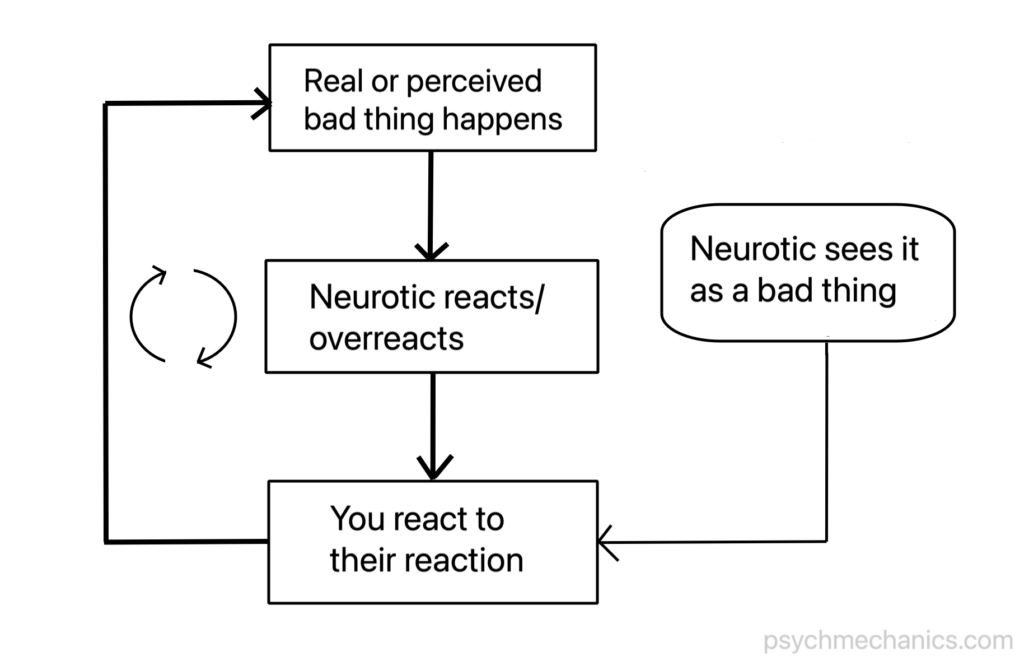
    People who are close to neurotic people often get caught in a vicious cycle. First, the neurotic person gets stressed because they witness a threat. The threat might be real or perceived. Then, they react negatively to that threat. Seeing their reaction/overreaction, the person close to them gets upset or criticizes this reaction/overreaction.

    The neurotic person, already stressed, sees their loved one reacting angrily to their reaction as another threat to which they need to react. The negative reactions pile upon each other, and the situation escalates. To the outside observer, both seem neurotic and out of control.

    vicious cycle of neuroticism

    Dealing with such a person

    1. Understand neuroticism

    If you’re generally calm, you likely expect others to be calm. A big part of learning how to deal with neurotic people is understanding and accepting that they’re different than you. They are the way they are due to their genetics and environmental influences. Expecting them to behave like you is a mistake, and you’ll only get disappointed. You were not put on earth to fix them. That’s their responsibility.

    2. Practice calmness

    I know it’s easy to lose your cool when you’re with a neurotic person. But try to see it as a challenge- a game. When the neurotic person tries to get on your nerves, practice emotional self-regulation. Avoid getting worked up and lashing out at them. This will significantly improve your emotional self-regulation.

    Emotional self-regulation is a critical skill to master. It’ll spill over to other areas of your life and make you a better person overall. You’ll react less in knee-jerky ways to what life throws at you. Having a neurotic person in your life is an excellent opportunity to master your emotions. You’ll become more aware of your own emotions. It’ll infuse your life with more intentionality and rationality.

    When you’re calm, you also break the vicious cycle of neuroticism. When the neurotic person in your life loses it, you avoid feeding their neuroticism and becoming a neurotic person yourself. Hold on tight to calmness, rationality, and intentionality.

    3. Pick your battles

    When I ask you to understand a neurotic person and be calm, I’m not asking you to ignore your own needs and boundaries. At least half the time, a neurotic person will behave neurotically without any reason. If you let go of these minor disturbances in your peace and calm, you’ll be better off in the long run. Do not take every sentence and reaction of a neurotic person seriously. Calmly and logically guide them to objectivity.

    If they violate your boundaries, that’s when you confront them, but assertively. Because your emotion feeds their emotion, you have to keep emotion out of the equation. You have to prioritize facts and reason. When a neurotic person is firmly under the grip of their emotions, it’s challenging to make them see the light. That’s why it’s essential to nip the evil in the bud. You must bring rationality into the equation as soon as they start acting neurotically. Later, it might be too late.

    4. Avoid arguments

    There’s no such thing as a discussion with a neurotic person. They’ll lure you into a ‘discussion’, and soon you’ll find yourself caught in pointless arguing, going nowhere. Neurotic people probably get some weird satisfaction from dragging people down with them. Don’t take the bait. You must understand that their discussions aim not to uncover the truth but to express their negative emotions.

    I’m not saying you should stop discussing things with a neurotic person. Instead, you should answer in a way that prevents them from dumping their emotions onto you. For instance, you could reply with one-liners or short, unemotional sentences.

    As soon as the interaction becomes like a ping-pong, you quit and withdraw from the conversation. Emotions have taken over. Don’t get dragged into the mud. Let them win. You can engage in endless, pointless arguments with them if you want. In the end, you might even win. But at what cost? Your mental health.

    5. Avoid criticizing and blaming

    Neurotic people are already highly self-critical. So, when you throw criticism at them, it adds fuel to the fire. You could say the same thing to an emotionally stable person, and they’d be able to take it. However, a neurotic person sees ‘criticism and blaming’ as another threat to which they must react negatively. Instead, focus on what’s good in them. If you address issues with them when they’re in a good mood, you’re more likely to get a positive response.

    When dealing with neurotic people, bluntness and straightforwardness don’t work. They’ll resent you for it. Instead, if you care about them, try to foster a loving and healthy relationship with them and watch their neuroticism decrease. Simple gestures of affection, such as hugging, can go a long way in stabilizing a neurotic individual.

    References

  • How to manipulate a dismissive avoidant

    How to manipulate a dismissive avoidant

    Why are you looking to manipulate someone?

    The desire to manipulate stems from an unhealthy desire to control. It stems from weakness and insecurity. Whenever you feel compelled to manipulate, look within first and try to figure out where it’s stemming from.

    People manipulate because they don’t believe they can meet their needs by asking directly. Manipulation is a control tactic by which a person makes someone do what they may not necessarily want to do. Needless to say, it is evil, and once the victim understands what you’ve done, it can ruin the relationship forever.

    Rather than manipulate, you want to influence or persuade. There’s a fine line between influence and manipulation. In manipulation, you’re taking away the other person’s autonomy, and you’re harming them in some way, often using deceptive tactics. Influence is more benign in the sense that you’re nudging them to do what you want, often using honest tactics. But the ultimate choice lies with them. Their decision doesn’t harm them in any way but might actually benefit them.

    Dismissive Avoidants (DAs) in relationships

    Those in a relationship with a DA often feel frustrated, disconnected, and lonely. This is because DAs have high space and independence needs. They want to spend a lot of time with themselves. Their connection needs are low. When they’re in a relationship with someone whose connection needs are high, like someone with the Anxious-Preoccupied (AP) attachment style, the relationship becomes stormy.

    If you want to manipulate a DA, you’re probably AP and are trying to get a DA to spend more time with you and meet your needs. If a DA is in a relationship with you, they do want to meet your needs. However, their attachment style makes them do things differently.
     
    If you want to influence a DA, you must understand what makes them tick. Specifically, you have to understand their needs and triggers. When you meet their needs and avoid triggering them, you’ll make them happy, and they’re more likely to present their best selves to you.

    DA needs (Meet these)

    1. Space

    Respect their mental and physical space. When these spaces are repeatedly encroached upon, they feel intruded and trapped. 

    2. Independence

    Help them be more independent. There’s nothing that DAs hate more than being overly dependent on other people.

    3. Growth

    DAs tend to have high growth needs. They like developing their minds and bodies. They’re lifelong learners who love learning new skills. If you feed their growth rather than hinder it, they’ll love you for it. One way to do that would be to engage in deep conversations with them.

    4. Peace

    DAs tend to be conflict-avoidant. They don’t want to waste their energy on unproductive things. They’d instead immerse themselves in their work, a book, or a hobby rather than in a pointless conflict. They believe that intelligent people don’t get into conflicts. Protect their peace.

    5. Safety

    All desire emotional safety in a relationship, but it’s one of the strongest needs of a DA. They want to feel like they can express themselves freely. They want you to hold space for their feelings and emotions.

    Triggers (Avoid these)

    1. Too much connection

    Yes, DAs do want to connect intellectually and deeply with others. They feel really good when they do that.1MacDonald, G., & Borsook, T. K. (2010). Attachment avoidance and feelings of connection in social interaction. Journal of Experimental Social Psychology, 46(6), 1122-1125. But there’s a limit to that. After a point, their social energy gets drained, and their mind starts ringing alarm bells:

    “Hey, why are you wasting time connecting with others? Relationships aren’t that important. Focus on developing yourself and becoming independent.”

    These alarm bells ring much sooner when they have pointless, valueless small talk. Such negative social interactions make a DA feel worse than the average person.

    2. Emotional closeness

    DAs are very careful who they allow into their inner circle. They share selectively and know how much to share with whom. In a romantic relationship, they feel increasingly uncomfortable as the relationship gets emotionally close. DAs are uncomfortable with emotional intimacy and vulnerability, so they’ll get triggered when they’re expected to be vulnerable too soon in a relationship dynamic.

    A DA I know once tried group therapy. As is common in these therapeutic settings, participants are encouraged to share their emotional burdens and vulnerabilities from day one. A DA needs more time than that to open up. So he quit the therapy immediately.

    3. Emotion-driven people

    All humans are emotion-driven. Some more than others. Since DAs tend to spend more of their time living in the rational part of their mind, they can’t stand primarily emotion-driven people. They don’t understand such people. They think being emotional is a weakness. They prefer people who activate the logical rather than the emotional part of their minds.

    4. Demands

    Because of their past trauma, DAs tend to be in survival mode 24/7. They’re always looking to protect their time, energy and space to meet their high personal growth and independence needs. When you demand their time and attention, you’re pressuring them to give away their most precious resources.

    DAs tend to show up best in their relationships when they’ve already taken care of their own needs first. 

    So, instead of asking them to spend time with you early in the morning, let them tend to themselves first. When they’re done with that, they’ll make time for you and give themselves fully to you because there’s no nagging voice in their head going:

    “Hey, why are you wasting time connecting…”

    They will have already taken care of that. So there’s no reason for those alarm bells to start swinging.

    No need to manipulate

    Contrary to what most people write about them online, DAs do want connection, but they want it differently than other attachment styles.2Carvallo, M., & Gabriel, S. (2006). No man is an island: The need to belong and dismissing avoidant attachment style. Personality and Social Psychology Bulletin, 32(5), 697-709. If you accommodate their attachment style, they’ll be more than willing to meet you halfway and accommodate yours. When that happens, the need for manipulation will disappear from the relationship. If you express your needs clearly and directly to a DA without pressuring them, they’ll listen and do what they can to meet them.

    References

  • How to respond to a compliment humbly

    How to respond to a compliment humbly

    A compliment is like a greeting. When you greet someone, you acknowledge their existence and expect them to do the same. You communicate that you value them and want them to value you, too.

    The same reciprocity lies underneath the dynamics of compliments.

    When someone compliments you, they’re giving you a status boost. They’re raising you in their eyes and the eyes of the audience present.

    When someone of high status compliments you, they share some of their status with you. Hence, people crave to be praised by high-status people.

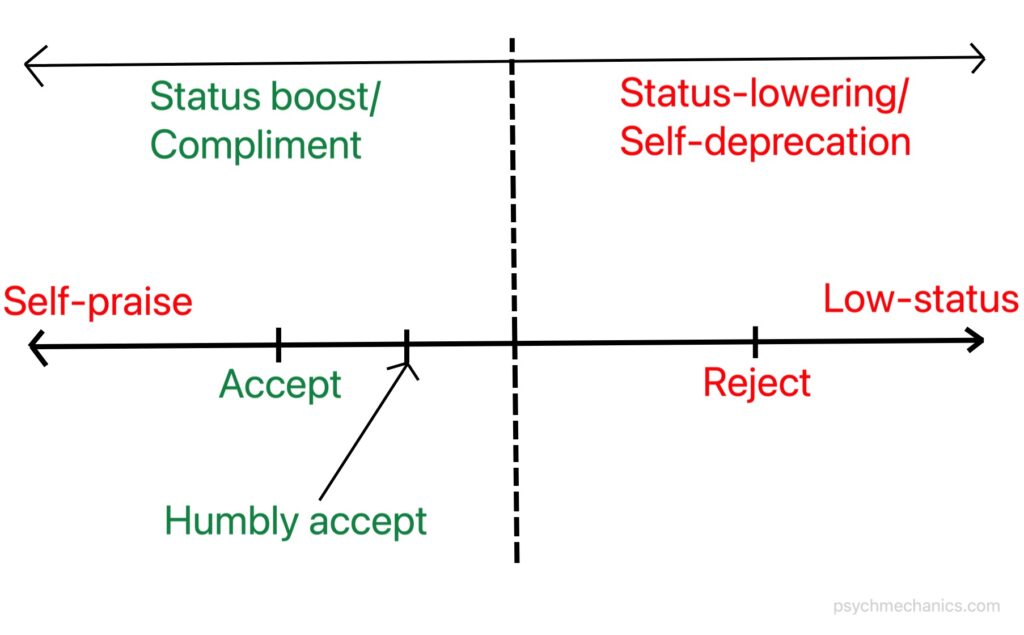
    Compliment response spectrum

    Say you’re in a conversation with someone. They compliment you out of the blue, and you get a status boost. Now, depending on your response, you can accept or reject the compliment.

    The tricky part here is fine-tuning your response so that it lands at just the right spot on the spectrum where you accept the compliment but don’t raise your status to obnoxious levels.

    Ideally, you want to stay humble with your response but not so much that you lower your status.

    compliment response spectrum

    Ways to respond to a compliment humbly

    1. Acceptance + Gratitude

    The first thing to do when someone compliments you is to accept it. I said earlier that compliments are like greetings. If you don’t accept compliments, it has the same effect on them as when you don’t accept their greetings.

    They feel rejected, devalued, invalidated, and unappreciated.

    But acceptance has to be paired with gratitude to make it a humble response.

    Acceptance alone is better than rejection, but it’s too status-enhancing.

    “You look pretty.”
    “I agree.”

    “You’re so smart.”
    “I know.”

    Even though the above responses come across as confident, they feel slightly off because they lack gratitude. A lack of gratitude keeps your status boosted, and you’re at risk of entering the self-praise or pride zone.

    When you include gratitude in your response, you fulfill reciprocity by acknowledging the compliment and paying something back in return. People who engage in reciprocal social interactions are perceived as less arrogant, humble, and trustworthy.

    Humble responses:

    “You look pretty.”
    “Thank you.”

    “You’re so smart.”
    “Thanks for saying that.”

    In face-to-face interactions, non-verbal signals are a massive part of gratitude. Smiling, leaning towards them, and expressing that you’re pleasantly surprised go a long way to show your acceptance of the compliment.

    Rejecting a compliment involves denying, questioning, or downplaying the compliment. While it may feel humble to do so, it’s invalidating and, thereby, a socially inappropriate way to handle compliments.

    “You did an awesome job.”
    “Oh! That was nothing.” (Downplaying)

    “You nailed the presentation today!.”
    “Not at all.” (Denying)

    “Your new hairstyle rocks!”
    “Really?” (Questioning)

    These responses are too status-lowering to the point of being self-deprecating. They reek of low self-esteem and self-doubt.

    2. Avoiding self-praise

    When you’re complimented, you get a status boost and are at risk of entering the self-praise territory. If you let the compliment get to your head, you can succumb to self-praise.

    Praising yourself after you’ve been complimented is like getting a double status boost. It’s too much. While it may sometimes appear funny or confident, it’s more likely to generate eye-rolls and cringe responses.

    “You’re so good at singing.”
    “I’m the best singer in the country.”

    “You look handsome.”
    “I’m also very intelligent.”

    Humble responses:

    “You’re so good at singing.”
    “Thank you! That’s very kind of you.”

    “You look handsome.”
    “That was nice to hear.”

    3. Repaying the compliment

    When done right, returning compliments is an excellent way to handle compliments humbly. You want to do it when you genuinely appreciate something about them, not out of obligation and formality.

    Because receiving a compliment triggers reciprocity, people feel pressured to return the compliment as soon as possible. In a hurry, they’re likely to praise something they don’t really appreciate in the other person.

    For example:

    “You’re beautiful.”
    “So are you.”

    Are they, though?

    If they’re average-looking, everyone in the room, including them, will probably think you said that just to show you’re nice.

    Also, even if they are beautiful, it still creates awkwardness because you immediately shift the focus back on them, thereby rejecting their compliment. You left their compliment hanging in the air.

    Humble response:

    “You’re beautiful.”
    “Thank you. So are you.” (Better response with acceptance + gratitude)

    4. Sharing credit

    Again, this has to be done accurately and genuinely. If someone praises you for work you didn’t do, give credit where it’s due. If some people helped you, share the credit with them.

    When you share credit with others who help you, you seem humble. This is why celebrities thank a list of people when they get an award and why authors have an “Acknowledgments” section.

    It’s heartwarming to see these high-status people being humble and team players.

    “Great work!”
    “Thank you! I did it all by myself.”

    Even though the above response has acceptance and gratitude built in, the fact that they’re hogging all the credit leaves others feeling off when they hear it.

    That’s true, even if they did, in fact, do it all themselves. It’s just a not-so-humble and self-aggrandizing way to handle compliments.

    No matter how great your success, there are bound to be people who helped you on the way.

    Humble response:

    “Great work!”
    “Thank you! Couldn’t have done it without my team.”

    Be wary of giving away all the credit to others, though. You can’t convey you had no contribution to your success. Then why is it your success in the first place?

    Doing so is self-deprecating and makes you look like you’re trying hard to appear humble.

    “You were wonderful at the conference!”
    “My assistant did everything for me.”

    Also, this response also creates awkwardness because it leaves their compliment in the air. You shifted focus to your assistant instead of properly acknowledging the compliment.

    Humble response:

    “You were wonderful at the conference!”
    “My assistant helped me a lot.”

    This response is a good balance of acknowledging the compliment and not raising your status too much by shifting the focus to someone else. Even though there’s a lack of gratitude, it still hits the bull’s eye of humility.

    5. Focusing on effort vs being special

    Self-praise is terrible in almost all circumstances. However, there are rare occasions where it ceases to be off-putting, if not inappropriate, and even inspiring.

    Take a look at this clip of rapper Snoop Dogg praising himself:

    Most people found this clip inspiring, even though it’s self-praise. Why?

    Because he’s praising his hard work and effort, not himself. There’s a difference.

    When you praise yourself or your unique personality traits like intelligence, you make others feel inferior. You communicate:

    “I’m more intelligent compared to you.”

    When you praise your effort, you give others hope that if they put in the same effort, they can get the same results. You communicate:

    “I’m not special. You can do it too.” (Humble)

    People find effort inspiring, but the reality is success takes more than effort. It also takes intelligence, creativity, and sometimes luck.

    But people don’t want to hear that because everyone can’t be intelligent, creative, and lucky. But everyone can work harder.

    If he had said in the video, “I wanna thank me for being smart” or “I wanna thank me for being so creative”, it probably wouldn’t have had the same effect on viewers.

    6. Avoid dragging the compliment frame

    The concept of ‘frames’ is interesting in social psychology. Every social interaction occurs within a frame.

    A compliment frame is a status frame involving giving and receiving a status boost. You lower your status if you hold the compliment frame for too long.

    Here’s what I mean:

    Scenario 1:

    Someone compliments you.
    You thank them and move on. (You avoid dragging the compliment frame)

    Scenario 2:

    Someone compliments you.
    You thank them profusely. (You drag the compliment frame)

    When you drag a frame, you remain stuck in it. People drag frames when they have something to gain from that frame.

    If you drag the compliment frame, you show that you need the compliment too much. It shows that you’re not used to getting compliments.

    If you get a compliment, accept it, express gratitude, and then move on, you avoid dragging the frame and show that getting compliments is not a big deal for you.

    This is why you never see celebrities dragging the frame when complimented. They take compliments graciously, like a high-status person should.

    But when they compliment a fan, if they do, the fan goes wild and ‘stays in the frame’ for too long. They’re over-impressed, and it takes them a while to get over it.

    “I read your book. It was amazing!”
    “Thanks! You just made my day!”

    This response, while being honest and gratitude-laden, is also very power-giving and status-lowering. The days of high-status people are already made. They don’t need their fans to make their day.

    This is why you never hear a celebrity saying “You made my day” to a fan. They care about their status and image.

    Humble response:

    “I read your book. It was amazing.”
    “Thanks. Glad to know you liked it.” (Moves on to give an autograph)

    Note how being glad is less of a status loss than having your day made. Hence, this response lands at just the right spot on the compliment response spectrum.

  • How to put someone in their place without being rude

    How to put someone in their place without being rude

    If you badly need to put someone in their place, you’ve probably been a victim of verbal aggression. Examples of verbal aggression include:

    • Put-downs
    • Hateful criticisms
    • Mockery
    • Sarcasm
    • Judging
    • Crude remarks
    • Talking in a condescending tone
    • Yelling
    • Offensive language
    • Threats
    • Violations of rights, space, and boundaries

    All these rude behaviors make you feel attacked. Since humans are wired to maintain their status and respect, you feel the need to defend yourself. You feel the need to put the aggressor in their place.

    But, as you’ve probably experienced, doing that usually escalates the situation and worsens things for both parties. Far from being able to maintain your dignity, you come across as aggressive and emotional.

    Hence, knowing how to put someone in their place without escalating the situation is a critical social skill.

    Communication styles

    When someone behaves aggressively towards you, you have three ways in which you can respond:

    1. Aggressively

    It’s meeting fire with fire. You respond with the same or even greater level of aggression. Responding to aggression with aggression works because people, like many other animals, are sensitive to dominance and intimidation.

    Responding to aggression with aggression communicates:

    “I’ll harm you if you harm me.”

    No one wants to be harmed. So they back off.

    But chances are, they won’t back off because they’re aggressive too. Or they wouldn’t have harmed you in the first place. Instead, they’ll attack back. So, responding to aggression with aggression usually escalates the situation.

    2. Passively

    Responding passively to aggression is doing nothing about it. Passive or submissive people find it hard to stand up for themselves. So, they tend to get walked all over.

    They don’t like being stepped on, like any other human, but don’t dare to do anything about it. Consequently, they suffer considerable blows to their self-esteem and are likely to become passive-aggressive.

    As you can see, these communication styles are nothing but the ‘fight’ and ‘flight’ responses to social threats. When faced with a social threat, most people behave either aggressively or passively.

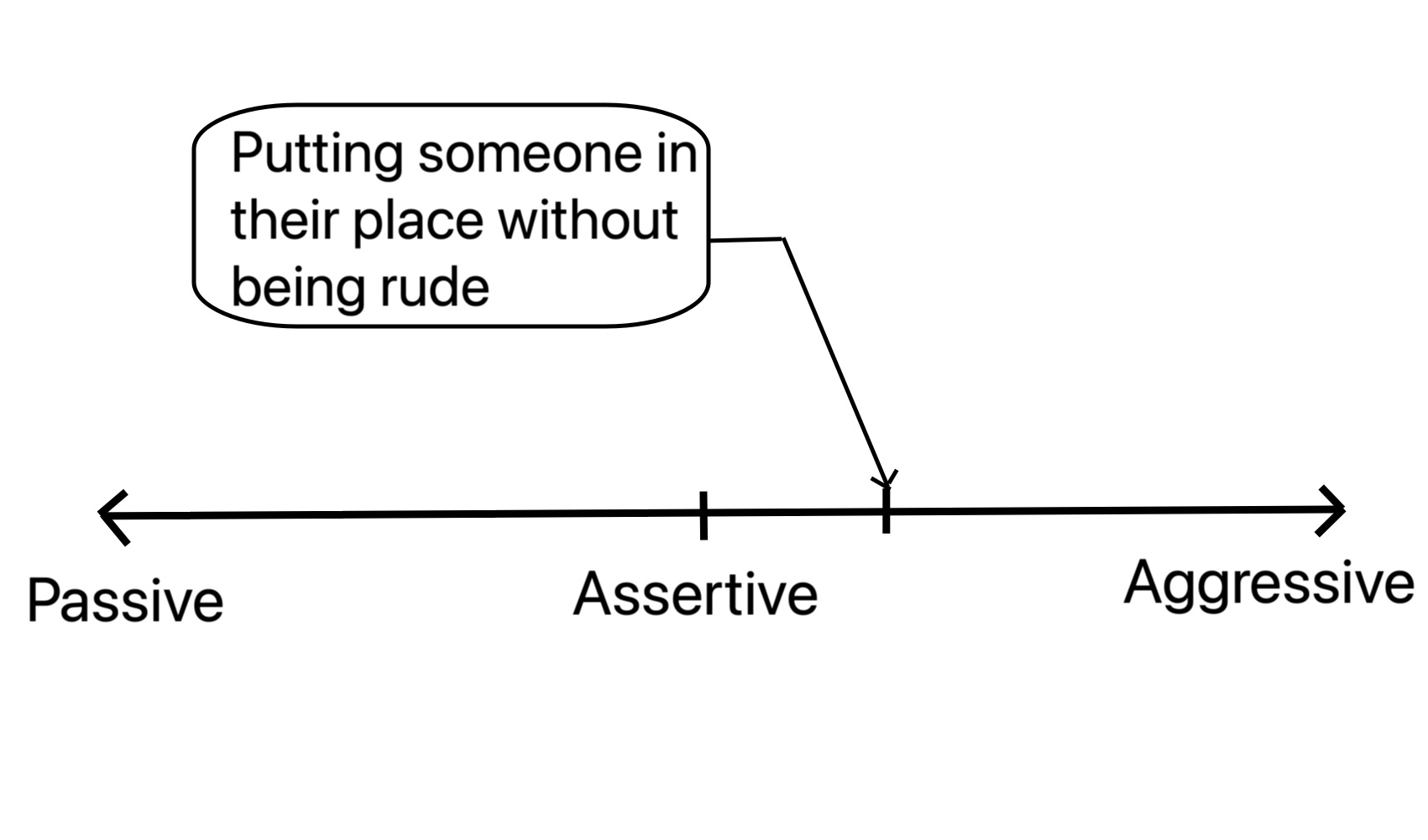
    3. Assertively

    There’s a third response to aggression that very few people can execute. Someone who responds assertively stands up for themselves without stepping on the rights of others.

    This isn’t easy to do and requires a lot of awareness, practice, and self-control.

    putting someone in their place without being rude

    An assertive person has no desire for revenge. Their only goal is to safeguard their rights. An aggressive person, in contrast, seeks revenge by intimidation and putting the other person in their place.

    Someone who wants to put the other person in their place without being rude wants revenge, but in a safe way. They want to teach a lesson to their aggressor, but in a way that doesn’t escalate the situation.

    They may not want to give others a taste of their own medicine (aggression), but they do want to leave a bitter taste in their mouths.

    They want to tone down their aggression just enough so it can still leave an impact. And the other person can barely do anything about it because the impact is low but not low enough to not pinch them.

    Of course, this is even harder to execute than assertiveness and requires God-level social skills.

    The art of non-aggressive aggressiveness

    Before you decide to do anything about someone being aggressive, you want to be sure that they’re indeed being aggressive. Sometimes there’s no doubt they’re violating you, but other times, it’s unclear.

    People who’ve been traumatized, for example, tend to over-detect social threats. In other words, they’re prone to assume aggression where there is none.

    If you’re reasonably sure the other person is being a jerk, and you want to put them in their place without escalation, here are some ideas:

    1. Ignore completely

    This tactic works best with strangers and people you don’t care that much about. We do get hurt when random strangers are mean to us. People care about people in general. But, of course, you won’t care as much about a stranger as you care about a family member.

    A stranger who’s rude to you isn’t worth your time and attention most of the time. By ignoring them entirely and acting like they don’t exist, you immediately put them in their place.

    This tactic also works on people close to you but can be too risky in that scenario. You don’t want to give them the impression that you don’t care about their existence.

    2. Stay calm

    If you get angry, you’re likely to be aggressive. If you feel afraid, you’re likely to be passive. To be assertive and subtly put them in their place, you have to control your emotions.

    I know people keep advising to keep calm when provoked. It’s sound advice but hard to execute. We need to play some mind games. I’ll give you a mental model to help you practice this:

    First, understand that getting you all emotional and worked up is likely a manipulation tactic. The person trying to stir your emotions is likely trying to control you. If they make you feel the way they want to make you feel, they can make you do what they want you to do.

    Second, some people like narcissists and sociopaths may simply get a kick out of getting an emotional reaction out of you.

    Imagine them having the remote control of your emotions, sitting on the couch, changing channels, and getting entertained by your emotional reactions while you’re the TV.

    You’re a human and not a TV. It’s time to snatch that remote control from them so they can’t push your buttons.

    3. Filter out their emotions

    The reason why it’s so hard to avoid being aggressive when provoked is because aggression, especially verbal aggression, is laden with emotions.

    We react emotionally to emotional assaults.

    For instance, you may get confused if someone says something condescending to you without that condescending tone. You’d probably debate whether or not they were being condescending.

    But something neutral said in a condescending tone almost always comes across as condescending. It’s because it’s the tone and other non-verbal cues that carry the emotions and stir emotions in us.

    So, mentally filtering out the other person’s emotions can be an excellent way to not respond aggressively to a provocation.

    One way to put someone in their place politely is to address the message rather than how it is delivered. If you completely ignore how it’s delivered and find logical flaws in the content of the message, you’ll put the other person in their place.

    By saying things like “I disagree” or “That’s your opinion” in an emotionally flat tone, you remove the emotional assault and address the facts.

    There’s nothing they can do about you disagreeing with them. It’s not an attack so they can’t attack back. It leaves a bitter taste in their mouth that they can do nothing about.

    4. Use wit and comebacks

    Comebacks are effective because they’re unexpected and shock the aggressor. They allow you to hit back without escalating the situation. Since the aggressor doesn’t know how to react to your comeback, they’re put in their place.

    Some people are naturally witty and come up with good comebacks. You can listen to them and learn how they think.

    The guy in the clip below knew he was likely going to be roasted on the show. He admitted in an interview that he studied comebacks and comedy to prepare himself. As a result, he totally annihilated the host:

    You have to be careful with comebacks as they can be demeaning and therefore, aggressive. Unless you’re fighting fire with fire, of course. All is fair in love and war.

  • How to talk to someone who turns everything around

    How to talk to someone who turns everything around

    Before you learn how to talk to someone who turns things around, you must thoroughly understand the phenomenon of ‘turning things around’. There are a lot of things going on in this dynamic that need to be well understood.

    In this article, I’ll break down what happens when someone turns everything around on you and why it happens. And how you can deal with this tricky situation.

    Do your homework first

    When you accuse someone of something, there are two possibilities:

    You’re either mistaken (unfair blaming) or right (fair blaming).

    Of course, it’s not always that simple.

    There are degrees to blaming as well. You can blame someone for something more than is fair. Your blame isn’t proportionate to their fault. This is also unfair blaming. Similarly, you can under-blame, i.e., blame someone less than what they deserve.

    We’re not concerned with under-blaming here, as that rarely happens. Humans tend to quickly blame unfairly by over-blaming for a minor fault or for no fault at all.

    So, before you think about dealing with someone who turns your blame around on you, you have to ask yourself:

    “Am I blaming unfairly or fairly?”

    Unfair blaming

    If you blame someone unfairly, they’re going to get hurt. Especially if you two are in a close relationship. They don’t want you to think they don’t care about you or want to hurt you. It’s natural for them to become defensive.

    In an attempt to defend themselves, they might turn things around on you.

    They’re doing it only because they’re hurt by your unjustified accusation. Now, they’re taking a sort of revenge by turning things around.

    Their ‘turning around’ may be fair or unfair. It doesn’t matter. What matters is what started the cycle. Unless you fix your unfair blaming, the situation won’t get better.

    Unless they can handle your unfair blaming well, which is rare.

    Reasons for unfair blaming

    1. Stress

    When we’re stressed, things that don’t usually bother us start to bother us.

    When you come home after a stressful day, it’s easy to take out that stress on your partner. A simple comment from them may anger you, but your anger is really directed toward how stressful your day was. This situation is a recipe for unfair blaming.

    2. Resentment

    If you’ve accumulated a lot of resentment for your partner, your mind will actively seek opportunities to express that resentment. This can lead to unfair blaming.

    You’ll find that you’re not blaming them for what they did now but for what they did in the past. This is part of the reason why digging into the past is so common in relational conflicts.

    3. Trauma

    Childhood trauma makes us hypervigilant about certain kinds of threats. You’re likely to detect threats from others where there are none. Past trauma makes you more likely to overreact and blame unfairly.

    Fixing your unfair blaming

    This requires a high degree of self-awareness. If you keep in mind the above reasons, it’ll be easy for you to understand why you’re doing what you’re doing.

    The other person’s defensiveness should cue you to question your own blaming.

    Fair blaming

    You blame someone fairly when you blame them in proportion to their fault. You expect them to take responsibility for their mistake and apologize. This repairs the relationship.

    Some relationship experts say that there should be no blaming in a relationship. This is an impractical and idealistic idea. When we care about people, their actions affect us. If they hurt us intentionally or unintentionally, we’re going to blame them.

    And that’s okay as long as it is fair blaming.

    The ideal response to fair blaming is that the other person accepts responsibility. This happens in healthy relationships. There’s a lot of fair blaming and taking responsibility in a healthy relationship.

    In an unhealthy relationship, the usual response to fair blaming is blame-shifting. The accused partner doesn’t want to admit they’re wrong and turns everything around.

    This creates a lot of problems.

    When your partner turns around your fair blame back on you, it detracts from the issue at hand, which is that you felt hurt.

    It doesn’t matter if your partner’s ‘turning around’ is fair or unfair. They’re turning it into a blame game. You blame them back, perhaps more firmly this time, and a full-blown conflict ensues.

    Why people don’t accept responsibility

    To understand why the other person isn’t taking responsibility, you must see things from their perspective. What’s going on in their head?

    Here are a few possibilities:

    1. They’re unaware

    It’s possible that they simply can’t see how they’re wrong. They don’t have enough awareness and intelligence to understand what they did wrong and why it affected you. If this is the case, they’ll see your fair blaming as unfair and turn things around on you.

    2. They’re insecure

    It’s common for insecure people not to admit they’re wrong. They know they’re wrong but won’t acknowledge it because it makes them look bad. All they’re doing by turning things around is protecting their pride.

    They’re more interested in ‘winning’ the argument than reaching a mutual understanding.

    It can be hard to help someone with a fragile ego see reality clearly.

    3. They’re controlling

    Narcissists, Gaslighters, and other abusers use blame-shifting to get the upper hand in the relationship. Their goal is to put you down and destroy your self-esteem.

    4. They’re triggered

    If they’re stressed, or you triggered their trauma somehow, they’ll get into defense mode and turn things around on you. They’ll completely misinterpret what you say and start fighting an enemy of their mind’s creation.

    People can be so wound up in their past that it can be challenging to get through to them.

    Talking to someone who turns everything around

    The most important thing is understanding why they’re doing what they’re doing. If you just try seeing things from their perspective, you give yourself a chance to deal with the situation appropriately.

    Still, here are a few ways to deal with this situation:

    1. Delay reacting

    When you blame someone fairly, and they turn it around on you, avoid turning around their ‘turning around’. This can lead to unnecessary conflict. Unnecessary conflicts waste a lot of energy and time.

    When you sense they’re turning things around on you, give yourself time to process the situation.

    2. Listen to them

    Listening to someone turning things around on you patiently can be challenging. Sometimes that’s the best thing you can do.

    By listening to them, you validate their version of reality and how they see things. You don’t have to accept their blame. Just consider the possibility of things being the way they see them.

    When they see you doing that, they’ll want to reciprocate when you put forward your version of reality.

    How you do it matters.

    When they’re done turning things around on you, frame your version of reality as a question:

    “Okay. I understand what you’re trying to say. Is it possible that [your version]?”

    When you do this, their emotional brain takes a backseat, and their logical brain comes online. They’re less likely to be defensive when their rational brain comes online.

    3. Re-frame your blame

    Even if you blame someone fairly, how you blame them matters. Maybe your fair blaming came across as unfair or hurtful.

    If you take back what you said, they’ll have nothing to turn around on you. It’s easy to turn around hurtful things, but non-hurtful things are hard to turn around.

    If you throw someone a spear, they can catch it and throw it back at you. If you throw someone a cotton ball, they won’t throw it back at you. There’s no point. A cotton ball can’t hurt anyone.

    You may want to turn your spear of a blame into a cotton ball.

    You can blame someone fairly, calmly, and assertively, even if you’re hurting badly.

    If you don’t want people to turn things around on you, don’t give them anything to turn around on you.

  • How to manipulate a manipulator (4 Tactics)

    How to manipulate a manipulator (4 Tactics)

    To manipulate someone means to make them do something that’s not in their best interests. Manipulations always incur some cost on the manipulated and a benefit to the manipulator.

    Manipulation is different from influence. You can influence someone to do something that is in their best interests. For instance, a marketing campaign that influences you to buy a product that improves your life isn’t manipulation because improving your life is in your best interests.

    On the other hand, a marketing campaign that influences you to buy something that does you no good is definitely manipulation. The marketer wins, and you lose. Manipulation is always win-lose.

    Detecting manipulation

    Often, people don’t realize they’re being manipulated until it’s too late. So, the best thing you can do to avoid getting manipulated is to detect manipulation in its early stages.

    Signs you’re being manipulated include:

    • You feel emotionally drained after your interactions with a manipulator
    • You feel powerless and helpless
    • You feel guilty, disrespected, and devalued
    • You feel pressured to act in a certain way
    • You feel frustrated and confused

    You may have noticed that all the above signs start with “You feel…”. This is because manipulation usually happens on an emotional level. Emotional manipulation is powerful and can easily be detected at the level of emotions.

    You have to notice the shifts in your emotional energy to tell whether or not you’re being manipulated.

    Never assume manipulation based on a one-off event. If they’re a manipulator, chances are they’ll try to manipulate you repeatedly. Look for patterns.

    Once you see the patterns, try to figure out what the manipulator is trying to gain by manipulating you.

    Now that you have a behavioral pattern and a motive, you can beat the manipulator at their own game.

    How to manipulate a manipulator

    Here are some universal tactics that can counter almost all forms of manipulation:

    1. Ignoring the manipulator

    As soon as you realize you’re being manipulated, opt out of their game. Stop giving any more energy to the manipulator. A manipulator needs engagement from you to manipulate you.

    When you’re disengaged, none of their tactics is going to work. Be like a wall when interacting with them. Everything they say and do bounces right off of you.

    Delaying reacting and give yourself time to respond appropriately or not at all.

    2. Not showing emotions

    If you’re at a point where you can no longer opt out of their game, a manipulator has likely gotten hold of your emotions. They’ve had you emotionally involved.

    This usually happens when people who are close to us manipulate us. It’s easy to ignore strangers, but ignoring friends and family members is hard and can have consequences.

    Once you’re under your manipulator’s emotional grip, you can’t help getting affected emotionally by the things they say and do.

    No matter how you feel inside, avoid expressing it on the outside. This can be hard to do, especially for people who tend to be expressive and honest. But you need to do it if you want to disempower your manipulator.

    When a manipulator sees they can press your emotional buttons, they’ll control you like a puppet. When they see they don’t emotionally affect you, they’ll conclude you’re hard to manipulate.

    3. Assertiveness

    Using assertiveness to counter manipulation can be risky because assertiveness involves a good level of engagement. If you’re assertive with your manipulator, you’ll likely sink deeper into their trap and get involved in a conflict.

    Although your goal should be to minimize engagement with the manipulator as much as possible, sometimes confrontation and conflict are necessary.

    If ignoring and being emotionally unexpressive doesn’t work, you’re forced to be assertive or even aggressive.

    When someone manipulates you, they get the upper hand on you. They gain power over you. You can disempower them using assertiveness or aggression.

    Examples of assertive communication would be:

    “I know you’re trying to manipulate me.”
    “I won’t tolerate that behavior from you.”

    Aggressiveness involves some devaluing of the manipulator to re-balance power:

    “You should be ashamed of your behavior.”
    “I expected that shitty behavior from you.”

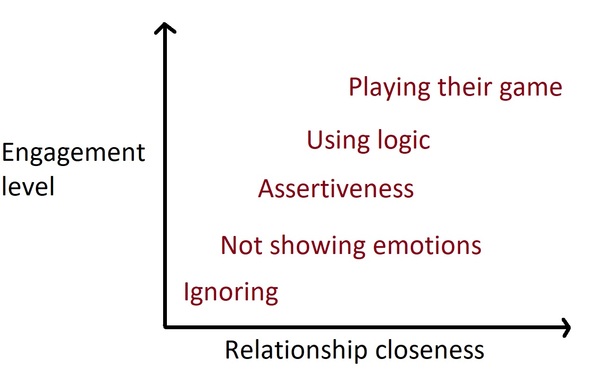
    4. Using logic

    Since most manipulation tactics are emotional, you can always use logic to counter them.

    Note that it requires a greater level of engagement from you. So you should reserve this method only for people who are the closest to you.

    engagement levels

    A manipulator will often use some biased emotional reasoning to manipulate you. For example, they might say something like:

    “You always do this to me.” (Making you feel guilty)
    “You’re a failure.” (Devaluing you)

    You can challenge the first statement by saying something like:

    “Always? Are you sure? Let’s think of examples where I did the opposite.”

    And the second statement by:

    “Awesome! I make one mistake, and I’m a failure. What about all the times when I didn’t screw up?”

    As you can see, you’re defending yourself here. It’s okay to defend yourself in close relationships when a lot is at stake.

    Note that using logic only works on logical people. If your manipulator is anything but logical, it’s best to stick to previous methods.

    5. Playing their game

    You know their behavioral patterns. You know their motives. Great!

    You have everything you need to give them the ultimate blow.

    You first let them think they’re getting away with their manipulation by doing precisely what they expect you to do.

    You back out just before they get that big win in the end. You don’t do what they expected you to do. Or you do the exact opposite. Doing so will throw them deep into the depths of confusion and frustration.

    They’ll have invested a lot of time and energy into manipulating you and not have anything to show for it.

    They’ll be sure not to mess with you again.

  • 8 Signs someone is trying to intimidate you

    8 Signs someone is trying to intimidate you

    Human societies are unequal. This is a natural consequence of some people being more valuable to society than others. Like any group, society values members who contribute to the group’s success.

    You’ll be valuable and of high status, if you contribute greatly to society. If you don’t, your status will be low.

    What do I mean by contributing to society’s success?

    Mainly, it’s helping other members survive and achieve reproductive success. These are the core human needs. People who can meet these core needs or have the traits that put them in a good position to meet these needs are seen as having high status.

    And those who can help others meet these needs are also high in status.

    For instance, a doctor who helps others survive is highly respected and valued. Similarly, an entrepreneur who provides a livelihood to others is also highly valued.

    High-status people are intimidating to low-status people because they have more power. Being high status means you’re in a dominant position, and being low status means you’re in a submissive position.

    We see this dominance-submissiveness dynamic everywhere- from families to business organizations. It’s deeply embedded in human nature.

    The purpose of domination and intimidation

    Since dominant and high-status individuals are powerful, they can easily control the less powerful, submissive, and low-status people. Often, high-status people have to do nothing to control low-status people.

    When a low-status person comes across a high-status person, the former tends to kiss up to them. They automatically do things for the high-status person. They automatically go into submissive mode.

    Think about how people treat rich men and beautiful women- arguably the most powerful people in society. A rich man stepping out of a fancy car makes heads turn. Security guards salute him. A beautiful woman usually has a fleet of people at her beck and call.

    This iconic scene from the movie Malena provides an excellent example of a beautiful woman’s power:

    Low-status people do things for high-status people because they’re intimidated. Whenever a low-status individual comes across a high-status one, the resulting status gap creates a feeling of intimidation in the low-status person.

    This feeling of intimidation drives a low-status person to become submissive and comply with the wishes of the high-status person.

    So, when someone tries to intimidate you by projecting themselves as having high status, they usually want you to comply somehow. The purpose of domination and intimidation is compliance.

    Why would someone try to intimidate you?

    To show you they’re superior to you, better than you, and higher in status than you.

    Often, the goal is to intimidate you into compliance. Other times, they may do it because they’re intimidated by you.

    If you’re better than them in one or more areas, they may feel intimidated by you. Having been thrown to a lower position, they get desperate to shoot themselves up to a higher position. They do this by trying to intimidate you.

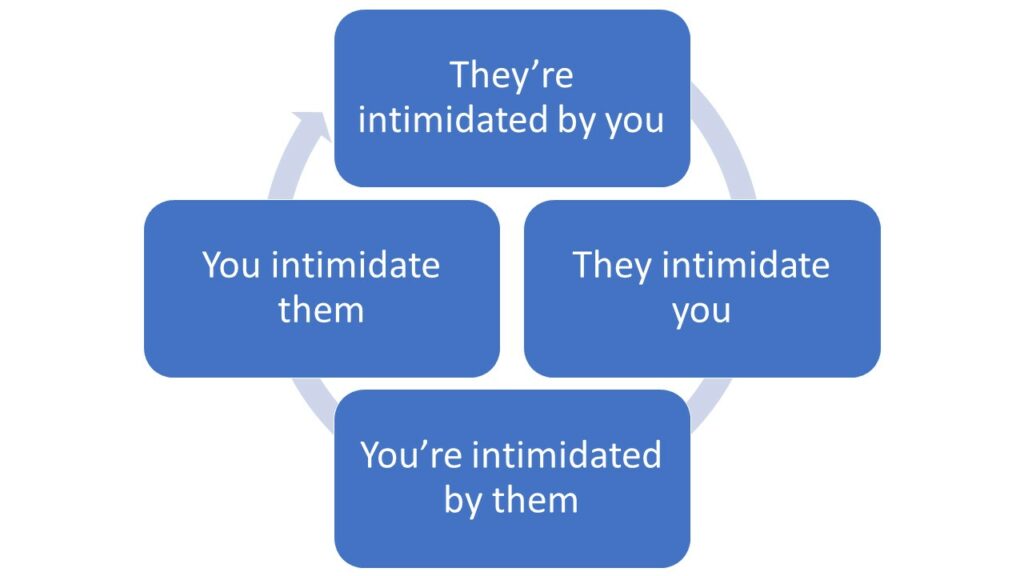
    You may have intimidated them unintentionally, and now they’re intimidating you intentionally.

    When you feel someone is trying hard to intimidate you, they’re probably intimidated by you and are engaging in ‘status climbing’ to make up for their status gap.

    You’ve awakened their insecurities, and they’re now putting up a front to show you that they’re just as important as you.

    cycle of intimidation
    The cycle of intimidation. Keeping up with the Joneses is a good example of this. Your neighbor gets something that’s better than what you have. You feel intimidated and get something that’s better than what they have, and so on.

    Intimidating vs. trying to intimidate

    You’re bound to feel intimidated if you come across someone better than you in an area you care about. It happens automatically. They don’t even have to do anything. They’re not trying to intimidate you.

    When someone is actively trying to intimidate you, it’s a different story. You can feel the pressure on you to get intimidated and comply. They’re crossing a line. You can feel they’re exerting dominance and making you do things you don’t want to do.

    You’ll feel it in your body when you get intimidated by someone trying to intimidate you. Your body language will change, becoming more submissive. You’ll find yourself complying with them in obvious and non-obvious ways.

    Signs someone is trying to intimidate you

    If someone is ‘trying’ to intimidate you, they may not have succeeded yet. You might still be in the initial stages of feeling intimidated. If you’re already intimidated, you might still be in the initial stages of compliance.

    In any case, the sooner you nip the evil in the bud, the better. We’ll soon look at signs that show someone is trying to intimidate you. Knowing these signs can help you stop feeling intimidated. And if you’re already intimidated, minimize or eliminate compliance.

    Most of these signs are part of non-verbal communication. A lot of power dynamics happen on a non-verbal level without the utterance of a single word. The good thing about non-verbal intimidation moves is that you can counter them non-verbally.

    I’ve tried to eliminate the obvious ‘signs’ of intimidation, such as yelling, blaming, shaming, humiliating, and bullying.

    1. Prolonged eye contact

    When someone makes prolonged eye contact with you, they’re sizing you up like predators size up their prey. They’re sub-communicating:

    “I’m not afraid to look at you and judge you.”

    It’s a challenge of sorts:

    “I’m looking at you, making you uncomfortable. What are you going to do about it?”

    Submissive reaction:

    When faced with prolonged eye contact, many people become submissive. They break eye contact and look away. They feel nervous and threatened. Their gaze becomes shifty as they look here and there, trying to scan their environment for more threats.

    When that happens, the other person succeeds in their intimidation attempt.

    Fixing submissive reaction:

    The intimidator might be forced to look away if you stare right back at them. By doing so, you communicate:

    “I’m not intimidated by you sizing me up. I can size you up too.”

    If you don’t want it to turn into a staring contest, you can look away, but you must look away at something important.

    For instance, a friend. You can’t look away from anything if you know what I mean. Looking away at nothing or having a shifty gaze tells them their intimidation attempt succeeded.

    When you look away at a friend or some object you go on to engage with, you’re communicating:

    “That friend or that object is more important to me than your intimidation nonsense.”

    2. Avoiding eye contact

    Avoiding eye contact can have multiple meanings in multiple contexts. In the context of status and power dynamics, when someone avoids making eye contact with you, they’re communicating:

    “You’re so beneath me I don’t want to engage with you. We’re not equals.”

    They come across as arrogant, aloof, and cold. They might be doing it deliberately to intimidate you.

    Submissive reaction:

    If you care about that person, you’re likely to become upset. You want to engage with them, but they don’t. You feel compelled to engage with them. But by doing so, you come across as lower in status than them.

    You don’t lose status and power if they reciprocate your eye contact and engagement. If they don’t, you look like you’re kissing up to them. There’s a power imbalance. You’re exerting more effort than them.

    Fixing submissive reaction:

    If you feel someone is intentionally avoiding eye contact with you to feel superior, you shouldn’t make any attempts to make eye contact with them. Fight fire with fire.

    3. Taking up space

    In any room, the highest and most prominent spot is reserved for people with the highest status. Whenever there was a function in our school, the principal always sat in an oversized chair while the students sat in cramped chairs.

    When someone tries to take up more space, they’re trying to show dominance. They’re being territorial and communicating:

    “I own this chair, car, table, etc.”

    “I’m the boss.”

    Submissive reaction:

    The common submissive reaction to this intimidation move is to let the other person take up space. By taking up less space than them, you accept your lower position compared to their higher position.

    I know all this sounds petty, but humans are petty.

    Fixing submissive reaction:

    If they own the property, they can take up as much space as they want. If you can’t take up an equally large or larger space in the room, I’d suggest you leave the room. You don’t have to sit there being their disciple while they gloat in their power.

    4. Standing up straight

    I’m sure you’ve seen bodybuilders strutting around like peacocks. Their gait can look weird, but why do they do it?

    It’s because they feel superior to others who don’t have the same physique as them. In other words, they’re trying to intimidate people.

    Submissive reaction:

    There can be many submissive reactions to this, but a common one is staring at the bodybuilder. Watching them in awe and validating their high status. Some people, intimidated by these strutters, look down and slouch their backs. A natural, submissive response.

    Fixing submissive reaction:

    Act unimpressed. If you want to make it worse, laugh at their ridiculousness. You could even mock them by walking like them. Don’t blame me if they come after you after that, though.

    Jokes aside, standing up straight is a good body language tip everyone ought to follow. But there’s a difference between standing up straight and ‘trying’ to stand up straight. The latter looks unnatural and forced.

    5. Moving you out of their way

    Submissive, low-status people make way for high-status people. Think of a celebrity or a politician moving through a crowd. The crowd makes way for the high-status person by getting out of the way.

    If someone forces you to move out of their way, they’re trying to intimidate you. They could’ve politely asked you to move, but they didn’t.

    Submissive reaction:

    The submissive reaction here is moving out of the way, of course. You may have noticed that people move out of the way very quickly, communicating:

    “How dare I get in your way, boss? Silly me. I’m going to run away.”

    Fixing submissive reaction:

    You can refuse to get out of the way because you too need to get somewhere. You may be blocking them, but you may be doing something important too. Of course, you don’t want to start a fight. You can politely say:

    “Could you wait for a minute?”

    If you aren’t doing anything important and have no choice but to move away, do so very slowly. Take all the time you need. Don’t rush into submission.

    If they ask you to move politely, you should have no problems with rushing. When there’s no intimidation, there’s no submission.

    6. No facial expressions

    This is again a disengagement tactic of high-status people, communicating:

    “You’re so beneath me, I don’t want to engage with you emotionally.”

    Submissive reaction:

    The common submissive reaction to this is putting in extra effort to engage emotionally. Going out of your way to get an emotional reaction out of them. Getting upset would be another reaction.

    Fixing submissive reaction:

    Self-respecting people don’t engage emotionally with those who don’t want to engage emotionally with them. Healthy relationships are based on give-and-take.

    7. Showing off

    When you’re a high-status person, it’s tempting to show off. You want people to value, admire, and respect you. The dark side of showing off is that you also want to intimidate people. You want to show them you’re better than them.

    People who show off mainly to intimidate others do it repeatedly and obnoxiously. People who show off in a socially healthy way try to tone down the intimidation part.

    When someone tries to intimidate you by showing off, it’s easy to deny the intimidation part.

    “They’ve worked hard. They deserve it.”

    “If you got it, flaunt it.”

    Despite saying these things, people feel something is off when someone shows off. Sometimes, they get confused about whether they should admire the showy person or despise them for trying to be superior.

    Submissive reaction:

    If you feel someone is showing off too much in your presence, they might be trying to intimidate you. The intimidation attempt is obvious when they highlight how they’ve got what you haven’t.

    A submissive reaction to this can be feeling unworthy because you haven’t got what they have. This manifests in congratulating them without being happy for them.

    Fixing submissive reaction:

    People are good at detecting empty congratulations. They know when you’re happy for them and when you’re not. It leaks out in your body language.

    If you’re not happy for them, you’re affirming their superiority and high status. Their achievement caused a dent in your world.

    Instead, turn a blind eye to their achievements as if they don’t matter to you. Or, you can downplay their achievements by setting the bar higher.

    For instance, if they say:

    “I made 100 sales this month.”

    You can say:

    “That’s great, but 200 would’ve been impressive.”

    Only do it when you can be sure they’re rubbing their success in your face. Not when you’re automatically intimidated by their achievements.

    I’d never advocate downplaying the achievements of people you care about. I strongly believe in encouraging people. But those who show off to intimidate you and make you feel inferior don’t deserve your encouragement.

    8. Controlling conversations

    People can try to intimidate you via verbal communication as well. It’s mainly done by attempting to control conversational aspects like:

    • Who speaks first
    • Who ends the conversation
    • What topics to talk about
    • Who talks more

    People usually try to intimidate you in conversations by talking over you. They want the conversational floor all for themselves. They’ll not let you make your point and interrupt you frequently.

    Submissive reaction:

    Letting people talk over you. When you do this, you communicate that what you have to say is unimportant. And, by extrapolation, you’re unimportant. You can always feel it when someone is trying to control a conversation.

    Fixing submissive reaction:

    What you say is important, and others should listen to you. If they don’t, leave the conversation.

    You’ll notice that with power-hungry people, every conversation unnecessarily turns into an argument or debate.

    Recently, I was having a ‘discussion’ with a relative. What I thought was a discussion soon started wearing the clothes of an argument.

    They weren’t listening to what I had to say. They talked over me by vomiting out everything they knew about the topic in an unstructured way. I felt they were trying to show me they knew more than me.

    When I realized this, I slowly ended the conversation. I refused to participate with equal intensity till the conversation dwindled on its own. I saw no point in continuing. While it may seem like I let them ‘win’ by letting them voice their opinions, I controlled the conversation by bringing it to a halt and disengaging.

    As you’ve seen repeatedly in this article, disengagement is power.

  • 7 Signs someone is projecting onto you

    7 Signs someone is projecting onto you

    Projection in psychology means projecting your own mental states and traits onto others- traits that they don’t possess. Just as a movie projector projects moving images from a reel onto a screen, people project what’s going in their minds (reel) onto others (screen).

    The screen itself is blank.

    Projection is of two types:

    A) Positive projection

    When we attribute our positive traits to others, it’s a positive projection. When we positively project onto others, we attribute our good qualities to them that they actually lack.

    An example of positive projection would be idealizing your romantic partner and believing they possess the good traits that you have, but they don’t.

    B) Negative projection

    When we talk about projection, we’re usually referring to negative projection. This type of projection is more common and can have drastic consequences.

    Negative projection is when you attribute your negative qualities to others. For instance, denying a lack of responsibility in yourself while calling others irresponsible.

    More examples of projection

    To further clarify the concept of projection, let’s take a look at some more examples:

    The cheating husband

    If a husband cheats on his wife, he may accuse her of cheating. In this case, he’s projecting his behavior (being a cheater) onto his wife (who’s not a cheater).

    The jealous friend

    If your best friend is jealous of your new relationship, she may accuse your boyfriend of being jealous of your friendship with her.

    The insecure mother

    If you’re about to get married and are spending more time with your fiancée, your mother might feel insecure and exert greater control over you. Meanwhile, she may accuse your fiancée of being insecure and controlling.

    What causes someone to project?

    Being social species, humans need to look good to themselves and others. They highlight their positive traits and hide negative ones.

    Projection is a means to hide your negative traits. When you project your negative traits onto others, the spotlight (and blame) shifts from you to them. They’re the villain while you’re a hero.

    Projection is a denial of one’s dark side. It’s a defense mechanism of the ego. Admitting your flaws and negative traits hurts the ego.

    Projection can be conscious or unconscious. Conscious projection is manipulation and is not very different from gaslighting.

    Unconscious projection usually stems from past trauma.

    For instance, if your father abused you as a child, you may experience problems with your social life when you grow up. You may find it hard to trust people.

    Abuse creates shame in you, and you come to believe that something is wrong with you. As you grow up and your ego develops, you may find it harder and harder to admit your ‘flaw’. So, you project that ‘flaw’ onto others:

    “I hate people. I don’t trust them. They’re flawed.”

    Of course, there’s some truth to it. Nobody’s perfect. That’s a fact. But you use this fact not just to state a fact but also to stroke your ego and put a lid on your shame.

    Signs someone is projecting

    If you suspect someone you know is projecting, look for the following signs:

    1. Over-reaction

    If their anger and reaction are disproportionate to the situation, they’re likely projecting onto you. It may seem like they’re attacking you, but they’re really only fighting with themselves.

    They’re embroiled in their inner conflicts, desperately trying to hide their dark side.

    When they yell at you and say:

    “WHY ARE YOU BEING SO MEAN?”

    What they’re really saying is:

    “I don’t want to accept that I’m mean.”

    If their overreaction is recurring and follows the same pattern, you can almost be sure they’re projecting.

    2. Blaming you unjustly

    If you dare remove the lid and peek into the dark pit of their hidden negative qualities, you’re sure to face a backlash. They’ll grab you by the collar, pull you away, and slam the lid close.

    When someone is projecting onto you, this is precisely what happens when they’re quick to blame you. They’re more interested in covering their lid than gathering facts.

    They don’t stop to think that blaming you for the things that you didn’t do or the traits that you don’t have only makes things worse.

    3. Living in a distorted reality

    When someone is projecting onto you, their perception of reality gets distorted. They create their own fantasy world where you’re the guilty party. They throw their unjust accusations at you, and nothing seems to change their mind.

    It’s hard convincing them to change their minds because they’re emotion-driven. They cannot be objective.

    4. Playing the victim

    Self-victimization is common in those who’re projecting. Often, it’s not enough to unjustly accuse you. They also want you to feel guilty for a trait you don’t have. So, they go on and on about what you’re (not) doing and how it affects them.

    5. Ruining your mental health

    If your mental health is never good when you’re with this person, chances are they’re projecting onto you. When someone projects onto you, your mental health can suffer for days.

    If someone accuses you of doing something you did do, you can fight back and justify your actions or admit your mistake and apologize. You know what happened happened. The issue gets resolved quickly. You suffer mentally for some time and then bounce back.

    But when they’re projecting onto you, the issue (non-issue) lingers. It lingers because you’ve been accused of something you didn’t do. You need time to process what’s going on. Your reality has been distorted.

    You can’t focus on other life areas. Because to focus on something, you need a ‘self’, and your ‘self’ just got turned inside out.

    Of course, it’s going to take longer to recover from that.

    6. Changing you

    When your ‘self’ gets turned inside out, it’s up to you to turn it outside in. It’s up to you to stick to the truth about who you are and what you have or haven’t done. It’s up to you to reclaim your identity.

    If you don’t, there’s a possibility that your distorted self becomes your new self. You come to believe the false accusations.

    “If they’re calling me stupid repeatedly, maybe I am stupid.”

    This projective identification is harder to reverse and recover from.

    7. Weaponizing projection to further project

    This is as deadly as it gets. Advanced manipulation.

    Since their projections are realities to them, they use them as a weapon to project again.

    They’ll say something like:

    “I told you your wife is an evil person. I’ve told you that three times already.”

    They think that just because they repeated their projections, that makes their projections real. Yes, they said it three times, but they were wrong all three times. Saying the wrong thing over and over doesn’t make it true.

    How to respond to someone who is projecting

    First, make sure they’re really projecting by looking for the above signs. You don’t want to project your own projection onto them. It’s possible that you’re the one who’s projecting but are unjustly accusing them of it.

    With that out of the way, you have to consider what type of person they are. If you think they’re smart and you can help them see reality, great. If they’re not as objective as you’d like, you need a different approach.

    Try opening their lid gently. Tell them it’s okay for them to have their flaws. You have them too. Most of us have been hurt and are healing. We’re all works in progress.

    Avoid anger as much as possible. You can’t fight with a person who’s not even in the same reality as you.