

Disagreements are a normal, inevitable part of any relationship. Our views and arguments are shaped by our knowledge and experiences.1Von Aufschnaiter, C., Erduran, S., Osborne, J., & Simon, S. (2008). Arguing to learn and learning to argue: Case studies of how students’ argumentation relates to their scientific knowledge. Journal of Research in Science Teaching: The Official Journal of the National Association for Research in Science Teaching, 45(1), 101-131. It’s safe to say that two people can’t have the same level of knowledge or the same types of experiences. Heck, even if they go through the same experience, they can interpret it differently and extract different knowledge from each other. It’s for this reason that, even if you agree with someone on a multitude of things, there will still be some areas of disagreement.
Agreeing = bonding
Humans generally want other humans to be similar to them. That includes similarity of opinions and beliefs. This gives us the reassurance that we are right in holding the opinions we hold. It also helps us bond with those who think as we do. So opinions and beliefs are not just opinions. They are a way for humans to bond and form groups. Those who think as we do are “Us” and those who don’t are “Them”.
This is why disagreements can quickly turn into arguments and conflict. When you disagree with someone, you’re not just attacking their position even if that was your sole intent. Since people identify with their positions, you’re also attacking them. You’re declaring:
“I don’t like and accept you. I’m not part of your tribe.”
When you see them as “Them”, they see you that way too and feel attacked. So they attack back to defend themselves. Thus begins the attack-defend cycle that is typical of so many ‘discussions’, arguments, and debates. Not to mention that attacking someone’s position also implies they are less intelligent, which is another blow to their ego after being declared an outcast.
Unhealthy arguing
People will do anything to win an argument, especially if there’s an audience to the argument. Their social image is at stake. After all, winning an argument shows that you are intelligent and wise. It’s a status boost. Losing an argument is a status loss. This is why, once they have taken a stance about something, people are resistant to changing it.
Unfortunately, this strong desire to win an argument makes people argue in unhealthy and unproductive ways. They become prone to all kinds of mental laziness and biases. The goal is to dominate the other party, not to reach an understanding. This kind of arguing usually goes nowhere and puts a strain on relationships. There’s a lot of anger, yelling, and personal attacks. Verbal aggression and abuse. In some scenarios, it can lead to physical altercations.
In short, unproductive arguments are costly. They waste a lot of time for no or negative return. They lead to emotional chaos and reduced well-being.2Paglieri, F., & Castelfranchi, C. (2010). Why argue? Towards a cost–benefit analysis of argumentation. Argument and Computation, 1(1), 71-91. So the key is to adopt a strategy of selective arguing and only argue when you think the benefits of doing so have a good chance of outweighing the substantive costs.
Arguing effectively: Healthy arguing
Because arguments are costly and draining, some people vow to never argue. I wouldn’t recommend that because you don’t want to miss out on the benefits of healthy arguing. What does that look like?
Valid arguments
First, both parties have a basic respect for truth and reason. They don’t want to win as much as they’re trying to seek the truth. Not that there’s anything wrong with wanting to win arguments. It’s natural to want to win an argument. But how you go about doing that matters. You want to win an argument by making valid or sound arguments. You want to provide reasons for your arguments that are better than the reasons the opponent provides for their position. Not better because you think they’re better, but because they’re objectively better.3Mercier, H., Bonnier, P., & Trouche, E. (2016). Why don’t people produce better arguments?.
Also, just because you have some ulterior motive of self-interest doesn’t automatically make your argument invalid. Usually invalid arguments have ulterior motives but an argument can be valid with or without an ulterior motive. This is a common bias people have. Proving an ulterior motive has nothing to do with the soundness of an argument.
For example, if someone believes that consuming meat is bad, you may dismiss them by saying that they’re trying to convert people to veganism. That may or may not be their motive. We’re not concerned with that. What matters are the factual truths and logical validity of their reasoning.
Related: 10 Ways people deflect in arguments
Attack the problem, not the person
Second, both parties have basic respect for each other. That means no personal attacks. Sometimes questioning the character of an opponent is relevant to the argument.4Zarefsky, D., Bizzarri, N., & Rodriguez, S. (2005). Argumentation: The study of effective reasoning. Teaching Company.
For example, if you’re claiming that a medical research center’s vaccine can’t be trusted, then questioning the trustworthiness of the center’s owner matters. If they have been dishonest in the past, there’s a good chance they’re being dishonest again. But in most cases, personal attacks are not relevant or productive. It’s just one party trying to unfairly undermine the credibility of another.
Being for the solution
Lastly, both parties want to resolve the argument. If your opponent keeps arguing endlessly, despite your myriad efforts to resolve it, that could mean they have more to gain from the argument itself than its resolution. You’ve probably come across that person who will engage in endless unproductive discussions. They may have no interest in resolving the argument. Their goal might be to prove they are smart and that they can use big words in long sentences. Or they might just enjoy the thrill of drama.
Argument structure
Arguing effectively is all about making valid arguments. Let’s get clear about some of the basics of argumentation:
Argument: A position or stance you have about something that you’re expected to support with good reasons.5Innocenti, B. (2021). Constructing effective arguments.
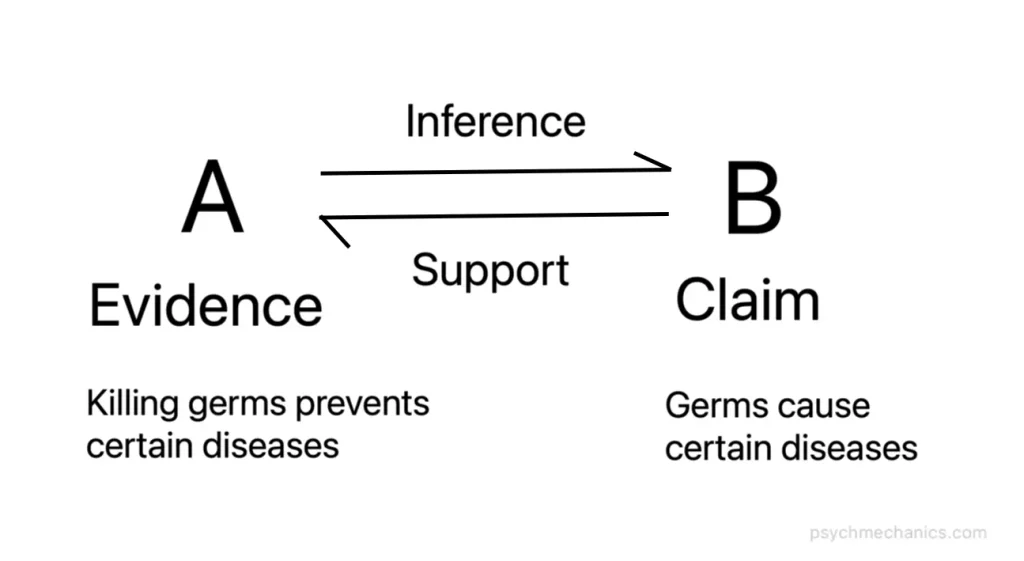
Claim: An inference that you make based on evidence.
Inference: Accepting the claim on the basis of evidence.
Evidence: A clue that supports a claim. It can be weak or strong.
Proof: Conclusive evidence for a claim.
Simply put, arguments are essentially “If A is true, then B is also true” statements. A is evidence, and B is a claim. You have to demonstrate how they logically link together if it’s not apparent.6Iordanou, K., & Rapanta, C. (2021). “Argue with me”: A method for developing argument skills. Frontiers in Psychology, 12, 631203. You can’t take huge leaps from evidence to claim or from claim to evidence. That would make your argument invalid. The more evidence you collect for your claim, the stronger your argument becomes.
Arguments are formed to persuade.7Mercier, H., & Sperber, D. (2011). Why do humans reason? Arguments for an argumentative theory. Behavioral and brain sciences, 34(2), 57-74. It is but natural to seek only evidence that supports your claims. But in doing so, you can get caught in confirmation bias. Hence it’s important, when you’re making arguments, that you take all the relevant evidence into consideration- the assumptions, exceptions, alternate explanations, and evidence to the contrary.8Walton, D. (2010). Why fallacies appear to be better arguments than they are. Informal logic, 30(2), 159-184.
The art of de-escalation
Part of selective arguing is knowing when to de-escalate. If you sense that an argument is going in the wrong direction or becoming worse, you can choose to de-escalate. I’ll give you a mental model that should help you pull yourself out of such situations:
When you sense a loaded moment in a discussion, i.e., the point where you sense the conversation is going downhill, stop. Don’t say anything. Imagine you two are on a video on some giant screen. The screen splits between you two. Then someone hits the rewind button, and your side of the screen starts playing your life backwards. You see all the experiences you’ve been through. The books you’ve read, the people you’ve talked to, and the media you have consumed. By looking at all that, you get a sense of why you have the position you have today.
With healthy arguers, even intense arguments might be worth it because they don't go off-track.
The same thing now happens with their side of the screen. Of course, you don’t know what they have been through. But you can extrapolate based on their current thinking, words and behaviors. You can guess what might have led them to how they are now. They might have told you about their experiences, how they live their days, etc. As their screen rewinds, you realize they have been through very different experiences than you. You realize that it’s pointless to keep arguing with them. They’re walking their own path.
This should make it easier for you to withdraw from arguing and trying to change your mind. Of course, if they’re an open-minded person, they’d be willing to change paths. The same applies to you. But when people have given you enough proof about their closed-mindedness, you can’t force the horse to drink.
This analogy was inspired by Black Mirror episode (S4E3).