When you encounter a life challenge and believe you don’t have the resources to cope with it, you experience stress. Life, especially modern life, is filled with stressors. Stress tends to emotionally destabilize us. So do negative emotions that often accompany stress. The bigger the problem we face, the worse our thinking and emotions get. We become emotionally unstable.
Emotional stability (ES), then, is maintaining our emotional balance in the face of difficult life challenges.1Fattah, A. (2020). Emotional intelligence and emotional stability in crises. Journal of Psychiatry and Psychiatric Disorders, 4(2), 56-62. It’s being able to regulate our emotions and prevent them from worsening. It means being calm and composed in the eye of the storm. An emotionally stable person remains grounded and doesn’t let extreme emotions, both negative and positive, cloud their thinking and judgment.
What it isn’t
ES is not emotional avoidance. You’re not trying not to feel emotions at all. That is impossible. Don’t even bother trying. Instead, it is feeling emotions fully but not letting them sway you; not letting them take over you. ES isn’t running away from your emotions. It’s facing them squarely and working through them.
ES also isn’t suppressing or bottling up emotions; doing so only makes them resurface in more difficult ways later. Nor is it about putting on a stoic face or limiting emotional expression. ES also doesn’t mean being happy and content all the time. Finally, it is neither emotional detachment nor numbness. Those are entirely different concepts.
What it is
Here’s how an emotionally stable person thinks when facing a challenging situation:
“I’m aware of what I’m feeling and why. Let me give myself space to figure out the best way to deal with this situation.”
When you think like this, you resist giving in to a knee-jerk response to your emotions. You realize that what your emotions are tempting you to do may not be the best course of action. You respond instead of reacting. Giving yourself space to work through your emotions helps you maintain your composure. And when you work through your emotions, you calm down.
Calming down happens after you’ve worked through your emotions, not before. This is why asking people to calm down instantly after they experience negative emotions does not work.
ES is a natural consequence of healthy emotional regulation, which is a part of emotional intelligence.2Maheshwari, A., & Gujral, H. K. (2021). Emotional Stability: A Study of Contributory Factors. International Journal of Indian Psychology, 9(4), 846-857.
ES vs emotional instability
The Big 5 model of personality places ES as the opposite of Neuroticism. A person scoring high on Neuroticism is emotionally reactive. They get triggered easily and experience negative emotions more intensely. Their moods tend to be highly unpredictable.
Here’s a full list of differences between an emotionally stable and unstable person:
| Dimension | Emotionally stable | Emotionally unstable |
|---|---|---|
| Baseline mood | Calm and balanced | Anxious, irritable or low |
| Emotional intensity | Moderate, proportionate to the situation | Intense, exaggerated reactions |
| Emotional variability | Gradual shifts | Rapid mood swings |
| Emotional triggers | Less easily triggered | Easily triggered by minor events |
| Emotional recovery | Quick return to baseline | Slow recovery, lingering emotions |
| Emotional awareness | Recognizes and labels emotions accurately | Confused or unaware of emotional states |
| Emotional regulation | Uses adaptive regulation strategies | Struggles to regulate emotions effectively |
| Impulse control | Pauses before acting | Acts impulsively under emotion |
| Stress response | Manages stress constructively | Overwhelmed or shuts down under stress |
| Frustration tolerance | High tolerance | Low tolerance |
| Resilience | Bounces back from setbacks | Dwells on setbacks or collapses |
| Cognitive clarity under emotion | Thinks clearly even when emotional | Thinking becomes distorted or clouded |
| Thought patterns | Rational, balanced | Catastrophic, black-and-white |
| Self-talk | Supportive and realistic | Critical, exaggerated, or pessimistic |
| Attention control | Can shift focus away from distress | Fixates on distress |
| Decision-making | Thoughtful and consistent | Erratic or emotion-driven |
| Behavior consistency | Predictable behavior | Unpredictable behavior |
| Delay of gratification | Can wait for long-term rewards | Seeks immediate relief or reward |
| Tolerance of uncertainty | Accepts ambiguity | Intolerant of uncertainty |
| Handling criticism | Reflective and composed | Defensive or overly hurt |
| Handling conflict | Calm, solution-focused | Escalates or avoids excessively |
| Interpersonal sensitivity | Balanced sensitivity | Overly sensitive or reactive |
| Trust in relationships | Stable trust patterns | Suspicious or overly dependent |
| Attachment patterns | More secure tendencies | More anxious or avoidant tendencies |
| Communication style | Clear, assertive | Reactive, passive, or aggressive |
| Emotional expression | Appropriate and controlled | Overexpression or suppression |
| Dependence on others | Emotionally self-reliant | Emotionally dependent or withdrawn |
| Need for validation | Moderate, internal validation | High need for external validation |
| Anger management | Controlled and constructive | Explosive or repressed anger |
| Anxiety levels | Manageable and situational | Chronic or disproportionate anxiety |
| Depressive tendencies | Temporary dips | Prolonged low mood or rumination |
| Catastrophizing | Rare | Frequent |
| Self-esteem stability | Stable self-worth | Fluctuating self-esteem |
| Identity stability | Clear, consistent self-concept | Confused or shifting identity |
| Motivation | Consistent and goal-oriented | Fluctuating, emotion-dependent |
| Productivity | Steady output | Inconsistent performance |
| Adaptability | Flexible and adaptive | Rigid or chaotic responses |
| Coping strategies | Healthy (problem-solving, reframing) | Avoidant or maladaptive (escape, denial) |
| Use of substances/escapes | Low reliance | Higher likelihood of reliance |
| Tolerance of discomfort | Can endure discomfort | Avoids discomfort at all costs |
| Mind-body regulation | Stable physiological responses | Heightened physiological reactivity |
| Sleep patterns | Relatively stable | Disrupted by emotional states |
| Long-term outlook | Optimistic but realistic | Pessimistic or unstable outlook |
| Goal pursuit | Persistent despite setbacks | Gives up or shifts goals frequently |
| Learning from experience | Reflects and adapts | Repeats patterns without insight |
| Sense of control | Internal locus of control | External locus of control |
| Reaction to failure | Sees as feedback | Sees as personal defeat |
| Consistency across situations | Emotionally consistent | Highly context-dependent emotions |
| Mental bandwidth | Preserved under stress | Consumed by emotional turmoil |
| Overall functioning | Stable and reliable | Erratic and inconsistent |
Key differences: Dimensions
ES can be understood by a useful framework called the five-dimensional model of ES.3Chaturvedi, M., & Chander, R. (2010). Development of emotional stability scale. Industrial Psychiatry Journal, 19(1), 37-40.
1. Pessimism vs optimism
Pessimists tend to view themselves, others, and the world negatively. They tend to be gloomy and depressed. They tend to have low self-esteem and are burdened with guilt. They also tend to be introverted and very passive in social situations.
Optimists, on the other hand, tend to be cheerful most of the time. They tend to be satisfied with themselves and find life rewarding. They persist in chasing their goals despite facing setbacks. They expect success and perceive failures as temporary.
I’d rather you be a realist than either a pessimist or an optimist. Paradoxically, humans have a negativity bias as well as a positivity bias. We tend to see things as more negative than they really are and, at other times, more positive than they really are. I like seeing reality accurately. If you can’t be a realist, then an optimist is the way to go.
2. Apathy vs empathy
Apathy signals selfishness and a lack of consideration for others. Pursuing your desires no matter the consequences is an emotionally unstable way to behave. In contrast, when you’re considerate of others, you can make more emotionally intelligent decisions. You build trust and strong connections with people.
3. Dependency vs autonomy
A person dependent on others and fate is emotionally unstable because their feelings are tied to external whims and changing circumstances. They are pushed around by people and events like a leaf in the wind. In contrast, an autonomous individual takes responsibility for their emotions, makes their own decisions, and takes realistic action to solve problems.
4. Anxiety vs calm
An anxious person has a low threshold for panic and worry. They get easily upset by things that go, or can go, wrong. In contrast, a calm and emotionally stable person has a high threshold for negative emotions. Minor stresses and inconveniences of life don’t usually perturb them.
5. Aggression vs tolerance
Emotionally unstable people are prone to direct as well as passive expressions of anger. For example, they’ll throw temper tantrums, have violent arguments, and be sarcastic. They feel compelled to defend themselves when they perceive an attack.
On the other hand, an emotionally stable person is more gentle and rarely has conflicts with others. They’re assertive, rather than aggressive. They don’t believe you necessarily have to argue or defend yourself violently.
How to be emotionally stable
So, how do you work through your destabilizing negative emotions? It’s not easy, but the benefits of regaining your emotional balance are worth it. ES makes you mentally strong and is linked to happiness.4Hills, P., & Argyle, M. (2001). Emotional stability as a major dimension of happiness. Personality and individual differences, 31(8), 1357-1364. It’s also one of the personality predictors of longevity.5Terracciano, A., Löckenhoff, C. E., Zonderman, A. B., Ferrucci, L., & Costa Jr, P. T. (2008). Personality predictors of longevity: activity, emotional stability, and conscientiousness. Biopsychosocial Science and Medicine, 70(6), 621-627. As you become more emotionally stable with practice and age, perceived stress has less of an impact on your psychological well-being.6Strizhitskaya, O., Petrash, M., Savenysheva, S., Murtazina, I., & Golovey, L. (2019). Perceived stress and psychological well-being: the role of the emotional stability. European Proceedings of Social and Behavioural Sciences, 56.
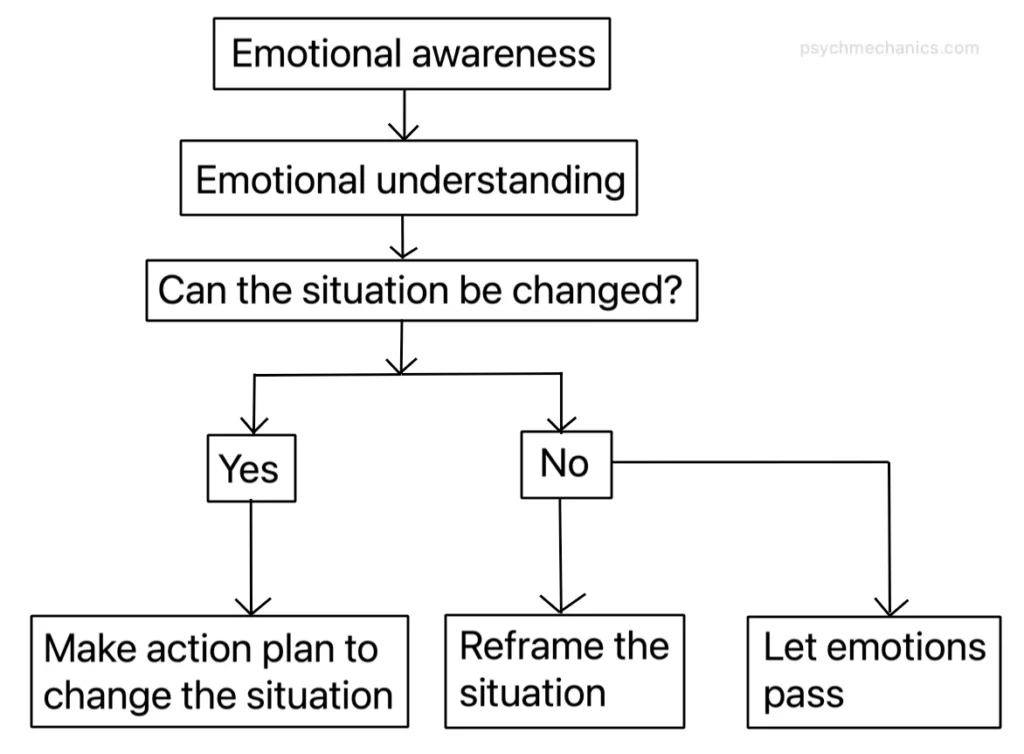
Emotional awareness
It all starts with self-awareness. Being aware of how your moods, feelings, and emotions change with changing life situations. Emotional awareness, a part of self-awareness, is noticing what you’re feeling and labelling it accurately.
“I felt jealousy.”
“I felt sad.”
Sometimes you’ll feel more than emotion, and that’s fine. Focus on the dominant emotion that’s disturbing you the most. Observing your emotions this way separates ‘you’ from your emotions. When you put yourself at a distance from them, you reduce the power they have over you.
Emotional understanding
The next step is understanding why you’re feeling that way. What happened that caused you to feel that way? What change occurred in your life? What thoughts ran in your mind that kindled your feelings?
When you face a life challenge you can’t immediately cope with, it’s normal to feel stress, pain, frustration, disappointment, sadness, and even depression. It shows that your brain is working as it should. You don’t have to fight these feelings. They’re merely signals. You have to deal with what’s producing the signal- the changed life situation.
Plan of action
The goal of emotions is to motivate you to take action. Sitting with and understanding your emotions is important, but your emotions won’t typically go away unless you act on them. When you make a plan of action, it’s an attempt to directly deal with your changed life situation- to change it back to how it was previously or make it better. You’re appropriately responding to the signal, so it disappears.
Reframing
What if the situation is truly beyond your control and you can do nothing to change it? In such a case, you change how you view the situation. Merely viewing the situation as uncontrollable can relieve you of your emotions because the action your emotions are asking you to take can’t be taken. Because it doesn’t exist. Another cognitive reframing technique is to look for the positives or opportunities in the seemingly negative situation.7Mestre, J. M., MacCann, C., Guil, R., & Roberts, R. D. (2016). Models of cognitive ability and emotion can better inform contemporary emotional intelligence frameworks. Emotion Review, 8(4), 322-330.
“I got demoted at work, but at least my workload will be less, and I’ll have more time for my hobbies.”
Since I want you to be realistic, I don’t want you to cognitively reframe in a delusional way, by lying to yourself. Self-gaslighting. None of that stuff. Reframing should be realistic and rational.
Letting feelings pass
What if you can’t reframe the situation? There are no positives in it. No lessons to be learned. In such a case, you can simply let your feelings pass. You can’t feel the negative emotions you’re feeling forever. They weaken over time as your mind finally digests that you truly can’t do anything about your situation.
Life situations keep changing, so there’s that as well. If you can’t do anything to solve your problem now, the best course of action is to do nothing. You may find that the problem resolves itself later. It’s better to wait to let the problem resolve itself or become insignificant with time than to do something to make the problem worse.