

There’s no doubt that good relationships are critical for well-being. But relationships are inherently risky. When you trust someone, you give them the power to break that trust.
We form relationships with others because we benefit from them. Reciprocity and mutual benefit are the very foundations of building and sustaining relationships. The benefits of being in a relationship can be higher than the potential risks of lying, cheating, deception, etc. Or at least, that’s how people perceive their relationships. Until they don’t.
The mechanics of flag-detection
Relationships carry the potential for huge gains in the future. The closer you get to someone, the more mutually beneficial the relationship can get, and you both can accrue higher benefits from each other. At the same time, relationships also carry the potential of huge loss in the future if they dissolve. This is especially true for a romantic relationship because that’s arguably the most important relationship for most people.
So, it makes sense that we should have a psychological mechanism that scans for undesirable qualities (red flags) in a potential partner to alert us and minimize the chances of huge future loss. This mechanism should also scan for desirable qualities (green flags) in them that signal future gain. The red flags motivate us to mend or end the relationship to cut our losses. The green flags motivate us to continue to build the relationship.
Table of the flags
Isolated events of red or green flag detection don’t count as much as patterns. Humans make mistakes. What you’re looking for is a pattern of behavior, in yourself and your partner. You both will probably have multiple red and green flags. The important thing is that the green flags should outweigh the red flags for it to be a healthy relationship. And the red flags that are present should be worked on, unless they’re dealbreakers.1Csajbok, Z., & Berkics, M. (2022). Seven deadly sins of potential romantic partners: The dealbreakers of mate choice. Personality and Individual Differences, 186, 111334.
| Category | Green flags | Red flags |
|---|---|---|
| Emotional safety | Feel safe and secure; can be yourself fully; can express thoughts and feelings without fear | Feel unsafe, anxious, or “on edge”; unable to speak your mind; fear of retaliation |
| Respect | Consistent respect even during conflict; appreciation, gratitude, admiration | Disrespect, belittling, mocking your interests; excessive criticism; arrogance or hostility |
| Communication | Open, honest communication; clearly expresses needs; listens and validates | Poor communication; avoidance; one-sided conversations; lying, withholding, or dishonesty |
| Accountability | Takes responsibility; apologizes; aligns words with actions | Never apologizes; blames you or others; actions don’t match words; manipulative behavior |
| Trust | Mutual trust; loyalty; authenticity; transparency | Gaslighting; secrecy; unfaithfulness; interest in other romantic options |
| Consistency | Emotionally stable; consistent effort and behavior | Inconsistency; hot-and-cold behavior; unpredictability; chaos mistaken as “love” |
| Boundaries | Respects boundaries; supports independence; allows space | Boundary violations; controlling behavior; restricting movement; hyper-monitoring/check-ins |
| Social support | Encourages time with friends/family (with or without them); values your support system | Isolation tactics; discourages or blocks social contact; reacts negatively to your social life |
| Individuality | Encourages authenticity; supports your interests and self-expression | Tries to change you; you abandon hobbies/interests; mirroring to manipulate connection |
| Growth | Encourages your goals; supports personal growth and self-care | Discourages goals; prevents self-care; only supports what benefits them |
| Power dynamics | Balanced decision-making; mutual influence | Controlling, rigid expectations; everything revolves around them; dominance |
| Security | Secure attachment; trust without excessive monitoring | Excessive jealousy, possessiveness, insecurity; reacts negatively to perceived threats |
| Conflict | Healthy conflict resolution; stays respectful; focuses on solutions; fights fair | Explosive anger, yelling, hostility; avoids or escalates conflict; manipulates arguments |
| Emotional maturity | Emotionally intelligent; empathetic; manages anger well | Emotional immaturity; mood swings; insecurity; clinginess or overdependence |
| Effort | Mutual effort; shows interest in your preferences and experiences | Self-centered; lacks effort; expects you to revolve around them |
| Relationship pace | Healthy pace; gradual, mutual commitment | Love-bombing; rushing intimacy or commitment; overly fast involvement |
| Behavior toward others | Treats others with respect and kindness | Rude, entitled, or disrespectful toward others |
| Lifestyle | Healthy habits; stable functioning; aligned life direction | Substance abuse, addiction, instability, lack of direction |
| Values | Shared values and long-term compatibility | Misaligned values; conflicting relationship expectations (e.g., exclusivity vs openness) |
| Physical safety | No fear; physically and emotionally safe environment | Intimidation, threats, coercion, physical or sexual violence |
| Background risk factors | Self-awareness; growth beyond past issues | History of abuse/battering patterns without accountability or change |
| Self-worth | Healthy self-esteem; not dependent on control or validation | Financial or emotional control tied to self-worth; insecurity-driven behavior |
The flags can be subjective
I took care to ensure the flags listed in the above table are universal. That is, most people would consider the red flags as red flags and green flags as green flags without debate or ambiguity. But this is not always the case. Sometimes these flags can be subjective. Sometimes, what seems like a red flag may really be a green flag and vice versa.
This is because each of us has this ‘relationship script’ in our minds that tells us how a relationship should be. Part of it is biological and part environmental. When we encounter a red flag, our relationship script is negatively violated.2White, R. C. (2016). Relational red flags: Detecting undesirable qualities in initial romantic encounters. Louisiana State University and Agricultural & Mechanical College.
Examples
Jenny grew up in a family where there was little emotional connection between the family members, especially her parents. Expression of feelings was discouraged and dismissed. When she met Jim, an emotionally expressive guy, she felt off and thought it was a red flag.
“This isn’t how relationships are supposed to be.”
Similarly, Tom grew up in a family where criticism and slight disrespect were okay. When he acted like that when dating Tammy, she felt something was seriously wrong. Tom’s subjective relationship script clashed with Tammy’s.
Of course, disrespect is a universal red flag3Shipley, M., Holden, C., McNeill, E. B., Fehr, S., & Wilson, K. (2018). Piecing Together Behaviors of Healthy Relationships. Health Educator, 50(1), 24-29., but some people do think that it’s okay in small amounts.
Related: Relationship readiness quiz
How to evaluate your relationship
The most important thing is to listen to what flag your mind’s waving at you, red or green. You don’t have to agree with the signal immediately, but you have to attend to it. You have to see it as an important data point and keep collecting more data points as your relationship progresses. Eventually, you’ll be able to connect the dots backwards and see clear patterns.
Red flags, however subtle, must be noted. It’s normal to doubt them or explain them away. It’s normal to be confused by the contradictory signals your partner gives you. What matters is, over time, what signals dominate. That tells you how the relationship is and what you should do going forward.
To help you with your future decision-making, here are some questions you can ask yourself:
- Do I generally feel good or bad in the relationship?
- Does this relationship bring out the best or worst in me?
- Am I growing or shrinking?
- Is my self-worth increasing or eroding?
Red flag detection framework
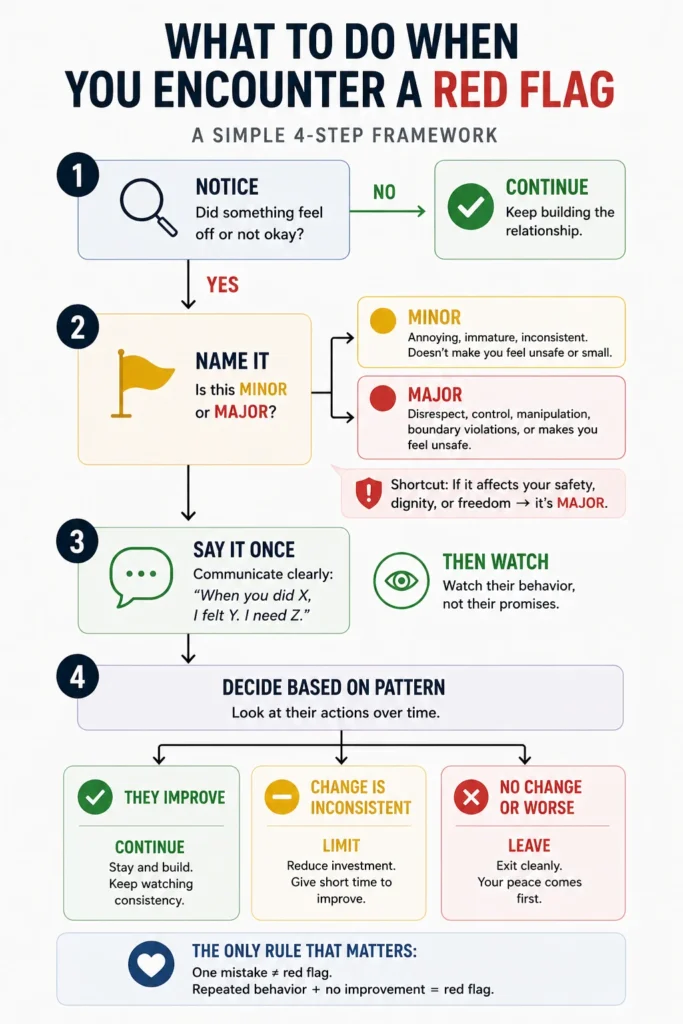
Romantic Encounters