

You know you’re an amazing person with a great personality, but you wonder what stops people from approaching you. It may be your looks. Yes, if you’re stunningly good-looking, it makes it less likely that people will approach you. This doesn’t make sense at first glance because better looks mean better genes, which means higher mate value. But it will make sense if you look at it from the lens of power dynamics.
Animals show dominant (powerful) and submissive (powerless) displays. When an animal comes across a mightier member of its species signaling dominance (like a giant gorilla beating its chest), the purpose of this body language is to intimidate. The smaller animal can choose to be submissive, thereby accepting the dominance of the bigger animal and avoiding dangerous conflict, or it can choose to intimidate back. If it thinks there’s a chance of victory.
Humans are no different. We live in a hierarchical society where power correlates with status. But being mighty and formidable is just one aspect of high status, more relevant to men than women.
Status aspects
The figure below shows other aspects of status that humans compete for to climb up the status hierarchy:
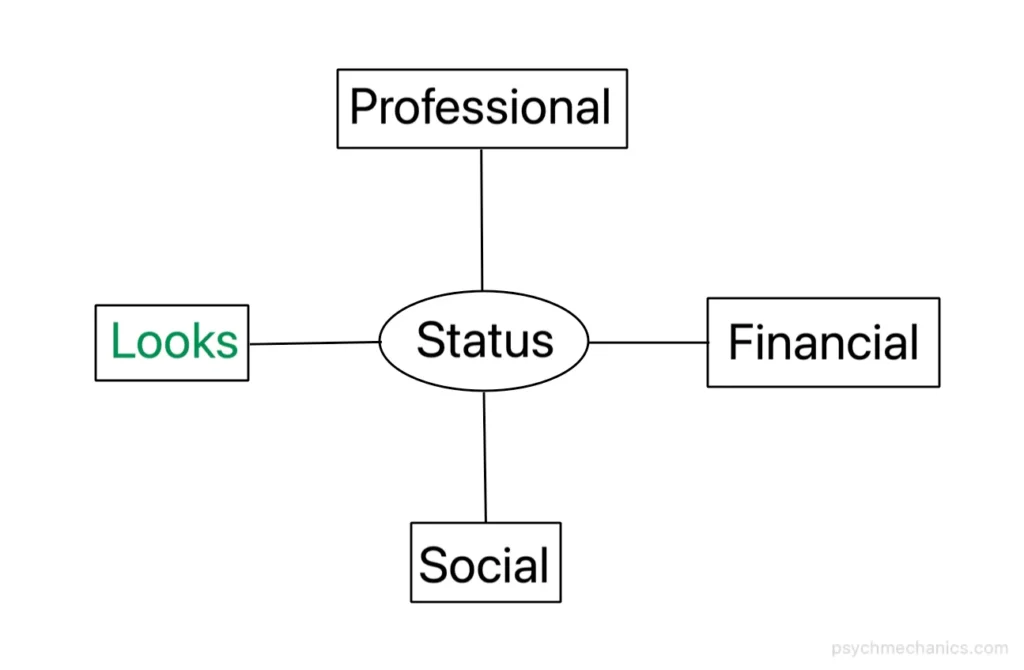
If you have high status in one or more of these aspects, you’re likely to come across as intimidating. If you have a high status in looks, i.e., you’re better looking than most people around you, people look at you and compare themselves to you. They feel inferior and intimidated. They think you are ‘above’ them. That makes it harder for them to approach you because we tend to approach and form relationships with people that we more or less see as our equals.
Like a small gorilla feeling threatened by a bigger gorilla, they might show submissive behaviors, dominant behaviors, or a combination of both.
Submissive behaviors
When people are intimidated by you, they experience discomfort. This discomfort leaks through their body language and speech. They display nervous body language signs such as:
Avoiding eye contact
Avoiding eye contact can have multiple meanings in social interactions depending on the context. This is why you should always keep the context in mind and rely on patterns versus single gestures when interpreting body language.
If you’ve seen animals fight, they give each other strong eye contact before the fight. So, strong eye contact is a sign of aggression and dominance. When one animal feels intimidated, it averts its gaze. Humans do the same. If someone feels intimidated by your looks, they may have a hard time making eye contact with you.
When they encounter you, they may look downwards or sideways. They may bury themselves in their phone. If eye contact does happen accidentally or intentionally, they’ll quickly look away.1Mehrabian, A. (2017). Nonverbal communication. Routledge. This is essentially the ‘flight response’ to a threat. They want to avoid engaging with you.
Distancing
If you happen to cross their path, they’ll quickly move out of your space. As a rule, low-status individuals get out of their way to make space for high-status individuals. I have always maintained that beautiful women are as powerful as rich, high-status men. A study showed that people maintained larger distances when walking past an attractive woman than an unattractive one.2Frevert, T. K., & Walker, L. S. (2014). Physical attractiveness and social status. Sociology Compass, 8(3), 313-323.
They may be friendly and have no trouble talking to others, but when you enter the picture, the energy shifts. They may be okay with staring at you from a distance, but if you get close, they want to run away. The inner discomfort they experience builds tension, which they then release by distancing themselves from you. When they finally get to a safe distance from you, they breathe a sigh of relief, gushing over you with their friend.
Awkwardness and clumsiness
When people fear others, a significant portion of their mental resources is consumed by the object of their fear. Same when they feel attracted to someone. Our minds are designed to hyper-focus on opportunities and threats. When a person is attracted to and intimidated by you at the same time, that is bound to hijack their attention.
When that happens, they’re likely to make mistakes they’d normally not make. They do stupid actions, drop things, and struggle with simple tasks even though they’ve done those tasks hundreds of times before. They say stupid things, stuttering and stumbling over their words.
Indirect attention-seeking
When you’re better-looking than someone, and they like you, they may approach you indirectly. Because of the status gap they perceive between you and them, they assume they’ll get rejected if they approach directly. Approaching indirectly allows them to reduce the risk of direct rejection. Indirect attention-seeking entails behaviors such as raising their voice when you’re around. They may be talking to others, but they want their voice to reach you so that you notice them.
Another example would be ‘deliberate coincidences’. They manufacture situations where you end up crossing paths with them.
Anxiety behaviors
When someone’s attracted to and intimidated by you, they only want to show their positive side to you. They want to be in your good books. So they fear making mistakes and looking bad. This increases anxiety, which leaks into their body language:
- Self-grooming behaviors such as fixing hair and clothes
- Self-soothing behaviors like fidgeting, finger or foot tapping, playing with a key in their pocket, etc.
- Displaying the facial expression of fear, i.e., lips stretched horizontally with chin pulled back.3Hopf, A. G., Buchheim, A., Hopf, M., & Eilert, D. W. (2026). A Psychological Guide to Lower Face Botulinum Toxin Injections: Baseline Emotional Functions of Facial Expressions. Journal of Cosmetic Dermatology, 25(4), e70833.
- Clasping their hands or an object tightly
- Over-explaining simple things and over-justifying
- Over-laughing at not-so-funny jokes to keep things light and avoid conflict
- Over-complimenting
- Over-agreeing with everything you say
- Extreme politeness
- Leaning over their friend when talking to you (for emotional, not physical, support)
‘Small’ body language
People tend to make themselves smaller physically when they are in the presence of an intimidating person. Looking down and lowering posture (bowing) is the usual way this is done. Another is adopting ‘closed’ body language gestures like crossing arms and raising shoulders while pulling them together.
They may also make themselves psychologically smaller by saying self-deprecating things about their own appearance. This shows that they are feeling inferior to you in looks.
Lack of expression
This ties in with their desire for disengagement because they don’t feel worthy enough to engage. So you’ll notice a general lack of expressiveness on their face and in their gestures. You’ll sense a rigidity in their demeanor. They won’t move their head and hands while talking. They’ll take fewer turns to talk and talk less per turn.4Burgoon, J. K., Wang, X., Chen, X., Pentland, S. J., & Dunbar, N. E. (2021). Nonverbal behaviors “speak” relational messages of dominance, trust, and composure. Frontiers in psychology, 12, 624177.
Dominant behaviors
The other typical response to feeling intimidated is to intimidate back, which is reflected in dominant body language and speech:
Interest-concealing
Showing interest directly is definitely dominant behavior, but someone who’s intimidated by you is unlikely to do that because they assume rejection. So they adopt another dominant approach: They act like they’re not interested in you.
The main way this is done is by avoiding eye contact. I know! I said in the previous section that it’s submissive behavior, but that’s not always the case. Again, the context and accompanying gestures matter. Avoiding eye contact can also signal a lack of interest. It’s a way for someone intimidated by you to regain power. This ‘deliberate ignoring’ may also include maintaining a physical distance between you two. Yes, distancing can also be a dominant signal.
These signals convey the message:
“I’m so above you, I don’t want to engage with you.”
Look for accompanying physical and verbal dominance signals to confirm that gaze aversion and distancing are being used to signal dominance.
Physical dominance
Staring
Yet another signal that can be dominant or submissive depending on the situation. Staring from afar and avoiding eye contact in proximity is submissive. But when they’re close to you and keep staring at you, that’s dominant behavior. They’re trying to steamroll you with their eyes, like animals before a fight. It’s a counter-intimidation tactic likely to be adopted by someone threatened by you.
‘Big’ body language
When someone feels intimidated, they may overcompensate by acting confident or arrogant. They may raise their posture to a point where it looks unnatural. Their walk looks like a performance. You can tell they don’t actually feel confident. They’re not relaxed. It’s a tense performance.
Furthermore, they may take up more space around them, put their hands on the things or people around them (signaling ownership), or put their hands on their hips. They may invade the physical spaces of those around them and may even push or shove them. If they make eye contact with you, they’ll probably give you a dirty look of disapproval.
Related: How we express disapproval with the mouth
Non-reciprocation
Their main non-verbal strategy with you will be that of non-reciprocation. They won’t reciprocate your eye contact, smile, or greeting. They’re non-verbally trying to prove that they’re better than you.
Verbal dominance
As is usually the case, physical aggression spills over to verbal. They may brag about themselves, showing how they’re better than you at so many things (if not looks-wise). They’ll downplay your attractiveness, telling you you’re not that attractive or giving examples of people more attractive than you.
When they speak, they’ll stare at you, forcing you to hold eye contact. But when they talk, they’ll look away, making you ‘chase’ their gaze. This is a subtle power move that also falls under non-reciprocation. Their expressiveness is a bit much. They’re loud with you and those around them, not to seek attention indirectly this time, but to assert dominance.
Overall, they become a mean jerk to you and others because they feel a strong need to be superior.
Key considerations
It has to be your looks
The most important thing to establish here is that you are the cause of the above behaviors, particularly your looks. A person intimidated by some other status aspect of you may also show some of these behaviors because the effect on them is the same: intimidation. You can tone down your looks to see if their behavior changes. Some say that they get approached more when they look less polished. However, I wouldn’t recommend dimming your light to make others comfortable in the long-term.
You vs. others
As we’ve seen, dominant behaviors tend to spill over to others, but not submissive ones. So, while observing their submissive behaviors, watch how they behave with you versus others. If they give you submissive signals but not to others, that’s a good sign they’re intimidated by you.
Patterns
To make sure you’re not imagining things, pay attention to patterns, not to isolated events. It’s good for the ego to think that someone may be intimidated by your looks. You may be selectively filtering out information that confirms this belief. Ask your opposite-gendered friends if you come across as intimidatingly attractive.
Alternative explanations
Some of the signs discussed above may also be shown by avoidants, introverts, autistic, or socially anxious people. The key here is that they tend to avoid engagement in all social interactions, not just with you. Someone who’s not usually socially anxious but your presence gives them temporary social anxiety is likely intimidated by you.
Try to rule out other alternative explanations for why someone might instinctively dislike you and give you aggressive displays. For example, it may be that you remind them of someone they hate or fear. Or you could belong to a group they hate or fear.
Genuine disinterest
Interest-concealing behavior is not the same as genuine disinterest. A person may show some of the signs above because they’re genuinely not interested in engaging with you. They’re not trying to show that they’re not interested.
Intimidation + attraction
Intimidation and attraction seem like opposite phenomena that shouldn’t co-occur, but they do. They also occur independently. Someone may be attracted to you but not intimidated. This is likely to be someone who’s also physically attractive or has high status in other aspects that keeps their mate value high. Also, someone may be intimidated by you but not attracted to you. Ugly people tend to generate that effect.
How to respond
First, attraction, with or without intimidation, doesn’t have to culminate in an approach. Not everyone who’s attracted to you has to approach you. You don’t know their situation. Maybe they’re already in a relationship. Maybe they’re going through a rough phase and are not interested in starting a relationship.
Second, the more competitive you are, the colder people think you are. ‘Competitive’ is another word for ‘high status’ or ‘power’. So, if people notice your physical competitiveness (good looks), they’re likely to assume you’re cold simply because they don’t have enough information about your warmth. So, you can try to keep warmth at the forefront when interacting with people.
Third, remember that basic human decency, respect, courtesy, kindness, and warmth don’t mean someone is intimidated by you. Those may look like submissive behaviors, but they are not. Secure people who value you are likely to display those behaviors.
Lastly, try to build relationships with secure people as much as possible. Insecure people tend to be power-hungry and simply can’t rise above the animalistic dance of the dominance-submission dynamic. They think you either have to dominate or let others dominate in a relationship. They have no concept of an equal relationship.