
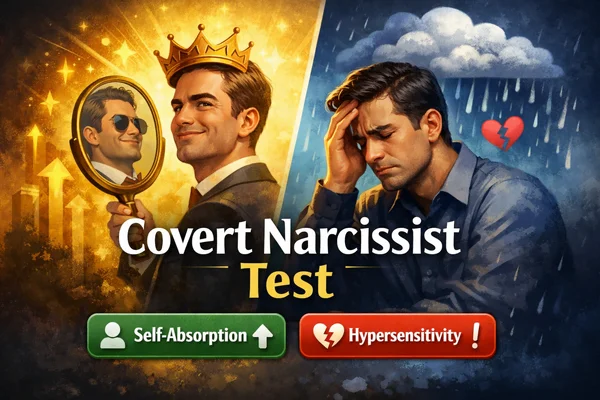
Narcissism is of two types:
- Overt
- Covert1Dipaola, D., Triscio, V., Bosco, E. F., Ferraris, M., & Gandino, G. (2019). A study on narcissism: A comparison between the overt and covert typologies using the Thematic Apperception Test. Minerva Psichiatrica, 17-23.
When we think of narcissists, we usually think of overt narcissists (ON). Overt narcissists openly display their narcissism. They’re usually extroverted, have high self-esteem, and are the loudest person in the room. They tend to be:
- Assertive
- Vain
- Showy
- Arrogant
- High in self-esteem2Rose, P. (2002). The happy and unhappy faces of narcissism. Personality and individual differences, 33(3), 379-391.
Covert/vulnerable narcissists (CN) also desire to be superior to others, but they subtly accomplish this goal. They’re socially inhibited, introverted narcissists.3Mathur, M., Khandelwal, P., Jain, S., & Jain, V. (2022). Guilt and shame proneness in relations to covert narcissism among emerging adults. Ambient Science, 9(1), 31-37. Outwardly, they show a socially acceptable persona to society, but the people closest to them are familiar with their inner, narcissistic side. They are:
- Overly sensitive to criticism4Gupta, P., Tyagi, N., & Sayal, A. (2025, November). Covert Narcissism: A Review of Covert Narcissism and Its Psychological Impact. In 2025 IEEE 7th International Conference on Computing, Communication and Automation (ICCCA) (pp. 1-6). IEEE.
- Prone to playing the victim
- Insecure with low self-esteem5Brookes, J. (2015). The effect of overt and covert narcissism on self-esteem and self-efficacy beyond self-esteem. Personality and Individual Differences, 85, 172-175.
- Passive-aggressive
The test
This test is based on the validated scale of covert narcissism known as the Maladaptive Covert Narcissism Scale (MCNS).6Cheek, J. M., Hendin, H. M., & Wink, P. M. (2013, June). An expanded version of the Hypersensitive Narcissism Scale. In Poster session presented at the meeting of the Association for Research in Personality, Charlotte, NC. It also incorporates research on the two-factor model of CN traits.7Stone, B. M., & Bartholomay, E. M. (2022). A two-factor structure of the hypersensitive narcissism scale describes gender-dependent manifestations of covert narcissism. Current Psychology, 41(9), 6051-6062. The model categorizes CN traits into:
- Self-absorption
- Hypersensitivity
You’ll get a total score on covert narcissism as well as a category-level breakdown of these two factors.
Disclaimer: This quiz is a tool for personal insight, not a clinical diagnosis. It is intended to promote reflection and growth. For a deeper understanding, consider speaking with a licensed therapist or psychologist.



You got a score of %%YOURSCORE%% out of 40

You likely have:
1. Stable self-esteem
2. Balanced self and other focus
3. Low sensitivity to external validation
Recommended tests:

You got a score of %%YOURSCORE%% out of 40
These may appear during:
1. Stress
2. Rejection
3. Comparison situations
You got a score of %%YOURSCORE%% out of 40
Common tendencies:
1. Feeling underappreciated
2. Internal resentment
3. Sensitivity to feedback
4. Subtle self-focus
These traits may affect relationships and emotional well-being.
You got a score of %%YOURSCORE%% out of 40
Likely experiences:
1. Chronic feelings of being misunderstood
2. Strong sensitivity to criticism
3. Hidden superiority and insecurity
4. Emotional withdrawal
5. Resentment
These patterns may significantly impact:
1. Relationships
2. Self-esteem
3. Emotional regulation
Category-level interpretation
| Category | Level | Range (%) | Interpretation |
|---|---|---|---|
| Self-Absorption | Low | 0-30 | You show a balanced focus between yourself and others. You are likely empathetic, considerate, and not overly self-focused. |
| Self-Absorption | Moderate | 31-60 | You may prioritize your own needs and recognition at times. You might occasionally struggle with empathy or validation-seeking. |
| Self-Absorption | High | 61-100 | You tend to be strongly self-focused. You may feel entitled to recognition, struggle with empathy, and find it difficult to take responsibility. |
| Hypersensitivity | Low | 0-30 | You are emotionally stable and resilient. You can handle criticism without taking it personally and are less dependent on validation. |
| Hypersensitivity | Moderate | 31-60 | You may sometimes feel hurt by criticism or overlooked. You might seek reassurance and occasionally feel insecure. |
| Hypersensitivity | High | 61-100 | You are highly sensitive to criticism and rejection. You may feel misunderstood, hold grudges, and experience frequent emotional distress. |
References
- 1Dipaola, D., Triscio, V., Bosco, E. F., Ferraris, M., & Gandino, G. (2019). A study on narcissism: A comparison between the overt and covert typologies using the Thematic Apperception Test. Minerva Psichiatrica, 17-23.
- 2Rose, P. (2002). The happy and unhappy faces of narcissism. Personality and individual differences, 33(3), 379-391.
- 3Mathur, M., Khandelwal, P., Jain, S., & Jain, V. (2022). Guilt and shame proneness in relations to covert narcissism among emerging adults. Ambient Science, 9(1), 31-37.
- 4Gupta, P., Tyagi, N., & Sayal, A. (2025, November). Covert Narcissism: A Review of Covert Narcissism and Its Psychological Impact. In 2025 IEEE 7th International Conference on Computing, Communication and Automation (ICCCA) (pp. 1-6). IEEE.
- 5Brookes, J. (2015). The effect of overt and covert narcissism on self-esteem and self-efficacy beyond self-esteem. Personality and Individual Differences, 85, 172-175.
- 6Cheek, J. M., Hendin, H. M., & Wink, P. M. (2013, June). An expanded version of the Hypersensitive Narcissism Scale. In Poster session presented at the meeting of the Association for Research in Personality, Charlotte, NC.
- 7Stone, B. M., & Bartholomay, E. M. (2022). A two-factor structure of the hypersensitive narcissism scale describes gender-dependent manifestations of covert narcissism. Current Psychology, 41(9), 6051-6062.