
Being a social species, humans crave love, support, and care from others. Since human babies are born helpless and unable to tend to themselves, we have a natural fear of abandonment. Abandonment means being left helpless and unprotected. Having abandonment issues means having a persistent fear of being abandoned in your close relationships.
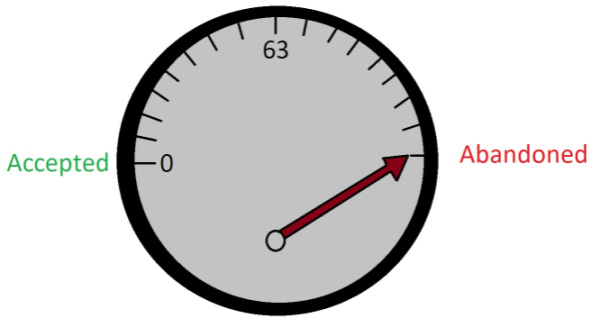
If you suspect you have abandonment issues, take this quiz to measure how your abandonment fears show up through two core patterns:
- Anxiety
- Avoidance
You’ll get a total abandonment issues score and a category-level breakdown of Anxiety and Avoidance.
Disclaimer: This quiz is for informational and self-reflection purposes only. It is not a diagnostic tool. Your results are only shown to you and not stored or shared by us. If you’re experiencing distress or have concerns about your mental health, consult a mental health professional.
Quiz





Signs
Core signs of abandonment issues include:
- Having a hard time forming and maintaining close, healthy relationships
- Feeling insecure in relationships
- A pattern of choosing toxic romantic partners
- Unhealthy communication patterns in relationships
- Getting triggered over small things in relationships
- Overly sensitive to criticism in relationships1Hughes, D. A., Golding, K. S., & Hudson, J. (2019). Healing relational trauma with attachment-focused interventions: Dyadic developmental psychotherapy with children and families. WW Norton & Company.
- Staying in toxic relationships
- Getting overly attached or obsessed with romantic partners
Causes
Since human babies are born helpless and have a natural fear of abandonment, they’re programmed to engage in certain attachment-eliciting behaviors to secure the care of their primary caregivers.2Cundy, L. (2018). Fear of abandonment and angry protest: Understanding and working with anxiously attached clients. In Anxiously attached (pp. 1-30). Routledge.
If the primary caregivers are consistently responsive to the child’s needs and distress, the child develops a secure attachment to their caregivers. This secure attachment regulates the child’s nervous system and promotes a sense of calm.3Viniegra, C. C., & Aumeunier-Gizard, M. F. (2021). Facilitating integrated mental, emotional, and physical states in children who have suffered early abandonment trauma. European Journal of Trauma & Dissociation, 5(4), 100214.
If, for whatever reason (often abuse or neglect), that consistent care and responsiveness is not there, the child typically develops insecure attachment. Which means that their natural fear of abandonment persists into later life and is not soothed by their caregivers. Insecure attachment, which manifests as anxiety or avoidance or as a combination of both, is at the root of abandonment issues.
Thus, people with abandonment issues are insecurely attached.4Fowler, C., & Dillow, M. R. (2011). Attachment dimensions and the four horsemen of the apocalypse. Communication Research Reports, 28(1), 16-26. It’s just a fancy way of saying that they’re anxious about losing their partners. This anxiety makes them behave in irrational ways to ‘preserve’ the relationship. Of course, these fear-based tactics backfire and ruin the relationship.
Impact
How our primary caregivers treat us helps us develop internal working models of other people and relationships. These working models are essentially templates that tell us what to expect from others in close relationships.5Meyer, B., Olivier, L., & Roth, D. A. (2005). Please don’t leave me! BIS/BAS, attachment styles, and responses to a relationship threat. Personality and Individual Differences, 38(1), 151-162.
If our primary caregivers were abusive, we expect our later relationship partners to be abusive. In fact, we seek abusive partners because that fits our inner template for close relationships. It’s our ‘normal’. Everybody has their ‘normal’ for relationships based on their upbringing and psychological makeup.
Clash of normals, and low self-worth
When your normal clashes with the normal of another person, your relationship with that person becomes a hotbed for getting triggered, miscommunication, misinterpretation, and conflict. Your abandonment issues clash with theirs. Persistent conflict in relationships not only decreases well-being but also makes it more likely that the relationship will dissolve.
Also, when you have abandonment issues, you carry this internalized sense of shame that makes you think you’re unworthy of love and care.6Frankel, J. (2024). Treating the sequelae of chronic childhood emotional abandonment. Journal of Clinical Psychology, 80(4), 809-823. This leads you to sabotage your relationships.
All this can lead to low mood, dissatisfaction, or even depression.7Taillieu, T. L., Brownridge, D. A., Sareen, J., & Afifi, T. O. (2016). Childhood emotional maltreatment and mental disorders: Results from a nationally representative adult sample from the United States. Child abuse & neglect, 59, 1-12. Feeling abandoned is one of the factors that leads depressed people to attempt suicide.8Ahmadpanah, M., Astinsadaf, S., Akhondi, A., Haghighi, M., Bahmani, D. S., Nazaribadie, M., … & Brand, S. (2017). Early maladaptive schemas of emotional deprivation, social isolation, shame and abandonment are related to a history of suicide attempts among patients with major depressive disorders. Comprehensive psychiatry, 77, 71-79.
Healing
Healing abandonment issues is all about moving from insecure to secure attachment. The best way, of course, would be to fix your relationship with your original caregivers. However, that’s not an option for many people for a variety of reasons. If you weren’t lucky enough to form a secure attachment with your caregivers, you can still do that in your other relationships. That too will have a healing effect.9Cozolino, L. J., & Santos, E. N. (2014). Why we need therapy—and why it works: A neuroscientific perspective. Smith College Studies in Social Work, 84(2-3), 157-177.
Your childhood trauma has given you the gift (or a curse) of hypervigilance. It’s described as ‘an irrational state of heightened sensitivity to potential threats’.10Gillis, K. (2025). Healing from Parental Abandonment and Neglect: Move Beyond Insecure Attachment to Build Safety, Connection, and Trust with Yourself and Others. New Harbinger Publications. I highly doubt it’s always irrational.
Magnifying glass
Think of hypervigilance as having a magnifying glass in your pocket that you can pull up in front of you and accurately read the intentions and nonverbal cues of other people. You’re highly sensitive to potential threats from people. It’s a survival response to prevent future hurt and abandonment.
But that magnifying glass also distorts and bends things. It makes you see things in a twisted way. You detect threats where there are none. Your insecurity-driven behaviors hurt the people around you. If having abandonment issues is having that glass in front of you all the time, healing is not the opposite- throwing it away. That would be naive. Despite our desire for the world to be a safe place, it is not.
Instead, healing is knowing when to pull out that glass- using it only when you need it. When other people give you a reason to use. It’s starting relationships with the intention and expectations of openness, honesty, and trust. And if that isn’t reciprocated, moving on.