

The word ‘cult’ comes from the Latin cultus, meaning care, cultivation, culture, or worship. A cult has a culture of its own, with a cult leader, usually a male, and followers.1Robertson, H. S. (2024). Coercion, conversion, control: Techniques utilized to recruit and indoctrinate new members into cult organizations. A cult leader and his followers are bound together by shared beliefs, practices, and rituals that are considered deviant by a society’s mainstream belief systems.
We see the leader-follower dynamic everywhere in society, from political systems to business organizations. What separates a cult from other groups with leaders and followers?
The answer: harm.
Cult leaders, unlike other leaders, eventually incur some kind of harm to their followers. This harm may or may not be intentional. A cult leader may genuinely believe what he believes and draw followers in with his convincing power. Other cult leaders aren’t so delusional. They’re manipulative and know full well they’re conning their followers.
Who forms a cult and why?
As I said, there isn’t much difference between cult leaders and conventional leaders. The only difference lies in the harm that cults tend to cause. So, cult leaders have the same leadership qualities that other leaders have that make them successful.
To understand the psychology of a cult leader, you have to think of them as someone trying to boost their status in society by projecting dominance. Status and dominance often go hand in hand. This is true for both animal and human communities.
Males have a lot to gain by raising their status. Doing so helps them gain better access to resources and potential mates. This explains why almost all cult leaders are men.
Now, there are two ways for men to gain status. The slow and long path of hard work and success, or the quick path of projecting dominance.
Why does projecting dominance work?
Projecting dominance, confidence, and charisma has a magnetic effect. It makes people believe you’re high status. People want to follow those who have confidence and firmly believe what they believe. People believe that by following a dominant alpha male, they’ll somehow raise their own status, better their lives, and be better off than rival human groups.
The result?
Usually, it is the cult leader, not the cult followers, who ends up in a better place. As soon as he gets a decent following, the cult leader’s real motives come to the fore: status, power, riches, and sexual access to females.2Tobias, M. L., & Lalich, J. (1994). Captive hearts, captive minds: Freedom and recovery from cults and abusive relationships. Hunter House Publishers.
A cult leader can project dominance in several ways. Some project intellectual dominance, with intelligent and revolutionary beliefs and ideas. Others project dominance through charisma and the mere conviction they have in their beliefs.
Cultish behavior can also be seen on social media, where some influencers display dominance and arrogance. They frequently share controversial views to gain a cult-like following.
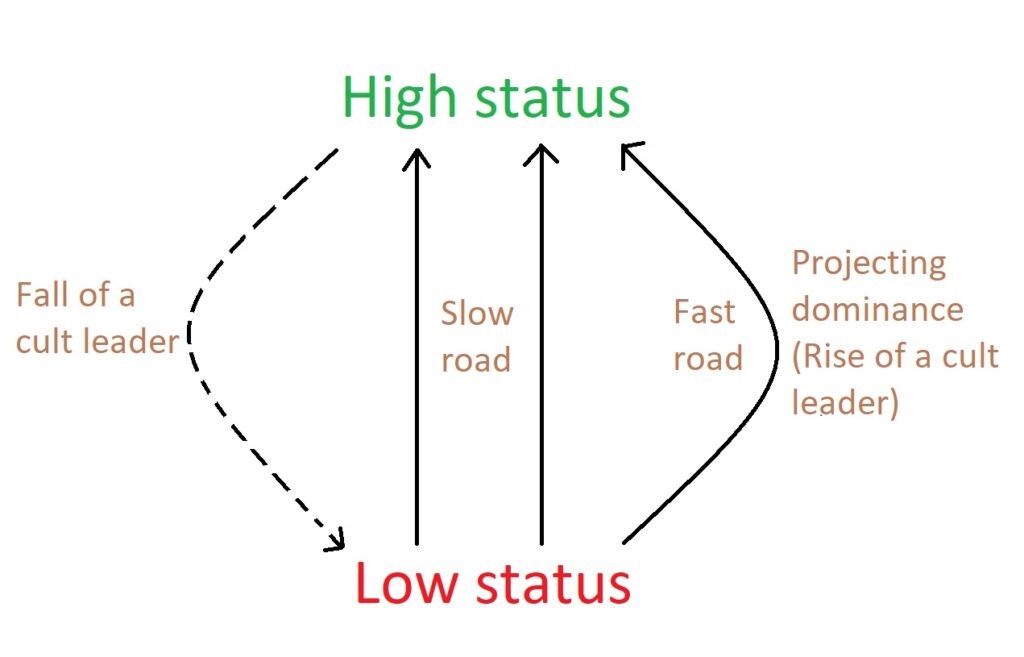
The slow road to high status is more likely to last than the quick road. The faster the cult leaders rise, the faster they may fall. Cults can’t grow too big, or they threaten the fabric of society. Even if what constitutes the fabric of society were cults once.
Characteristics
Cult leaders tend to have certain personality traits that enable them to attract and influence their followers. In this section, we’ll see what those traits are and what strategies and techniques are enabled by them that influence and manipulate cult followers. The intention is not to diagnose or label leaders. The goal is to help you understand patterns of psychological influence.
Traits and techniques of cult leaders should be understood together because they work together.
1. Grandiosity
Cult leaders believe they’re special and are on a special mission to lead humanity to the light. They have fantasies of unlimited success and power. They’re constantly seeking the admiration of others and enjoy being the center of attention. They believe they’re ‘chosen’ for a special mission. Since they project this image of being perfect and superior in every way, they have trouble accepting mistakes.
Enabled influence techniques
- Seeing oneself as the ultimate authority
- Demanding unquestioning loyalty
- Framing dissent as ignorance, betrayal, or moral failure
- Positioning oneself above normal rules or accountability
When you see someone as superior, following them seems a natural thing to do. Like other social primates, humans are wired to follow those higher in the pecking order.3Best, J. V. C. (2018). Cults: A psychological perspective.
2. Lacking empathy
Cult leaders tend to show little or no empathy for others’ emotional suffering. They don’t take responsibility for the harm that they cause. They treat people as tools to be used rather than as humans to relate to. It’s not surprising that the common personality traits seen in cult leaders include:
- Narcissism
- Psychopathy
- Antisocial personality disorder4Greenidge, C. (2021). The Making of Cults: The Factors that Contribute to Membership and the Leaders’ Influence.
Enabled influence techniques
- Exploitation
- Emotional manipulation
- Justifying harm as necessary
Cult leaders may ask their followers to engage in morally questionable behaviors, all in the name of a ‘higher purpose’ or ‘greater good’. Physical, financial, or sexual exploitation is rationalized and framed as discipline or spiritual necessity. Intelligent cult leaders exploit their followers in a way that the followers don’t even see as exploitation.
For instance, a cult leader may demand sexual access to female followers, making a ridiculous claim such as “This will purify our souls” or “It will bring us to a higher plane of existence”.
3. Strategic deception
Cult leaders tend to be experts at understanding others’ deepest needs, insecurities, and vulnerabilities. They know exactly what image to project and what words to use that will resonate with the followers. They have no problems with lying and dishonesty.
Enabled influence techniques
- Gaslighting
- Information control
- Rewriting events or histories
- Framing contradictions as misunderstandings
Cult leaders pull their followers into this shared reality where ideas, opinions, and beliefs get reinforced, like an echo chamber.5Earnest, A. (2024). Manipulation: Methods employed by Cult and Religious Leaders to Exploit Followers. They remove or limit access to information that may contradict their claims. If something happens that contradicts the shared reality, it’s gaslighted away and seen as a lack of comprehension. If an outsider questions their beliefs and practices, they will say, “It’s beyond your comprehension.”
4. Paranoid thinking
Cult leaders divide the world into “Us vs Them”, “Enlightened vs Ignorant”, “Loyal vs Traitor”. They have to do this because having a common enemy strengthens group cohesion.
Enabled influence techniques
- Outsiders framed as dangerous or corrupt
- Encourage isolation from ‘Them’
By making their followers believe they are under threat from outgroups, they’re able to mobilize the followers to fight the outgroups and the defectors.
5. Emotional insecurity
The behavior of cult leaders seems overcomensatory. They’re likely over-compensating for an internalized sense of insecurity and shame.6Them, T. F. Y. S. K., Authority, C., Custody, C., Religion, C. C. F. F., Church, C. A., Ritual, C., … & Know, C. W. C. S. (2003). Traumatic abuse in cults: A psychoanalytic perspective. Cultic Studies Review, 2(2), 101-129. A childhood experience of parental abandonment, chronic and overwhelming narcissistic injury is commonly observed in cult leaders.7Olsson, P. A. (2017). Malignant Pied Pipers: A Psychological Study of Destructive Cult Leaders from Rev. Jim Jones to Osama bin Laden. Strategic Book Publishing & Rights Agency.
Something happened in their past that made them see themselves as less than others. So to make up for it, they bolster their self-image and project it to others. They develop a strong need for external validation and are overly sensitive to rejection or embarrassment.
Enabled influence techniques
- Projecting their need for being special onto followers
- Making followers extensions of themselves8Singer, M. T., & Lalich, J. (1995). Cults in our midst: The hidden menace in our everyday lives. San Francisco: Jossey-Bass.
- Creating dependency in followers by dictating rigid rules for all life areas
Thanks to a cult leader’s wounded self, they want to bolster their ‘self’ so much that it fills them up and overflows into other people. The whole endeavour can be seen as one of self-expansion. Cult followers are essentially copies of the cult leader. They want to be like their leader. Of course, this erodes their true self, if they ever bothered to look for their true self at all.
6. Sensitivity to criticism
This again boils down to a fragile self-esteem masked by confidence. Criticizing the cult leader is not mere criticism. It’s challenging their self-proclaimed superiority and authority. Since their self already has a shaky foundation, it can crumble with the slightest criticism. The reaction? Disproportionately extreme or even violent.9Meloy, J. R. (2006). Empirical basis and forensic application of affective and predatory violence. Australian & New Zealand Journal of Psychiatry, 40(6-7), 539-547.
Enabled influence techniques
- Discouraging criticism
- Publicly shaming critics
- Framing criticism as betrayal or moral failure
Critics are seen as someone who just don’t get it. They’re seen as wilfully ignorant people and morally inferior. Silencing dissent protects the cult leader’s self and public image.
7. Charisma
Charisma is the ability to draw people to you with your charm, strong communication skills, and personality. Cult leaders tend to be highly charismatic and inspirational. They paint a vision in the minds of their followers of a utopia, a better life, and the followers are mesmerized, keen to believe that their charismatic leader will lead them to glory.10Grabo, A., & van Vugt, M. (2016). Charismatic leadership and the evolution of cooperation. Evolution and Human Behavior, 37(5), 399-406.
Enabled influence techniques
- Rapid recruitment into the cult
- Emotional bonding before critical evaluation
- Creating a sense of meaning and belonging
Charisma is not harmful per se, but when combined with the desire for power and control can be an effective tool to bypass skepticism and accelerate attachment.
8. Certainty
Since the future and many other things in life are uncertain, people crave uncertainty. This craving is satisfied by an excessively certain cult leader who has answers to all of life’s questions and uncertainties.11Goldberg, L. (2012). Influence of a charismatic antisocial cult leader: Psychotherapy with an ex-cultist prosecuted for criminal behavior. International Journal of Cultic Studies, 3(1), 15-24.
Enabled influence techniques
- Claiming exclusive access to truth or solutions
- Grand promises of transformation or salvation
Especially during times of stress, people tend to be vulnerable to overreliance on absolute certainty.
9. Dominant
As discussed earlier, projecting dominance is key to becoming a cult leader. Nobody wants to follow a submissive leader unsure of himself.
Enabled influence techniques
- Monitoring behavior or beliefs
- Enforcing conformity
- Information control
- Demanding obedience
Cult leaders tend to control every little aspect of their followers’ lives. What to wear, what to eat, what to say, what not to say, what to think, and so on.12MIMOUNE, S. (2024). Beyond the Veil: Unraveling Cult Dynamics, Manipulation Strategies, and Societal Impact in Jon Krakauer’s” Under the Banner of Heaven”. This is done to keep the followers in line and reinforce their low status and low power.
A big part of dominance is putting down other dominant figures of society so you can look better than them. This is why politicians, who share many traits with cult leaders, demonize, belittle, and defame their competitors, which goes hand-in-hand with fostering an ‘Us vs Them’ mentality.
10. Persuasive
Cult leaders are excellent marketers. In fact, many marketers and salespeople behave a lot like cult leaders. They have to, or they won’t be able to attract attention and look convincing. They know what makes people tick and how to cater to their followers’ basic needs.
Enabled influence techniques
- They advertise a ‘higher purpose’
- They prey on fear (“The sky is falling. Join us and be safe.”)
Cult leaders, savvy marketers, and advertisers appeal to what’s called the peripheral route information processing. These are our subconscious, automatic reactions to stimuli. For example, to sell a drug, a drug company might get a guy in a white coat to tell you how beneficial the drug is. You notice the guy’s appearance and automatically trust him because he looks like an authority figure. Similarly, a cult leader may wear la ong and shiny hat or robe to convey ‘authority’.
All groups have cultish tendencies
A group can quickly become cult-like when there’s excessive admiration and adoration for the group leader. Being part of a group and following a group leader in hopes of reaching the promised land of high status and bliss is a deep-rooted desire of human nature.
It stems from ancestral times when humans lived in patriarchal groups and fought rival, genetically dissimilar human groups for land and other resources.13Van Vugt, M., & Schaller, M. (2008). Evolutionary approaches to group dynamics: An introduction. Group Dynamics: Theory, Research, and Practice, 12(1), 1. But this primal tendency has caused, and continues to cause, many problems for humanity.