

Dreams are a reflection of our waking concerns.1Cartwright, R., Agargun, M. Y., Kirkby, J., & Friedman, J. K. (2006). Relation of dreams to waking concerns. Psychiatry research, 141(3), 261-270. What goes on in our psychic life is what we see in our dreams. When I say ‘psychic life’, I mean thoughts and emotions, especially emotions.
Running away from someone or something is a common dream theme. They’re a type of ‘being chased‘ dream that people often see. Indeed, ‘being chased’ is the most common type of recurrent, negative dream.2Zadra, A. (1996). Recurrent dreams and their relation to life events and well-being. Trauma and dreams, 231-247.
Why so common?
When we’re stressed, our ancient fight-or-flight mode gets activated. Dreaming about running away is the dream version of being in flight mode. Running away from threats is so fundamental to animal life that this survival response is present in almost all animals.
Our mammalian ancestors regularly fled from predators and hid in caves and burrows. Only when the dinosaurs got wiped away did mammals get a chance to come out and flourish in the open. So, running away and hiding from a threat is a way we’re wired to deal with the stresses and dangers of life.

‘Running away’ dreams = threat avoidance
Dream interpretation can be of two types: direct or symbolic. Direct dream interpretation is when the dream figures you see in your dreams represent themselves. For instance, if you felt afraid seeing one of those ‘animal attack’ documentaries, the fear may spill over into your dream. You might dream of running away from a wild animal. This dream has a straightforward interpretation. The fear you experienced in waking life got expressed in your dream.
Symbolic dream interpretation is trickier. In some dreams, what we see are symbols for something else. For instance, the mind has no way to represent work-related stress. You feel it in your waking life, but your mind doesn’t know how to represent stress in the dream. So, you may dream that you’re running away from a wild animal or ghost. That wild animal or a ghost represents stress.
At their core, ‘running away’ dreams are threat-avoidance dreams. Something in your waking life has activated your flight mode. You’re trying to escape something. Most likely, the threat is too big. You can’t face or fight it.
When interpreting such dreams, you must gather as many details from your dream as you can- writing your dreams down helps.
- How did you feel?
- Who were you running away from?
- Where were you going?
- How did the dream end?
Dreams are highly subjective, and knowing these details can help you interpret your dream in a way that best applies to your unique situation.
Common feelings in such dreams
Pick what applies to your unique situation for better interpretation:
- Fear
- Anxiety
- Stress
- Frustration
- Guilt
- Shame
- Overwhelm
- Panic
- Helplessness
- Powerlessness
- Desperation
Possible interpretations
Let’s now look in detail at the possible interpretations of ‘running away’ dreams. I’ll start with the most direct interpretation and then move to more symbolic meanings.
1. Avoiding someone
Mostly, dreams reflect your waking-life concerns and anxieties. So, if you’re running away from a person in your dream, you likely want to avoid that person in real life. You see that person as a threat. It could be an abusive boss or a lover, a manipulative parent or a friend- any person who’s causing you emotional pain.
Since dreams usually represent our suppressed or half-expressed emotions, you’re likely to see this dream if you have doubts about a person. You might be ambivalent about them. In such cases, your subconscious tries to ease your doubts by ‘confirming’ that the person is indeed a threat using your dream.
The key idea here is that dreams often result from emotional leakage. The emotion you're suppressing in waking life, for whatever reason, leaks out in the dream. In case of an abusive lover, your love for them may motivate you to suppress the fear they cause in you.
2. Avoiding yourself
Just as it’s hard to face the things we don’t like about ourselves when we’re awake, the same is true when we’re dreaming. If that someone you’re running away from in your dream doesn’t represent any real threat, you could be running from yourself.
These are dreams of projection where we project our negative traits onto other people. That someone you’re hiding from may have qualities that you don’t like in yourself. Instead of dreaming that you’re running away from yourself (a rare dream), it’s easier for your subconscious and ego to project those traits on someone you know or a stranger.
You can best interpret such dreams by focusing on the negative traits of the person you were running from. Then, ask yourself if you have the same negative characteristics.
3. Stress
If your financial condition or relationship stresses you out, your mind doesn’t know how to represent these abstract threats. So, it resorts to the most ancient dynamic it knows- the fight-or-flight mode to communicate feeling threatened in the dream. Your financial situation or relationship is causing you stress and triggering your flight mode.
Your mind doesn’t always equate running away with fear or stress. If you went through a period of significant stress in the past, then your subconscious may ‘borrow’ the scenes from those experiences to construct your current dream imagery.
It’s known that Vietnam veterans suffering from PTSD have negative dreams about war. What many don’t know is that they also saw war dreams when experiencing distress in their personal lives, such as marital issues.3Moffitt, A., Kramer, M., & Hoffmann, R. (Eds.). (1993). The functions of dreaming. State University of New York Press. Their minds had an advanced template for representing or communicating ‘stress’ than the basic ‘fight-or-flight’ template.
4. Wish to escape
Maybe you’re not stressed by your current life situation. You just don’t like it and want to escape. You feel your current responsibilities trap you. Your sense of freedom has been compromised. These feelings can also trigger ‘running away’ dreams. Such dreams don’t reflect the desire to escape from a threat as much as a desire for freedom. For instance, escape dreams were common for British prisoners of war for obvious reasons.
In the Freudian view of dream interpretation, wish-fulfilment is a central tenet.
5. Guilt and shame
The hiding part of ‘running away’ dreams could be about guilt and shame. Fear of being exposed as a fraud, incompetent, lacking confidence, or a fake could also trigger such dreams. If you’ve been shunned recently, such dreams may reflect feelings of disconnection and alienation.
You may feel guilty in your waking life because you harmed someone. That someone may chase you in your dream, seeking retribution. Or you may dream that an authority figure, like a police officer or priest, is chasing you. They want to catch you for the wrong you did.
6. Fear of change
Such dreams may also reflect a fear of change and improving yourself. Maybe you recently got a chance to make a significant change in your life, but you missed it. Perhaps you repeatedly find yourself falling back on old habits.
Change is stepping into the unknown, which can be uncomfortable and scary. Dreaming about running away could mean you’re running from an unknown and frightening future. Again, the mind doesn’t know how to represent ‘uncertain future’ in the dream. So it might use the image of a stranger, a ghost, or a monster.
7. Unresolved emotions
So far, we’ve been talking about how ‘running away’ dreams represent the current threats that you might be facing in your waking life. Some of those current threats may actually be past threats. If you’ve experienced past trauma, then the unresolved and unprocessed emotions from that event may get reflected in your dreams.
Usually, something during the day might have triggered you and brought back those painful memories. But that’s not always the case. You might get dreams related to your traumatic experiences long after, and without encountering trauma triggers. It’s because you keep revisiting these emotions beneath your awareness. Many of our dreams are about such emotional hang-ups and unfinished personal businesses.
Pay attention to recurring 'running away' dreams. They're likely to be traumatic in origin.
Coping
Interestingly, the intensity with which you feel a negative emotion in a negative dream correlates to how intensely you feel that emotion in waking life, which, in turn, correlates to the severity of the threat in waking life. That means the worse you feel in the dream, the worse your problem in waking life is.
After seeing such a dream, it’s a good idea to write about what you saw in detail. Maybe talk to a friend. If the dream was very distressing, talking to a professional is recommended. Once you wrap your head around the meaning of such a dream, think about what problems you need to solve in your waking life.
Are these problems related to your present or past? Are they a concern about the future?
Once you resolve the problem or take care of the threat in your waking life, your dreams will change accordingly. When you make progress toward solving the problem, the intensity of your dominant negative emotion will decrease.4Rapaport, J. (2021). The Past is Never Dead: A Qualitative Analysis of Recurrent Dreams (Doctoral dissertation, Adelphi University). When you completely solve the problem, such recurrent dreams will go away.
Real-life example
While researching this topic, I found a great example on a forum that captures everything discussed so far:
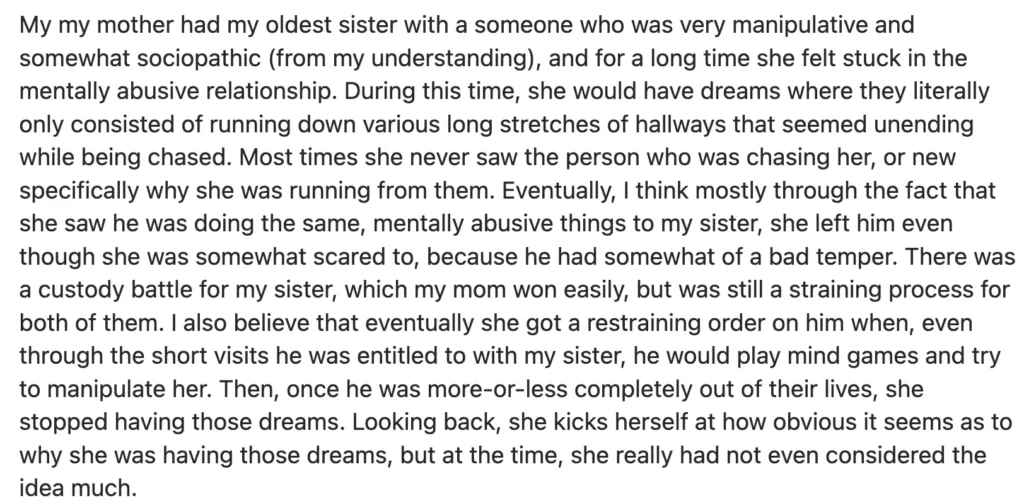
Notice how her subconscious mind hid from her who the chaser was. It would’ve been too painful to acknowledge that the threat was coming from someone so close. The ambivalence I talked about earlier. Her mind could’ve used a symbol for her partner but decided not to use any. Hence, only the sense of ‘being chased’ or ‘looming threat’, but not knowing who or what the threat is.
Had she interpreted her dream in time, things would’ve probably been better for her. Anyway, this is a good example of why we should pay attention to the messages of our subconscious mind.