

The ‘hands clasped in front’ body language gesture is displayed in three major ways. Clasped hands in front of the face, hands clasped on a desk or a lap, and, whilst standing, hands clasped over the lower abdomen.
When a person assumes this gesture, they are exercising some sort of ‘self-restraint’. They’re symbolically ‘clenching’ themselves back and withholding a negative reaction, usually anxiety or frustration.
The higher the person clenches their hands whilst standing, the more negative they are feeling.
People often assume this gesture when they cannot convince the other person. Also, when they are anxious about what they’re saying or hearing. When you’re talking to them, try moving the conversation in a different direction, or ask questions.
This way, you can at least break the person’s negative attitude if it’s present.
Body language of clasping hands below the belt
Those who feel vulnerable in a situation but are expected to show confidence and respect may clasp their hands over their crotch or lower abdomen.
By covering up the crotch or the lower abdomen, the person feels secure and confident. Therefore, people commonly confuse this gesture with confidence. Confidence may be the product of this gesture, but it’s definitely not the cause.
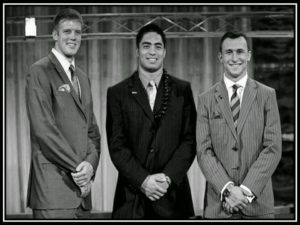
For instance, football players display this gesture when they’re listening to their national anthem to pay their respects to the anthem. Inside, they might feel vulnerable, given there are thousands of eyes on them.
This gesture is also commonly observed when leaders and politicians meet and stand to pose for photographs. You might also see this gesture when a priest delivers a sermon or any other social meeting, presided over by an authoritative figure.
Hands clasped behind the back
Think of a headmaster inspecting school premises, a policeman patrolling the beat, and superiors giving instructions to subordinates. They often clasp their hands behind their backs. Authoritative figures display their authority using this gesture.
This gesture communicates the message, “I feel confident and secure. I’m in charge of the affairs here. I am the boss”.
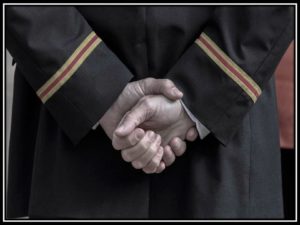
The person exposes his full-frontal portion of the body without needing to protect the throat, vital organs, and the crotch. In evolutionary terms, the person has no fear of attack from the front and is, therefore, displaying a fearless and superior attitude.
Clasping the wrist/arm behind the back
This is again a self-restraint gesture, done when a person tries to hold back a negative reaction. By clasping the wrist or arm behind the back, they achieve some degree of self-control. It is as if the gripping hand is preventing the other hand from striking out.
So we can say that the person who needs to ‘get a good grip on himself’ does this gesture. The person doesn’t want to display a negative and defensive attitude toward people. That’s why this gesture happens behind the back.
If the person brought their hands to the front and crossed their arms around the chest, people would easily figure out that reaction.
In other words, it is an arm-cross defensive gesture, but behind the back. The higher the person clasps his other arm, the more negative they’re feeling.
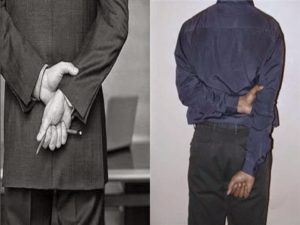
Say a boss is giving instructions to some newly employed juniors. He clasps his hands behind his back most of the time. What if a colleague arrives on the scene and also starts giving instructions?
The boss, who was already present on the scene, may feel threatened, which might challenge his superior position. So he may start holding the wrist behind his back, not his hand.
Now, what if the president of the company arrives on the scene and rebukes the colleagues-the instructors, saying something like, “Why are you wasting time giving instructions? They already read them in the job profile. Start assigning them some actual projects.”
At this point, our superior, who was gripping the wrist, might clasp his arm at a higher position because his superiority has been threatened further.