
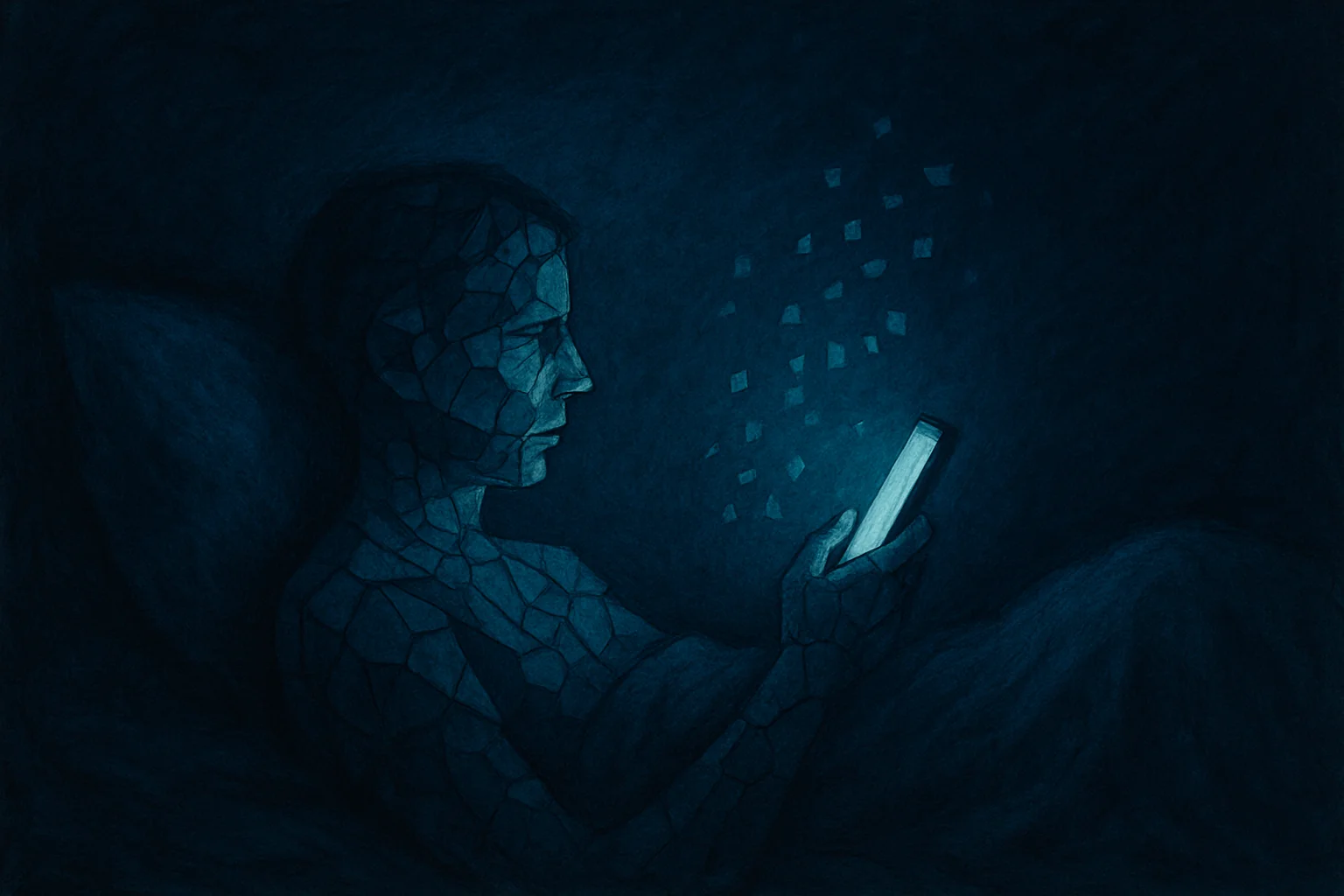
It’s been days since you’ve had a proper night’s sleep. You promise yourself that tonight’s going to be the night when you finally sleep on time so you can wake up early tomorrow. When tonight comes, you find yourself lying in bed, way past your planned sleep time. As you scroll past another social media reel, you help yourself to a snack. Soon, it’s 4 AM. You get a quick 2-3 hour sleep and wake up feeling groggy.
If something like this has happened to you, you’re not alone. Gen Z coined the term ‘bed-rotting’ for this behavior, which became common during lockdown. There was even a trend on TikTok where people shared their bed-rotting experiences, and many resonated.
The definition
Bed-rotting is spending excessive amounts of time, hours, or even days, lying in bed but not sleeping, but engaging in activities like:
- Social media scrolling
- Streaming movies or shows
- Snacking
Those sound like fun activities. Why call it ‘rotting’? I think the phenomenon is aptly named because even fun things, in excess, create a feeling of physical and mental decay. Doing fun things excessively is the very definition of addiction. Like other addictions, in the long run, bed-rotting can also create more harm than any short-term good that it brings.
Self-care or self-harm?
The bed-rotting trend sparked a debate on whether or not it’s self-care. Bed-rotters claimed that the practice helped them de-stress after a long day. It was seen as a defiance of the ‘hustle culture’ that promotes extreme and toxic productivity.
Bed-rotting in itself is not a diagnosis. It’s a behavior. Only you can decide whether or not it’s good for you. Having a background in Psychology and years of experience researching the field, I’ll argue that it causes more harm than good. It may be okay, even self-care, when done moderately. But I’ll explain later why it’s hard, if not impossible, to do it moderately. Your own experience has probably already taught you that.
Like other addictions, when bed-rotting becomes so excessive that it interferes with your daily life activities, self-care practices, and the pursuit of goals, it becomes a problem.
You might be asking now:
“How bad can it really get?”
Bed-rotting and depression: The connection
The early warning signs that bed-rotting is getting out of hand are when it:
- Becomes excessive
- Feels out of control
- Creates distress
- Causes guilt or shame
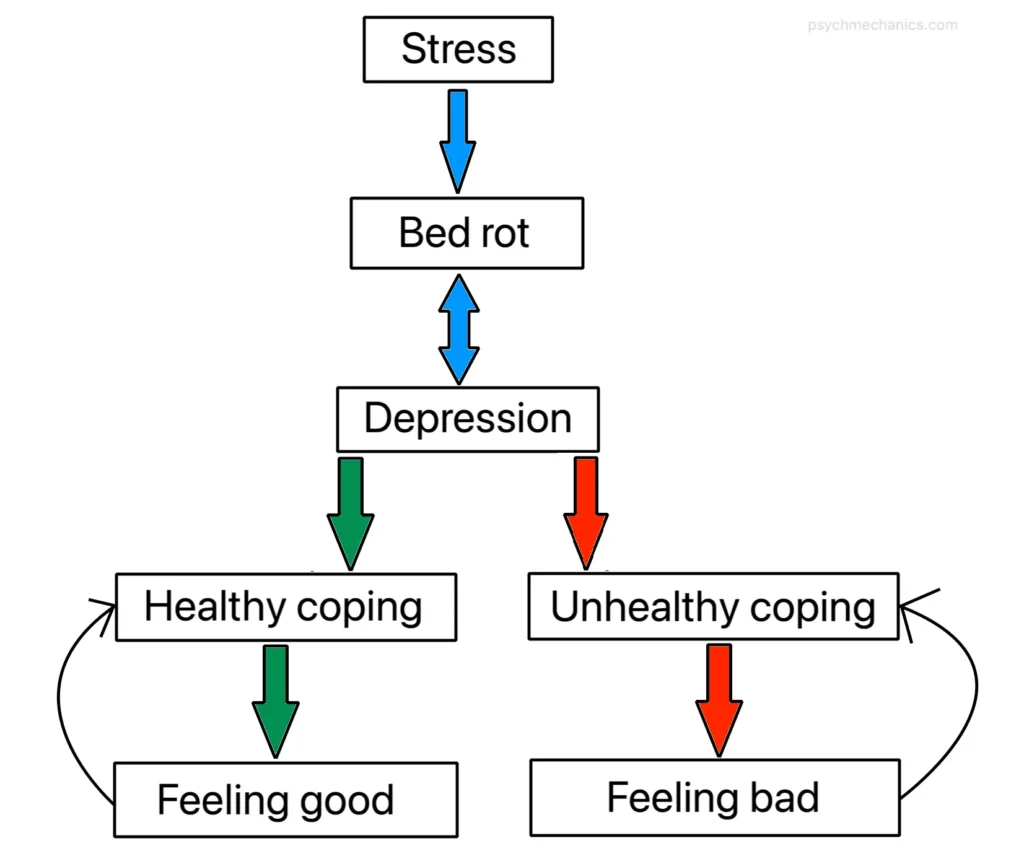
At such a point, you know it’s gotten out of hand, and many just surrender to it as it gets worse. You may have bed-rotted because you wanted to de-stress, but now it’s causing you distress. Distress often leads to more unhealthy behaviors (like bed-rotting), which leads to more distress, a vicious negative cycle that’s likely to induce depression.
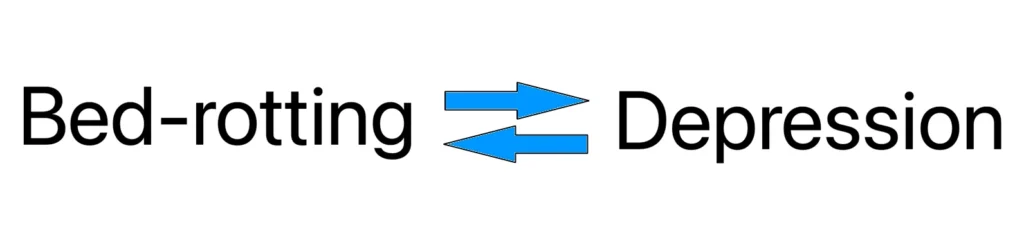
Bed rotting and depression have a bidirectional relationship. They can lead to each other. You may be experiencing chronic stress due to a significant life problem that induces depression. Depression significantly lowers your energy, and is known to make you feel unmotivated to get out of bed.
On the other hand, not getting out of bed and not doing your daily activities, not meeting basic needs, and not pursuing goals also lead to stress as well. And when that stress becomes chronic, you can fall into depression. So even if you bed-rot with no depression, you’re likely to get there. It’s just a matter of time if your behavior continues.
Overlap with depression
It’s no wonder then that bed-rotting looks a lot like depression. Bed-rotting behaviors check 5 of the 9 core depression symptoms:
1. Loss of interest or pleasure ✅
When you stay in bed for prolonged periods of time, you’re uninterested in doing the things you previously enjoyed, like hobbies.
2. Fatigue or loss of energy ✅
Feeling too emotionally drained to get out of bed is the hallmark sign of depression.
3. Sleep disturbances ✅
Bed-rotting with excessive screen time disrupts the sleep cycle by suppressing melatonin, the hormone that signals it’s time to sleep.1Nakshine, V. S., Thute, P., Khatib, M. N., & Sarkar, B. (2022). Increased screen time as a cause of declining physical, psychological health, and sleep patterns: a literary review. Cureus, 14(10).
4. Impaired concentration ✅
When you bed rot, you don’t have the mental energy to focus or start a task. Your brain feels foggy. You may be unsure about what to do, so you do nothing. This highly overlaps with something called executive dysfunction in depression.2Wegmann, E., Müller, S. M., Turel, O., & Brand, M. (2020). Interactions of impulsivity, general executive functions, and specific inhibitory control explain symptoms of social-networks-use disorder: An experimental study. Scientific reports, 10(1), 3866.
5. Psychomotor retardation ✅
While bed rotting, you feel drained not only mentally but physically as well. It’s hard to draw the line between the two. Your body movements become slow and sluggish. You not only don’t have the mental energy to do something, but also lack the physical energy to do it.
Bed-rotting alone may not cause them, but when you experience bed-rotting-induced depression, you may also experience the remaining depression symptoms:
- Depressed mood
- Changes in weight/appetite
- Feeling of worthlessness/guilt
- Thoughts of death/suicide3Dresp-Langley, B., & Hutt, A. (2022). Digital addiction and sleep. International journal of environmental research and public health, 19(11), 6910.
More findings linking bed rotting to depression & anxiety
- More time in bed is associated with more depression.4Lorenz, N., Sander, C., Ivanova, G., & Hegerl, U. (2020). Temporal associations of daily changes in sleep and depression core symptoms in patients suffering from major depressive disorder: idiographic time-series analysis. JMIR Mental Health, 7(4), e17071.
- Heavy social media use during a bed rest session not only increases the incidence of depression, but also of anxiety.5Aysi, A. M. T. N., Firdaus, A. R., Pangestu, S. M., & Utomo, H. B. (2025, June). Short-Form Content, Brain Rot, and Bed Rot: A Literature Review of the Impact on University Students. In Proceeding of International Conference on Social Science and Humanity (Vol. 2, No. 3, pp. 767-776).
- Sleeping less and sleeping late predict higher anxiety and depression the next day.6Nota, J. A., Chu, C., Beard, C., & Björgvinsson, T. (2020). Temporal relations among sleep, depression symptoms, and anxiety symptoms during intensive cognitive–behavioral treatment. Journal of Consulting and Clinical Psychology, 88(11), 971.
Weakened cognitive control = Root of all evil
Passive behaviors like social media and watching TV are linked to increased intake of junk food.7Ameer Arsalan Hadi, P. (2021). Nutritional status and sedentary lifestyle of individuals a review. International Journal of Modern Agriculture, 10(2). Junk food increases impulsivity by decreasing serotonin levels in the brain. Increased impulsivity leads to decreased or weakened cognitive control means you find it hard to resist temptations.
Hence, such addictive behaviors usually occur in cycles. You do one bad habit like bed-rotting, and it makes it easier to do other bad habits. It’s a downward spiral.
Self or cognitive control is like a muscle. When you bed rot, you weaken this muscle. When self-control gets eroded by a single addictive behavior, like bed rotting, it leads to other excessive behaviors.8Zahrai, K., Veer, E., Ballantine, P. W., de Vries, H. P., & Prayag, G. (2022). Either you control social media or social media controls you: Understanding the impact of self‐control on excessive social media use from the dual‐system perspective. Journal of Consumer Affairs, 56(2), 806-848. Resisting those other temptations requires self-control, which was already knocked out by the first behavior. It’s a domino effect. This is why I don’t recommend moderation when it comes to addictive behaviors. It’s much better to cut them out completely.
What to do about it?
Forget all the opinions, hot takes, trends, and research. Forget everything you read in this article and ask yourself:
How does bed rotting feel to me?
If it feels like rest, relaxation, and rejuvenation, you probably have nothing to worry about. If it feels like you’re decaying, turning into a zombie, then change is required. Write down in detail how you feel on paper or print it out. Write:
- What triggered it
- How you behaved
- How it felt
- The negative outcomes
You now have tangible evidence of the negative effects of bed rotting that increases awareness making cognitive control more likely. Next time you’re tempted to bed rot, your mind will recall this evidence and exert mental brakes upon your behavior.
Bed rotting vs Self-care: Key differences
| Category | Bed Rotting | Self-Care |
|---|---|---|
| Purpose | Escaping, avoiding or numbing out difficult emotions. | Emotional regulation, facing difficult emotions. |
| Emotional state | Overwhelmed, anxious, or depressed. | Calm, positive, energized. |
| Mental clarity | Mental fog, indecisiveness, impaired focus. | Increased clarity, decisiveness, and focus. |
| Functioning | Interferes with daily functioning; delays tasks. | Helps functioning; makes tasks easier afterward. |
| Behavior | Unhealthy, repetitive, hard to stop. | Healthy, easy to stop when done. |
| Sleep | Poor sleep. | Quality sleep. |
| Long-term effect | Weakened cognitive control, worsened mental health. | Strengthened cognitive control, improved mental health. |
Change your environment
Sure, you’re responsible for your behaviors. But the environment often has a greater impact on behavior than most people acknowledge. Put simply, our bodies and brains were not designed for modern life. The mismatch between what our bodies and brains evolved for and the environment we experience today is at the root of not only physical diseases but also mental disorders.9Hoogland, M., & Ploeger, A. (2022). Two different mismatches: integrating the developmental and the evolutionary-mismatch hypothesis. Perspectives on Psychological Science, 17(6), 1737-1745.
Modern artificial products like junk foods and social media are deliberately engineered to be addictive.10Goodwin, B. C., Browne, M., & Rockloff, M. (2015). Measuring preference for supernormal over natural rewards: A two-dimensional anticipatory pleasure scale. Evolutionary Psychology, 13(4), 1474704915613914. That means even self-control can’t do you much good when the reward systems of your brain are hijacked by these products.
So you can forget about those apps that promise to help you control excessive social media scrolling during bed rotting. They create a ‘cake in the fridge’ effect where, even though you can’t see the cake, you know it’s in the fridge. The temptation is still there and exerting a pull on your mind. Deleting the social media apps from your phone can be counted as truly changing your environment.
Strengthen cognitive control
When you’re stressed and experiencing negative emotions, it’s tempting to de-stress yourself with cheap dopamine of bed rotting and associated activities. But it’s a black hole you want to avoid. Instead, you can engage in healthier, non-addictive coping behaviors like journaling, going for a walk, doing hobbies, etc. Even though they don’t release as much dopamine, they’re better for your well-being in the long run.
Modern artificial products make you feel good in the short term, but can wreck your life in the long term. In contrast, the more you engage in healthy coping mechanisms, the more you’ll strengthen cognitive control. Higher cognitive control means more planned behavior, less giving in to temptations and impulses, and more feeling good.
Final words
You must acknowledge how bed rotting makes you feel. Those negative emotions are nothing but signals from your mind asking you to stop the self-harm. The anxiety that people feel when they bed rot can make them come up with defenses and rationalizations for their behavior:
- “I work so hard- I deserve this.”
- “This is totally normal. Social media says so.”
- “It’s only a few hours, not a big deal.”
- “It’s important for nervous system regulation.”
- “I prefer staying in bed.”
- “Tomorrow, I’ll become a new person.”
It’s not about whether these statements are true, but about how the mind protects itself from anxiety and overwhelm by rewriting the narrative. How it gives you permission to bed rot.
Look at these comments posted by a couple of TikTok users in response to an “I’m bed rotting, and it’s good” post:

These comments reveal a certain cognitive dissonance going on in the minds of the commenters. Think about it- If bed rotting were truly self-care, they wouldn’t need to validate it socially. People rarely look for social validation when they take a walk or pursue a hobby. Validation as in:
“I want to see other people doing this so I know I’m not the only one or wrong.”
You bed-rotted and probably felt bad, which is how the mind works. It has to warn us of negative behaviors, or we might do them endlessly. You then found someone else, in fact, hundreds and thousands of people, who do the same thing. You feel better knowing you’re not alone. If you were doing something healthy, you’d not need to feel better via social validation. The healthy behavior would make you feel better by itself.