Category: Tips and techniques

[rank_math_breadcrumb]

Learn how to use the knowledge of psychology to deal with your negative moods and emotions, feel good, be productive, handle people well, and reach your goals. Self-improvement and personal development are inevitable while you’re trying to understand how the mind works. It all starts and ends with the mind.

Top posts:

Recent posts:

  • How to deal with a sociopath husband

    How to deal with a sociopath husband

    A sociopathic person is one who has antisocial personality disorder. Sociopaths pursue their self-interest with disregard for others. They have a win-lose mentality. While both men and women can be sociopaths, sociopathy is more common in men.

    Sociopathy in boys is often detected at a young age (around 8 years). It’s not clear what exactly causes sociopathy. Experts believe it’s related to traumatic experiences.

    If you’re a woman married to a sociopath, it’ll help to understand sociopathy better before we can discuss how to deal with a sociopath husband.

    Sociopathic traits

    Let’s look at the common signs of sociopathic behavior. If most of these signs are present in someone, they’re likely to be a sociopath.

    1. Aggression

    To have their way with people, sociopaths often behave aggressively. Aggression forces the other person into submission and compliance. Sociopaths are prone to verbal and physical aggression.

    2. Gaslighting

    Gaslighting comprises a cluster of behaviors including manipulation, lying, deceit, crazy-making, and blaming. It’s a way for the sociopath to devalue the other person. Through gaslighting, the sociopath makes their victim question their sanity and feelings.

    Gaslighting allows the sociopath to bend reality according to their own wishes- a reality that is undesirable and uncomfortable for the victim. A reality in which the victim is at fault.

    3. Lack of empathy

    Basic empathy is ‘I can feel what you feel because I’ve felt what you’re feeling’. Advanced empathy is ‘I respect how you feel even if I’ve never felt what you’ve felt’. Sociopaths lack both basic and advanced empathy.

    Having empathy and consideration for others flies in the face of a win-lose mentality. So, sociopaths have nothing to do with these traits.

    4. Lack of remorse

    Psychologically healthy people apologize to those they care about when they know they’re in the wrong. Hurting others creates guilt and remorse in them. They’re motivated to repair their relationships.

    Sociopaths lack remorse. They’re more interested in winning and being right. Apologizing is like losing for them. So, they’ll never apologize, even if they’re clearly and demonstrably in the wrong.

    5. Desire for control

    Sociopaths desire control and domination of others. They tend to control everyone around them. This way, they can bend others to their wishes. If their control is threatened somehow, their ego gets hurt, and they seek revenge- to gain back lost control.

    6. Superficial charms

    For a sociopath, charm and charisma are masks they wear to get what they want. People who have internalized charm make it a part of their personality. It’s a way of their being.

    But sociopaths use charm as a means to an end. As soon as they get what they want by being charming to people, the mask drops off. It’s too much work holding on to and presenting a false self.

    Dealing with a sociopath husband

    If you’re married to a sociopath, chances are you fell for their superficial charm and charisma. Now that you are part of their life, their real self is coming to the fore.

    Before you do anything, take a moment to look at the trajectory of your relationship. If it’s not going well, it’s likely to get worse with time. Nip the evil in the bud using the following strategies:

    1. Complain about your problems assertively
    2. Praise his positive traits
    3. Quell his fears
    4. Teach him win-win
    5. Give non-judgmental feedback
    6. Leverage his desire to win

    1. Complain about your problems assertively

    You don’t want to become aggressive with a sociopath because they want to win at all costs. So they’ll respond to your aggression with even more aggression. If you can pull off complaining about your problem in a calm, non-hostile, and assertive manner, you won’t push their ‘aggression button’.

    This may make them at least consider your problems, if not empathize with you. The key is to keep complaining until they listen. I know it can be hard but try not to mix any emotions in your complaints and see what happens.

    2. Praise his positive traits

    Humans are rarely all good or all bad. If you look for positive traits in your husband, you’ll surely find them. Highlight and praise those traits in him so his identity latches on more to such traits.

    If you do it enough, it may induce cognitive dissonance in him the next time he goes back to his sociopathic self.

    Of course, it’s difficult to praise someone who has hurt you. You can do that when your relationship is going well or neutral.

    3. Quell his fears

    If your husband is dominating and controlling, it’s natural to protest against this behavior without exploring the root cause. For example, if he insists on checking your texts, it may be because he’s afraid you’ll cheat on him.

    Instead of fighting his controlling behavior, try addressing the root cause. Give him reassurance that you won’t leave him (unless you are). Re-establish trust.

    Once you’ve done all that, you can then tell him how his insistence on checking your texts feels controlling to you. He’ll be much more likely to listen to you when he’s not under the grip of fear.

    4. Teach him win-win

    Many experts believe sociopaths cannot change. I believe that humans can be taught anything provided they have a willingness to learn. This is the growth mindset. If sociopaths, for some reason, learned sociopathy, we can also teach them win-win.

    The key here is to appeal to their rational mind. With no aggressing and blaming, try to make them understand how their behavior is hurting you and the others.

    Social proof always helps. If your husband has hurt your kids and the kids are silent about it, then he may think you keep blaming him because you’re an enemy. This activates his win-lose mentality.

    Instead, when the kids also express how they’ve been hurt, he may be forced to self-reflect. It’s unlikely he’ll accuse every family member of being an enemy.

    5. Give non-judgmental feedback

    Try removing him from his behaviors when you’re complaining. Instead of saying:

    “You insulted me in front of my sister. How insensitive and careless can you be?”

    Say:

    “I felt insulted when you passed that insensitive comment during the family dinner.”

    Here, you’re calling the comment insensitive not the commenter, implying that this was a one-off behavior and not something the commenter often does.

    Blaming the person feeds their identity you most want to change. By constantly calling your husband abusive, insensitive, and manipulative you feed their identity of being abusive, insensitive, and manipulative.

    Of course, this doesn’t mean you ignore such behaviors. All you’re doing here is framing your complaints differently. You’re setting expectations of good behavior and framing inappropriate behavior as occasional slips.

    6. Leverage his desire to win

    Think of ways in which you can leverage the desperate need of a sociopath to win at any cost. Saying something like “You’re failing to understand the nature of the problem” might trigger his need to win i.e. be able to understand.

    Of course, it’s all about how you say it. If you say it submissively or defensively, he’ll dismiss and devalue you in a ‘What the hell do you know?’ kind of way.

    Instead, you want to challenge him. Say it in a “Let’s see if you can do this” tone without mocking him.

    For instance, in the middle of an argument, when the emotions are starting to get intense, you can step back and say:

    “Wait a minute! I don’t think you’ve fully understood what my problem is here. Can you say what it is?”

    This can give him a chance to step outside of himself and look at things more objectively. His first reply will probably be dismissive. To which you can reply:

    “Yes, but there’s more than that…”

    Or:

    “No, that’s just one way of seeing it.”

    As he jumps through your hoops and tries to explore your problem more, the problem will become objective. You get removed from the problem, and his dismissiveness subsides because there’s no one left to dismiss.

    Now, it’ll be more about winning at understanding the problem versus winning over you.

    Final words

    You’re probably only focused on the negative traits of your husband. Things are rarely so black and white. Weigh both their positive and negative traits. See if the positives outweigh the negatives. If they do, then maybe your marriage is worth saving.

    If the negatives far outweigh the positives, there’s no point in continuing the relationship. If you’ve done all you can to change him but nothing has worked, maybe it’s time to move on.

  • How to be less neurotic (6 Effective ways)

    How to be less neurotic (6 Effective ways)

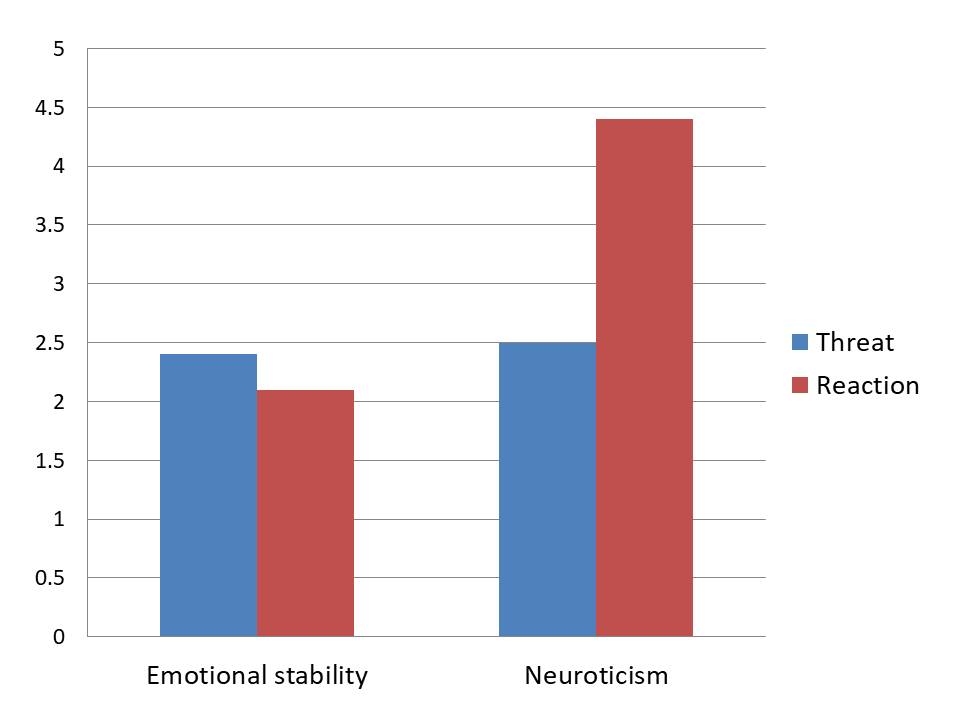
    Neuroticism is a personality trait in the Big Five or OCEAN model of personality. It lies on one end of a spectrum, the opposite end of which is Emotional Stability. Thus, those scoring high on Neuroticism tend to be emotionally unstable.

    Neurotics experience negative thoughts and emotions frequently and intensely. They have a lower threshold of experiencing worry, anxiety, and depression. Neurotics overthink and over-analyze everything to the point of causing distress. They’re irritable and chronic negative thinkers.

    Seeing the negative side of things isn’t necessarily bad; it helps to be better prepared. The main issue with neurotics is that their negative emotional reactions are often disproportionate to the threats they’re experiencing.

    In other words, they’re prone to perceiving neutral events negatively, and their reactions to minor, everyday inconveniences are overblown.

    For example, they’ll get overly upset if they spill a drink on their clothes. While an emotionally stable person understands these accidents happen, a neurotic will make a big deal out of it.

    If an emotionally stable person is criticized, they might think it had little to do with them and more with the commenter. In contrast, a neurotic person may get upset over the comment and ruminate over it endlessly.

    neuroticism chart
    Emotionally stable people can respond to threats less intensely than expected if they feel that’s the optimal thing to do.

    Neurotics have a heightened sensitivity to potential threats. They have an overactive stress response. It’s difficult to pinpoint the exact cause of neuroticism. Researchers believe that both biological and environmental factors are at play.1

    Benefits of reducing neuroticism

    Since neuroticism likely has a genetic and biological component, it isn’t something one can overcome completely. While one can’t stop being neurotic, one can at least restrain their neuroticism.

    Neuroticism takes a huge mental toll on the individual. It makes a person prone to experiencing unnecessary stress and other mental health problems.

    A neurotic’s social life is also negatively affected. Since they overreact to minor inconveniences, others feel like they have to be on their toes all the time. This reduces comfort, and the lack of comfort is detrimental to a relationship.

    People want to be with people who are chill, and neurotics are anything but chill. They spread their negativity and negative emotions to others. People have enough negativity of their own to deal with than to carry the burdens of other negative thinkers.

    george costanza neurotic
    The character of George Costanza from the comedy show Seinfeld is a good example of a neurotic person.

    How to be less neurotic

    Following are the strategies and tactics that can significantly help reduce neuroticism:

    1. Learn to hide negative emotions
    2. Develop self-awareness and emotional intelligence
    3. Think about the consequences
    4. Overcome cognitive distortions
    5. Use healthy coping strategies
    6. Learn perspective-taking

    1. Learn to hide negative emotions

    The major problem with neuroticism is emotional reactivity. If you’re neurotic, you need to work on reducing your emotional reactivity. Emotional reactivity simply means displaying emotional reactions.

    Internally, you can feel however you want to feel. You don’t have much control over that. You only need to work on reducing your emotional displays. Others can’t know about your emotional state unless you show it in your facial expressions, words, and body language.

    When I talk about hiding your emotions, I don’t mean suppressing them. Hiding emotions is not the same as bottling them up. You’re not denying how you feel. You acknowledge how you feel internally– even analyze it- but choose not to let it show.

    I know there’s a lot of talk these days about being vulnerable and showing your emotional side. The reality is that if you do that, you’ll come across as weak and lacking in self-control.   

    People instinctively know that controlling emotions requires considerable mental strength. So if you’re an emotional mess, you’ll be perceived as mentally weak- like it or not- even by people who applaud you for being so vulnerable.

    I suggest you reserve your vulnerability for those closest to you.

    When you’ve practiced hiding your emotions for long, you handle emotionally difficult situations well. Others see you as a calm and mature person. The key is to keep practicing. Traits are developed with practice.2

    Eventually, you might even reduce your neuroticism because you are not getting emotional, which presents disconfirming evidence to the mind. The mind likes to see consistency in how you feel and behave. When you cut the behavior part, the mind’s like:

    “Okay, no negative emotions were displayed. Maybe these emotions I’m sending are unwarranted.”

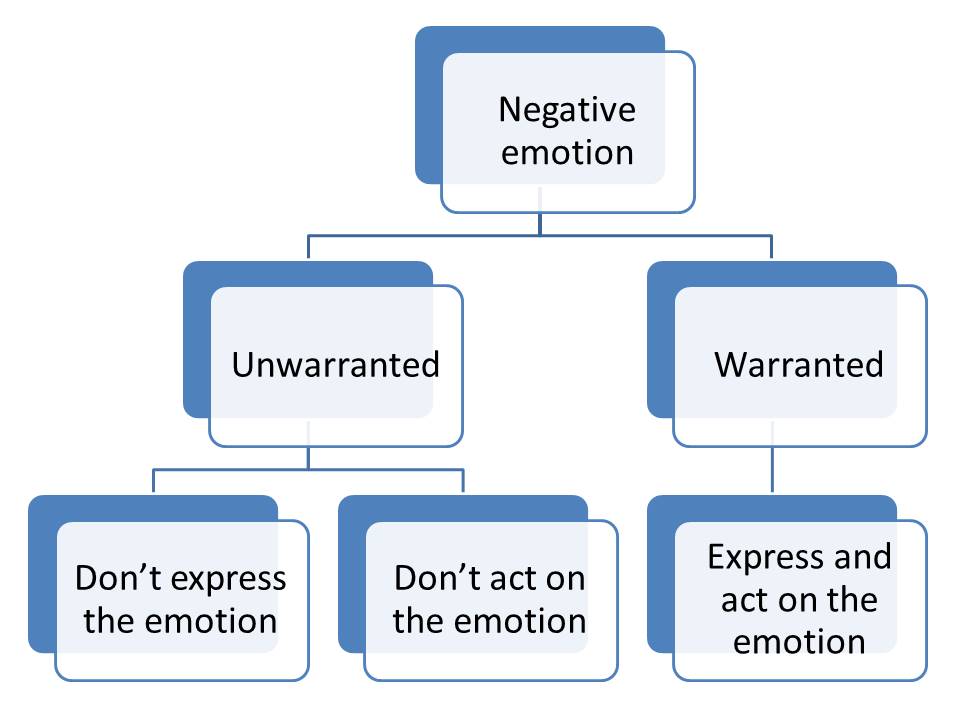
    negative emotion decision tree
    This is a general, rough guideline. Of course, sometimes you should hide even warranted negative emotions.

    2. Develop self-awareness and emotional intelligence

    You can curb your neurotic tendencies if you’re highly self-aware and emotionally intelligent. Self-awareness and emotional intelligence help you look at your emotional state objectively. You try to understand why you’re feeling the way you’re feeling.

    When you attain objectivity in an emotional situation, you’ll already have reduced your neuroticism by half. It automatically makes you emotionally unreactive. You can use these instances to better understand yourself and what triggers you.

    Becoming more self-aware and emotionally intelligent will also help you ascertain whether your emotional reaction is warranted.

    3. Think about the consequences

    Many times, going on a neurotic rant can have negative consequences for us. When we’re under the grip of an emotion, it’s hard to foresee the consequences of our neurotic outbreak.

    Arguments and fights often start with a neurotic outbreak. You behave neurotically; they respond to your neuroticism with their neuroticism, and the whole thing blows up.   

    4. Overcome cognitive distortions

    Neurotic behavior often results from a faulty perception of reality. We humans have a negativity bias. We pay more attention to negative aspects to be better prepared and ensure survival.

    This bias leads to overreaction i.e. seeing negativity where there is none and reacting to it.

    While emotionally stable people can see through these distortions, neurotics have a hard time doing so.

    One such cognitive distortion is overgeneralization. A neurotic will fail in a test and think they’re a failure. Anything bad happens to them, and they quickly attribute it to their lack of competence.

    Another such distortion is catastrophizing, i.e., perceiving a situation as worse than it is. For example, after getting rejected at a job interview, a neurotic person may be like:

    “I’m never going to get a job.”

    This cognitive distortion can be countered by asking questions like:

    “Really? You only got rejected once. How can you be so sure? There are people who got rejected much more than you and still landed a job.”

    5. Use healthy coping strategies

    When people are under the grip of negative emotions, they get desperate to feel good again. They chase instant pleasure and fall into the trap of addictions.

    There are better ways to cope with negative emotions.

    You could write down how you feel, listen to music, watch a movie, take a walk, talk to a friend, exercise, etc. All these activities will reduce the intensity of negative emotions and give you time to analyze them more rationally.

    While it’s a much-debated topic, the dichotomy between emotionality and rationality is real. You can’t be both emotional and rational at the same time. It’s like a switch exists in your mind that can only let you be in emotional or rational mode.

    Reacting too emotionally too soon is rarely a good idea. Let the emotions subside. Let the fog clear, the dust settle. Then, you can see more clearly and respond appropriately.

    6. Learn perspective-taking

    Many social problems occur because people fail to see things from others’ perspective. The default tendency is to only care about your own perspective. So, one has to continually work on putting one in others’ shoes.

    Neurotics are hyper-focused on the negatives in the world, in themselves, and in other people. They’re waiting to get offended. They see confrontations where there are none.

    Learning to see things from others’ perspectives helps you better understand their motives. It helps you resist jumping to the conclusion that people are out to get you.

    References

    1. Barlow, D. H., Ellard, K. K., Sauer-Zavala, S., Bullis, J. R., & Carl, J. R. (2014). The origins of neuroticism. Perspectives on Psychological Science, 9(5), 481-496.
    2. Hudson, N. W., Briley, D. A., Chopik, W. J., & Derringer, J. (2019). You have to follow through: Attaining behavioral change goals predicts volitional personality change. Journal of Personality and Social Psychology, 117(4), 839.
  • How to move on from an ex (7 Tips)

    How to move on from an ex (7 Tips)

    When we enter relationships, we have certain expectations from our relationship partners. When those expectations are violated, things get sour, and a breakup looms around the corner. A breakup can be a very complicated psychological phenomenon.

    How you move on from an ex largely depends on how and why the breakup happened.

    Breakups can occur for good and bad reasons. If you initiated a breakup because you weren’t getting what you wanted from the relationship, that’s a good reason.

    A bad reason would be putting your partner through some kind of stupid test to see if they come crawling back to you. That is a power-hungry behavior and don’t be surprised if it backfires. People- at least the smart ones- can often tell when they’re being played.

    Why breakups hurt

    From an evolutionary psychological perspective, a breakup means a loss of reproductive opportunity. Since reproduction is the major goal of existence, the mind is designed to make you feel as horrible as it can when you miss a reproductive opportunity.

    These bad feelings motivate you to get back together with your ex or go look for a new partner. Hence the phenomenon of rebound relationships.

    How bad a breakup feels depends to quite an extent on your and your ex’s mate value i.e. how valuable a person is as a mate. 

    If your ex had an equal or greater mate value than yours, the breakup’s going to hurt a lot. If your own mate value is sufficiently high, you can mitigate some of the hurt because you know you can easily attract a new partner.

    In any case, going through a breakup is like coming off a drug addiction because love is like a drug to the brain. It’s going to hurt. The key is to accept these mechanics of the mind and process the pain.

    What next?

    What you do after a breakup depends on how bad the breakup was. If the breakup was terrible and they did something unacceptable, the best strategy is to totally cut them off from your life. Especially when they have no qualms about what they did and how it affected you or, worse, abused or insulted you.

    If they don’t care about your feelings now, they never will.

    Follow the no contact rule. Remove everything from your life that reminds you of them. Burn the gifts and block them on all social media handles.

    Feel the pain you have to feel and, with time, you’ll move on.

    Sometimes breakups aren’t as straightforward as that. The relationship might have ended but a part of you still wants to hold on to them. You’re torn between wanting and not wanting them.

    We get stuck in such a grey area or liminal space in a relationship when our partner only partially violates our expectations. They did something wrong and you had a valid reason to end the relationship. Or, you did something wrong and they had a valid reason.

    Either way, you still think they have some good qualities so you want to keep the possibility of a relationship alive. This is where a couple can choose to stay friends.

    Although many advise against staying friends with your ex, this is actually a very mature and dignified way to break up. Relationship or no relationship is ‘all-or-nothing’ thinking. Reality isn’t always that black and white.

    We all have certain criteria for relationships and friendships. If they meet your criteria for a friend, but not a relationship partner, there’s no point in not being friends.

    Friends with benefits

    When you end a relationship, you move from security and certainty to uncertainty. Uncertainty is intolerable to the mind. Staying friends with your ex removes some uncertainty.

    It gives you a safe place from where to explore the world again to find the relationship you truly want. Heck, your ex may even introduce you to your new partner.

    The truth is: You can’t be sure if you can find someone as good, or better, than your ex. You may end up with someone even worse.

    Therefore, staying friends with your ex is a good strategy to create a backup option. Who knows, the spark may re-ignite in the future. Of course, they have to want to stay friends too. It’s possible they might want to get back together again.

    It’s a win-win situation to be in.

    There might be some residual feelings left when you become friends. Don’t worry about that. Let them be there. Eventually, they’ll extinguish if you find a new partner or get re-ignited if you get back with your ex.

    breakup decision tree

    Mate value and market conditions

    A high mate value person can easily find a new mate so they’re likely to move on from a relationship quickly.

    In general, women have higher mate value than men. This is why breakups can affect the genders differently.

    On average, men are more romantic and find it hard to move on from a relationship. Only high-value men, who are rare, tend to be immune to this.

    Women, on the other hand, have greater walkaway power in relationships. This is because they always have other men lined up for them. It’s not as hard for them to find a new mate as it is for men. Therefore, they tend to be more practical and unromantic with breakups.

    Most breakups are initiated by women because, in the human mating marketplace, women are the choosers.

    Unlike men, women have a ticking biological clock they need to worry about. So they often push their partners into commitment. If they’re unable to do so, they quickly dump their partners and move on.

    Of course, there are exceptions to this. If a man is high mate value, she might pursue him longer and take a long time to recover after a breakup.

    We all know women like men with a great sense of humor. Having a great sense of humor makes a man high value. Now, here’s an interesting finding:

    Studies show that women take longer to get over a partner with a good sense of humor.

    Since mate value can change over time, a person’s walkaway power in relationships can change over time.

    The key is to be mindful of one’s own mate value- what one can and cannot attract with their current mate value.

    For example, younger women have higher mate value than older women. Younger women can afford to make the wrong choices in choosing partners, but older women need to be more careful.

    How the mind works after a breakup

    To motivate you to get back with your ex, your mind focuses on their good qualities. It’s easy, in this state, to forget that you broke up with them for a reason.

    When you start a relationship, the mind focuses on the good qualities of your relationship partner. When you want to break up, it focuses on their bad qualities. And when you finally break up, it focuses again on their good qualities again.

    Like a puppet, you’re moved hither and thither by your own mind.

    Remind yourself that your mind often tries to fool you because it sees things only in terms of good and bad. It resists seeing the full picture because that’s not useful for quick decision-making. But you can only make critical relationship-based decisions when you can see the full picture.

    Tips for moving on from an ex

    Following are the tips that can help you gain closure and move on from your ex:

    1. First off, just because you love them doesn’t necessarily mean you have to be in a relationship. A relationship has its own requirements, and sometimes, being in love isn’t enough.
    2. You broke up with them for a reason. Think about that reason. Think about the things about your ex you couldn’t tolerate.
    3. Keep reminding yourself why you broke up with them. If it happened once, it can happen again.
    4. Mentally project yourself into the future, living with your ex. Think of their irritating behaviors. It’s possible you might be worse off in the future, with a partner, than you are now, without one.
    5. Remember the mind is keen to reproduce, your happiness is secondary. So it overvalues romantic relationships and opts for ‘a bird in hand is worth two in the bush’ approach.
    6. If you broke up with them, it’s likely that you haven’t found what you’re looking for. Ask yourself: “Do I want to go back to my ex and settle for what I don’t want or should I keep looking?”
    7. Get clear about what you want from a relationship partner. Write it down. Only choose a partner who satisfies most or all of those criteria. You’re in a much better position to get what you want when you know what you don’t want.
  • How to let go of resentment

    How to let go of resentment

    Resentment occurs when we believe someone close to us has intentionally harmed us. When we’re wronged, we feel angry in the moment. Anger is an emotion that tells us that our rights have been violated. That is, the other person has incurred significant costs for us.

    When we suppress our anger in the moment for whatever reason, it can get carried over into the future, turning into resentment. Resentment is nothing but lingering anger.

    For example, a child who’s abused by a parent cannot express anger in the moment for fear of further abuse, punishment, or being abandoned. Therefore, such childhood trauma is likely to lead to deep and lasting feelings of resentment toward the parent.

    When we feel resentment, we replay the negative past event in our minds over and over, intensifying the bad feelings associated with resentment. People who feel resentment spend considerable mental energy being resentful.

    Hence, they want to know how to let go of resentment so they can unburden themselves. It can be done, but it needs to be done appropriately. What you need first is a proper understanding of how resentment works.

    How resentment works

    As with many other things in human psychology, it all starts with humans being a social species. We expect people in our social circle, be it our family members, friends, or colleagues, to meet our important needs.

    When they fail to meet our needs, we become angry. The thing with anger is that it’s an ephemeral emotion. It comes and goes. It motivates one to take action in the moment. Therefore, anger can only help us deal with social harm in the here and now.

    But human relationships tend to be lasting. A person close to us who intentionally wronged us now may also wrong us in the future, simply because they have greater access to us.

    The mind needed a mechanism to hold on to the anger so that we could guard ourselves from the person who could also harm us in the future. Resentment serves this purpose effectively.

    Resentment lets us hold on to anger so we can be leery of people in our social circle who’ve harmed us once and can harm us again. If we had no such mechanism, people close to us could easily exploit us over and over.

    Resentment motivates us to distance ourselves from those who’ve harmed us. It motivates us to avoid interacting with them, thereby reducing the chance that we’re harmed again.

    Resentment is strongest toward people who are closest to us because they have the power to harm us for as long as our relationship with them lasts.

    This is why resentment lasts so long. People can be resentful of their family members for decades because their family members are always a part of their social circle. The threat is constant and hence, the resentment is constant.

    Compare this to when someone you’re not going to interact with in the future harms you.

    For instance, when a stranger cuts you off while you’re driving, you get angry but not resentful. You might swear at them, show them the finger, and be done with it. There’s no reason to hold on to the anger. You’ll probably never see them again.

    resentment in close relationships

    The key thing about resentment is that it only develops when we believe that the other person has intentionally harmed us. When people intentionally harm us, they’re likely to repeat that behavior in the future because intentions tend to be stable.

    When people harm us unintentionally, we don’t need to worry about that too much since such mistakes and accidents are one-offs. Intentionality is the fuel to the fire of resentment.

    Why resentment feels bad and burdensome

    Resentment, like many other negative emotions, feels painful. So people are motivated to end the pain without understanding the purpose behind the pain. The mind uses negative emotions to grab your attention, just as it uses physical pain to bring your attention to the injured body part.

    Just as physical pain is healed by attending to it, negative emotions like resentment can also be healed by attending to it and understanding its purpose.

    Resentment consumes significant amounts of mental energy for a good reason- to protect you from future social harm.

    As with other negative emotions, the main problem people have with resentment is their perception of resentment. They think resentment is bad just because it’s burdensome and painful. They don’t see the purpose it serves.

    This is why you come across ridiculous advice for letting go of resentment such as:

    • “Stop being resentful! Just stop!”
    • “Forgive those you resent.”
    • “Resentment is poison. Let it go!”
    • “Think loving thoughts for those you resent.”

    Yeah, right.

    People don’t need to get over resentment as much as they need to get over their misunderstanding of resentment.

    When their perception of resentment changes and they understand its purpose, that itself can make resentment much less burdensome. They can now stop fighting against it so hard.

    resenting resentment

    Letting go of resentment the right way

    Besides understanding the purpose of resentment, following are the things you can do to let go of resentment:

    1. Express it
    2. Be aware of your social biases
    3. Give yourself closure
    4. Frame your expectations as unreasonable
    5. Forgiveness

    1. Express it

    As mentioned earlier, resentment is often unexpressed anger. You couldn’t let out your anger in the moment, so you developed resentment. But you can always let your anger out later.

    Expressing your resentment to the person you’re resentful of is the healthiest way to deal with resentment for several reasons:

    • You let them know how you feel about what they did. You dump your emotions where you should dump them- very unburdening.
    • You give them a chance to explain themselves. Maybe you misinterpreted their actions. Maybe you over overly focused on your own needs, perceiving only a slice of reality.
    • It presents them with an opportunity to reduce intentionality. If they manage to convince you they didn’t mean to harm you, resentment dissolves because intentionality dissolves.

    2. Be aware of your biases

    Being a social species, our minds place prime importance on relationships. We’re quick to make enemies and friends.

    A person may have been constantly rude to you, but one friendly gesture from them makes you re-evaluate where you stand with them. It pushes you into thinking that maybe they’re not that bad after all.

    Similarly, a person may have done you a lot of good, but you only focus on what they didn’t do or what they did wrong. You’re quick to label them an enemy just because they did this one thing wrong.

    Another bias we have is called the fundamental attribution error, i.e. we’re quick to attribute a person’s behavior to their intention, ignoring situational factors.

    Ask yourself if your resentment is warranted and if it is, express it to the person as soon as possible so you don’t have to carry it around.

    3. Give yourself closure (Declare them an enemy)

    Sometimes, it may not be possible to express your resentment. For example, you may be resentful toward your ex whom you’re no longer in touch with.

    If you don’t give your mind closure, you’ll keep carrying the resentment. You can’t rationally convince your mind that:

    “Hey, I’m no longer with her. She can’t harm me again. So be done with the resentment already.”

    Especially if you haven’t moved on and still have a tinge of hope that you’ll be together again. In fact, still being resentful of your ex is the surest sign that you haven’t completely moved on. Their ghost still lingers in your social circle.

    In such situations, you can give yourself closure by noting down the lessons learned from the experience. Think of the reasons you broke up with them. Basically, convince your mind that your ex was an enemy, unworthy of your social circle.

    This works because your mind only thinks in terms of friends and enemies. When you’re resentful of your ex, you’ve still classified them as a friend- a part of your circle. When you give your mind good reasons why they were an enemy, your mind ejects their ghost from your social circle.

    4. Frame your expectations as unreasonable

    Being selfish, people often place unreasonable expectations on others without realizing it. When these expectations aren’t met, they declare that they’ve been harmed.

    Therefore, resentment not only stems from direct harm that others inflict on us, but also when others don’t do what we expect them to do or don’t do enough. Often, but not always, these expectations and demands are unreasonable.

    If you can identify such unreasonable expectations that led to your resentment, you can finally heal.

    5. Forgiveness

    A common advice given to people who are resentful is:

    “Forgive them. Just forgive them!”

    Forgiveness can’t happen in a vacuum. You can’t just wake up one morning and decide to forgive everyone you resent.

    For forgiveness to happen, the other person has to accept responsibility for their actions if they did indeed harm you. They have to accept they harmed you and promise they’ll not repeat it again.   

    Since the purpose of resentment is to guard you against future harm, their promise that they won’t repeat it works like a charm. It’s like adding water to a fire.

    Resentment no longer rents space in your mind because it’s no longer needed.

  • How to annoy a passive-aggressive person

    How to annoy a passive-aggressive person

    A passive-aggressive person tends to adopt a passive-aggressive communication style. When someone’s rights are stepped on, or when their goals are frustrated by others, they can either behave:

    • Passively = Do nothing
    • Aggressively = Get their rights back by stepping on others’ rights
    • Passive-aggressively = Indirect aggression
    • Assertively = Get their rights back without stepping on the rights of others

    Both passive-aggression and assertiveness lie in the middle ground between passivity and aggression, the two extremes, but they differ in a key aspect.

    While assertiveness ensures the rights and needs of the other person are safeguarded, passive aggression doesn’t.

    Passive aggression is indirect aggression. Passive-aggressive people violate the needs and rights of others indirectly. It’s a weak form of aggression, but it’s still aggression.

    Some examples

    The following examples will clarify what it means to be passive-aggressive:

    Agreeing, and then switching

    Passive-aggressive people think confrontation equals aggression, and they have no concept of assertiveness. If you ask them to do something, they’ll not say “No” to avoid directly offending you (Aggression). But they also won’t do the task they agreed to do (Passive aggression).

    This way, they succeed in both not offending you and, ultimately, having their own way. Often, when you find they haven’t done the thing, it’s too late to confront them. You figure it’s better to put out the fire yourself than waste time confronting them.

    “I’m fine” or “It’s okay”

    When someone says “I’m fine” or “It’s okay” but their metacommunication (tone, body language, etc.) communicates otherwise, they’re being passively aggressive. They’re pissed at you but aren’t communicating it directly through their words.

    Deliberate forgetting

    This is related to agreeing and then switching, the difference being that the person comes up with a justifiable excuse, in this case- forgetting.

    When people say they forgot to do something, it’s a believable excuse because humans are prone to forgetting.

    But when it comes from a person who’s usually not that forgetful or simply couldn’t have forgotten the task, given its importance, chances are high it’s deliberate forgetting.

    Another form such passive-aggressive behavior takes is leaving things half-done or leaving some things undone. When people don’t want to do the work they’ve been tasked with, they might leave it half-done. This is, again, an indirect way to express hostility and resentment.

    Deliberate mistakes

    An employee who’s given a task they’re not willing to do might commit intentional mistakes to ruin the project if they can do so without serious consequences. It’s usually a passive-aggressive attempt to ensure they’re not given the same tasks again.

    Back-handed compliments

    A backhanded compliment is an insult disguised as a compliment to take the edge off of the insult and make it less direct.

    For example, saying something like “Your work was surprisingly good” implies that it’s often not good. And saying “You look beautiful today” to someone implies they don’t look good on other days.

    Note here that passive aggression is all about intent. It may be that someone says, “You look beautiful today” with no intention of hiding an insult. It might be that you’re particularly well-dressed today. You paid more attention to the word “today” while they slipped it in their compliment unthinkingly.

    Silence and withdrawal

    This is perhaps the most common form of passive aggression in relationships. People who’re close to us naturally want to engage with us. Withdrawal and silent treatment convey “I’m mad at you” without being directly aggressive.

    Related: Passive-aggressive behavior in relationships: 20 Examples

    Why do people behave this way?

    As you’ve seen, people behave passively-aggressively when they want to show aggression indirectly. They can’t show direct aggression for fear of offending others to their face. Yet, they don’t want to be passive at the same time.

    Passive aggression is often a response to perceived or real injustice. Passive-aggressive behavior usually comes from people close to us because they’re the ones who care about not offending us directly the most.

    The goal of passive-aggressive behavior is to send this message across to the other person:

    “Ultimately, my needs and wants shall prevail over yours.”

    It’s a win-lose orientation where the passive-aggressive person is trying to score a point over the other person.

    Passive-aggressive behavior is annoying, and it’s natural to want to annoy passive-aggressive people back. The way to annoy a passive-aggressive person is to frustrate their goal.

    Often, people respond to passive aggression with aggression, which brings immense satisfaction to the passive-aggressive person. It tells them that their strategy to piss you off covertly worked. As a result, it only reinforces their behavior.

    The next section will discuss how to annoy a passive-aggressive person effectively.

    Ways to annoy passive-aggressive people

    1. Confrontation

    Assertive, not aggressive, confrontation is the best way to frustrate the goals of a passive-aggressive person. You see, passive-aggressive people hate confrontation. It’s not their style.

    When you catch them in the moment and stand up for yourself assertively, you catch them off guard. You’ve blown their cover and exposed their naked hostility. This forces them to change their style and be more direct.

    For example, instead of reacting with silence or “Thank you” to the comment, “Your work was surprisingly good”, you can respond by calmly saying, “So it’s usually not good?”

    This way, you’ve exposed them, and they’re forced to retreat because they don’t want confrontation.

    Rarely, you’ll find someone saying, “Yes, usually it’s bad”. That’s direct aggression, and the person who can say a thing like that wouldn’t need to be passive-aggressive in the first place.

    Here’s why aggressive confrontation doesn’t work:

    As mentioned earlier, it signals success to them. It means they were successful in getting under your skin. An aggressive response also makes you look bad because your response seems disproportionate to their weaker, more passive aggression.

    To make things worse, they can add salt to the wound by saying something like, “Calm down! Why are you getting all worked up?” knowing full well that their goal was to indeed get you all worked up.

    Imagine responding to “Your work was surprisingly good” by yelling back:

    “WHAT DO YOU MEAN SURPRISINGLY GOOD?”

    See the difference? Sticking to assertiveness is often the best strategy.

    aggression levels

    2. Exposing motives

    This goes one step beyond assertive confrontation. You basically tell them why they’re doing what they’re doing. The beauty of this strategy is that you get to be as confrontational as possible without being aggressive.

    For example, replying to the passive-aggressive “I’m fine” with something like:

    “You know what: You don’t have to do that. You can tell me you’re not fine when you’re not.”

    This not only exposes their operations but also their motives. When motives are exposed, you can’t make the person feel more naked.

    If you’re an employer, you can confront the employee who leaves work half-done by saying something like:

    “If you didn’t want to do it, you could’ve told me. I’d have done it myself.”

    When you confront them at the level of motives, you signal to them that their passive-aggressive ‘game’ will not work on you.

    3. Tit-for-tat

    Passive-aggressive behavior often succeeds in annoying us. The problem is: We can’t overtly express our annoyance in most cases. Instead, we can play the same game back at them: We can respond to passive aggression with passive aggression.

    The upside of this strategy, when executed well, is that it’s a variation of the ‘exposing their motives’ technique. By playing the same game back at them, you show them how ridiculous they’re being.

    It also forces them to put themselves in your shoes and make them realize how annoying their passive aggression must be to you.

    The key to executing this strategy well is being passive-aggressive to them in the same manner in which they’ve been passive-aggressive to you.

    For example, if they throw backhanded compliments at you, you do it too. If they say, “I’m fine” you say that too when you’re mad, making sure your tone and body language communicate otherwise, of course.

    The only downside of this technique is that you’ll give them a tinge of satisfaction that their passive aggression worked. If it hadn’t, you wouldn’t be compelled to hit back passive-aggressively.

    Still, the benefits of annoying them back this way might outweigh any satisfaction that they can get out of it. It kind of forces them into a corner. If they hit back again, you can be satisfied that your counter-strategy worked.

    I recommend stopping at this point because you don’t want to go down the endless spiral of passive-aggressive tit-for-tats. If you come to this point, you’ve probably taught them the lesson by now.

    4. Non-reaction

    Not reacting to passive-aggressive behavior in any shape or form is the surest way to annoy a passive-aggressive person. While it may be effective in pissing them off, it’s not so good for your own mental health.

    The thing is, passive aggression does get under our skin, especially when it comes from people we care about. If we don’t react to it at all, we do teach them that their passive aggression isn’t working.

    But the problem with this passive strategy is that the hurt will keep building up. You may put on a calm and non-reactive face for a time. But if they continue to be passively aggressive, you’re likely to cave in and crack under the pressure, resorting to aggression.

    This strategy requires a lot of inner work to successfully pull off. You need to have attained a certain level of mastery over your emotions.

  • How to respond to indifference

    How to respond to indifference

    Indifference simply means not caring. When someone is indifferent toward you, they’re showing they don’t care about you. Caring for others is an investment in others. Therefore, indifference can be seen as a way to withdraw or decrease investment from someone.

    In this article, we’ll discuss signs of indifference, what causes indifference, and how to respond to indifference appropriately.

    When we enter relationships, we expect to give and take. Indifference is a form of not giving. It’s the opposite of validation- a basic need of humans.

    Hence, when someone is being indifferent towards you, you detect this investment imbalance, and it bothers you. Of course, indifference from people you’re indifferent to doesn’t matter because you’re not invested in them.

    Indifference from someone only bothers you when you’re invested in them and care about them. You’re investing in them, and you expect them to give back. But they’re not giving back. They’re being indifferent towards you.

    Signs of indifference

    There are many ways to show indifference, but the most common way is to avoid or show a lack of interest in, communicating with you. Unwillingness to engage is the surest sign of indifference. All other investments come after engagement.

    Indifference can manifest in the following ways:

    1. Not initiating communication

    If you’re the person who always starts conversations with them in your relationship, we got a problem. Chances are they’re indifferent toward you. In a healthy, balanced relationship, both parties frequently initiate contact.

    2. Not asking you questions about you

    Many relationships and friendships are purely transactional. They want something from you and you want something from them. But humans crave lasting relationships that go beyond mere transactions.

    A sure sign of a lasting relationship is that they’re not just interested in what you have to offer but also in you as a person. When they’re interested in you as a person, the transaction becomes lasting and psychological. They want to be with you because it contributes to their well-being.

    Hence, a lack of interest in who you are as a person can be a sign of indifference. Once they get what they want from you, the relationship is doomed.

    Not asking questions about you, your background, your interests, or your values shows they’re indifferent toward you.

    3. Cutting short conversations

    Again, this is a way to disengage and show indifference. Communication equals investment, and avoiding or cutting short communication shows an unwillingness to invest.

    This can manifest in face-face conversations where they don’t pay attention to what you have to say. Body language gestures showing a lack of interest or boredom reveal all.

    While texting, too, you can tell when someone is interested in having a conversation with you and when they’re not.

    When they answer with a short “Yes” or a “No” or don’t put any effort into extending a conversation, it’s likely a sign of indifference. They just want to escape the conversation.

    The extreme manifestation of this would be not returning your calls or not replying to your texts at all. If that happens to you, you need to re-evaluate where you stand in the relationship.

    What causes indifference?

    What could make someone not invest in a relationship? Half the job of responding appropriately to indifference is figuring out what’s causing it.

    Following are the possible reasons behind a person’s indifference:

    1. They’re not interested in you

    Well, duh. Obvious as it sounds, it’s crazy how some people just don’t get it. They keep pursuing those who’re indifferent toward them. Those who’re indifferent towards you may not directly tell you they don’t like you out of politeness. They’re being indifferent, hoping you’ll get the message.

    Again, relationships have to be about give and take. If you give but don’t get, move on.

    2. They really don’t care about your stuff

    Just because people are in a relationship doesn’t mean they have to like every little thing about the other person.

    Yet we humans have a tendency to validate our life’s decisions, hobbies, and interests. We want others, especially those close to us, to like what we like. If it happens, great! But don’t expect it to happen for every little thing.

    Just because they’re indifferent towards a quirky hobby of yours doesn’t mean they’re not interested in you. There may still be dozens of aspects of your personality they still like.

    You may show them a movie by your favorite director, and they’re “meh” about it. They just don’t care about this stuff. It’s their opinion, and you ought to respect it. They’re indifferent to it, not necessarily to you.

    At the same time, a relationship built on few mutual interests is a relationship built on shaky grounds. If they don’t care about any of your stuff, we got a problem. Here, it’s likely they’re indifferent toward you because they’re indifferent towards everything that makes up, well, you.

    3. You pissed them off, and now they’re punishing you

    This happens all the time in relationships. If you did something they don’t approve of, they want to communicate their displeasure. A common way this is done is through indifference. The goal is to motivate you to make amends and avoid the behavior in the future.

    This temporary withdrawal of investment is based on what you did. Avoid jumping to the conclusion that they’re not invested in you.

    4. They’re masking interest

    Sometimes, we display behaviors opposite to how we really feel. Freud called this reaction formation, and it’s a defense mechanism.

    So, a person might be interested in you. This makes them feel powerless. They don’t like the effect you have on them. It makes them anxious.

    So they communicate the opposite to manage their anxiety and improve their image. They show they’re indifferent towards you.

    This is forced indifference. The way they truly feel isn’t communicated in their behavior. However, how they truly feel might sometimes leak out in their behavior.

    As a result, they may alternate between caring and not caring, sending you mixed signals.

    5. They’re testing you

    If one party in a relationship feels they’re giving more than they’re getting, they might carry out an investment test. They withdraw or decrease their investment to see how you’ll react. They expect you to increase investment or keep investing how you’ve been investing.

    If you do these things, you pass the test. If you also withdraw investment, responding to indifference with indifference, you make them feel you’re not invested in the relationship as much as they are.

    At this point, they might either end the relationship or re-start investment if they’re really into you, hoping you’ll invest in the future.

    6. They found someone else

    Not all have the courage to be straightforward and honest in their relationships. If they found someone else, they might start being indifferent toward you, hoping you’ll end the relationship. That’s relationship death by a thousand cuts of tiny indifferences.

    If you’re the one who found someone else and catch yourself being indifferent, just tell them. End the relationship right away. It’s not cool to leave people hanging on false hope.

    How to respond to indifference appropriately

    As you’ve seen, there can be many reasons people are being indifferent toward you. The human tendency is to always jump to the conclusion that they don’t care about you. But you got to collect more data and do more analysis before you can reach that conclusion.

    Your response to indifference will depend on the person, the situation, and the stage of the relationship you two are in.

    In general, be more sensitive to indifference in the initial stages of a relationship. In established relationships, it’s okay for partners to occasionally show indifference.

    Here are some specific things you need to note, though:

    Is it one-off or continual indifference?

    A one-off indifference event is unlikely to be about you but about what you did or even about them. It’s likely to be a temporary withdrawal of investment.

    If the indifference is continual, it’s likely they don’t care about you.

    Let’s face it: Humans have a strong tendency to be selfish. Maybe they’re taking your investments in the relationship for granted. They’re getting out of it as much as they can and giving nothing back.

    Humans naturally keep track of ‘give and take’ in relationships. However, when you’re much more invested in them than they are, because, let’s say, they’re super attractive and you’re average-looking, it’s easy to lose track of give and take.

    Your mind’s like:

    “We have so much to gain from them (reproductively). It’s okay if they don’t invest. Let’s forget about investment tracking for a while and keep thinking about how awesome it’d be if they were ours.”

    Thing is, if they’re not into you at all, you’re playing a losing game. Your own mind deceives you into believing that you can get something that’s out of your league because the mind is designed to be selfish and maximize reproductive gains.

    This explains why people become obsessed with celebrities and those who’re way out of their league.

    If you keep giving, hoping to get in the future, maybe it’s time to test the validity of those hopes.

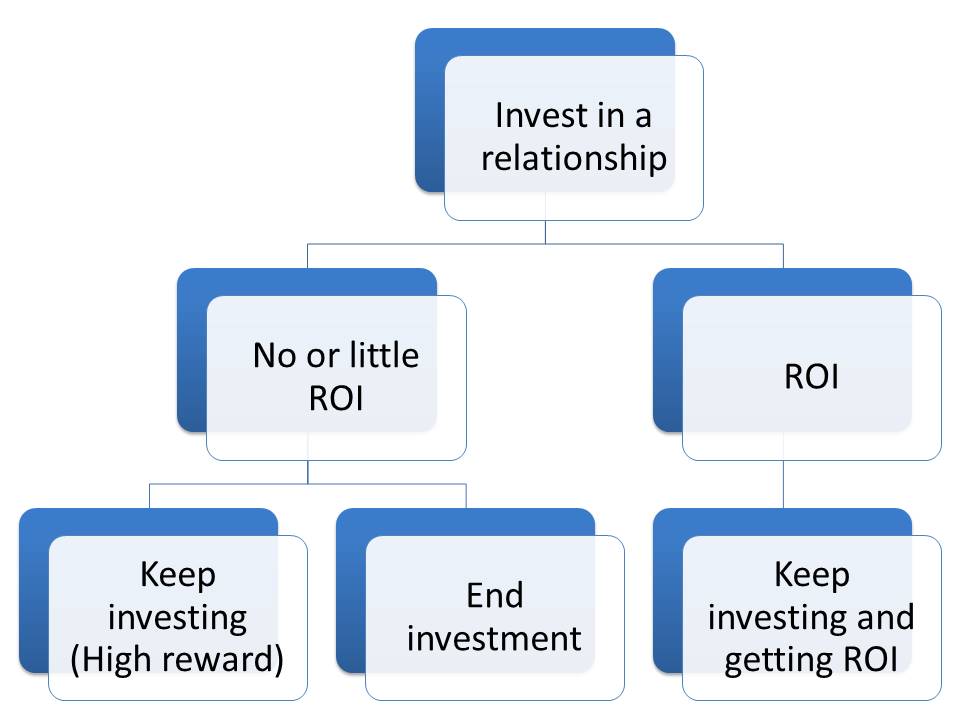
    investing in a relationship decision tree
    ROI = Return On Investment; Note that when the potential reward is high, we can get stuck in keeping on investing with no or little ROI.

    What are they gaining by being indifferent?

    Asking this question to yourself can be helpful. As pointed out earlier, showing indifference can be a strategy to mask interest or to test you.

    When you can point to the exact reason they’re being indifferent, you can then respond accordingly.

    Ask yourself questions like:

    • What’s your current response to their indifference?
    • Could it be that your current response is feeding their indifference?
    • What if you changed your response? What do you expect to happen?

    The best strategy in any situation: Confront them

    If you’re on the receiving end of indifference and can’t figure out the exact reason, confront them. It’s the best way to clarify things and figure out what’s going on.

    You can’t make decisions based on assumptions. More often than not, that leads you down the wrong path.

    Often, we see reality through our own narrow lens of perception. By confronting them and telling them how you feel, they’ll be encouraged to share their version of the story. This will broaden your perception, and you’ll make a better decision.

    Everyday indifference: Putting it all together

    Indifference doesn’t always have to be overt. Sometimes, it’s shown subtly. For instance, you ask your partner what dress you want to wear, and they’re like:

    “I don’t care.”

    Another example would be asking them where you should eat, and they say:

    “I don’t know.”

    When you’re at the receiving end of these responses, you always feel invalidated irrespective of whether they invalidated you intentionally or unintentionally. You see these responses as them cutting short the conversation, not willing to engage.

    Maybe they really don’t care about your dresses or choosing what place to eat. Or it may be that they’re deliberately being indifferent. Or both.

    Again, this goes back to being indifferent to you versus being indifferent to your stuff. You can’t really figure out what it is without confronting them or collecting more information.

    Consider how showing even a bit of investment makes all the difference.

    Say, instead of blurting out, “I don’t care”, they first looked at some dresses and then said:

    “I don’t care. Wear what you want.”

    This wouldn’t make you feel invalidated because there was some, albeit tiny, investment on their part. They cared enough to look at the dresses. In your mind, that automatically gets translated to “They care about me”.

    In sum, before you assume that someone is being indifferent toward you, you need to collect more information. It’s because decisions based on such assumptions can have a serious impact on your relationships.

  • How to deal with rigid people (7 Effective tips)

    How to deal with rigid people (7 Effective tips)

    Rigid people are people with inflexible thoughts and behavior patterns. Being rigid in one’s thinking is the very opposite of being open-minded.

    Rigid people are resistant to new ideas, ways of being, and ways of behaving. As a result, they learn little and they grow little. They have a fixed mindset versus a growth mindset.

    People may be rigid because it’s part of their personality or they may be rigid in some life areas while being more flexible in other areas. In this article, we discuss what causes rigidity in people and how to deal with rigid people.

    What causes rigidity?

    People can have rigid thoughts and display rigid behaviors for several reasons. Generally, people are rigid because being rigid serves them in some way. Common reasons behind being inflexible are:

    1. Lack of conviction

    People hold on to what they know or their ways of behaving when they’re unconvinced that change can help them. This sounds obvious, but it’s a useful reminder that we might be too quick to label someone as rigid.

    We should first look at ourselves and make sure we are doing a good job of trying to convince them to change their ways.

    It’s easy to label others as rigid when in reality we’re the ones who lack convincing skills. If you’re going to sell a new idea to someone, you have to do your own homework first. You have to level up your convincing skills.

    2. Protecting beliefs and habits

    Humans are creatures of habit. Once they form a belief or develop a habit, they just roll with it. They get comfortable with their thoughts and habits. They feel secure in these familiar patterns.

    A novel idea feels unsafe, unfamiliar, and uncomfortable. Through confirmation bias, people maintain their existing ideas and reject new, especially opposing ideas. Through cognitive dissonance, they try to resolve the discomfort caused by new ideas.

    3. Need for closure

    This is closely related to the previous reason. People have a strong need for closure, meaning, they want matters to be settled as soon as possible. They hate ambiguity. They want to stick to their ‘settled’ ideas about something.

    They don’t want to re-open questioning and debate. Having to reconsider things takes considerable mental energy and many people are too cognitively lazy to expend that energy.

    The need for closure often leads to ineffective problem-solving and jumping to conclusions. Closed-minded people have an especially powerful need for closure. They don’t want to re-open old files in the cabinet of their mind, even if they have a good reason to do so.

    4. Need for control

    When we believe we’ve figured out aspects of the world (attained closure), we feel in control. Admitting our knowledge might be lacking throws things back into chaos. Those who constantly evolve consistently go through periods of order and chaos.

    Rigid people want to cling to their order and fear chaos, even if that chaos has the potential to bring a better future order.

    Control freaks and those with OCD symptoms are especially likely to fear losing control and are obsessively attached to their thoughts and behavior patterns.

    5. Avoiding pain

    An important reason people are rigidly attached to their beliefs and ideas is that they identify with them. As a result, losing their beliefs means losing their identity. An identity crisis is not a pleasant experience to go through.

    When people identify with their beliefs, they derive pride from them. Losing these beliefs not only means losing their identity but also losing important sources of pride and ego gratification.

    All this, combined with the fear of being wrong or looking stupid, makes people rigidly attached to their ideas. Admitting you’re wrong is painful, especially for those who identify with their ideas. They have an emotional investment in their ideas.

    How to deal with rigid people

    Changing a rigid person’s mind is not an easy task. It can sometimes take a lot of time and energy. So before you decide to deal with a rigid person, make sure doing so is going to be worth your while. Otherwise, just let it slide. In most cases, it’s just not worth it.

    Still, following are the strategies you can use to make people less rigid:

    1. Express your ideas clearly and convincingly
    2. Involve them in your idea
    3. Frame your idea as a possibility
    4. Use authority and social proof
    5. Communicate your idea assertively
    6. Show them the mirror
    7. Aggression

    1. Express your ideas clearly and convincingly

    Vague and poorly expressed ideas cannot change people’s minds. A well-expressed idea registers well in the other person’s mind. When that happens, they may not resist it as much because it makes sense to them.

    You can also state your ideas repeatedly so they become familiar to your target person. Once familiarity sets in, so does comfort. Now, the new idea isn’t this unknown devil they need to immediately destroy. They can give it a shot.

    2. Involve them in your idea

    Another trick is to involve them in your idea. The major reason they’re fighting the idea maybe because it’s your idea. Instead of presenting the idea as your idea, lead them to it. Make them think they played a part in coming up with the idea.

    For example, instead of saying something like, “I suggest we hire a sales team” to your rigid boss, you can say:

    “Our sales numbers have the potential to get better.”

    The boss will probably ask you how. Then you can suggest hiring a sales team.

    Your idea might have been brilliant. But framing it as your idea might have led to resistance. By involving your boss in the idea, you decrease the chances of resistance. They feel they helped you come up with the idea and it’s hard to resist one’s own ideas.

    3. Frame your idea as a possibility 

    Rigid people are sure of their own ideas. When you’re sure of your ideas too, you too become rigid. When rigid ideas collide, they create a lot of friction.

    You have to be sure of your idea, of course, but sometimes you need to communicate it gently to reduce friction.

    One way to do this is to talk about your idea as a possibility. Again, you remove yourself from your idea such that it’s no longer your idea but a rational possibility.

    For example, when a rigid person says something you don’t agree with, you can say:

    “I think it’s also possible that [state your idea].”

    “Don’t you think it’s possible that [state your idea]?’

    When people are fighting your ideas, often they’re fighting you. When you remove yourself from your idea, you decrease resistance because it’s lame to fight a mere idea, a possibility.

    4. Use authority and social proof

    Authority and social proof are powerful convincing tools. Marketers use them all the time. Find people your target person respects, and try to convince them instead. We tend to agree with those we admire and respect.

    Get as much buy-in for your idea from others as you can. For instance, if the entire office agrees with your idea except your boss, that’d make your boss look unreasonable for being so rigid.

    5. Communicate your idea assertively

    Assertiveness is an important communication skill. When you find that someone is being too rigid and stubborn with their ways, you can do one of the following depending on the situation: (see Assertiveness vs Aggression for more details)

    • Be passive (Do nothing)

    While it may be the best strategy at times, often when you do nothing, nothing changes.

    • Be aggressive

    If you criticize their idea or push your idea aggressively, you’re bound to face resistance. This strategy rarely works and often leads to a power struggle that sours the relationship.

    • Be assertive

    It’s the sweet spot between passivity and aggression. You communicate your idea or disagreement without a tinge of aggression. When there’s no aggression, the other person has no reason to defend. When they’ve no reason to defend, they’re less likely to resist your idea.

    Ideas communicated assertively settle in their minds as they face no resistance. When you keep communicating your ideas assertively, they’ll gather a momentum of their own in your target person’s mind. Having no reason to defend, they’ll find themselves forced to consider your ideas.

    6. Show them the mirror

    This one is more likely to work with intelligent and self-reflective people. You basically point out the flaws in their logic and expose their biases. You appeal to their rationality.

    This way, you’re not attacking their idea- their oh-so-precious idea. Instead, you’re criticizing the way they’ve reasoned to come up with that idea.

    When you criticize someone’s idea directly, you’re communicating:

    “Your idea is crap. Therefore, you’re crap.”

    When you criticize their reasoning, you’re communicating:

    “The way you’ve reasoned is crap. You can do better. You can be more rational.”

    The key is not to make them look stupid for being irrational. Don’t use any insults or labels.

    To force them into self-reflection, you can also ask them something like:

    “Why are you being so rigid?”

    7. Aggression

    Extreme circumstances sometimes demand extreme measures. Aggression, for example, can sometimes be effective in breaking the rigidity of people.

    Be warned: It’s a risky strategy that may only work on open-minded people who’re being uncharacteristically rigid. They can handle criticism well.

    Basically, you insult or mock their ideas. You can even show anger and yell at them if you want to. You can also use satire and biting sarcasm.

    This extreme aggression strategy aims to shock and completely disarm the other person. Moderate aggression is faced with moderate aggression but few can handle extreme aggression.

    They’re forced to see the error in their ways. They cannot defend themselves because the attack is so strong.

  • How to validate someone (The right way)

    How to validate someone (The right way)

    Humans are ultra-social species who crave validation from each other. Social validation is the glue that keeps human relationships together. Put simply, being validated means being acknowledged, and being invalided means being dismissed.

    Before we can discuss how to validate someone, it’s important to realize that humans seek validation in several areas. Most experts focus only on emotional validation, but that’s just one, albeit important, area that people seek validation in.

    People also seek to validate their identity, beliefs, opinions, values, attitudes, and even existence. The need to validate one’s existence is perhaps the most basic and raw of all the human validation needs.

    When you validate someone’s existence, by talking to them for example, you acknowledge they exist. They’re like:

    “I exist. I’m a person. Others can interact with me.”

    Existential validation plays a big part in keeping people sane. It kills people when they can’t validate their existence.

    For example, people who go for long periods of time without interacting with anyone risk losing their sense of existence. This is why solitary confinement is the worst kind of punishment.

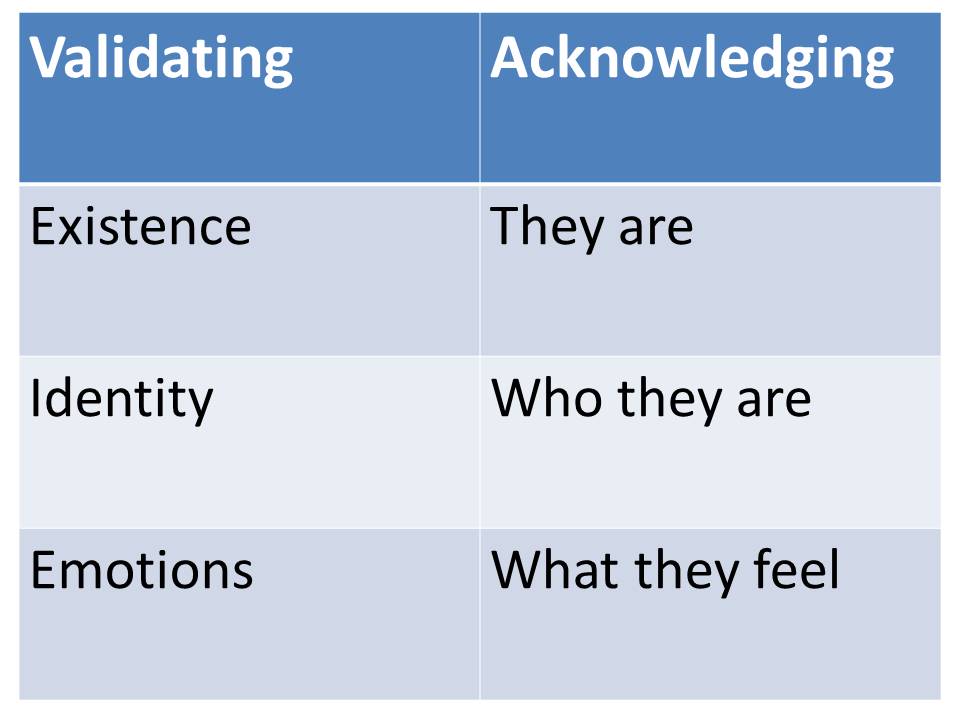
    Validating identity

    After you’ve acknowledged that the person exists, the next key area of validation is identity. Validating someone’s identity is acknowledging who they are. This is often based on what they project themselves to be.

    People have a strong need to be socially accepted. So they often project an identity they believe will be most accepted by their tribe. When you acknowledge who they’re projecting themselves to be, it gives them immense satisfaction.

    Beliefs, attitudes, opinions, and values-all comprise our identity. Therefore, validating any of these is part of validating one’s identity.

    types of social validation
    Types of social validation.

    The two levels of validation

    To keep things simple, I devised my own, easy-to-remember two-level validation model. Social validation can occur on two levels:

    1. Registration
    2. Evaluation

    1. Registration

    It simply means you register in your mind the information emanating from the other person, even if that information is as basic as “They exist”.

    When you register or acknowledge what the other person is sharing with you, you’ve validated them. This is the minimum and sufficient requirement for social validation.

    For example, in conversations, effective registration could take the shape of paying your full attention to them. You can’t register the information they’re sharing if you’re distracted. Hence, not paying your full attention to them makes them feel invalidated.

    For effective registration to occur, you have to let them share effectively. This is where many people struggle. You have to let the other person express fully, so you can register fully, and, thereby, validate them fully.

    If you’re blocking their expression, you won’t register what they have to offer, making them feel invalidated.

    Think about the common complaint women have in relationships:

    “He doesn’t listen to me.”

    What they’re saying is that their partner is blocking their expression, say by giving advice or a solution. When their expression is blocked, they feel invalidated, even if the solution offered is effective.

    By offering a solution, men cut short women’s emotional expression. They don’t realize that when women share problems, they’re mostly looking for validation.

    Of course, solutions are important. But they have to follow registration, which brings us to the next level of validation:

    2. Evaluation

    Evaluation of the information the other person is sharing is the next level of validation. Of course, before you can evaluate something, you have to register it in your mind first.

    When evaluation happens during registration, it short-circuits expression, making the other person feel they’re not given space to express themselves fully.

    We can use evaluation for validating a person further. For example, agreeing with them, empathizing with them, liking what they shared, etc. are all positive evaluations that validate them further.

    At this stage, you’ve processed the information they shared with you and are offering your take on it. At this point, agreeing or not agreeing doesn’t matter that much since the other person already feels some basic validation. But if you do agree, you validate them further.

    If you disagree or dislike what they shared (negative evaluation) before properly registering what they shared, you only end up irritating and invalidating them. Not a socially smart thing to do. Always keep the registration-evaluation sequence in mind.

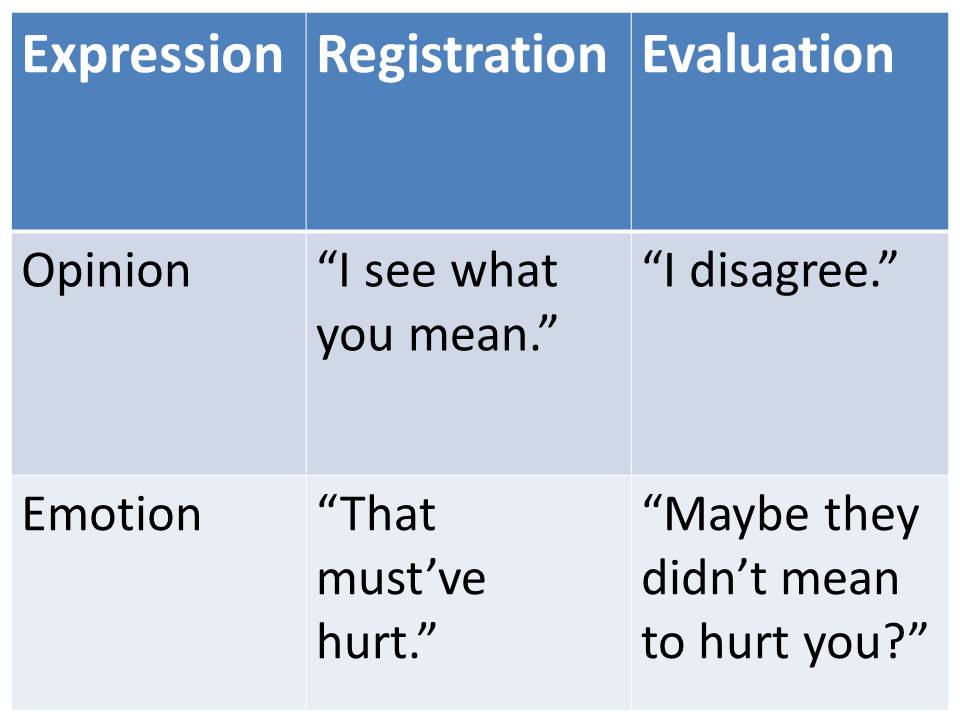
    registration-evaluation sequence
    The registration-evaluation sequence.

    Validating emotions

    You can’t always relate to what others are sharing. They tell you that something happened that made them feel a certain way, and you’re like:

    “Why’s he so sensitive?”

    “Why’s she being a drama queen?”

    That’s negative evaluation! If you don’t care about the person, go right ahead, evaluate them negatively. Throw your judgements on them. But if you care about them and want to validate them, steer clear of such knee-jerk evaluations.

    Now, avoiding evaluations is hard when you can’t relate to what they’re sharing. Thing is, you don’t have to. If you can, that’s great. You’re positively evaluating their information and reflecting it back to them. You’re empathizing.

    That’s the higher level of validation, but you don’t need it. Registration is all you have to do to provide the basic level of validation to someone.

    “I understand how you feel.” (Do you though?)

    Say your best friend is going through a tough time and they share their feelings with you. You say:

     “I understand how you feel.”

    If you’ve never experienced anything close to what they have, they’ll think you’re lying or being insincerely polite. You’d appear fake to them.

    Instead, when you can’t really relate to how they’re feeling, you can simply say:

    “That must have felt horrible.”

    You’re not claiming you understand, but you’re registering their experience in your mind (validation!) and only inferring their feelings.

    Again, empathy and being able to relate isn’t required for validation. Just show them you’ve registered what they’re trying to communicate. Empathy, if possible, is the cherry on top of the cake of social validation.

    Emotional validation largely comes down to how in touch a person is with their own emotions. People who’re in touch with their own emotions can better validate the emotions of others.

    They understand emotions have their own value, irrespective of how they arise. They understand emotions need to be explored, not dismissed.

    Putting it all together

    Say your spouse comes up to you and tells you about this new business idea they’re super excited about. You register their idea, think it’s exciting, and reflect your own excitement (positive evaluation), saying:

    “This is really exciting!”

    Congrats! You just validated them to the extreme.

    If you listen to their idea and think it is stupid, you might say:

    “What a stupid idea!”

    You might hurt them, yes, but you haven’t invalidated them. You’re showing that you registered their idea and think it is stupid (negative evaluation). You moved from the registration stage to the evaluation stage.

    Now, let’s say while they were talking about the idea excitedly, you cut them short, sarcastically saying:

    “You and your business ideas!”

    You just invalidated them. They’re going to be pissed that you didn’t even listen (register) to their idea before you threw your evaluation bomb to decimate their expression.

    Can you see how invalidation is worse than negative evaluation?

    Now, think about the effect a positive evaluation would have when it’s used to cut short expression.

    Say you’re expressing your exciting idea and they cut you short, saying:

    “That’s a great idea!”

    Even if they weren’t lying and, based on what little they heard, thought it was a good idea, you’re likely to think they’re lying or being dismissive. You feel invalidated, despite the positive evaluation.

    It’s hard for you to believe that they liked your idea because they didn’t even take the time to register it.

    This has happened to me on several occasions.

    For example, I come across a cool classical piece on YouTube and share it with a friend. Even though the piece is about 4 minutes long, 10 seconds after I send it to them, they’re like:

    “Great song!”

    Of course, 10 seconds isn’t enough to register the greatness of a piece of classical music 4 minutes long. It not only makes me feel invalidated, but raises a red flag in my mind.

    They come across as fake, dishonest, and wanting to please. I lose a bit of respect for them.

    Instead, had they said something like:

    “Look, man. I’m not into classical music. Stop sending me this stuff.”

    I would’ve felt a bit validated because they at least paid enough attention to it to figure out it’s classical music. They followed the registration-evaluation sequence properly. Also, they gain my respect for being honest.

  • How to find your purpose (5 Easy steps)

    How to find your purpose (5 Easy steps)

    Countless books have been written on how to find your purpose. It’s among the most asked questions in self-help, therapy, and counseling areas. In this article, we’ll explore what purpose really means and how to find what your purpose is.

    As many wise people have pointed out, purpose isn’t something out there waiting to be found. We’re not born to do something. This mentality can keep people stuck without them finding any meaningful purpose in their lives.

    They wait passively for a moment of insight to strike them and finally know what their purpose is. The reality is- finding your purpose requires being proactive.

    Having a purpose in life means you’re actively trying to reach a goal that is larger than yourself, i.e. it can impact many people. Dedicating ourselves to a cause that is larger than ourselves imbues our lives with a sense of meaning. We feel our lives are worthwhile. We feel we’re doing something important.

    But why?

    Why do we want to have a purpose?

    Why do people have this need to do ‘something big’ or ‘make a huge impact’ on the world?

    The answer is: It is one of the most reliable ways to increase the chances of survival and reproduction- our basic evolutionary goals.

    Having a purpose and impacting many people is the best way to raise your social status. Social status highly correlates with evolutionary success. In my article on low self-esteem, I mentioned that we have an innate desire to be seen as valuable members of our society. It enables us to provide more value to others.

    When we provide more value to others, they provide more value to us (money, connections, help, etc.). Therefore, being seen as valuable gives us the resources we need to further our fundamental evolutionary goals.

    The more people we provide value to, the more value we get. It’s all about climbing up the social hierarchy. The higher you climb, the more visible you become, and the more people want to exchange value with you.

    There were limited things our ancestors could do to climb up the hierarchy- conquer more land, form stronger alliances, hunt more, etc.

    In contrast, modern life provides endless avenues for us to raise ourselves in the eyes of ‘our people’. The more options we have, however, the greater the confusion. As author Barry Schwartz notes in his book The Paradox of Choice, the more options we have, the less we’re satisfied with what we choose.

    All children dream of becoming celebrities because they can see that celebrities can affect many people.

    We come pre-wired to notice who in our environment is garnering the most social attention and admiration. We have a desire to copy them and achieve the same level of social status, which, in turn, provides us with resources to meet our fundamental evolutionary goals.

    Kids often dream of becoming world-famous. As people grow older, however, they usually refine the definition of ‘their people’, i.e., the people they want to impact. However, the desire to impact a large number of people remains intact because that can maximize their gains.

    Hence, people seek a purposeful life to gain social acceptance and admiration from their perceived in-groups. Failing to do so seriously threatens their evolutionary goals. Studies show that when people experience social exclusion, their lives lose meaning.1

    Having purpose and well-being

    The mind is designed to reward us when we go toward fulfilling our fundamental evolutionary goals.2

    Hence, the feeling of ‘having a purpose’ likely evolved to signal to us that we’re going in the right direction.

    Research shows that gainfully pursuing evolved goals such as affiliation, kin care, and raising social status increases the feeling of having a purpose in life.3

    Affiliation is nothing but having good relations with others, i.e. being seen as valuable. Providing kin care i.e. caring for your immediate family is also a way to be more valuable to your family members (Your closest in-group). Hence, affiliation and kin care are also ways to raise social status.

    Besides subjective well-being, living a purposeful life also has other benefits. Studies show that people who have a purpose live longer.4

    A purposeful life also contributes to better physical health in old age.5

    Having a purpose makes people more resilient in the face of negative life events.6

    Also, having identified a purpose in life is associated with increased life satisfaction across age groups.7

    As you can see, the mind rewards us generously for living a purposeful life, i.e. fulfilling the evolutionary goals it was designed to fulfill maximally. No wonder the poorest countries are also among the unhappiest. When you struggle to make ends meet, purpose gets thrown out of the window.

    The mind’s like:

    “Forget about reaching evolutionary goals maximally. We got to focus on whatever minimal success we can get our hands on.”

    This is why you see the poorest of the poor reproducing and having kids while the richest of the rich reject a partner because they ‘don’t have the same values’. The poor don’t have such luxury. They just want to reproduce and be done with the whole thing.

    Role of psychological needs and identity

    While the ultimate goal of having a sense of purpose is to raise social status, it can be done through various psychological needs.

    Our life experiences primarily shape our psychological needs. They’re like different routes people use to reach their ultimate evolutionary goals.

    Having a purpose in life that is rooted in a psychological need tends to be stable. ‘Following your passion’ often comes down to ‘satisfying your psychological needs’.

    For example, someone who loves problem-solving might become a programmer. While they might say programming is their passion, but it’s really problem-solving that they love.

    If something threatens their programming career, they can switch to another one where they can use their problem-solving skills e.g. data analysis.

    The psychological need to be- and to be seen as- a good problem-solver is directly connected to reaching fundamental evolutionary goals. It’s something that’s valued by our society and having this skill makes one a valuable member of current society.

    The point I’m trying to make is that the “why” precedes the “how”. It doesn’t matter how exactly you meet your psychological needs as long as you’re meeting them.

    This is why passions are not always set in stone. People can change their careers and passions as long as they continue to meet the same underlying needs.

    Our psychological make-up and needs define who we are. It’s the basis of our identity. We have a need to act in accordance with our self-identity. We need our actions to be consistent with who we think we are, and who we want others to think we are.

    Identity is who we are, and purpose is what we want to do being who we are. Identity and purpose go hand in hand. Both feed and sustain each other.

    When we find a purpose, we find a ‘way of being’. When we find a way of being, such as when we resolve an identity crisis, we also find a renewed life purpose to go after.

    identity and purpose

    Living a purposeful life boils down to being true to who you are or who you want to be. If there’s a misalignment between your identity and what you’re doing, it’s bound to make you miserable.

    Our identity or ego is a source of esteem for us. When we reinforce our identity, we increase our self-esteem. When people follow their purpose, they feel pride. That pride not only comes from doing good work per se but also from reinforcing the image of oneself that one presents to the world.

    How to find your purpose (Step by step)

    Here’s a no-nonsense, practical guide to finding your purpose:

    1. List your interests

    We all have interests, and these interests are likely to be connected to our deepest psychological needs. If you swear you don’t have an interest, then maybe you need to try more things.

    Often, you can find your interests by going back to childhood and thinking about the activities you enjoyed doing. You should have a list of interests ready before you move to Step 2.

    2. Engage in your interests

    Next, you need to make a plan to engage in those interests, preferably on a daily basis. Set aside time each day to engage in your interests for at least a month.

    Soon, you’ll find that some of those activities don’t do it for you anymore. Cross them off the list.

    You want to narrow it down to 2 to 3 activities that you enjoy doing daily. You know, those activities that drive you. You’ll find that these activities align the most with your core values, psychological needs, and identity.

    3. Selecting ‘the one’

    Increase the time you spend each day doing those 2-3 activities. After a few months, you want to assess whether you’re getting good at them.

    Has your skill level increased? Pay attention to the feedback from others. Which activity or skill are they praising you for?

    You should find that you’ve become somewhat proficient in at least one of these activities. If an activity lights that fire of desire in you to learn more about it and to become better at it, you know it’s ‘the one’.

    What you need to focus on is selecting one activity that you can take with you into the future- that one skill you can develop and nurture for a long time.

    This doesn’t necessarily mean you ignore the other activities altogether. But you got to pay maximum attention and spend maximum time doing ‘the one’.

    4. Increase your investment

    As one Harvard Business Review article pointed out, you don’t find your purpose, you build it. Having selected ‘the one’ to focus on is just the beginning of a long road. From this point onward, you want to spend years developing this skill.

    Ask yourself this question to ensure a fair level of commitment:

    “Can I do this thing for the rest of my life?”

    If the answer is yes, you’re good to go.

    Commitment is important. Find any top performer in any area and you’ll find that they were committed to their craft for years. They didn’t look left and right. They weren’t distracted by that ‘cool new business idea’. Focus on one thing till you master it.

    Eventually, you’ll get to a point where you can be valuable to your society and make an impact.

    5. Find role models and mentors

    Spend time with people who already are what you want to be and who are where you want to be. Following your passion is really a simple two-step process:

    1. Ask yourself who your heroes are.
    2. Do what they’re doing.

    Role models inspire and motivate us. They remind us that we’re not crazy for following our hearts and protect our belief that we, too, can make it.

    Not working a day in your life

    I’m sure you’ve heard of the saying:

    “When you do what you love, you don’t have to work a day in your life.”

    It’s true. Doing what you love is a selfish thing. Someone must be crazy to pay you for that. Hobbies and passions are things we’d do anyway, regardless of success or failure.

    The reason work feels like a burden to many people is because they’re doing something for something (paycheck). They derive little to no value from the work itself.

    When your work inherently provides you with value, you don’t feel you’re working in the typical sense of the word. Getting paid for it becomes an additional value. Everything seems effortless.

    We all start our lives from a position of having to do some things and wanting to do other things. We have to go to school. We have to go to college. We want to have fun. We want to play basketball.

    While there can be some things you have to do that are also fun (e.g. eating), this overlap is small in the beginning for most of us.

    have to do and want to do

    As time passes and you start following your purpose, this overlap should increase. Things that you have to do but don’t want to do should be reduced to a minimum. You should maximize the things you want to do, increasing their overlap with the things you have to do.

    how to find your purpose figure
    Htd = Have to do; Wtd = Want to do

    You have to put in work, no matter what you do. There’s no question about it. But ask yourself this:

    “How much of my work do I have to do and how much of it do I want to do?”

    That question right there will answer whether you’ve found purpose and what you need to do to get there.

    It feels weird making things like purpose and passion mathematical. Still, the greater the ratio of ‘want to do’ to ‘have to do’, the more likely it is that you’re following your passion.

    References

    1. Stillman, T. F., Baumeister, R. F., Lambert, N. M., Crescioni, A. W., DeWall, C. N., & Fincham, F. D. (2009). Alone and without purpose: Life loses meaning following social exclusion. Journal of experimental social psychology, 45(4), 686-694.
    2. Kenrick, D. T., & Krems, J. A. (2018). Well-being, self-actualization, and fundamental motives: An evolutionary perspective. e-Handbook of Subjective Well-Being. NobaScholar.
    3. Scott, M. J., & Cohen, A. B. (2020). Surviving and thriving: fundamental social motives provide purpose in life. Personality and Social Psychology Bulletin, 46(6), 944-960.
    4. Hill, P. L., & Turiano, N. A. (2014). Purpose in life as a predictor of mortality across adulthood. Psychological science, 25(7), 1482-1486.
    5. Windsor, T. D., Curtis, R. G., & Luszcz, M. A. (2015). Sense of purpose as a psychological resource for aging well. Developmental psychology, 51(7), 975.
    6. Schaefer, S. M., Boylan, J. M., Van Reekum, C. M., Lapate, R. C., Norris, C. J., Ryff, C. D., & Davidson, R. J. (2013). Purpose in life predicts better emotional recovery from negative stimuli. PloS one, 8(11), e80329.
    7. Bronk, K. C., Hill, P. L., Lapsley, D. K., Talib, T. L., & Finch, H. (2009). Purpose, hope, and life satisfaction in three age groups. The Journal of Positive Psychology, 4(6), 500-510.
  • 4 Problem-solving strategies in Psychology

    4 Problem-solving strategies in Psychology

    In Psychology, you get to read about a ton of therapies. It’s mind-boggling how different theorists have looked at human nature differently and have come up with different, often somewhat contradictory, theoretical approaches.

    Yet, you can’t deny the kernel of truth that’s there in all of them. All therapies, despite being different, have one thing in common- they all aim to solve people’s problems. They all aim to equip people with problem-solving strategies to help them deal with their life problems.

    Problem-solving is really at the core of everything we do. Throughout our lives, we’re constantly trying to solve one problem or another. When we can’t, all sorts of psychological problems take hold. Getting good at solving problems is a fundamental life skill.

    Problem-solving stages

    What problem-solving does is take you from an initial state (A) where a problem exists to a final or goal state (B), where the problem no longer exists.

    To move from A to B, you need to perform some actions called operators. Engaging in the right operators moves you from A to B. So, the stages of problem-solving are:

    1. Initial state
    2. Operators
    3. Goal state

    The problem itself can either be well-defined or ill-defined. A well-defined problem is one where you can clearly see where you are (A), where you want to go (B), and what you need to do to get there (engaging the right operators).

    For example, feeling hungry and wanting to eat can be seen as a problem, albeit a simple one for many. Your initial state is hunger (A) and your final state is satisfaction or no hunger (B). Going to the kitchen and finding something to eat is using the right operator.

    In contrast, ill-defined or complex problems are those where one or more of the three problem solving stages aren’t clear. For example, if your goal is to bring about world peace, what is it exactly that you want to do?

    It’s been rightly said that a problem well-defined is a problem half-solved. Whenever you face an ill-defined problem, the first thing you need to do is get clear about all the three stages.

    Often, people will have a decent idea of where they are (A) and where they want to be (B). What they usually get stuck on is finding the right operators.

    Initial theory in problem-solving

    When people first attempt to solve a problem, i.e. when they first engage their operators, they often have an initial theory of solving the problem. As I mentioned in my article on overcoming challenges for complex problems, this initial theory is often wrong.

    But, at the time, it’s usually the result of the best information the individual can gather about the problem. When this initial theory fails, the problem-solver gets more data, and he refines the theory. Eventually, he finds an actual theory i.e. a theory that works. This finally allows him to engage the right operators to move from A to B.

    Problem-solving strategies

    These are operators that a problem solver tries to move from A to B. There are several problem-solving strategies but the main ones are:

    1. Algorithms
    2. Heuristics
    3. Trial and error
    4. Insight

    1. Algorithms

    When you follow a step-by-step procedure to solve a problem or reach a goal, you’re using an algorithm. If you follow the steps exactly, you’re guaranteed to find the solution. The drawback of this strategy is that it can get cumbersome and time-consuming for large problems.

    Say I hand you a 200-page book and ask you to read out to me what’s written on page 100. If you start from page 1 and keep turning the pages, you’ll eventually reach page 100. There’s no question about it. But the process is time-consuming. So instead you use what’s called a heuristic.

    2. Heuristics

    Heuristics are rules of thumb that people use to simplify problems. They’re often based on memories from past experiences. They cut down the number of steps needed to solve a problem, but they don’t always guarantee a solution. Heuristics save us time and effort if they work.

    You know that page 100 lies in the middle of the book. Instead of starting from page one, you try to open the book in the middle. Of course, you may not hit page 100, but you can get really close with just a couple of tries.

    If you open page 90, for instance, you can then algorithmically move from 90 to 100. Thus, you can use a combination of heuristics and algorithms to solve the problem. In real life, we often solve problems like this.

    When police are looking for suspects in an investigation, they try to narrow down the problem similarly. Knowing the suspect is 6 feet tall isn’t enough, as there could be thousands of people out there with that height.

    Knowing the suspect is 6 feet tall, male, wears glasses, and has blond hair narrows down the problem significantly.

    3. Trial and error

    When you have an initial theory to solve a problem, you try it out. If you fail, you refine or change your theory and try again. This is the trial-and-error process of solving problems. Behavioral and cognitive trial and error often go hand in hand, but for many problems, we start with behavioural trial and error until we’re forced to think.

    Say you’re in a maze, trying to find your way out. You try one route without giving it much thought and you find it leads to nowhere. Then you try another route and fail again. This is behavioural trial and error because you aren’t putting any thought into your trials. You’re just throwing things at the wall to see what sticks.

    This isn’t an ideal strategy but can be useful in situations where it’s impossible to get any information about the problem without doing some trials.

    Then, when you have enough information about the problem, you shuffle that information in your mind to find a solution. This is cognitive trial and error or analytical thinking. Behavioral trial and error can take a lot of time, so using cognitive trial and error as much as possible is advisable. You got to sharpen your axe before you cut the tree.

    4. Insight

    When solving complex problems, people get frustrated after having tried several operators that didn’t work. They abandon their problem and go on with their routine activities. Suddenly, they get a flash of insight that makes them confident they can now solve the problem.

    I’ve done an entire article on the underlying mechanics of insight. Long story short, when you take a step back from your problem, it helps you see things in a new light. You make use of associations that were previously unavailable to you.

    You get more puzzle pieces to work with and this increases the odds of you finding a path from A to B, i.e. finding operators that work.

    Pilot problem-solving

    No matter what problem-solving strategy you employ, it’s all about finding out what works. Your actual theory tells you what operators will take you from A to B. Complex problems don’t reveal their actual theories easily solely because they are complex.

    Therefore, the first step to solving a complex problem is getting as clear as you can about what you’re trying to accomplish- collecting as much information as you can about the problem.

    This gives you enough raw materials to formulate an initial theory. We want our initial theory to be as close to an actual theory as possible. This saves time and resources.

    Solving a complex problem can mean investing a lot of resources. Therefore, it is recommended you verify your initial theory if you can. I call this pilot problem-solving.

    Before businesses invest in making a product, they sometimes distribute free versions to a small sample of potential customers to ensure their target audience will be receptive to the product.

    Before making a series of TV episodes, TV show producers often release pilot episodes to figure out whether the show can take off.

    Before conducting a large study, researchers do a pilot study to survey a small sample of the population to determine if the study is worth carrying out.

    The same ‘testing the waters’ approach needs to be applied to solving any complex problem you might be facing. Is your problem worth investing a lot of resources in? In management, we’re constantly taught about Return On Investment (ROI). The ROI should justify the investment.

    If the answer is yes, go ahead and formulate your initial theory based on extensive research. Find a way to verify your initial theory. You need this reassurance that you’re going in the right direction, especially for complex problems that take a long time to solve.

    memories of murder
    Korean film Memories of Murder (2003) presents a good example of why verifying the initial theory is important, especially when the stakes are high.

    Getting your causal thinking right

    Problem solving boils down to getting your causal thinking right. Finding solutions is all about finding out what works, i.e. finding operators that take you from A to B. To succeed, you need to be confident in your initial theory (If I do X and Y, they’ll lead me to B). You need to be sure that doing X and Y will lead you to B- doing X and Y will cause B.

    All obstacles to problem-solving or goal-accomplishing are rooted in faulty causal thinking leading to not engaging the right operators. When your causal thinking is on point, you’ll have no problem engaging the right operators.

    As you can imagine, for complex problems, getting our causal thinking right isn’t easy. That’s why we need to formulate an initial theory and refine it over time.

    I like to think of problem-solving as the ability to project the present into the past or into the future. When you’re solving problems, you’re basically looking at your present situation and asking yourself two questions:

    “What caused this?” (Projecting present into the past)

    “What will this cause?” (Projecting present into the future)

    The first question is more relevant to problem-solving and the second to goal-accomplishing.

    If you find yourself in a mess, you need to answer the “What caused this?” question correctly. For the operators you’re currently engaging to reach your goal, ask yourself, “What will this cause?” If you think they cannot cause B, it’s time to refine your initial theory.