Category: Tips and techniques

[rank_math_breadcrumb]

Learn how to use the knowledge of psychology to deal with your negative moods and emotions, feel good, be productive, handle people well, and reach your goals. Self-improvement and personal development are inevitable while you’re trying to understand how the mind works. It all starts and ends with the mind.

Top posts:

Recent posts:

  • How to make someone laugh (10 Tactics)

    How to make someone laugh (10 Tactics)

    Laughter is not only the best medicine but also a great way to raise your status in society. When you make people laugh, you make them feel good. This makes them perceive you as a valuable member of society, and your self-esteem rises.

    So, it makes sense to want to learn how to make someone laugh, especially in present times.

    As stress continues to become a normal part of the human condition these days, people are increasingly looking for ways to cope. Laughter is a healthy way to cope with stress. It improves physical and mental health.

    In this article, we’ll discuss why people laugh- the theories behind it and then we’ll move on to the specific tactics to make people laugh. When you have a deep, theoretical understanding of laughter, you can make people laugh in your own creative ways instead of just relying on specific tactics.

    That said, we’ll also briefly discuss why the tactics work in light of the theories.

    Theories of laughter

    1. Harmless shock

    Laughter almost always occurs when people experience what I call ‘a harmless shock’. Laughter comes down to pattern-breaking. When you break someone’s pattern of perceiving reality, you violate their expectations and shock them. When this shock is harmless to them, they laugh.

    Our brains are wired to notice changes in patterns. In ancestral times, a change in a pattern usually meant there was a threat in the environment. The sound of a twig breaking in the bushes, hearing footsteps and growls at night, probably meant that a predator was nearby.

    Therefore, we’re wired to pay attention to a disruption in our patterns. Such shocking events create tension in us and frighten our brains. When we learn that the shocking thing is actually harmless, we laugh to release that tension.

    2. Superiority theory

    Another closely related theory of laughter that makes sense is the superiority theory. According to this theory, laughter equals winning. Just as we scream when we’re victorious in a contest, laughter is a way of expressing victory over someone or something.

    A joke is like a game. In a game, there’s this initial phase in which tension builds up. The greater the tension and conflict, the more you scream with joy upon being victorious.

    Similarly, in many jokes, there’s this initial phase where the setup or groundwork of the joke is laid. This increases tension, which is then relieved via the punchline. The greater the tension, the harder you laugh to release that tension.

    As Charles Gruner, author of The Game of Humor, says in his book:

    “When we find humor in something, we laugh at the misfortune, clumsiness, stupidity, moral or cultural defect, suddenly revealed in someone else, to whom we instantly we feel superior since we’re not, at that moment, unfortunate, clumsy, stupid, morally or culturally defective.”

    – Charles R. Gruner

    While jokes seem all fun and games, they actually reveal the dark side of human nature. The side of human nature that rejoices upon the misfortune of others and basks in sudden superiority.

    People find different things funny

    While there are some things that people find universally funny, there are also things that only some people find funny. Some jokes require a certain level of intelligence for people to get.

    So, when you’re trying to make someone laugh, it helps to know what kind of humor they’re into. Many people aren’t self-aware enough to tell you what things they find funny. You may have to find that out yourself. You do that by throwing all kinds of jokes at them and seeing what they respond to.

    Once, a good friend of mine recommended a TV show called South Park to me, saying it was hilarious and satirical. I like satire, but I don’t like toilet humor. There was a lot of the latter in the show, and I just couldn’t stand it. I also don’t enjoy slapstick and adult humor. I mean, those jokes have to be really, really funny to break out a chuckle from me.

    I’m more into smart and creative humor like sarcasm, irony, puns, and satire.

    The point is, you’ll have to work a lot harder to make me laugh if you don’t make jokes that are in line with my preferred type of humor.

    How to make someone laugh

    Now let’s look at some of the specific tactics to make people laugh that are in line with the theories of laughter.

    1. Funny stories

    Funny stories have a setup that builds tension and a punchline that resolves the tension. The skill lies in setting up the setup and building the tension. The more effective you’re in doing that, the more effective your punchline will be.

    One of the best examples of effective tension-building I’ve ever seen was in the 2005 movie Cache. Watch the clip from the beginning to 2 minutes 22 seconds:

    Imagine if the speaker had magically turned into a dog at the punchline. The ‘harmless’ part of the ‘harmless shock’ would’ve gotten removed, and the people would’ve screamed in fear and shock, not in laughter.

    2. Sarcasm and irony

    Sarcasm is saying the opposite of what’s true. Sarcasm and irony need to be accompanied by a sarcastic tone or facial expression (rolling eyes) for people to get it, or it gets taken literally.

    When you’re being sarcastic, you point out the stupidity in people. This makes you and the onlookers feel momentarily superior to the object of sarcasm. Sarcasm can thus be offensive to the object of sarcasm. Only use sarcasm if you know they can take it or would find it equally amusing.

    Irony is saying or showing people something that is contradictory. The contradiction shocks the brain harmlessly. Here’s an example of irony:

    fb pun

    3. Puns and witty remarks

    A pun is a joke that exploits different meanings of a word or a phrase or the fact that different words are similar-sounding but with different meanings. Here are some examples of puns:

    “My niece calls me ankle; I call her knees. Ours is a joint family.”

    “I’m a big fan of whiteboards. I find them quite re-markable.”

    And here are some of my own (Yes, I’m proud of them):

    “I’m firing my massage therapist because he rubs me the wrong way.”

    “A guy invited me to play soccer. I said I don’t know how to shoot, so I’ll pass.”

    “A farmer I know is too afraid of growing fruits. Seriously, he needs to grow a pear.”

    At first glance, puns and witty remarks may seem to have nothing to do with sudden superiority. But remember, the superiority theory of humor says we laugh we when feel superior to someone or something.

    Puns tend to follow the typical structure of a joke. First, groundwork is laid for the pun to provide context and build tension. Sometimes the word or phrase used in the pun itself creates tension in your mind because it has multiple meanings.

    When you realize that the punster intentionally created the double-meaning situation, the tension is relieved, and laughter ensues.

    4. Understatements

    You use an understatement by making something big appear smaller or making something serious appear less serious. This creates a comedic effect because you’re breaking pattern. You’re presenting familiar things in an unfamiliar way.

    Say there’s a hurricane in your area, and you say something like:

    “At least the plants will get watered.”

    It’s funny because no one sees a natural disaster like that.

    5. Exaggerations

    Also called hyperbole, these are the opposite of understatements. You make something bigger than it actually is or more serious than it really is. Again, these break people’s patterns, presenting the familiar in an unfamiliar manner.

    Once, my mother went on a picnic with some of our relatives. When they were about to eat, my aunt and her kids grabbed the biscuit bags- without asking others first- and began eating them.

    My mother had an excellent way to describe this behavior. She said:

    “They had their heads in the bags.”

    This line had me rolling, and I wondered why I found it so hilarious.

    Of course, they didn’t have their heads in the bags, but saying it this way communicates your disappointment at their cattle-like behavior. It paints a vivid yet deplorable picture of the behavior in your mind. You’re superior, and they’re inferior. You can laugh at them.

    6. Callbacks

    This is an advanced technique that is often used by professional comedians. You say X to someone, which creates a shared context between you two. Later in the conversation, you refer to X. Your referring to X is unexpected and breaks pattern.

    When people refer to the movies or shows they’ve watched, they’re using callback humor.

    Say your name is John, and you’re eating with a friend. They ask for some of your food, and you’re like: ‘John doesn’t share food’. Your friend won’t laugh if they haven’t seen Friends.

    7. Relatable truths

    What makes relatable jokes funny?

    Sometimes, a comedic effect can be achieved merely by observing things as they are with no additional layer of sarcasm or irony. When someone tells you a relatable truth, you laugh because nobody verbalized that observation before. This violates your expectations.

    Others probably experienced the same situations, but they didn’t think of sharing or describing it. So, mere sharing or describing a situation that isn’t normally shared or described makes it unexpected and humorous.

    8. Injecting novelty into things

    You can make anything funny by injecting some sort of novelty into it. Something that violates the expectations of your audience. For this, you have to know what they expect and then defy their expectations.

    You don’t need any of the above-mentioned tactics to do it. You can inject novelty into a situation simply by saying something ridiculous or impossible.

    Say it’s raining heavily, and someone asks you how heavy the rain is. You say:

    “I think I saw an ark pass by with animals.”

    Of course, it also uses callback. Those not familiar with the biblical story will only get confused by that reply.

    9. Doing impressions

    When you do impressions of a celebrity, people find it funny because they only expect the celebrity to behave that way. When comedians do impressions on others, they also tend to make fun of those they’re imitating. This adds a layer of superiority to the joke to make it funnier.

    10. Slapstick humor

    We can not only violate expectations with words but also with actions. This is where slapstick comedy, practical jokes, antics, and pranks come in. There’s a lot of such stuff on social media, and people seem to love it.

    A lot of slapstick humor consists of people falling or slipping. Seeing someone else in an inferior position like that makes people laugh, lending credence to the superiority theory.

    Charlie Chaplin’s stuff and the funny movies of Robin Williams fall under this category of humor.

    A note on self-deprecating humor

    You may have noticed that I didn’t include self-deprecating humor in the above list. There’s a reason for that. Self-deprecating humor, i.e., humor where you make fun of yourself, can be tricky.

    It works because it puts you in an inferior position and makes the listener feel superior. Also, people making fun of themselves is unexpected.

    However, the risk of putting yourself down is that people respect you less. Self-deprecating humor can only work in certain situations.

    Here’s a simple matrix that shows when you can use self-deprecating humor and when you can put others down:

    harm matrix

    As you can see, self-deprecating humor is only advisable when others already know you’re a high-status person, i.e., when they already have a high level of respect for you. You may even come across as humble or a good sport in such cases.

    However, if you’re not already high status, you risk losing the respect of others if you attempt self-deprecating humor. If you’re unsure about your social standing, use self-deprecating humor sparingly.

    You can freely make fun of other high-status people, though. You have nothing to lose. The people you’re making fun of are those that your audience envies and loves feeling superior to (aka celebrities).

    Lastly, avoid making fun of low-status people as much as possible. People who’re poor, sick, or unfortunate in some way. You come across as insensitive.

    If you make fun of the victims of a recent earthquake, people will say, “Too soon!” even if they feel like laughing because of the sudden superiority (they’re fortunate in comparison).

    Still, they realize it’s insensitive to make such a joke at such an early stage when the ‘unfortunate ones’ are still healing their wounds. As time passes and it’s no longer ‘too soon’, you’re sort of allowed to make fun of them.

    Final words

    Humor is a skill like any other. If you believe some people are naturally funny and you’re not, you won’t even try. Like any skill, you’ll probably fail at first many times before you get good at it. It’s a numbers game.

    You have to risk throwing jokes out there and not be bothered if they fall flat. One great joke can make up for 10 bad ones, but you have to be willing to make the bad ones first to get to the good one.
  • How to undo brainwashing (7 Steps)

    How to undo brainwashing (7 Steps)

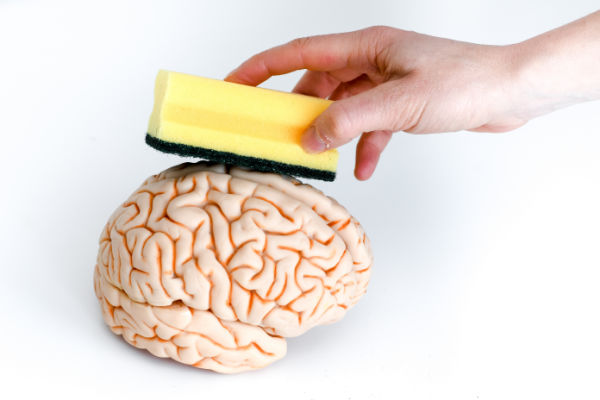
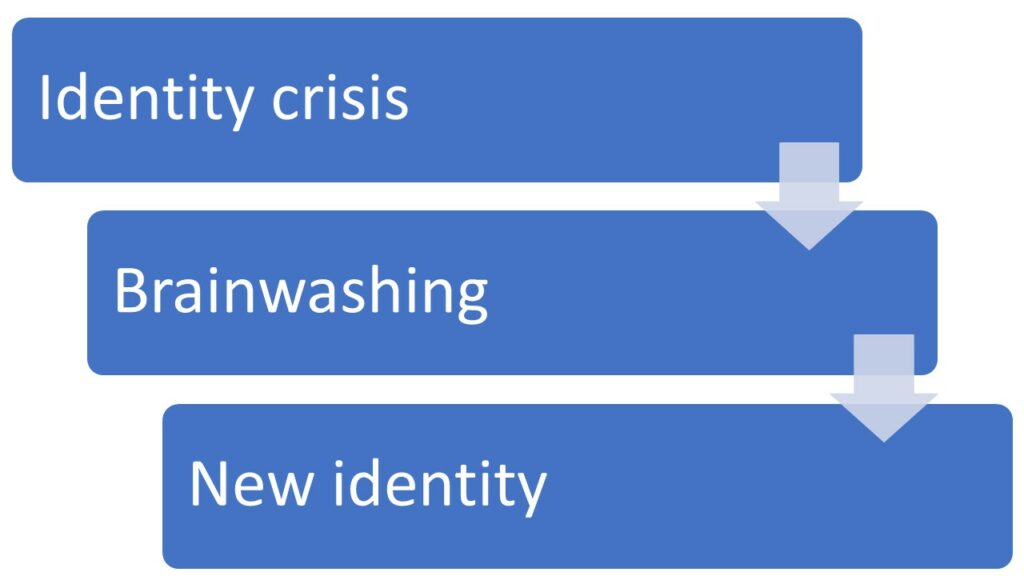
    Brainwashing is the process of repeatedly indoctrinating a person with a new set of beliefs. It’s helpful to think of brainwashing in terms of identity. When someone is brainwashed, they ditch their old identity and acquire a new one.

    The indoctrinated beliefs that support the person’s new identity change their thoughts and behaviors. The person is transformed.

    We’re all brainwashed in one way or the other by our society. It’s the process of socialization we all go through to better fit into our culture. While brainwashing has negative connotations, it isn’t necessarily a bad thing.

    People can form healthy beliefs via brainwashing. In childhood, at least, we learn a lot of things via brainwashing.

    Brainwashing is essentially acquiring beliefs without critical thought. Children can’t think for themselves and need to be brainwashed to turn them into functional members of society. But once a person becomes an adult, it becomes more and more important that they test the validity of their beliefs.

    Adults who’re not critical of their beliefs are vulnerable to abuse and exploitation. Those who go through the stage of individuation during their teenage years and develop a healthy sense of self have stable levels of self-esteem.

    This is not to say that those who’ve developed a strong identity for themselves can’t be brainwashed. Certain life events can make even the most stable people vulnerable to brainwashing.

    The brainwashing process

    In this article, when I mention brainwashing, I’m talking about an adult who suddenly becomes someone else via brainwashing. Brainwashing is usually associated with abusers and cults. Following are the agents that frequently engage in brainwashing:

    • Abusive parents and spouses
    • Cult leaders
    • Psychics
    • Radical preachers
    • Secret societies
    • Revolutionaries
    • Dictators
    • Mass media

    People brainwash so they can gain power over, control, use, and exploit the brainwashed.

    Not all can be brainwashed equally. Some people are more vulnerable to brainwashing. Sometimes, certain events occur that make people especially prone to brainwashing.

    People who’ve developed a strong identity for themselves are less prone to brainwashing. They’re not easily swayed by the influence of others. They know who they are and what they want. Their identity rests firmly on the foundation of intangible things no one can take away from them- their skills, traits, abilities, passion, and purpose.

    This is important because one may have developed a strong sense of self that rests on a volatile foundation. This is true for most people who strongly identify with their jobs, relationships, and material possessions.

    So, when a crisis happens and they lose their jobs, relationships, or possessions, it leaves a gaping hole in their identity. They suffer from an identity crisis.

    When someone goes through an identity crisis, they’re desperate for a new identity. They become vulnerable to brainwashing because it promises them a new identity.

    the brainwashing process

    People develop their identities via socialization. Identity formation is therefore a social thing. People seek to develop an identity that will be acceptable to their ingroups.

    This is why group psychology is such a key feature of brainwashing. Almost always, when a person is brainwashed, they leave their previous group (and related identity) to adopt a new group (and related identity).

    Brainwashers carry out their brainwashing in the following steps:

    1. Isolating the target

    If the target is lost and already going through a crisis, it’s likely they’ve separated themselves from their own group, at least mentally. The brainwasher isolates them physically as well by taking them to a different location and asking them to cut all contact from their previous group.

    2. Breaking down the target

    The brainwasher or abuser does what they can to completely destroy the target’s previous identity. They’ll make fun of the way the target has been living their life up until now. They’ll mock their previous ideologies and group affiliations.

    To prevent any resistance and destroy whatever self-esteem is left in the target, they’ll often humiliate, embarrass, and torture the target.

    3. Promising a new identity

    The target is now ready to be shaped the way the brainwasher wants to shape them. The brainwasher promises them a new identity that will ‘transform’ their life. The brainwasher invites the target into his or her group, where other members have also been transformed.

    This preys on the target’s fundamental human need for an identity seen as desirable by the group to which they belong.

    4. Rewarding the target for joining

    Cult members celebrate when they recruit a new member to give them a sense of accomplishment. The target feels they’ve done something worthwhile. Often, the brainwashing group will give the recruit a new name that’s in alignment with their newly adopted identity.

    Signs of a brainwashed person

    If you see most of the following signs, there’s a good chance they’ve been brainwashed.

    • They’re no longer themselves. They’ve turned into someone else.
    • Obsessed with their new beliefs, group, and the group leader. They can’t stop talking about these.
    • Strong attachment to their new beliefs. They’ll constantly tell you how you’re wrong about everything. They act like they’ve found ‘the answer’.
    • Follow the group leader unthinkingly, sometimes to their own detriment. But they can’t see that they’re being harmed.

    How to undo brainwashing

    If a target has been deeply brainwashed and for long, undoing brainwashing can be immensely difficult. How long it takes to undo brainwashing will depend on the depth of brainwashing.

    Beliefs solidify over time and are harder to break. The earlier you can undo someone’s brainwashing, the better.

    Following is the step-by-step approach you can take to reverse a person’s brainwashing:

    1. Isolate them from their cult

    As long as they stay in their group, they’ll keep reinforcing their identity and beliefs. So, the first step is to remove them from their group. Our beliefs require support from our environment.

    When the target is isolated or placed in a different environment, their mind can take a break and give itself a chance to re-evaluate things.

    2. Present yourself as an ingroup

    Ironically, the methods to undo brainwashing look a lot like brainwashing itself. It’s because the mind works how it works. We can’t escape the rules of the mind.

    Presenting yourself as an ingroup means you show the target that you’re on their side. If you try to convert them right out of the gate, they’ll resist you and think of you as the outgroup, i.e., the enemy.

    You can show them you’re on their side by being non-judgmental, non-defensive, compassionate, and respectful. You don’t want to give them any reason to resist you.

    3. Poke holes into their beliefs

    You don’t want to blast through their beliefs by telling them how wrong and ridiculous they are. That approach rarely works and makes them defensive.

    Instead, you want to ask them questions, show genuine curiosity. Ask them questions about what they believe with a mindset of “Let’s deconstruct these ideas together”. As you do this, make sure you point out the flaws in their convictions in a non-attacking manner.

    This ‘death by a thousand cuts’ approach will slowly weaken their beliefs. Do it repeatedly to plant the seeds of doubt in their mind.

    4. Show them how they’ve been brainwashed

    When you’re poking holes into their convictions, show them that their beliefs have no logical basis. Tell them they’ve accepted the ideas of their cult without critical thought.

    As you do this, it’s important to separate them from their beliefs. You don’t want to attack them, only their beliefs.

    Instead of saying:

    “You’re so naïve for having fallen into this trap.”

    Say:

    “Can you see how you’ve been brainwashed by X? Don’t worry, we can reverse it together. We can work through it.”

    This communicates that they’re separate from their beliefs. If they acquired those beliefs, they can also ditch them.

    Your goal is to appeal to their need for being rational. You show them that the way they developed their beliefs was anything but rational.

    5. Show them the MO of other brainwashers

    At this point, if they’re starting to question their beliefs, you can push them further by showing the modus operandi- and exposing the agenda- of brainwashers. Tell them stories and show them clips of cults who brainwashed and harmed people.

    This solidifies the idea in their mind that they were influenced like many others and can get back on track.

    While you do this, you’re planting the idea in their mind that the brainwasher is their enemy, i.e., the outgroup.

    6. Restore their previous identity

    You know you’ve successfully reversed the brainwashing if they experience an identity crisis. We experience an identity crisis any time we drop a major identity. They may feel lost, cry, or be angry.

    Your task at this point is to gently restore their previous identity. Talk to them about their previous self- how they were before the brainwashing. While you do this, make sure you communicate that you and everyone else liked their previous self very much.

    Tell them the thoughts they had, the opinions they held, and the things they used to do. This will help them settle in nicely into their previous identity.

    Note that once a person is brainwashed, they may not be able to completely return to their previous self. They don’t have to. Their mind has been stretched.

    They only need to drop the negative aspects of their indoctrinated beliefs and brainwashed identity. They can safely keep the harmless aspects of the brainwashing, and incorporate those into their previous self.

    7. Update their identity

    Explain to them how their brainwasher preyed on their weak identity and a lack of self-worth. If you care about them, you don’t just want to restore their previous identity; you want to update it.

    If they return to identifying with temporary, intangible things, they’ll again become susceptible to brainwashing when the next crisis hits. You want to teach them how to identify with their permanent skills, mindsets, and abilities.

    This will not only pave the way for a healthy level of self-esteem but also inoculate them from future brainwashing.

  • How to heal from abandonment issues

    How to heal from abandonment issues

    People with abandonment issues fear being abandoned by their loved ones. Being the social species that we are, all of us dislike being abandoned by others, especially by our relatives and in-groups. While some level of this fear is normal, a person with abandonment issues lives in this fear constantly.

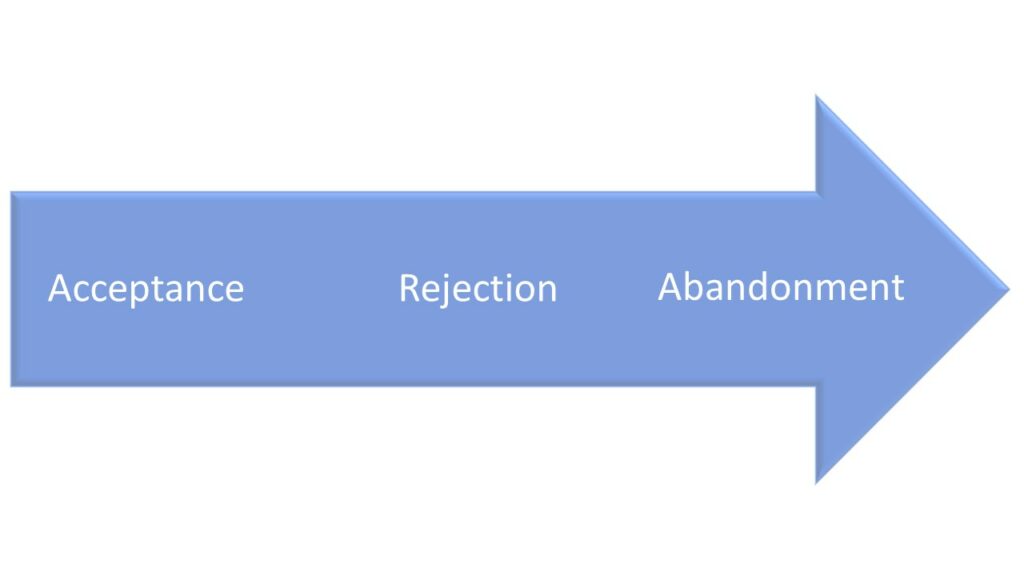
    Accepting and rejecting someone lies on a spectrum. We accept someone on one end of the spectrum and reject or abandon them on the other.

    It can be argued that rejection is better than abandonment because, at least in rejection, you don’t completely ignore the person. In rejection, you acknowledge them and then kick them out. In abandonment, you don’t even acknowledge them.

    acceptance spectrum

    What causes abandonment issues?

    Abandonment issues are mainly caused by parental emotional neglect in childhood. When parents don’t shower enough love, care, and attention on their children, the latter feel abandoned.

    Also, abandonment issues result from parents not letting let their children develop their own identities.1

    Children who’re loved develop a strong and healthy sense of self. They feel worthy and this gives them a better chance to thrive in life. Children who’re unloved fail to develop a strong sense of self. They feel unworthy and it prevents them from thriving in multiple areas of their lives.

    The deep-seated feelings of abandonment get carried over into adulthood and have an especially detrimental effect on the person’s relationships.

    Abandonment issues can also occur in adulthood if a person goes through a traumatic event involving the loss of a loved one such as a break-up, divorce, or a death.

    Signs of abandonment issues in children

    Separation anxiety is common in children. They usually cry when their parent leaves their company. In children with abandonment issues, this anxiety is exaggerated. Children with abandonment issues:

    • Cling to their parents all the time
    • Panic when their parent leaves
    • Fear of being alone, even at bed time
    • Get upset at the idea of their parent leaving in the future

    Signs of abandonment issues in adulthood

    Unresolved feelings of childhood abandonment can manifest in an adult’s behavior in a variety of ways. If a person shows more than half of the following signs, they likely have abandonment issues.

    1. People pleasers

    Those with abandonment issues seek to please people at all costs. They don’t want to do the slightest thing that has the chance of pissing people off.

    2. Attention seekers

    Their need to feel accepted forces them to present themselves to others as much as possible. They like showing off and having the spotlight of attention on them. If they notice that someone else in the room is getting more attention than them, they strive to get the attention back to themselves.

    3. Over-investing in relationships

    People with abandonment issues feel insecure in a relationship. So, they over-invest to ‘win over their partner over’ and reduce the chances of being abandoned. They shower their partner with compliments and gifts.

    4. Trust issues

    Feeling insecure makes it hard for them to trust others. They always have to be extra-sure before they can trust others or they think they’re risking being abandoned.

    5. Pushing others away

    A pre-emptive strike, they push people away before people get the chance to push them away.

    “I’ll abandon you before you abandon me.”

    6. Codependency

    Since people with abandonment issues tend to have a weak sense of self, they mainly build their self through their relationships. They identify with their relationship partners and, in doing so, often overstep their boundaries, becoming emotionally dependent on them.

    In short, they don’t have an identity and a life of their own.

    7. Constant reassurance

    Those with abandonment issues have to be constantly reassured that they won’t be abandoned. While some degree of such reassurance-seeking is normal in relationships, a constant need for reassurance points to abandonment issues.

    8. Controlling behavior

    Since they fear being abandoned, they do what they can to control the behavior of their partners so that their partners won’t leave them.

    9. Shallow relationships

    People with abandonment issues move from one shallow relationship to another because they fear intimacy. If they don’t get their emotions involved, they can’t be hurt and abandoned.

    10. Sabotaging relationships

    They act in irrational ways to get out of relationships. For example, they’ll make a big deal out of a petty issue so they can end the relationship and prove to themselves they’re unworthy of love.

    11. Clinging to unhealthy relationships

    If a relationship isn’t good for them, they’ll still cling to it because it’s better for them to be someone with someone than to be alone. They can’t stand being alone because then they’ll have to face who they really are, i.e., nothing.

    abandonment issues
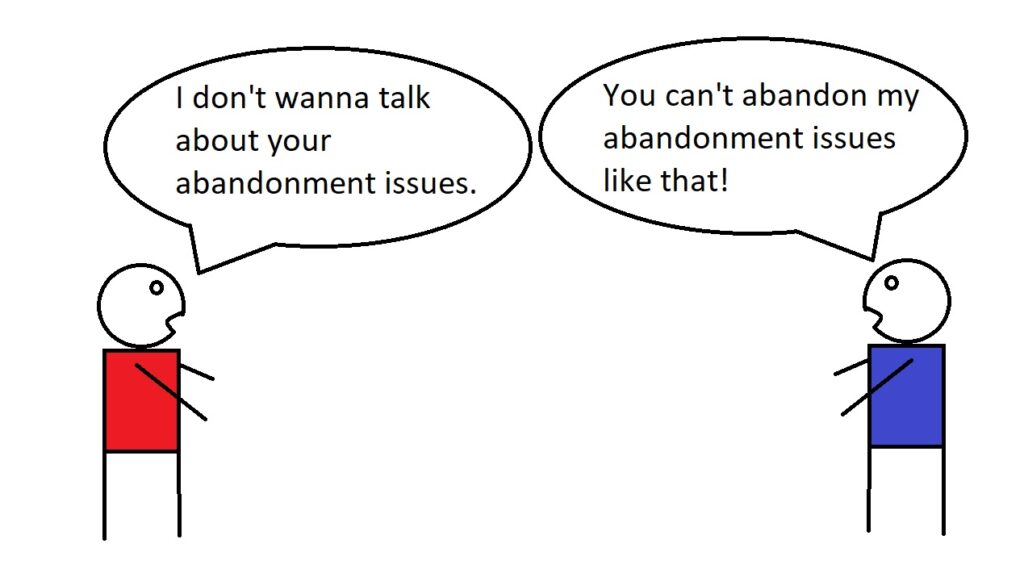
    His abandonment issues now have abandonment issues.

    Healing abandonment issues

    The first step to healing abandonment issues is to recognize you have them. Begin by looking back at your relationships. How have they been? Are there patterns you’ve been repeating over and over?

    It’s not always easy to link your present abandonment issues with your childhood, but you don’t need to. You can still cope with and overcome your abandonment issues.

    Following are some of the most effective ways to heal abandonment issues:

    1. Emotional expression

    You may have been abandoned in childhood, but couldn’t fully process it because you were powerless and dependent on your parents.

    The abandonment issues lingering inside you crave expression, no matter what mode of expression you choose. You may go to therapy and let it all out, talk to a friend, express yourself through art, and so on. Heck, you may even talk to your parents about it if they’re open.

    Expressing emotions helps the mind to process them. This makes it easier for the mind to put these things behind and move on.

    2. Healing internalized shame

    As mentioned earlier, children who’re not loved feel unworthy. They develop what’s called internalized shame. While feeling shameful is normal in certain situations, internalized shame becomes a person’s state of being.2

    This shame plus feelings of inadequacy envelop the core identity of a person, preventing them from experiencing life fully and exploring their potential.

    The way to heal this internalized shame is to work on developing a strong sense of self. Cliché as it may sound, internalized shame can only be overcome by ‘finding yourself’ or becoming your own person.

    You then need to keep feeding this new you until it completely envelops the core of who you are.

    3. Overcoming irrational fears

    Realize that your fear of losing your loved ones is exaggerated and irrational. Merely understanding how the dynamics of abandonment play out in your relationships should be enough to help you stop in your tracks and self-reflect.

    Practice catching yourself when this irrational fear of losing others has you under its grip. With time, it’ll get easier and you’ll make better decisions.

    4. See the good side of your relationships

    Your fear of abandonment forces you to see only the unpleasant side of your relationships so it can justify itself. You have to constantly re-adjust by focusing on the good side of your relationships. This will help you view your relationships more realistically, unclouded by fear.

    5. Flip the script

    We all run these relationship scripts in our heads that were shaped by our childhood experiences.

    “I’ll never marry someone like my mom.”

    “I want to be with a guy who’s like my father.”

    Our relationships with our parents and siblings create these models of love and affection for us that we look for or avoid in others.

    “What does this have to do with abandonment?”, you ask.

    Well, if you have the ‘I want him to be like my father’ script and you find he isn’t anything like your father, fear of abandonment can ensue. You’ll be like:

    “He does love me but he isn’t like my father.”

    This will create cognitive dissonance in your mind and you may resolve it by concluding your partner will soon abandon you. You want to sort of ‘maintain your script’ at the cost of losing a healthy relationship.

    When you become aware of these scripts, they can cease to have power over you.

    6. Ditching borrowed fears

    In Psychology, there’s this concept called introjection which means adopting the mental states and traits of those close to you.3

    For example, if your mother had abandonment issues because her father was never there for her, you may have ‘caught’ these issues from her.

    The more you identify with a parent, the more aspects of their personality will you introject. The solution to this- and I risk sounding like a broken record here- is to work on developing your own identity.

    Children go through this individuation stage during their development. They either come out of it becoming a new person or they remain copycats of their parents. Being a copy of your parent isn’t necessarily a bad thing, but be prepared to carry their personality baggage.

    7. Seek social inclusion

    Once you’ve developed an identity for yourself, seek people like you so you can feel accepted. If your identity deviates drastically from your social group, you’ll feel alien and abandoned.

    8. Accept yourself

    Look! the king of cliches is here- accept yourself. What does it even mean?

    Internalized shame makes us turn away from ourselves in a way. We hide from the shame and cannot accept who we are. Once you replace that shame with an identity you like, you can start accepting the new you.

    Once this happens, the world around you re-adjusts. You no longer attract unhealthy relationships. You expect people to treat you the same way you treat yourself. Your relationship with yourself becomes the model for your relationship with others, overriding whatever previous models your past may have saddled you with.

    Take the brief abandonment issues quiz to test the level of your abandonment fears.

    References

    1. Black, C. (2009). Changing course: Healing from loss, abandonment, and fear. Simon and Schuster.
    2. Claesson, K., & Sohlberg, S. (2002). Internalized shame and early interactions characterized by indifference, abandonment and rejection: Replicated findings. Clinical Psychology & Psychotherapy: An International Journal of Theory & Practice, 9(4), 277-284.
    3. Gobes, L. (1985). Abandonment and engulfment issues in relationship therapy. Transactional Analysis Journal, 15(3), 216-219.
  • How to comfort someone?

    How to comfort someone?

    Life is full of ups and downs. The ups are accompanied by positive emotions and the downs by negative emotions. Negative emotions bring discomfort and pain. The mind uses negative emotions to draw our attention to the pain.

    One could, theoretically, listen to one’s negative emotions, work through them and find solutions to end the pain. However, under the grip of such emotions, most people find it hard to stay calm and think rationally.

    When they’re experiencing a hard time, people seek an escape from their negative emotions. They achieve this via certain healthy and unhealthy coping mechanisms. One of the most effective and probably the healthiest coping mechanism is being comforted by social support.

    We’re a social species, and regulating our negative emotions via social contact is a key feature of our psychology. It starts in infancy when a baby calms down upon being held by another human. The need for emotional regulation via social contact and support persists throughout adulthood.

    This is why when we go through a rough time, we’re compelled to reach out to comforting people close to us.

    In sum, comforting someone is the process of taking them from a negative emotional state to a positive or neutral state via social contact.

    comforting someone

    Comforting others is a skill

    We all know that not all can comfort us equally. You probably don’t reach out to all your close friends for comfort. Some people seem to be better at comforting than others.

    That said, most people simply aren’t good at comforting others. They don’t know how to react when their loved ones are going through a rough time. Worse, they sometimes end up making others feel worse with their insensitive statements.

    If you’re a poor comforter, you can improve your skill of comforting others in no time. It’s all a matter of saying and doing the right things. You’ll say and do the right things when you gain a better and deeper understanding of the social dynamics involved.

    Social dynamics of comforting others

    We start by exploring the mental state of a person in discomfort. Those under the grip of negative emotions are prone to think irrationally. So, if you give them rational advice, don’t be surprised if they find it attacking, insensitive or irrelevant.

    When you’re trying to comfort someone, it helps to think in terms of emotions. The other person is emotionally hurt and they need to heal, emotionally. They’re not seeking rational advice, instructions, or platitudes.

    More often than not, the events that hurt people tend to be the ones that socially exclude them or have the potential to do so. Events such as:

    • A breakup
    • An argument
    • Rebuke by someone in authority
    • Making a mistake
    • Depression
    • Loss of a loved one

    So, the logical question to ask yourself is:

    “What can I say or do that will reverse the social exclusion?”

    Or simply:

    “What can I say or do that will make them feel included?”

    Approaching the problem with this mindset will go a long way in helping you come up with tactics to comfort someone.

    The second thing to keep in mind is that an emotionally hurt person tends to feel worthless. They feel vulnerable and their self-esteem takes a hit.

    So, another way to comfort someone is to raise their self-worth.

    While much emotional discomfort has a social cause, there are also non-social reasons that cause distress. For example, being stressed at work.

    People who experience this type of discomfort are more receptive to rational solutions. Still, as a thumb rule, always try to satisfy the emotional need for comfort first before you move on to something rational.

    Thus, social exclusion and a loss of self-esteem are the biggies of emotional discomfort. So, comforting someone is all about fixing these.

    How to comfort someone

    Before you learn how to comfort someone, it’s important to think about how close the other person is to you and the quality of your relationship. The closer you are to them, the more you can use the following comforting tactics liberally.

    If you’re not that close and there isn’t enough trust in the relationship, you risk coming across as intrusive. As a rule, don’t comfort those who didn’t seek comfort from you.

    1. Active listening

    The first thing to do when someone comes to you with a problem is to just listen. It’s mind-boggling how people try to short-cut this. Be fully present and soak in everything they tell you.

    “What happened?”
    “Tell me everything.”

    Active listening communicates:

     “I’m here for you.”
    “I’m willing to listen to you.”

    It’s the easiest thing you can do to make them feel included. 

    2. Validation

    Once you’ve listened to what they have to say; once they’ve verbalized their mental state, the next step is to validate them. Validating someone simply means acknowledging their thoughts and emotions.

    Examples of validating statements:

    “I’m sorry to hear that.”
    “That must’ve been so hard on you.”

    These statements acknowledge their mental and emotional state. Invalidating statements, on the other hand, try to dismiss or minimize their mental state. For example:

    “You need to get over it.”
    “It can’t be that bad.”
    “You’re overreacting.”

    Note that people who use invalidating statements are usually well-intentioned. But their statements backfire because they don’t realize they’re dismissing the other person’s mental state.

    Researcher Dale Hample aptly called these anti-comforting messages. They communicate:

    “I’m not engaging with your mental state.”
    “I’m not engaging with you.”

    Very excluding.

    3. Empathizing

    Your validation will be 100 times more effective if you can see things from their perspective. This is a skill that can take years to master.

    Empathy works when you can relate to how they’re feeling- when you’ve also experienced something similar. For instance:

    “I’ve been through a nasty breakup, too. It’s hell.”

    Again, it communicates social inclusion:

    “We’re in this together. We’re a team.”

    4. Being non-judgmental

    People often judge others negatively for feeling negative. This is a double whammy because not only are you invalidating them, you’re also attacking them. You’re sprinkling the salt of your negative judgments on their already bruised self-esteem.

    “You’re so weak.”
    “You need to be emotionally strong.”
    “You’re stupid for having made such a silly mistake.”

    By communicating that they’re worthless, you give them another reason to feel bad.

    Conversely, by being non-judgmental, you allow their self-esteem to heal. They feel justified in feeling how they’re feeling.

    5. Raising their self-esteem

    You can go one step further from being non-judgmental to actually raising their self-worth. Focus their attention on their excellent qualities- praise and encourage them.

    “You’re a resilient person. I strongly believe you can overcome this.”

    Note that this shouldn’t be done at the cost of invalidating them. Don’t jump to telling them how special they are before you’ve taken the time to listen to them and validate them.

    6. Comforting through physical contact

    The simple acts of holding someone, resting your hand on their shoulder, or hugging them can be very comforting. Again, don’t do these things before you’ve validated their mental state or you come across like you’re providing ‘fake’ comfort.

    fake hug
    A ‘fake hug’ often happens too early in the interaction. The hugger thinks they can quickly hug the problem away.

    7. Showing them you’re on their side

    When people are hurt by others, their group psychology kicks in. They think of the person who hurt them as an outgroup and they recruit ingroup support. You are their ingroup support.

    This is why saying bad things about the ‘outgroup’ can be very comforting.

    “Yeah, your boss is a total jerk.”

    8. Lowering yourself

    Another excellent tactic that works on their loss of self-worth. When something bad happens to a person, they feel unworthy and lower than the average person.

    If you lower yourself too, you reduce the gap and they don’t feel as bad about themselves.

    For example, if they made a silly mistake, you can say:

    “I once made the same mistake.”
    “I’ve made ton of mistakes in my life.”

    Not only does this communicate that it’s okay to make mistakes- a healthy mindset to have- but it also heals their self-esteem. They’re like:

    “I’m not an unworthy person for making mistakes.”

    9. Offering solutions at the right time

    Once you’ve brought them to a neutral or positive emotional state from a negative one, it’s time to engage their rational brain.

    But wait.

    You need to be careful here too. Don’t shove advice down their throat. You need to approach their troubles with a mindset of:

    “Let’s explore what’s going on. Maybe we’ll stumble on a solution along the way.”

    It’s better to gently lead them to a solution than to throw it in their face. If you do the latter, they’ll feel you’re being dominating. They might disagree for the sake of disagreeing, to take back their power. Even if your solution is valid, they’ll resist it.

    Offer your solutions without attacking or overpowering them. You need emotional intelligence to help them understand their emotions and come up with appropriate solutions.

  • How to stop dissociating

    How to stop dissociating

    Dissociation is a psychological phenomenon in which a person feels disconnected from reality or from themselves. It occurs on a spectrum, ranging from mild to severe.

    Spacing out and daydreaming are common examples of mild dissociation. You may have noticed that they’re often triggered by mild discomfort, boredom, and information overload. The mind going blank is another example of dissociation. It’s triggered by the painful feelings of fear and anxiety that one may experience while giving a speech or talking to a crush.

    On the other end of the spectrum, we have severe dissociation that is triggered by severe trauma. For example, in dissociative identity disorder, a person’s identity dissociates into two or more separate identities.

    What triggers dissociation?

    Dissociation is the mind’s way to disconnect from a painful reality. Humans are strongly motivated to avoid pain. Dissociation is a defense mechanism the mind uses to avoid getting overwhelmed by negative emotions, such as anxiety and fear.

    As such, any trauma may trigger dissociation, such as:

    • Abuse
    • Assault
    • Accidents
    • Natural disasters
    • Military combat

    Dissociation is a common symptom of not only dissociative disorders but also anxiety and mood disorders.1Boysan, M., Goldsmith, R. E., Çavuş, H., Kayri, M., & Keskin, S. (2009). Relations among anxiety, depression, and dissociative symptoms: the influence of abuse subtype. Journal of Trauma & Dissociation, 10(1), 83-101.

    While mild dissociations tend to be harmless, severe dissociations—especially chronic ones—can have significant negative consequences.

    Once a traumatic event has occurred, dissociation can linger in the psyche of the victims. People have experienced dissociation for minutes, hours, days, months, and even years.

    Triggers that remind a trauma victim of their past trauma bring to the surface painful memories that can also trigger dissociation. Dissociation has this spillover effect, whereby it gets triggered by all fearful or anxiety-provoking situations.

    Dissociation can thus become the go-to coping mechanism of the mind once it’s triggered by trauma. Nothing in the victim’s life remains the same anymore. It’s as if a switch gets turned on in their minds that keeps disconnecting them from reality, or from themselves.

    A quick way to experience dissociation is to stare at something for a long time. Eventually, the mind cannot tolerate the discomfort of perceiving the same stimuli repeatedly, leading to dissociation.

    I sometimes experience dissociation when I’m looking at myself in the mirror. I get this temporary ‘sense’ that I’m an outside entity occupying my body.   

    Types of dissociative experiences

    There are two types of dissociative experiences:

    1. Depersonalization = Disconnecting from oneself
    2. Derealization = Disconnecting from the surroundings

    1. Depersonalization

    In depersonalization, the person feels detached from their own body, perceptions, actions, and emotions. People who’ve experienced depersonalization sometimes feel they’re floating above their bodies.

    On rare occasions, a person not only perceives but also interacts with their ‘double’.2Cardefia, E. (1994). The domain of dissociation. Dissociation: Clinical and theoretical perspectives, 15-31.

    Other depersonalization experiences include:

    Feelings of yourself being absent or unreal, Intense fear, distorted sense of time, breathlessness, blurry vision, feeling physically and emotionally numb, bodily actions that seem to happen on their own, feeling like you’re dragging your body around.3Lambert, M. V., Sierra, M., Phillips, M. L., & David, A. S. (2002). The spectrum of organic depersonalization: a review plus four new cases. The Journal of neuropsychiatry and clinical neurosciences, 14(2), 141-154.

    2. Derealization

    In derealization, a person feels disconnected from their surroundings and other people to the point that the world around them seems unreal. Some say the world feels dull and grey.

    I once experienced derealization during a flood that submerged almost all areas around our locality. As I looked at the roofs of submerged houses, I felt I’d been transported to another, fake world.

    Derealization is a form of denial of the current reality. The current reality is too painful for the mind to process, so the mind distorts it.

    How to stop dissociation

    If you experience mild dissociations occasionally, you have no cause for concern. Dissociation becomes a problem only when it’s severe and chronic. As you can imagine, being constantly ‘offline’ can impair all areas of one’s life.

    Following are the different ways to stop dissociation:

    1. Grounding techniques

    These techniques are designed to get you back into your head and body. This is usually done by engaging one or more senses. Examples of grounding techniques include:

    • Looking at something visually appealing
    • Tasting something tasty
    • Describing the sounds that you’re hearing
    • Touching something hot or cold
    • Smelling something strong-smelling
    • Moving your body

    When you engage your senses, you pull yourself back into your head, allowing you to break free of a dissociation session.

    We’ve all done some grounding at some point. Say we’re eating with someone, and they seem to have taken a trip down memory lane. We then engage their visual sensory system by waving our hands before their eyes.

    2. Remembering the function of dissociation

    When people experience severe dissociation, they get scared and confused because they haven’t experienced anything like it. Reminding yourself of the purpose of dissociation is a good way to cope with dissociation. You let it do its work. When it’s done, it’ll leave.

    The tricky thing about coping with dissociation is that you’re coping with a coping mechanism. When you understand the purpose of dissociation, you fight it less.

    Instead of fighting dissociation, you see it as a signal that there’s some pain in your life that you need to face. Some unresolved issue needs resolving, and some unfaced fear needs facing.

    Facing pain provides us with valuable information about ourselves. It tells us what we need to fix in our lives. Dissociation’s purpose is to avoid pain, no matter how useful facing that pain might be. Let it do its work. You can dig deep into the pain later.

    “Your pain is the breaking of the shell that encloses your understanding.”

    – Kahlil Gibran, The Prophet

    3. Processing unprocessed trauma

    Trauma tends to linger in our psyche because it remains unprocessed. Healthy processing of trauma means making sense of it so you can make peace with it and move on. Of course, this isn’t a piece of cake. Gaining knowledge and seeking help from competent professionals can be immensely helpful.

    When you heal your trauma and can put your past behind you, you can start to feel safe again. Dissociation can’t coexist with safety and comfort. It’ll go away when your mind no longer needs to protect you.

    4. Developing a strong sense of self

    If you’re a regular reader here, you know I’ve talked about the importance of a strong sense of self a gazillion times. Dissociation fragments the self: sometimes temporarily and sometimes for a long time.

    How quickly your self re-integrates will depend on how resilient it is. If you have a fragile sense of self, it’ll be easy to disintegrate.

    When you dissociate, your mind begins the process of creating a separate identity with a separate memory. The mind tries to compartmentalize the painful memories into this newly created memory bank so that ‘your’ memory doesn’t have to deal with them.

    Therefore, dissociation leads to disturbances in the self and disrupts the healthy development of the self.4Carlson, E. A., Yates, T. M., & Sroufe, L. A. (2009). Dissociation and development of the self.

    This is one of the reasons why people who experience dissociation and trauma also have low self-esteem. They’re not clear about who they are and what they want. When you have a strong sense of self, you can better resist the dissociating forces of dissociation.

    References

  • How to handle being shunned

    How to handle being shunned

    Humans are a social species that evolved to live in tightly-knit, genetically related groups. Early humans highly depended on their groups for survival. Being shunned by one’s social group likely meant death.

    Therefore, humans have developed psychological mechanisms to be sensitive to the signs of shunning. They seek to conform to their group and avoid non-conformist behaviors that are likely to get them shunned.

    Also, they experience psychological pain when they’re shunned. The pain that people experience upon being shunned has been termed social pain.

    Interestingly, physical pain and social pain are experienced as the same in our brains.1

    Just as physical pain draws our attention to the injured body part, social pain draws our attention to problems in our ‘social body’ or social circle.

    Shunning can be as simple as avoiding eye contact to as extreme as being exiled from one’s home country. It can occur at the level of interpersonal relationships to the level of one’s social group. The silent treatment that relationship partners give each other is a form of shunning.

    However, in this article, when I talk about being shunned, I’m referring to being shunned by one’s social group.

    Why do people get shunned?

    Shunning is basically a group’s attempt to protect and preserve itself. Ancestral human groups had to protect themselves from other human groups and predators. The stronger and more united a human group was, the better it could protect itself.

    Ancestral human groups were largely based on genetic relatedness or genetic similarity. Individuals were motivated to help those who were related to them because, by doing so, they were helping the reproductive success of their own genes.2

    The simplest way to tell if an individual belonged to the group was by looking at their physical similarity to other group members.

    If someone looked too different, they were probably from another, genetically unrelated tribe. They were an outgroup. And human groups had to protect themselves from outgroups.

    The different-looking individual would’ve gotten shunned because they were perceived as a threat to the integrity of the group. They were “other genes” trying to infiltrate one’s own gene pool.

    The same thing happens today at so many levels. People who look different and belong to groups different from one’s own are stigmatized, discredited, and shamed. Racism and nationalism being glaring examples.

    Physical similarity is just one among many similarity criteria that hold groups together. Groups that live together also had to be psychologically similar. They had to share the same beliefs, values, norms, and traditions.

    Anyone who deviates from the norms of one’s social group is communicating:

    “I’m not one of you.”

    By doing this, they’re threatening the group and inviting ostracism.

    In this scenario, shunning can be used as a means of social control. The person being shunned is effectively being told:

    “Be like us to be a part of us or get out.”

    How to handle being shunned

    At best, a person who’s shunned is ignored or socially boycotted. At worst, they may be subjected to acts of violence.

    A lot depends on what part of the world you live in. In freer countries, there’s more freedom for a person to be as different as they want from any of their social group. In not-so-free countries, social exclusion can have dangerous consequences.

    To help you handle being shunned, I want to introduce an important concept to you- warmth score. Once you understand what warmth scores are and how they play a role in shunning, you’ll know how to handle being shunned.

    Warmth scores and shunning

    Within a group, people are usually nice and warm to each other. Their warmth scores for each other are all positive. They all tend to look the same, think the same, and behave the same. This instills in them a feeling of belonging and security.

    Say one group member questions the norms of the group. They find flaws in the group’s dominant ideology. Essentially, by being different, they’re behaving coldly with the other group members. This person’s warmth score in the eyes of the group members decreases.

    If the person continues thinking differently and poking holes in the group’s norms, their warmth score drops to zero. At this point, they might get socially boycotted. They’re seen as a threat to the group- an outgroup.

    Of course, when you’re seen as an outgroup by your group, you’re going to see them as outgroups too. This creates a breeding ground for mutual hostility.

    Social exclusion creates anger, fear, and anxiety in the excluded individual, and they may resort to aggression. They’re likely to become increasingly offensive to the group. Their warmth score becomes negative.

    The group will probably retaliate with aggression. This creates a negative cycle whereby the person’s warmth score keeps becoming more and more negative. Then comes a point where the group will have it no more and commit an act of violence on the person.

    When you hear instances of assassinations and mob lynching, they’re not usually one-off events. Many small preceding events lead to that event. The pot had been boiling for long. What you see is the dramatic overflow.

    warmth scores chart

    If you’re someone caught in this negative cycle and don’t live in a free society, I highly recommend you nip the evil in the bud.

    Stop offending your group immediately. And turn a blind eye to the offense and aggression that they subject to you. Remove people from your life who gave you hate for thinking differently. Block them on social media. They’re only going to drop your warmth score more and more.

    With time, things will settle down. Your warmth score will become less negative and eventually climb to zero.

    When your warmth score is zero, you’re in a relatively safer position. Now you can think clearly.

    Basically, you have two options. You either rejoin the group or find another group to join.

    Re-joining the group

    I understand that not all people have the freedom or the means to join a new group. You may be forced to stay in your group. But to do so, you need to cease showing them you’re too different from them.

    In fact, to make your warmth score positive, show them you’re like them.

    “Think as you like but behave like others.”

    – Robert Greene, The 48 Laws of Power

    I’m all for being different and rocking the boat, but there’s a limit to how far you can go. Make sure you don’t rock the boat so much that it tips over and ends up drowning you.

    Sometimes you have to do the smart thing. Share your uniqueness with those who’ll appreciate it. Don’t throw your pearls before swine.

    Joining another group

    Find a group that’s in alignment with your values and beliefs. Luckily, in today’s world of the internet and social media, you can always find communities you can resonate with. This largely counteracts the negative effects of social exclusion.

    Studies show that positive social interactions with even one other person can dissolve the negative effects of social exclusion.3

    joining new group

    Developing tolerance

    No matter how much conviction you have in your beliefs and values, the simple fact of life is that you can’t expect others to think like you. If you live in a society where freedom of thought is appreciated, great. You probably already have a decent level of tolerance for differing thoughts.

    If you don’t like the values and traditions of your society, ask yourself if it’s worth trying to change people’s minds. Changing people’s minds is not an easy thing to do- a near-impossible feat. Is it worth the potential costs associated with trying to do so? If yes, good luck! If not, I’m sure you have better things to spend your time on.

    References

    1. Eisenberger, N. I., Lieberman, M. D., & Williams, K. D. (2003). Does rejection hurt? An fMRI study of social exclusion. Science, 302(5643), 290-292.
    2. Bourke, A. F. (2011). The validity and value of inclusive fitness theory. Proceedings of the Royal Society B: Biological Sciences, 278(1723), 3313-3320.
    3. Twenge, J. M., Zhang, L., Catanese, K. R., Dolan‐Pascoe, B., Lyche, L. F., & Baumeister, R. F. (2007). Replenishing connectedness: Reminders of social activity reduce aggression after social exclusion. British Journal of Social Psychology, 46(1), 205-224.
  • How to stop being salty

    How to stop being salty

    Being salty means being bitter towards something or someone. When others make you salty, they ‘leave a bad taste in your mouth’. Of course, they don’t physically put something bitter in your mouth. But it certainly feels that way.

    Human experiences are fascinating, as always.

    It’s natural to feel bitter towards someone when they intentionally harm you. But bitterness goes beyond that. Humans are naturally selfish and competitive. We also feel bitter towards someone if they get ahead of us.

    Following are the situations that have the potential to trigger your bitterness:

    • When your best friend doesn’t invite you to a party
    • When your friend gets better grades than you
    • When your sibling gets a higher paying job than you
    • When your parent fails to meet your demand
    • When you lose a game
    • When your crush doesn’t reply to your texts
    • When your relationship partner talks to an attractive person
    • When your roommate leaves a mess
    • When you believe that life is unfair

    Saltiness vs resentment

    There’s an important difference between being bitter and being resentful. Resentment is accumulated bitterness. If your bitterness lingers longer than it should, it turns into resentment. Resentment is a poison for relationships.

    Therefore, it’s important that you learn how to stop being salty or at least understand what’s making you so bitter.

    Ways to stop being salty

    We have little control over how we feel, but we do have a good deal of control over how we respond to our feelings. Hence, you can’t really avoid or stop feeling salty, but you can definitely stop being salty.

    Following are the important mindsets and practices that will help you better deal with your saltiness:

    1. Analyze your bitterness
    2. Choose whether to express your bitterness
    3. See things from others’ perspectives
    4. Realize it’s okay to lose and fail
    5. Embrace your dark side
    6. Accept that life can be unfair

    1. Analyze your bitterness

    See situations that trigger your bitterness as opportunities for self-understanding and self-improvement. What triggers you is often what you need to heal.

    When you give yourself time and space to analyze your bitterness, you’re less likely to leave a bad taste in others’ mouths. You’re too focused on yourself.

    Try figuring out what’s making you feel bitter and what you can do about it.

    2. Choose whether to express your bitterness

    If your bitterness is warranted, it’s a good idea to express it. But only with people close to you. People who’re not close to you are less likely to care about your bitterness. They’ll most likely accuse you of being ‘too sensitive‘.

    As a rule, express your bitterness in close relationships when you can. It’ll give the other person an opportunity to clarify things. If they really care about you, they’ll care about addressing your bitterness, warranted or not.

    For people that aren’t close to you and who make you bitter, it’s a good idea to focus more on assertiveness. Present your bitterness as minor discomfort. Let them know how they’ve inconvenienced you in an unemotional manner.

    When your bitterness is unwarranted, the best way to deal with it is to not express it at all. Resolve it in your own mind. This is why an analysis of bitterness is the crucial first step.

    3. See things from others’ perspectives

    This is by far one of the most important social skills to develop. I practice it all the time. I still feel I have a long way to go.

    We’re wired to care much more about ourselves than about others. This gets in the way of trying to put ourselves in others’ shoes. When we see things from others’ perspectives, we often find they had good reasons to do what they did. They weren’t intentionally harmful toward us, even though what they did made us salty.

    If you’re salty because someone’s more successful than you, think about how hard they must have worked to get where they are. They’re just like you with their own dreams and goals. They deserve to reap the fruits of their hard work. How would you feel if someone got embittered by your hard-earned success? Exactly.

    4. Realize it’s okay to lose and fail

    So many people- even those who consider themselves enlightened- suffer from this problem. Yes, failing and losing feel bad. It’s okay. Life’s about winning and losing. You can’t win all the time.

    I was once playing an indoor game with a person close to me. They were consistently losing, and I could sense it was making them salty. I lost on a couple of occasions, too. It didn’t feel great, but I was more or less okay with it.

    When they kept losing, they kept saying, “Let’s play another game” so they could eventually win. When they finally won, they didn’t want to play again.

    At this point, I was laughing internally. I couldn’t believe winning was so important to them. After all, it was only a game. I didn’t ask them to play another game because I’m okay with losing.

    The incident got me thinking, though. Some people are so afraid of losing and failing that they won’t even try things. What a poor and stifling mindset to have.

    5. Embrace your dark side

    Another problem that many people have is that they have too high an opinion of themselves. They think they’re noble souls and morally superior to others.

    When they get embittered over petty things, this moral high ground of theirs is shattered. When they’re brought face to face with their darkness, they can’t handle it. They may also get an identity crisis.

    The solution to this is to embrace your dark side. We all have an evil side to us we like to keep hidden, and for good reasons.

    The key is to remember that those evil tendencies come as part of the package of being human. You can’t really get rid of them. But you can use them as a force for good.

    For example, your competitiveness can drive you to become successful and do good in the world.

    Being moral isn’t:

    “I’m free from all evils.”

    Being moral is:

    “I know I have both good and evil tendencies. I’d like to make the best use of both to live a life in alignment with my values.”

    6. Accept that life can be unfair

    Life doesn’t owe you anything. Life isn’t a person you can expect to be fair. Don’t be good so that life can be good to you. Be good because you want to. Many people live in the mistaken belief that if they’re good, life will bestow good things upon them.

    Whatever happens, happens. It often has nothing to do with the type of person you are. Karma isn’t real. So, there’s no point in feeling bitter towards life.

  • How to stop being shallow

    How to stop being shallow

    There seem to be two types of people in the world- shallow and deep. You probably have some idea of who deep people are. Their thoughts, feelings, and words have depth. They have the ability to see beyond the surface.

    Shallow people are the complete opposite. They lack depth in their thoughts, words, feelings, and knowledge. They’re more concerned with superficial things and can’t seem to go deeper.

    Highly sensitive people and introverts, and people who’re both, are more likely to be deep. Whereas extroverts and low-sensitivity people, and people who’re both, are more likely to be shallow.

    Before we discuss how to stop being shallow, let’s first get good at identifying shallow people.

    Signs of shallow people

    Besides being an extrovert and/or low in sensitivity, following are the signs someone is likely to be a shallow person:

    1. They avoid deep conversations

    Since a shallow person can’t think deeply, they have little to contribute to deep conversations. So they avoid deep conversations like a plague.

    They might even make fun of people who have deep conversations to cover up the inferiority they feel from not being able to take part in such conversations.

    2. They avoid talking about their feelings

    A shallow person cares a lot about appearances and impressing others. Talking about one’s feelings involves showing one’s vulnerable side. Since a shallow person wants to appear perfect, they avoid showing their vulnerable side even to people who’re close to them.

    3. They don’t form meaningful relationships with people

    A shallow person’s relationships are just like them- shallow. People form meaningful relationships with other people when they can connect deeply with them.

    A shallow person lacks the ability to connect deeply with people. Their relationships hardly go beyond the pleasantries and the formalities.

    4. They’re closed-minded

    Thinking deeply has a lot to do with setting aside your preconceived notions, questioning your beliefs, and seeing things from different perspectives. A shallow person wants none of that. They’re content with their preferred and safe ways of thinking about the world.

    5. They’re attention seekers

    Since shallow people are so caught up in trying to impress others, they like having all the attention on themselves. They’ll talk loudly and over other people so they can take the lion’s share of attention in social situations.

    6. They lack empathy

    Shallow people have an air of selfishness to them. They seem to not care about others at all. They prefer being friends only with those who can benefit them materially. Deeper, more meaningful relationships go beyond material benefits.

    7. They identify with their material possessions

    More often than not, they buy things not because they need them but because they want to brag about them. They find it hard to give up their prized material possessions because losing those would for them mean losing a part of themselves.

    8. They lack consideration for others and put them down

    Again, it’s just a way to make themselves look better. They’ll find a weak and unassertive person and constantly put them down in front of others. The unassertive person may accept this bullying because the shallow person says, “I’m just joking”.

    Yes, mutual joking and teasing is a healthy part of friendships, but of equal friendships. If the unassertive person dares to make a joke on the shallow person, the latter will get real pissed.

    Why a shallow person may want to become deeper

    First off, there isn’t a single person out there- deep or shallow- who doesn’t want to improve their relations with people. Most just don’t know how. Becoming a bit deeper will greatly help shallow people to connect with others, especially deep people.

    When a deep person enters a relationship with a shallow person, it’s quite frustrating for the former. The shallow person may love them, but because they can’t connect with them deeply, the deep person feels a tad unsatisfied.

    If you’re a shallow person trying to connect with a deep person, you don’t have to overhaul your personality overnight. But you can take small steps today to have a deeper connection with the deep people you care about.

    How to stop being shallow

    Following are the practical things you can do to stop being shallow:

    1. Improve your communication skills
    2. Talk more about your inner world
    3. Talk less about surface-level things
    4. Cultivate interest in deeper topics
    5. Be open-minded
    6. Practice being non-judgmental
    7. Unleash your creativity
    8. Don’t let your possessions own you
    9. Appreciate the beauty in simple things

    1. Improve your communication skills

    Overcome the tendency to talk more than you listen. Doing this simple thing will improve your relationships with deep people significantly. Even if you’re not really interested in what they have to say, the simple act of listening to them will validate them and foster a connection.

    2. Talk more about your inner world

    Talk more about your thoughts and feelings. When you talk about your thoughts and feelings, others are like:

    “He/she is a human being I can relate to.”

    It increases your closeness with people. Talk about how things make you feel. Talk about your experiences and your reactions to those experiences.

    3. Talk less about surface-level things

    You might love small talk and celebrity gossip, but try going deeper for once. Practice becoming a good thinker. Surround yourself with deep people and their ways of thinking will rub off on you. It’ll open up a whole new world for you.

    4. Cultivate interest in deeper topics

    I know interest can’t be faked. You’re interested in something or you’re not. But interest can be cultivated. Try learning more about deep topics. The more you dig into them, the more likely it is that you’ll develop an interest in them.

    At the very least, try to cultivate a minimal level of interest in the things the deep people in your life care about. You don’t have to become a pro, just try to gain some basic knowledge so you can have good conversations.

    5. Be open-minded

    Being open-minded entails breaking out of your intellectual comfort zone often. Think and talk about the things you’ve never thought of and talked about before. If you do this regularly, you’ll leave shallowness and being boring far behind.

    6. Practice being non-judgmental

    We humans are judgmental by nature. The tendency is worse in shallow people. When you get tempted to criticize someone’s hairstyle or dressing sense, don’t.

    Remind yourself that a person is more than their looks, and second, you’re just trying to feel better about yourself. You’re free to think what you want about people but avoid verbalizing your low opinions of superficial things about them.

    7. Unleash your creativity

    By being shallow, you’re not just ruining your relationships, you’re also stifling your creativity. Creativity and deep thinking go hand in hand. If you can’t stretch your mind to new horizons, you can’t become creative. Creativity and thinking outside the box show you have depth of thought.

    8. Don’t let your possessions own you

    You own your possessions, they don’t own you. Move away from identifying with material things to identifying with your personal qualities so that even if you lose your possessions, you won’t lose yourself.

    9. Appreciate the beauty in simple things

    If you’re a shallow person, you frequently miss the beauty in the simple things around you. You’re too caught up in celebrity gossip to appreciate the sunset. You’re too caught up in impressing others to appreciate movies, music, art, and poetry.

    Make time for these things and your life will become more colorful, and you’ll become less shallow.

    Final words

    Becoming a deep person is mainly about shifting focus from the outer, superficial world to the inner world. But become too deep and you may become an impractical, overly sentimental and an off-putting person. Become too shallow and your relationships, creativity, and open-mindedness will suffer.

    As with many things in life, it’s about balance. Look deeply into yourself and into things, but also keep an eye on the surface.

  • How to stop being nosy

    How to stop being nosy

    Humans are social species hard-wired to care about the business of other humans in their social circles. It’s what made us tick for thousands of years. An unwanted consequence of this tendency is nosiness.

    I have done a separate piece on what makes people nosy that you might want to check out.

    Long story short, nosiness allows people to collect important information about others. They use that information to compare themselves to others, get an idea of their own social standing and find out how reproductively successful others are.

    Humans evolved in tightly knit, genetically related groups in which the group members highly depended on each other for their survival and reproductive success. As human society progressed, the groups became larger and larger.

    The result being that an individual today comes into contact with many people (in real life, and more so on social media). Most of these people don’t belong to their ‘tribe’. Yet, their tribal tendency to poke their nose into another tribe member’s affairs remains.

    So, they end up interfering in the affairs of people that don’t actually belong to whatever they consider their tribe.

    Closeness and information sharing

    How much information a person reveals about themselves is proportional to their closeness to the receiver of that information.

    Imagine there are concentric circles of closeness around each person. People who belong to the inner circles or zones have access to more personal information about the person whereas people belonging to the outer circles enjoy little access.

    Every person you come across either belongs to the:

    1. Stranger zone

    People falling in this zone have little or no access to your personal information. Nosiness from such people can be the worst and may even turn you aggressive.

    2. Acquaintance zone

    Those in this zone know you and you know them. There’s minimal exchange of personal information. Nosiness from people who belong to this zone is also unacceptable.

    3. Friendship zone

    A lot of personal information is mutually shared in this zone. Still, some important personal matters are also kept secret. We rarely accuse these people of being nosy.

    4. Relationship zone

    People belonging to this zone are people who’re the closest to you. They have access to most of your personal information. They’re only deprived of the contents of your mind that you’ve never shared. These people are almost never accused of being nosy unless they find a way to peek into your mind.

    zones of closeness

    How the closeness zones work

    When we share our personal information with someone, we do that based on how close we think they are to us or how close we want them to be.

    For instance, when you’re trying to convert a friend into a lover, you do that by sharing more personal information with them. You also encourage them to share more personal information so that it becomes a mutual thing.

    This way, you pull them from the friendship zone into the relationship zone. This mutuality is what keeps a person in a particular zone.

    For a person to stay in a zone, the personal information they share with you has to be balanced by the proportionate personal information you share with them.

    If either you or them withdraw from sharing personal information, they move to the outer zones. If you both increase the amount of shared personal information, they move into the inner zones.

    When they expect you to share more personal information than you should based on the zone they’re currently in, it’s their attempt to forcefully move into your inner circles. This is nosiness.

    Nosey people expect you to share your personal information with them even though you don’t expect them to share the same information. There’s no mutuality here. They’re stepping out of the bounds you’ve set for them.

    Their attempt to get close to you (or show ‘care’) by asking for your personal information creates an artificial closeness that you feel compelled to push back against.

    artificial nosiness

    Ways to stop being nosy

    If you’re a nosy person, you’re asking people personal questions that they don’t expect from you based on the zone you’re in.

    In each zone, people can only ask certain types of questions. Sure, you can try to ask more personal questions and push your way through into their inner circles. But that can only happen if they let you. There needs to be mutuality.

    Following are the things you can do to stop being nosy:

    1 Assess their response to your increasingly personal questions

    A great way to know what zone you belong to is to ask them increasingly personal questions. If they answer your questions, great. You’re definitely in the zone you thought you were in. Or you can move into the one you want to move into.

    If they don’t answer, you’re probably being nosy. If you have to pressure people to answer your questions, you’re definitely overstepping your limits and being nosy.

    2. Re-adjust and calibrate

    It’s understandable that you may want to get closer to a person. Or you may desperately want to know something about them. Whenever you try to step outside of your bounds and they push back, always re-adjust. Avoid asking further inner zone questions and stick to your zone.

    Occasionally, you might want to share information about yourself that is more personal than the zone you’re currently in. If they’re glad you shared this information, they’re likely to reciprocate, moving you into the inner zones.

    The key is to stick to your zone as much as possible and occasionally make bids to enter their inner zones, watch how they react, and re-adjust.

    3. The mutuality test

    The best way to determine whether you’re being nosy is to use the mutuality test. Ask yourself the following questions:

    “Have they asked me a similar question about the same topic before?”

    “Would I answer them if they asked me a similar question?”

    If the answer to any of the above is “No”, you’re risking being too nosy.

    4. Avoid asking questions about evolutionarily sensitive topics

    People prefer to guard their evolutionarily sensitive information against other people the most. Such topics include:

    • A Close relationships (e.g., “Are you and X still together?”)
    • Money (e.g., “How much do you make?”)
    • Health (e.g., “What were the results of your diabetes test?”)

    You should always double-check that you’re in the right zone when you ask questions on these topics.

    Of course, this ‘zones of closeness’ framework is only a general guideline. There are situations where people have to share personal information with those they’re not close to.

    For example, sharing information about your health with your doctor. Another example would be sharing information about your relationships with a therapist.

    Interestingly, feeling close to your therapist is a common phenomenon. It’s because you’ve shared so much personal information with them that your mind seeks consistency by pulling them into one of your inner zones.

  • How to stop being so sensitive

    How to stop being so sensitive

    A highly sensitive person easily senses threats in their social environment. They have a lower threshold of getting offended. Hence, they’re often labeled as thin-skinned and overreactive by others.

    Both genetic and environmental factors seem to contribute to high sensitivity. Introverts and those who score high on Neuroticism are likely to be highly sensitive.

    Traumatic experiences in early childhood sensitize a person’s nervous system to easily detect threats in their social environment. Therefore, being highly sensitive is a defense mechanism designed to enhance a person’s ability to detect and respond to social threats.

    Pros and cons of high sensitivity

    Highly sensitive people are amongst the most interesting people out there. Some of their positive qualities include:

    1. Feeling things deeply

    Highly sensitive people have lower stimulation thresholds so they’re easily stimulated. They need time to process information and avoid overstimulation. They’re able to dive more deeply into things others may not pay much attention to.

    This is why highly sensitive people are more affected by books and movies. While others may be like “Yeah that was a good movie”, good art transforms highly sensitive people. Similarly, they’re more affected by songs and music.

    2. High self and other awareness

    People who’re overly sensitive are super aware of themselves and of others. They talk a lot about their own mental states and are interested in the mental states of others. This enables them to easily connect with others. They easily sympathize and empathize with others.

    3. Intuitive

    This is the consequence of their high self and other awareness. They’re more in tune with their intuition than the average person. They pay attention to and respect what their intuition has to say. They can give more weight to their intuition in their decision-making compared to the average person.

    4. Passionate

    Highly sensitive people want to do things that make them feel good. They’re feelings-driven and may make choices in their career and relationships that seem ‘irrational’ to others.

    Now let’s look at some cons of high sensitivity:

    1. Being thin-skinned

    As mentioned earlier, highly sensitive people are easily hurt. They’re likely to see social threats where there are none. Sure, their high sensitivity helps them detect subtle social threats others can’t see but this ability comes at the cost of seeing a non-threat as a threat.

    2. Unable to control emotions

    Highly sensitive people find it hard to control their emotions. There are many situations in life where controlling one’s emotions is desirable. Overly emotional people are perceived as weak. Highly sensitive people know this and constantly struggle with this. It motivates them to seek information on how to be less sensitive.

    3. Unable to handle criticism

    The hallmark of highly sensitive people. Instead of seeing criticism as feedback, their brains see criticisms as personal attacks in their persistent defensive mode.

    4. Overthinking

    While being highly sensitive gives a person the gift of thinking things through, this ability comes at the cost of overthinking stuff they shouldn’t pay much attention to. For instance, they might spend too much time rearranging their desk at work than actually working. Their minds can’t help but pay attention to the details.

    Changing your response to triggering events

    There isn’t much we can do to change our sensitivity given that genetic and childhood factors are at play. Therefore, being less sensitive is mostly about changing our response to triggering events as opposed to changing our sensitivity to them per se.

    Thus, the goal of being less sensitive is to tone down your emotional reaction to triggering events.

    emotional sensitivity chart

    How to be less sensitive

    Following are the strategies you can try to tone down your emotional responses and ‘become less sensitive’ in your own eyes and in the eyes of others:

    1. Learn to hide your emotions
    2. Delay your emotional reaction
    3. Avoid taking things personally
    4. The subtle art of non-reaction
    5. Heal your insecurities
    6. Learn to handle criticism

    1. Learn to hide your emotions

    I was going to title this ‘Learn to control your emotions’ but realized that reducing your emotional response is more about hiding than controlling. We can’t really control the triggering of our emotions.

    What we do have some control over is whether we express our emotions. Even if you feel offended, you don’t have to express how you feel in your facial expressions, words, and body language.

    There’s no way for others to know you’re getting emotional unless you show it. You can feel how you feel internally and silently. Only express your emotions when it’s useful to do so. When you feel your emotions silently, you aren’t suppressing them. You acknowledge them and choose not to express them.

    When you do this enough, you create negative feedback where your mind is feeling one thing but your body is neutral. This may eventually raise your threshold of being offended because the mind doesn’t like inconsistency. It wants the bodily gestures to reflect our feelings.

    Choosing not to express your emotions makes your mind second-guess its emotional responses, ultimately triggering you less often.

    2. Delay your emotional reaction

    Whenever you’re emotionally triggered, delay your response. I know this isn’t easy but with enough practice, you’ll get good at it. Whenever your mind pushes you to be emotional, say to yourself, “Okay, let’s see what this is all about”.

    You want to delay your emotional reaction so you can create space to analyze your emotional reaction. After thorough analysis, you might find that your emotional reaction was unwarranted.

    For example, you may get angry when your girlfriend doesn’t reply to your texts sooner. Instead of lashing out at her, you can delay your reaction, giving yourself space and time to analyze. Eventually, you might come up with a more realistic alternate explanation, such as:

    “It’s her studying time right now.”

    Delaying your emotional reaction helps you see things from the other person’s perspective. When you do that, you’re likely to find that their motives had nothing to do with you.

    3. Avoid taking things personally

    Humans are prone to taking things personally. In highly sensitive people, this tendency is worse.

    Being in a constant defensive mode, taking things personally enables them to ‘more effectively’ defend themselves against perceived threats. But a lot of times those threats are just that- perceived.

    As a rule, avoid ascribing harmful intent to people based on one-off events. If they really mean harm to you, they’ll repeat their harmful behavior. Always gather more data before you label someone an enemy.

    4. The subtle art of non-reaction

    When you’re attacked or feel you’re being attacked, try not to react at all. When you react, you give them the power to get under your skin. When they successfully get under your skin, you’ll be perceived as weak.

    If they get to know your buttons, they’ll push them at will and you’ll become their puppet. Avoid handing them the remote control of your reactions by embracing non-reaction.

    Non-reaction blocks their attempt at getting under your skin. But you need to do it effectively. Your facial expression and body language shouldn’t communicate fear because that’ll make people go like, “He was too dumbfounded and weak to say anything back”.

    Instead, you want to give your attacker the “I don’t care what you say” or “Oh, here you go again with your BS” look.

    It’ll help if you can pull off a smirk and look away. Also, immediately get back to doing what you were doing, showing you’re not affected in the least by their attack. Maintain a blank facial expression and say something like, “Are you done? Anything else you want to say?”

    In your own mind, you need to see them as absolute nobody who knows nothing about anything. If they’re so clueless, they wouldn’t know anything about you. So you can’t take them seriously.

    5. Heal your insecurities

    What we’re triggered by often reveals what we need to heal. Getting offended at things others wouldn’t normally find offensive points to insecurities. There are two ways of healing insecurities:

    • A Changing things
    • Accepting things you can’t change

    For instance, if you’re insecure because you’re thin, the best way to deal with it is to grow bigger (changing things).

    On the other hand, if you’re short, the sooner you accept it as a part of who you are, the better. Focus on improving your other qualities to increase your overall value as a person.

    6. Learn to handle criticism

    This a tricky one. Criticism may either be warranted or unwarranted. The problem with highly sensitive people is that they mistake warranted criticism for unwarranted criticism.

    Of course, truly unwarranted, unnecessary, and public criticism points to harmful intent. The person is trying to make themselves feel better by putting you down.

    But- and here’s the tricky part- the desire to put you down is easier to hide when the criticism is warranted. If you accuse them of putting you down, they can easily hide behind the legitimacy of the criticism.

    This is why highly sensitive people have so much trouble with criticism. It’s difficult to tease out constructive criticism from criticism laden with intent to harm.

    If the criticism seems unwarranted, I suggest you look at how that person treats you in general. If they don’t normally mistreat you, their criticism is likely to be constructive.

    It’s also about how, where, and when they criticize.

    Public criticism is never good. Constructive criticism shouldn’t make you feel bad at all. But people tend to be bad at criticizing (I realize I’m criticizing criticizing) so they might harm you unintentionally.

    Again, look at their general behavior towards you. That’s more likely to reflect their true intentions.