Category: Tips and techniques

[rank_math_breadcrumb]

Learn how to use the knowledge of psychology to deal with your negative moods and emotions, feel good, be productive, handle people well, and reach your goals. Self-improvement and personal development are inevitable while you’re trying to understand how the mind works. It all starts and ends with the mind.

Top posts:

Recent posts:

  • How to get over phone anxiety (5 Tips)

    How to get over phone anxiety (5 Tips)

    Phone anxiety or telephobia is when you want to make or attend a phone call, but fear stops you from doing it. You know that the call is important to you, but you get so nervous that you try to talk yourself out of doing it.

    People who don’t like talking on the phone usually have phone anxiety. This anxiety is an extension of their social anxiety. They have problems interacting with people in general.

    At the same time, some people just don’t like talking on the phone. Not due to anxiety but other reasons such as phone calls taking up too much time.

    Also, some people don’t have social anxiety- they’re okay with in-person interactions- but phone calls can get their hearts racing.

    This is why it’s essential to realize that you can only say that you have phone anxiety when, deep down, you want to make or attend that call but are afraid of doing it.

    Needless to say, being afraid of making or attending calls can be detrimental to your professional and personal life. While most jobs no longer require you to call nowadays, many customer-facing jobs (like Sales) still require that you get good with phone calls.

    Phone anxiety symptoms

    If you still have doubts about whether or not you have phone anxiety, the following symptoms of phone anxiety should clarify things:

    • Extreme fear before, during, and after the phone call
    • Doing what you can to avoid phone calls
    • Delaying making or attending phone calls
    • Over-analyzing the call after the call
    • Being afraid the call won’t go well
    • Worrying about bothering the other person
    • Worrying about saying the wrong things
    • Experiencing physical symptoms of anxiety like increased heart rate and shaking
    • Being self-conscious during the call
    • Your loved ones complaining that you never call them

    What causes the phobia of phone calls?

    To answer this question, we need to look at how telephonic communication differs from other modes of communication, especially texting and face-face interaction. Email is delayed texting.

    Unlike texting and face-face interaction, phone conversations require that you think on your feet. Texting gives you time to craft the perfect text. You can even ask your friends to provide you with feedback on the text.

    You don’t have that luxury in calling. Phone calls immediately put you on the spot. If you were to pause to craft the right thing to say, the other person would find it hard to make sense of the pause. Pauses make phone conversations awkward.

    But phone conversations are more intimate than texts. You feel more connected to the person whose voice you’re hearing.

    Still, phone calls aren’t as intimate as face-to-face interactions. Phone calls allow you to pick up on paralanguage- the manner of speaking- which conveys a lot in addition to words. But a lot is still left out that can only be accessed during in-person interactions.

    So, phone calls put you in this weird spot between texting and in-person communication. You feel intimate, but there’s a ton of nonverbal communication that you miss out on.

    When we interact with others, we pay attention to their feedback to gauge how the interaction is going. The other person’s nonverbal feedback allows us to read their emotions and course-correct.

    Phone calls deprive you of all this crucial information, and your fear that you might be bothering the other person or that the call isn’t going well exacerbates.

    Phone anxiety may get worse when you’re in a public place. Sounds that we can’t make sense of are effective in drawing our attention. When people hear you talking on the phone, they only get to hear one side of the communication.

    Our minds like to fill in the gaps. This makes them pay more attention to you than they would to regular two-sided interaction. Their brains can’t help but try to figure out the other side of the communication.

    You know this, and it makes you even more afraid to make phone calls in public.

    How to get over phone anxiety

    At the root of phone anxiety- and social anxiety in general- is the fear of being evaluated negatively. Also, you don’t want to mess up because the call is important to you.

    This is why phone anxiety may only show up when you have to attend a high-stakes call. Be it a call for a job interview or the first call with your crush.

    All novel experiences tend to induce slight anxiety in us, but high-stakes novel experiences where mistakes can be costly are breeding grounds for anxiety. When messing up has the highest potential to ruin your life, that’s when you’re most afraid to mess up.

    Ironically, the fear of messing up often makes people mess up.

    Phone anxiety can be effectively dealt with using the following techniques:

    1. Strive to be rational

    Your high-stakes phone call induces extreme fear in you, which makes you distort reality to fit that fear. You become worried that you’ll mess things up. You recall incidences from your life where you messed up similar situations in the past.

    You’re trying to weave a narrative to feed your fear.

    Take a step back and think more rationally. Some good questions to ask yourself are:

    • “Have I always messed up similar situations in the past?”
    • “What are some examples where my first call with someone went well?”
    • “What’s the worse that can happen if I mess up?”
    • “Will I be done for if I mess up, or can I still remedy things?”
    • “Am I being a perfectionist?”

    Having healthy beliefs about failure can help significantly. Even if you mess up the phone call, the world will probably not end. You’ll get more opportunities to make things right.

    Having a healthy belief about anxiety will help even more. Realize that it’s natural to feel some fear when you’re doing something new. When you let anxiety be and quit fighting it, it comes and goes like a guest in a hurry.

    2. Make more phone calls

    We feel so anxious while trying new things because we have little or no deposits in what I call our confidence bank account.

    We all have a confidence bank account for each of our skills. The more deposits you have in an account, the more skilled you are. What are these deposits, you ask?

    These deposits are reps with positive outcomes. The more you do something successfully, the larger your confidence bank account for that skill grows.

    Of course, the first deposit will be small and will probably yield a negative outcome (failure). But as you keep trying and depositing, your deposits become better.

    So, the way to get good at phone calls (and everything else) is to do it repeatedly.

    Since many people prefer texting over calling these days, their ‘calling confidence bank account’ is lacking. They don’t have a lot of experience taking on the phone. The way to remedy it is to expose yourself to more phone calls.
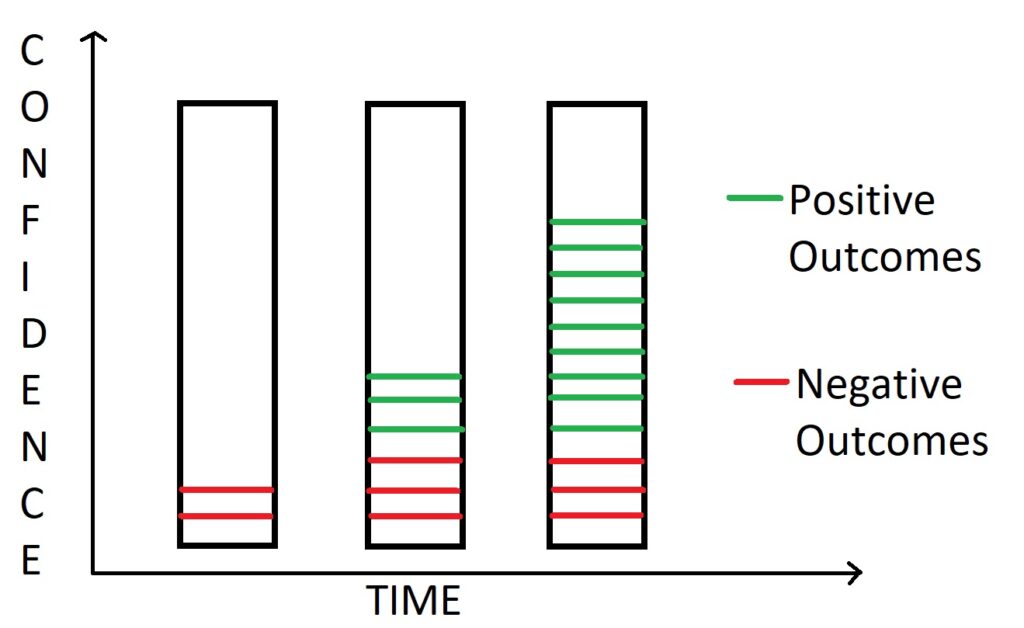
    confidence deposits
    Positive outcome deposits overshadow negative ones over time, building confidence.

    3. Preparation

    Anxiety is nothing but a message from your mind that you’re unprepared for an important upcoming event. You’re unprepared because you’re not confident. You’re not confident because your confidence bank account is lacking.

    You want more deposits, but you don’t have much time. What do you do?

    After all, it takes months or years to obtain sufficient positive outcome deposits. But there’s a way to short-cut this process, a way to trick your mind into being more confident about something where it lacks deposits.

    That trick is preparation.

    Preparation and practice are nothing but making continuous deposits into your confidence bank account.

    By rehearsing how you’ll speak during the phone call over and over, you eventually convince your mind that you have enough positive outcome deposits to go for it.

    4. Reframe the situation as a chance to learn

    Sure, by not making the phone call, you’ll stay in your comfort zone. But what are the costs of that?

    Avoiding the call altogether may be detrimental to your personal or professional life. It’s likely to be worse than calling and messing it up. Your deposit will remain at the same low or zero level.

    If you make the call and mess up, at least you deposited something in your confidence bank account. You’ll learn a ton and make better deposits in the future. Avoiding the experience altogether is missing a chance to make a deposit.

    5. Focus on the other person

    Before the call, intend to focus more on the other person. Anxiety forces us into this ‘self-monitoring mode’ where we obsessively focus on ourselves to avoid making mistakes.

    But if you decide to see this situation as a chance to learn, you’ll maximize your learning if you focus more on the other person. Listen to what they have to say and pay attention to how they respond to you.

    The more you focus on them, the more likely you will pay attention to their needs. They’ll feel understood, and the communication will go well.

    Sometimes you can’t fool your mind

    If you lack proper communication skills, you can’t fool your brain into thinking that you’ll do well. Preparation can help, but you need to put in the reps and make those actual deposits.

    Also, if you’re likely to bother the other person, you can’t fool your brain into thinking that you won’t bother them. For instance, most people don’t like getting cold-called.

    So, if you’re in Sales or Marketing and cold-calling is your marketing strategy, maybe your anxiety about bothering people is justified and you should try a different marketing approach.

  • How to fix a relationship after a huge fight

    How to fix a relationship after a huge fight

    While occasional fights are typical for most relationships, a huge fight can drive a wedge into a relationship. Big relationship fights affect us differently than small fights that get quickly resolved.

    Huge relationship fights force us to re-evaluate the relationship. We wonder how things got so bad. We probe deeper than ever into what went wrong. You said things to your partner you thought you’d never ever say. Anger made you say and do things that you now feel bad about.

    You feel hurt, sad, anxious, and depressed.

    All is not over. You can still change things for the better. How you handle things now could vastly improve your relationship in the future.

    Here’s a step-by-step guide to fixing a relationship after a huge fight:

    1. Don’t make matters worse

    If you’ve just come from a huge relationship fight, the worst has probably already happened. The arrows have left the bow. Dragging out the conflict further by adding more fuel to it would make matters even worse.

    Stop everything, cut the interaction, and separate yourself from your partner.

    If you see that the conflict is getting uglier with each passing second, you should de-escalate things immediately by not attacking back. Resist the temptation to have the last word by countering the pointed remark with your pointed remark.

    2. Reflect on what went wrong

    Now that you’re on your own, your anger has subsided, and you’re no longer in ‘attack mode’, you can reflect on what happened with a cool head.

    You’ll naturally play the movie of your fight in your head repeatedly. Don’t just sit there and watch the movie. Think about why things took the turn they did.

    Think about what I call communication breakpoints. Conflicts usually arise when one partner says something and the other misinterprets it as offensive.

    How did you and your partner handle these breakpoints?
    Did you become defensive without clearing up what they meant?

    For instance:

    Him: “I forgot to get milk from the grocery store.”
    Her: “You always do this. Big surprise.”
    Him: (gets angry) “Why don’t you do it then?”

    She thinks he forgot to get the milk because he doesn’t care about her. Not true. He simply forgot. Based on her misinterpretation of the situation, she accuses him of “always” doing this. Again, not true.

    Then, he gets angry at her misinterpretation of the situation, and the conflict escalates.

    It’s important to understand where her accusation “You always do this” is coming from. It highlights the trap people are likely to fall into when they’re under the grip of emotions like anger or fear.

    When we feel threatened, our mind tries to justify the threat using selective stories from the past. This emotional inertia, driven by confirmation bias, sustains the anger and fuels the conflict.

    When she accused him of “always” doing this, she was already offended (“He doesn’t care”). So, her mind probably pulled all the previous incidences of him being careless while ignoring the incidences where he showed care.

    So yeah, she isn’t lying or anything. It’s just that her mind’s playing tricks on her to sustain her negative emotion. But he thinks she’s deliberately lying (his misinterpretation of the situation) and gets angry.

    Rarely will partners deliberately hurt each other in relationships that are healthy overall. Most conflicts in such relationships are the result of communication break points.

    It doesn’t matter who fell into the trap of poor communication first. When you’re fighting, you’re both knee-deep into it.

    3. Resume communication

    Resuming communication after a fight is all about fixing the breakpoints that led to the conflict.

    When we get angry, our emotional part of the brain takes over, and communication suffers, increasing the frequency of breakpoints.

    Now that you’ve had the chance to reflect on the interaction, it’s time to resume communication and review what went wrong in the previous interaction. This step is essential and shouldn’t be skipped. Some people are like:

    “Let’s forget what happened and start afresh.”

    Nope. You and your partner were at each other’s necks for a reason. You can’t just ‘forget’ what happened and move on. You have to address your issues before you move on.

    These issues and fights expose weak points of a relationship. The relationship evolves and strengthens over time when these weak points are addressed.

    If you don’t resolve issues properly as they appear, they’ll turn into resentments and rear their ugly heads in future conflicts years later. Your partner will use them as weapons against you in their future conflicts with you. You’d be like:

    “Why’s she bringing this up now? I thought she was over this.”

    4. See things from their perspective

    When you resume communication with a cool head, you’re in an excellent position to see things from your partner’s perspective- the master skill of interpersonal communication. Earlier, when you were jabbing your partner with your words, you couldn’t do this.

    Now is an excellent time to understand where they were coming from, where you were coming from, and why you two clashed head-on.

    5. Validate their thoughts and concerns

    Healing a relationship after a huge fight is all about moving from poor communication to better communication. Validating the other person’s thoughts and emotions is crucial for effective communication.

    When communication breakpoints occur, partners enter ‘attack and defend’ mode and leave the ‘communicate properly’ mode.

    Now that things have calmed down, you’re in a good position to validate your partner’s thoughts and have them validate yours.

    6. Apologize for your part in the conflict

    Even if you weren’t directly responsible for communication breakpoints, how you reacted to those breakpoints, and your partner’s reactions, likely fueled the conflict.

    It isn’t about who started the fight. It’s about who fueled it. Both partners are responsible for fueling the conflict. Therefore, both partners should apologize for their respective parts in the conflict.

    7. Learn what you can from the fight

    A relationship is like a person. If it doesn’t learn from its mistakes, it repeats the same mistakes. Over time, conflicts tend to fall into the same patterns.

    In fact, having a different conflict each time is a good sign that the relationship has learned from a previous conflict and is evolving.

    I’m not suggesting that you actively seek conflict, but it’s concerning if you repeatedly have the same conflict. It means your relationship has stagnated.

    You and your partner improve and grow when you healthily resolve your relationship conflicts. You become better and better at communicating, empathizing, seeing things from another’s perspective, and handling conflicts.

    You gain tremendous self and other understanding. Your relationship becomes more resilient. You’re like:

    “If our relationship can survive this, it can survive anything.”

  • How to get through to a stonewaller

    How to get through to a stonewaller

    Stonewalling is when one relationship partner ceases all communication with the other partner. The stonewalling partner disengages from their partner, physically and emotionally.

    The victim of stonewalling may try hard to communicate with a stonewaller, but it’s as if the stonewaller has erected a stone wall around themselves that blocks all communication from their partner.

Stonewalling behaviors

Stonewalling can take many forms, but giving ‘the silent treatment’ is the most common way people stonewall in relationships. Other stonewalling behaviors include:

Reasons people stonewall

Stonewalling can be voluntary or involuntary. When unintentional, it’s mostly a defensive reaction to stress and overwhelm. When it’s voluntary, it’s usually a punishment for perceived wrongdoing.

1. Stonewalling as a defense mechanism

It may be a lot to handle when things get emotionally charged, especially for men and introverts. Research shows that around 85% of men stonewall in relationships. They go to their figurative ‘man-cave’ and take a long time to self-soothe.

Women, on the other hand, can self-soothe relatively quickly. One minute, they’re angry with you; the next, they’re saying loving things to you.

Women feel stress and drop that stress rather quickly with some ‘self-care’. For men, stress is a problem they need to solve quietly in their ‘man-cave’.

2. Stonewalling as punishment

Deliberate stonewalling is used to punish one’s relationship partner.

Both relationship partners have the desire to connect. When one partner thinks they’ve been wronged, they’ll stop talking to the other partner. This silent treatment sends the following message:

“I’m withdrawing my love, care, and support because you wronged me.”

It’s an act of revenge and punishment. It’s also a way to exert power.

Now, it’s up to the stonewalled partner to ‘win’ the stonewaller back. If the stonewalled partner wants to talk and connect again, they must apologize and make amends.

3. Stonewalling as an avoidance mechanism

Stonewalling can be used to avoid or de-escalate conflicts. Conflicts gain momentum when there’s continuous back-and-forth between the two parties. When one party stonewalls, it short-circuits the conflict.

Also, it’s just fruitless to argue with some people. No matter what you say, you know they won’t listen. They refuse to empathize with you or don’t know how to communicate. In such cases, stonewalling can be a valuable tactic to avoid long, pointless arguments.

Effects of stonewalling

Stonewalling can damage a relationship because it closes all lines of communication. Communication is what keeps relationships alive. Research has shown that stonewalling is a significant predictor of divorce.

Stonewalling damages relationships by:

Getting through to a stonewaller

Before you take steps to re-establish communication with a stonewalling partner, try to figure out what they’re trying to achieve with their stonewalling. Is it a defense mechanism? A punishment? Or an avoidance strategy?

Sometimes these reasons can overlap. If you have no reason to think your partner may be punishing you, great. You only need to allow them to calm down and process their emotions. Once they do, they’ll resume communication with you as if nothing happened. Once communication is on again, you can complain about their stonewalling behavior assertively. Let them know how it makes you feel and why it’s unacceptable.

Responding to stonewalling by getting angry or trying too hard to re-establish communication immediately seldom works. If you batter a stone wall, it won’t break; you’ll only get hurt. There’s a reason they’re showing this behavior. Let them.

When stonewalling = punishment

If you have reason to believe that stonewalling is a punishment, you need to follow the same strategy. Give them space to stonewall.

What you do next will depend on how much you value the relationship. After you’ve given them some time, resume communication. Ask them why they stonewalled you.

Often, you’ll find they had a genuine reason to feel wronged. Apologize if you did wrong them, intentionally or unintentionally, and clear their misconceptions if you didn’t.

Tell them that even if they felt wronged, they should’ve been upfront about it and that stonewalling isn’t how to handle such issues. Be sure to call them out about their stonewalling so they don’t repeat this behavior.

If they’ve been stonewalling you repeatedly, chances are they’re using stonewalling to manipulate you and exert power over you. If you always rush to win them back after a bout of stonewalling, they have an excellent little weapon in their kit that they can use any time they want to have their way.

In this case, you want to respond to their stonewalling with stonewalling. Doing that will send them the message that you can do it, too.

By stonewalling them back, you refuse to give them the pleasure and satisfaction of bothering you at the mere press of the stonewalling button. Show you’re unaffected by their stonewalling. They’ll think their stonewalling isn’t working, and they’ll drop it like a hot potato.

If they care about you, they’ll be forced to quit their game, and the power struggle will end.

Stonewalling in relationships is a symptom of a lack of open communication. If partners cannot openly communicate their hopes, dreams, fears, and concerns, the relationship won’t last.

  • My ex moved on immediately. What do I do?

    My ex moved on immediately. What do I do?

    Breakups are hard and what’s harder is seeing that your ex has moved on immediately after the breakup. While you’re still here, grieving over the loss of your relationship, your ex has already started a new relationship.

    You feel repulsed, disgusted, angry, and hurt.

    You think:

    “Did I mean nothing to them?”
    “Was it all fake?”
    “Did they ever really love me?”
    “Were they putting on an act this whole time?”

    Wait a minute!

    If you really loved them and wanted them to be happy, shouldn’t you be glad they moved on quickly?

    No, you find yourself miserable and hurting. All those noble-sounding claims of “I’m happy if they’re happy with someone else” vanish into thin air.

    The reality is humans are selfish and want the best for themselves. They put themselves first, especially in matters of survival and reproduction.

    When you lose a romantic partner, you lose a reproductive opportunity, and there’s no way you can fool your mind into thinking, “I’m happy if they’re happy with someone else.”

    I’m not saying you can’t get there. You can, but only when you’ve gained closure and truly moved on. And that usually happens when you find a new relationship i.e. when you secure a new reproductive opportunity.

    What not to do when your ex moves on quickly

    When you’re hurting because your ex moved on right away, you’re in a vulnerable position. You’re in a negative mental state where your mind tries to discount the entire relationship as fake.

    You selectively re-visit bad moments of the relationship and negative things your ex did to ‘confirm’ that your ex never really loved you.

    At the same time, you forget all the positives of the relationship. You forget the times your ex loved you and cared about you. You forget the fond memories of the relationship.

    As you can see, this is a very biased and unfair way to look at your previous relationship.

    Try not to be selective in your reminisces of the relationship. You’re only painting a negative picture of the entire relationship to reinforce your present mental and emotional state.

    Another common way to deal with the hurt is to discount your ex’s new relationship by calling it a rebound relationship. You believe your ex hasn’t had the time to grieve appropriately and deal with the pain. They can’t stand being alone, so they’ve jumped into a new relationship.

    You call your ex shallow and claim they haven’t learned from their mistakes. Well, you chose to be in a relationship with this ‘shallow’ person previously. What does that make you?

    Different people are affected differently by breakups. People have their own ways of coping. Some take time to recover while others recover quickly.

    In fact, those who get into the so-called rebound relationships tend to move on quickly from a breakup. It doesn’t necessarily mean the previous relationship meant nothing to them.

    They probably moved on quickly for their mental well-being.

    What to do when your ex moves on immediately

    Now that you’ve rebalanced your mind and re-visited not just the bad but also the good moments of the relationship, you’re in a better position to gain closure. Be grateful for the time you spent together, and move on.

    Think about the reasons why the relationship didn’t work out. Project yourself mentally into the future where you’re back with your ex and have to deal with the same problems that ended the relationship. Do you want it to be your future?

    Sometimes, the fact that your ex has moved on to a new relationship can give you the closure you need because you can be sure there’s no chance to get back together.

    Often, the reason we’re not able to move on from a breakup is we still think there’s a chance things can work out.

    Accept the fact that your ex has moved on. Avoid blaming them, saying bad things about them, and claiming they haven’t grown or healed. They were a significant part of your life, even if you’re not together now.

    When your ex hasn’t really moved on

    So far, in my discussion, I‘ve assumed that your ex found a new, suitable partner and has really moved on. However, there are instances when your ex hasn’t really moved on from you.

    They jumped into the new relationship because they needed temporary relief or they wanted to show you that they’ve moved on.

    It’s possible that the hurt you’re feeling now was a deliberate plan of your ex. They knew that you seeing them move on so quickly would hurt you.

    I want to reiterate here that this scenario is not likely. If your ex was a good person overall, they wouldn’t resort to these tactics. If they’ve done extreme things in the past to hurt you, you should consider this possibility.

    If your ex is trying to make you jealous by showing you that they moved on, there are a couple of things you can look for to confirm that is indeed the case:

    1. “Let’s be friends.”

    There are three reasons why an ex would insist on being friends with you. These reasons are not necessarily exclusive.

    The first is that you’re a cool person they still care about you, not enough to be in a relationship but enough to be friends. This is a very enlightened and mature way to handle a breakup, and few people can pull this off.

    The second reason is that they want to have options. They think that they can get back together with you if their new relationship fails.

    The third, and the most twisted reason, is that they want to rub their new relationship in your face. They aren’t over with you yet and are hungry for revenge. It shows they’re still bitter and want to get back at you.

    For instance, when you talk, if they can’t stop gushing about their new partner, you’ll feel it. You’ll feel it when they make a big show of their new relationship on social media, knowing full well that you’re active on the platform and can see their posts.

    Even if what they’re doing hurts, appear totally unaffected if you want to drive them mad.

    However, you’ll soon realize how ridiculous the entire thing is. Eventually, you’ll get frustrated and end the ‘friendship’ too.

    2. Who’s the new lover?

    Another way you can tell that your ex hasn’t really moved on is by looking at their new partner. If they lowered their standards for this new partner, it’s likely they jumped on the most accessible option to either avoid the pain of being alone or to make you jealous, or both.

    You’re like:

    “I can’t believe she chose him. She didn’t even like him.”

    This is a good sign of desperation and laying your hands on what you can find for the short term.

    Honestly, if you suspect your ex is playing games like these, they’re not worth being in a relationship. They can’t even break up with you properly and with integrity. You can’t expect them to be a good relationship partner with all these immature antics.

    Seriously, cut your losses and move on.

  • How to be more mature: 25 Effective ways

    How to be more mature: 25 Effective ways

    Have you ever been told any of the following?

    “Don’t be such a child.”
    “You’re such a baby.”
    “What are you, 8?”
    “Please grow up!”

    If you’ve been on the receiving end of these phrases often, chances are, you’ve been displaying immature behaviors. No adult likes to be seen as immature.

    In this article, we’ll break down the concept of maturity, differentiate it from immaturity, and list how you can act more mature.

    Maturity can be defined as displaying adult-like behaviors. Immaturity, then, is not displaying behaviors that adults typically display. In other words, being immature is displaying behaviors that children typically display.

    I say ‘typically’ because you’re bound to find some outliers in both groups. Children who act maturely and adults who act immaturely.

    Broadly, maturity has two types:

    1. Intellectual = Intellectual maturity is thinking like an adult, which is reflected in your words and actions.
    2. Emotional = Emotional maturity is all about being emotionally aware and intelligent. It’s reflected in your healthy relationship with yourself and others.

    Why be more mature?

    If you’ve been called immature before, there’s a good chance you’re struggling in your career and relationships. The behaviors of children are best suited for childhood. Children have limited intellectual and emotional capacities.

    As children go through the various stages of cognitive development, they become increasingly cognitively and emotionally advanced. When they become adults, they acquire the skills required to navigate adult life.

    Of course, this is only true of normal, healthy development. Not all go through this healthy psychological development. Case in point: people who are kids trapped in adult bodies.

    Freud aptly defined maturity as the ability to love and work.1Hogan, R., & Roberts, B. W. (2004). A socioanalytic model of maturity. Journal of Career Assessment, 12(2), 207-217.

    People who can love and work provide value to society. So, they’re respected and admired. They have tons of experience and insight that they can share with the younger members of society.

    In short, coming off as immature is not good. You instinctively know this, or you wouldn’t get so upset when someone called you immature.

    To do well in life, you have to be mature. You have to help people and treat them well. You have to become a valuable member of society. This is the way to raise self-esteem.

    Self-esteem isn’t raised by looking in the mirror and telling yourself you’re enough (What does that even mean?). It’s raised through contributions.

    Balancing maturity and immaturity

    Given what we’ve discussed so far, it’s tempting to think that all behaviors associated with children are bad. This is not true.

    If you discard all your childlike tendencies, you’ll become too serious and a boring adult. People will tell you to take it easy. If you stay immature like a child without developing any maturity, you’ll be told to grow up.

    You have to hit that sweet spot between immaturity and maturity. The ideal strategy is to discard all the bad behaviors associated with children and retain the positive ones.

    If you can retain the childlike curiosity, creativity, humor, willingness to make mistakes, being excited and experimental, terrific.

    These are all excellent traits to have. But because these are associated with children, you still need to balance them with the right dose of maturity, or people won’t respect you.

    When they show excitement (a childlike trait), a famous entrepreneur or artist is hailed as a genius.

    “Look at him! How excited he is about his idea. We’re so lucky to have him!”

    “Thank God he has preserved his inner child. Not many can do this.”

    If a regular person shows the same level of excitement, they’re called ‘crazy’ and ‘immature’:

    “It’s not going to work. Grow up!”

    “Why are you getting so excited like a child about this? You’re just making castles in the air.”

    The famous entrepreneur or artist has already proven himself. He’s already shown that he’s reliable and responsible like an adult through his success. His success-induced maturity balances his immaturity.

    The regular person has nothing to balance his immaturity with.

    Similarly, it’s very endearing to see 70- or 80-year-olds rocking to some heavy metal in their car. We know they’re mature enough, having lived so many years. They can slip some immaturity in without appearing too immature.

    If a 30-year-old were to get overly excited about the new music album he just bought, you can’t help but feel that he needs to act a bit more mature.

    Being mature: Discarding childish traits

    While some positive behaviors are associated with children, there are a whole lot that are negative and need to be discarded by adults. The goal is to do the opposite of what children do.

    I’ll now list the different ways to act more maturely, contrasting them with the immature behaviors of children when I can.

    1. Think mature thoughts

    It all starts with the mind. It’ll reflect in your words and actions if you think about serious, deep, and mature things. The highest level of thinking is thinking about ideas. That quote that goes something like, “Great minds discuss ideas; small minds discuss people” is on point.

    Children hardly think about profound ideas. They’re more concerned about what their friends tell them in school. They’re more interested in gossip and rumors.

    2. Control your emotions and actions

    Mature people have reasonable control over their emotions. They hardly do things under the influence of intense emotion. This doesn’t mean they don’t feel strong emotions. We all do. They’re just better than the average person at managing those emotions.

    They take the time to think about the consequences of their actions. They don’t flip out or have public outbursts.

    Immature people, like children, hardly have control over their emotions and actions. They have no problems throwing tantrums in public.

    3. Develop emotional intelligence

    Emotional intelligence is all about being emotionally aware and understanding emotions. Mature people tend to be in touch with their own and others’ emotions. This allows them to be empathetic and understand the needs of others.

    Children can display empathic behaviors, but their selfishness often overrides their empathy. They’re egocentric and tend to put their needs first. They want that new toy no matter what.

    4. Hang with mature people

    Personality rubs off. You are who you hang out with. You may have noticed that when you get close to and start to hang out with this new person who’s not like you, you become like them over time.

    Spending time with people who are more mature than you is probably the easiest way to become mature. It’ll happen automatically, and you’ll feel like you didn’t have to put in any effort.

    5. Be purposeful

    Adults tend to be purposeful in what they do. One of the most prominent signs of maturity is knowing where you’re going in life. As Stephen Covey said, “Begin with the end in mind”. Not beginning with the end in mind is a recipe for being pushed around in different directions and not reaching your destination.

    Children don’t seem to have a purpose in what they do because they’re still experimenting and learning.

    6. Be persistent

    After you’ve begun with the end in mind, the next mature thing to do is be persistent until you reach your goal.

    Immature people and children pick one thing, drop it, and then pick another.

    7. Be patient

    Patience and persistence go together. You can’t be persistent without being patient. Your inner child wants things now!

    “Give me that candy now!”

    Realizing that some things take time and delaying gratification are the strongest signs of maturity.

    8. Build your own identity

    A natural consequence of going through the different psychological development stages is that you build an identity for yourself. Not the one your parents or society try to develop for you, but your own.

    ‘Building an identity’ sounds vague, I know. It means that you know who you are and what you want. You know your strengths, weaknesses, purpose, and values.

    Children are more or less the same because they haven’t yet had the opportunity to build their own identity (which first happens during teenage). It’s rare to find a child with unique interests and personalities.

    9. Listen more, talk less

    In a world where people can’t stop blurting out their opinions on everything, you come across as more mature when you weigh what you say. When you listen more, you understand more. Being understanding is a sign of intellectual maturity.

    Children keep yapping about things all day, often having no clue what they’re talking about.

    10. Learn socially appropriate behaviors

    Maturity is knowing what to say and when. Being silly and making jokes with friends is okay, but don’t do that in a serious situation like a job interview or a funeral. Mature people can ‘read the room’ and sense the dominant mood of the group.

    As any parent would confirm, teaching kids socially appropriate behaviors is one hell of a job.

    11. Treat others respectfully

    Mature people have the basic human decency to treat others respectfully. They’re respectful by default and expect others to be the same. They don’t raise their voice at others and don’t humiliate them in public.

    12. Don’t threaten people

    Mature people influence and persuade others to get what they want. Immature people threaten and bully others. Maturity is realizing that others can choose as they wish and not impose your demands on them.

    Children keep demanding things from their parents, sometimes resorting to emotional blackmail.

    being immature

    13. Accept criticism

    Not all criticism is laden with hatred. Mature people understand the importance of criticism. They see it as invaluable feedback. Even if the criticism is laden with hatred, maturity is being okay with it. People have a right to hate who they want.

    14. Don’t take things personally

    Most of the things you take personally aren’t meant to be attacks. Always stop and investigate further before you take things personally. Usually, people don’t wake up every day to hurt others. They have their own motives for doing what they do. Maturity is trying to figure out those motives.

    Children are selfish and think the world revolves around them. So do adults who take everything personally.

    15. Acknowledge your mistakes and apologize

    Maturity is giving up the need to always be right. We all make mistakes. The sooner you own them, the better everyone will be for it.

    The instant response of children when they’re caught is something like, “I didn’t do it. My brother did it.” Some people carry this “I didn’t do it” mentality right into adulthood.

    16. Become self-reliant

    Adults are people who take on responsibilities. They do things for themselves and help the younger folk. If you don’t do things for yourself and don’t develop life skills, you’re likely to feel and come across as less of an adult.

    17. Develop assertiveness

    Assertiveness is standing up for yourself and others without being aggressive. Being submissive or aggressive is easy, but being assertive takes skill and maturity.

    18. Quit being an attention seeker

    Attention seekers can’t stand it when someone steals their attention. They do outrageous things like posting deeply personal or shocking stuff on social media to get attention.

    Of course, children do all kinds of crazy things to get attention.

    Adult criminals who make mischief are no different. They want to be in the media’s attention constantly. The same goes for celebrities who keep doing shocking and controversial things.

    19. Free yourself from optimism bias

    Being positive is excellent, but mature people steer clear of blind hope. They don’t have any unrealistic expectations of themselves or others.

    Children are bubbling with irrational hope.2Bjorklund, D. F. (1997). The role of immaturity in human development. Psychological bulletin, 122(2), 153.

    20. Avoid complaining and blaming

    Mature people understand that complaining and blaming solve nothing. They push through their problems with strategy and action. They’re like, “Okay, what can we do about this?” instead of wasting time on things they can’t control.

    21. See things from others’ perspective

    Perhaps the most adult of all adult traits is the ability to see things from the vantage point of others. People are prone to actor-observer bias, which states that we cannot see things from others’ perspectives because we’re not in their heads.

    But it’s not hard to overcome if you try. You only have to put yourself in their shoes.

    Children don’t even know that others have a mind of their own until about three years of age.

    People must be reminded to see things from others’ perspectives, revealing that our default psychology is geared to only care about our vantage point.

    22. Have a win-win mindset

    Mature people understand that they can’t get far by exploiting others. They generally approach business, relationships, and life with a win-win mindset. Maturity is being fair to yourself and others.

    23. Develop intellectual humility

    Modesty is a mature trait. While being modest in many things is easy, being intellectually humble isn’t easy.

    People get easily attached to their ideas and opinions. They’ll make progress in other life areas, but rarely will they make any mental progress.

    Intellectual humility is knowing that you don’t know. It’s being receptive to new information if it contradicts the information you already hold in your mind.

    24. See the bigger picture

    Mature people try to see the bigger picture of things. They don’t have strong opinions on things. They’re comfortable with the contradictions and complexities of the world.

    They don’t rush to take sides in a fight or an argument. They understand where both parties are coming from.

    25. Handle failures like a pro

    Mature people give themselves permission to fail and make mistakes. They understand that failure is feedback.

    They don’t make a big deal of their mistakes because they know humans are prone to making mistakes. They fall, rub the dirt off their shirts, and move on.

    References

  • How to forget about someone

    How to forget about someone

    The human mind is a forgetting machine. We’ve forgotten most of the things that we’ve ever come across.

    The mind is always trying to forget stuff because it has to make space for new items. Memory storage takes up resources, so memory needs to be constantly cleaned up and updated.1

    Research shows that the conscious part of the brain actively reduces access to memories.2

    This is because the conscious mind needs to free itself for new experiences and to make new memories.

    Attention is a limited resource too. If all your conscious attention was fixated on memories, you’d be hindered from new experiences.

    Despite this, why do we hold on to some memories?
    Why does the mind sometimes fail at forgetting?
    Why are we unable to forget some people and experiences?

    When remembering trumps forgetting

    Our minds are designed to remember important things. The way we ascertain what’s important to us is through our emotions. So, the mind tends to hold on to memories that have an emotional significance for us.

    Even if we want to forget something consciously, we can’t. There’s often a conflict between what we consciously want and what our emotion-driven subconscious wants. More often than not, the latter wins, and we cannot let go of some memories.

    Studies confirm that emotions can short-circuit our ability to forget things we’d most like to forget.3

    We’re not able to forget some people because they’ve had an emotional impact on us. This emotional impact may be either positive or negative.

    Positive emotional impact

    • They loved you/You loved them
    • They cared about you/You cared about them
    • They liked you/you liked them

    Negative emotional impact

    • They hated you/You hated them
    • They hurt you/You hurt them

    The mind’s priority chart for memory

    Given that storing memory takes up mental resources and the memory database is constantly updated, it makes sense that the mind prioritizes the storage of important (emotional) information.

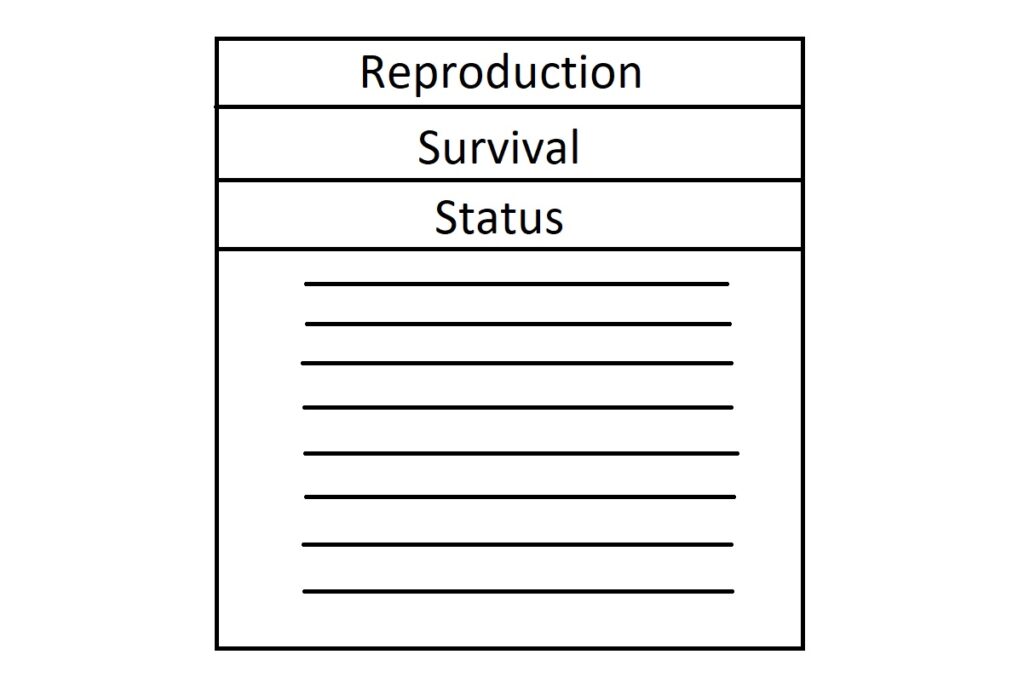
    Think of the mind as having this priority chart of memory storage and recall. The items associated with things near the top of the chart are most likely to be stored and recalled. The things near the bottom are hardly stored and easily forgotten.

    memory priority chart

    As you can see, things having to do with reproduction, survival, and social status are more likely to be stored and recalled.

    This is how the mind’s priority chart is organized. You can’t prioritize it your way. The mind values what it values.

    Note that the items near the top of this chart often have to do with other people. When others facilitate your survival, reproductive success, or social status, they have a positive emotional impact on you.

    When they threaten your survival, reproduction, and status, they have a negative emotional impact on you.

    This is why you find it hard to forget people you like, have a crush on, care about, or love. In trying to remember these people, your mind is trying to aid your survival, reproduction, and status through positive emotions.

    It’s also why you find it hard to forget people you hate or who hurt you. In trying to remember these people, your mind is trying to help your survival, reproduction, and status through negative emotions.

    Positive emotions

    • You keep thinking about your crush because your mind wants you to approach them (and eventually reproduce).
    • You loved your parents as a kid because it was necessary for your survival.
    • You can’t stop thinking about how your boss praised you in the meeting (raised your social status).

    Negative emotions

    • You keep thinking about the kid who bullied you in school years later (threatened survival and status).
    • You can’t get over a recent breakup (threatened reproduction).
    • You can’t forget the boss who insulted you in front of your colleagues (status threat).

    How to forget someone: Why empty advice doesn’t work

    Now that you understand what goes on when you can’t forget someone, you’re better equipped to handle such situations.

    The problem with most advice out there about forgetting people is that it’s empty.

    If you’re going through a rough breakup, people will give you empty advice such as:

    “Get over him/her.”
    “Forgive and forget.”
    “Move on.”
    “Learn to let go.”

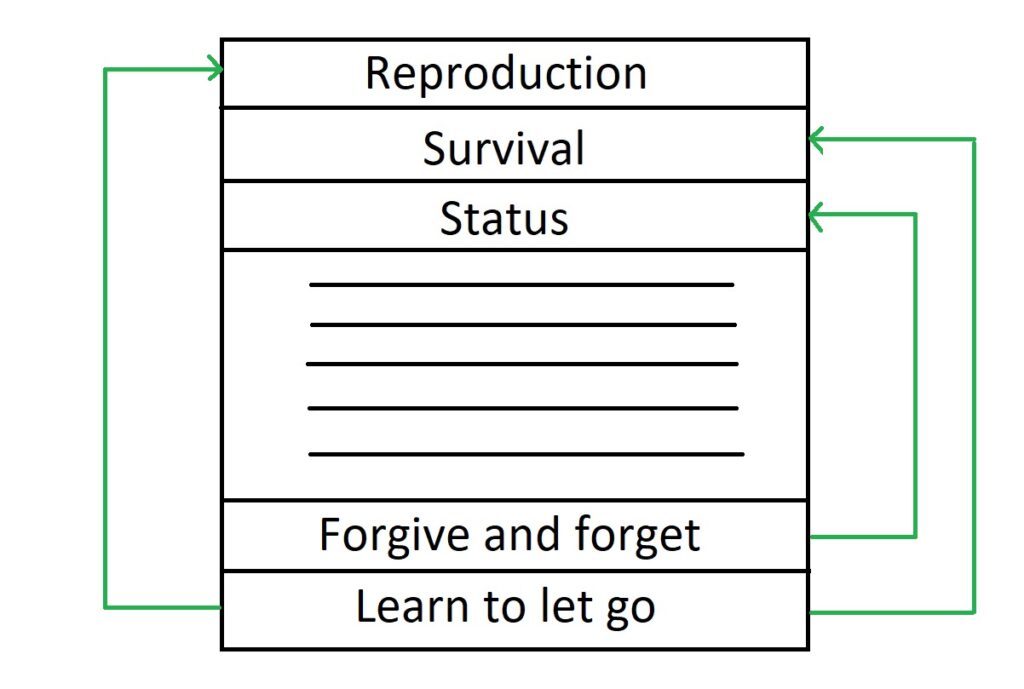
    The problem with these well-intentioned pieces of advice is that they fall flat onto your mind. Your mind doesn’t know what to do with them because they’re irrelevant to the top items in its priority chart.

    The key to forgetting people and moving on, then, is to link these empty pieces of advice to what the mind values.

    priority chart with links

    When you’re going through a breakup, something important in your life has ended. There’s a gaping hole in your life. You can’t just ‘move on’.

    Say a friend tells you something like this:

    “You’re at a point in your life where you should focus more on your career. When you get established, you’ll be better positioned to find a relationship partner.”

    See what they did there?

    They linked ‘moving on now’ to ‘being better-positioned later to find a partner’, which is at the top of the mind’s priority chart. This advice is by no means empty and could work because it uses what the mind values against the mind.

    Say you’re mad at someone because they humiliated you in public. You keep thinking about this person. They’ve taken over your mind. While showering, you think about what you should’ve said back to them.

    At this point, if someone tells you to ‘forgive and forget’, it’ll likely piss you off. Consider this advice instead:

    “The guy who was rude to you has a reputation for being rude. He’s probably been hurt by someone in the past. Now he’s lashing out at innocents.”

    This advice frames the guy as a hurt individual who can’t get over their issues- precisely what your mind wants. Your mind wants to raise you in status compared to him. They’re hurt, not you. No better way to put him down than to think he’s been hurt.

    More examples

    I’m trying to think of some unconventional examples to elucidate this concept further. Ideally, you want your relationship partner to satisfy all the important items on the priority chart.

    A woman who’s married to a mafia boss, for instance, may have her reproductive and status needs met, but her survival could constantly be in danger.

    If her survival was constantly under threat while she was with him, she might finally be relieved to break up with him. It’ll be easy for her to move on.

    Similarly, you could constantly be thinking about your crush, but one negative piece of information about them could threaten your top item. And it won’t take long for you to move from them.

    A big part of why people cannot forget those they’ve broken up with is that they think they can’t find someone similar or better. Once they do, they can move on as if nothing happened.

    If you want to forget people who’ve hurt you in the past, you need to give your mind a solid reason why it should bury the hatchet. Ideally, that reason should be based on reality.

    Importance leads to bias

    Because survival, reproduction, and status are so crucial to the mind, it tends to get biased in these matters.

    For example, when you’re going through a breakup and missing your ex, you’re likely to overfocus on only the good bits of the relationship. You want to re-live those memories while forgetting that there were negative sides to the relationship too.

    Similarly, it can be easy to perceive neutral behavior as rude because, as social species, we’re on the lookout for enemies or those who threaten our status.

    If a car cuts you off, you’re likely to think the driver is a jerk. It could be they’re in a rush, trying to get to an important meeting.

    References

    1. Popov, V., Marevic, I., Rummel, J., & Reder, L. M. (2019). Forgetting is a feature, not a bug: intentionally forgetting some things helps us remember others by freeing up working memory resources. Psychological science, 30(9), 1303-1317.
    2. Anderson, M. C., & Hulbert, J. C. (2021). Active forgetting: Adaptation of memory by prefrontal control. Annual Review of Psychology, 72, 1-36.
    3. Payne, B. K., & Corrigan, E. (2007). Emotional constraints on intentional forgetting. Journal of Experimental Social Psychology, 43(5), 780-786.
  • How to break a trauma bond

    How to break a trauma bond

    Trauma happens when we find ourselves in a threatening situation. The threat could be to our survival or reproductive success. Events that cause trauma include accidents, illnesses, natural disasters, break-ups, losing a loved one, abuse, and so on.

    A trauma bond is a bond that develops between an abuser and the abused. The victim forms an unhealthy attachment to the abuser. Trauma bonds can form in any type of relationship, but they’re common and most severe in romantic relationships.

    Studies have shown that there are specific instances where trauma bonds are much more likely to form.1 These are:

    • Intimate partner violence
    • Child abuse
    • Hostage situations (see Stockholm Syndrome)
    • Human trafficking
    • Cults

    In this article, we’ll discuss how trauma bonds get formed and what we can do to break free of them.

    How trauma bonds get formed

    We respond to serious dangers in two primary ways- fight or flight. If we can ward off the danger, we fight. If we can’t, we take flight. In trauma bonding, the victim is unable to do either.

    If you look closely at the situations that are likely to lead to traumatic bonding, you’ll notice they have a common feature. The victims in those situations are often too powerless to either fight or take flight.

    So, they adopt another defensive strategy- freeze. They get stuck in an abusive relationship. They feel fear but are unable to do anything about it.

    The key to understanding trauma bonds is realizing that the abusive relationship typically isn’t 100% abusive. If it were, then the victim would’ve left if they had the power to do so.

    For instance, adults in abusive romantic relationships often have the power to leave, but they don’t. Why?

    It’s because the relationship isn’t 100% abusive. Instead, these unhealthy relationships tend to go through cycles of abuse (fear) and love. If there were only fear in the relationship, it would’ve been much easier to leave.

    If someone chooses to stay in an abusive relationship, they’re gaining from it more than they’re losing, at least in their own minds.

    trauma bond chart

    Trauma bonds are addictive

    Trauma bonds can be addictive because they work on the principle of intermittent rewards. The victim knows there’s love in the relationship, but they don’t know when their partner will be loving towards them.

    Just as people get hooked on social media because they don’t know when they’ll get the next notification, trauma bonds leave their victims craving for affection.

    The mind prioritizes survival and reproduction

    If there’s a mix of love and fear in a relationship, our minds are wired to emphasize love because being loved can be critical for reproduction. Sure, fear can threaten our survival. But in the tussle between survival and reproduction, the latter wins. Some animals even sacrifice their lives to reproduce.2

    A child who depends on her abusive parent for survival can’t come to terms with the abuse. Her mind holds on to the belief that her parent loves her and it was her fault that the abuse happened. This allows her to explain away the abuse so she can keep expecting only love and care from her parent.

    The same dynamic operates in adult relationships, but this time, reproduction is at stake. The mind is wired to do what it can to make us stay with a romantic partner and reproduce.

    If there’s a mix of abuse and love in such relationships, the mind focuses on the love part and ignores the abuse. As a result, people get stuck seeing their partners in a positive light and get entangled in a trauma bond.

    Contribution of childhood experiences

    People who’ve been abused in their childhood by their parents or other caregivers tend to seek similar relationships as adults. There are a couple of reasons for this:

    1. They don’t know any other relationship template

    They come to believe that relationships are supposed to be abusive. Abusive relationships feel familiar to them.

    2. They’re trying to process their past trauma

    Trauma that doesn’t get resolved lingers in the mind. The mind seeks to process it via intrusive thoughts, flashbacks, and even nightmares. Sometimes, it seeks to process and heal the trauma through re-enactment.3

    Re-enactment allows the victim to re-experience the trauma so they can process and make sense of it. Seeking abusive relationships in adulthood could be an unconscious strategy for processing childhood trauma through re-enactment.

    trauma bond cartoon

    Breaking a trauma bond

    Trauma bonds can break on their own when abuse far exceeds love or when love disappears, and only abuse remains.

    Say you’re in a trauma bond with this person who verbally abuses you. The amount of love they shower upon you counterbalances their verbal abuse.

    One day, they physically abuse you, and you decide you’ve had enough. Their love just isn’t enough to counterbalance so much abuse.

    Alternatively, say you are trauma-bonded to this person, and they suddenly withdraw all their love and affection. All that remains is abuse, and you decide that the relationship isn’t worth it.

    Trauma bonds, like any addiction, rely on the hope of getting that next fix. When that hope is gone, the bond is gone.

    If you think you are trauma-bonded in a semi-abusive relationship, you can still do some important things to recover:

    1. Become conscious of the abuse

    The number one reason people can’t seem to break their trauma bonds is that they simply don’t understand what’s going on. Once you understand and make the abuse conscious, it’s easy to break the trauma bond.

    I’d still recommend talking to your partner first just to get their perspective. It’s possible they might be unconsciously repeating their own childhood patterns of abuse. If you two can work it out together, great.

    If they show no remorse or willingness to fix things, it’s likely that the abuse was deliberate.

    2. Heal your own past traumas

    It’s possible you’re unconsciously seeking abusive relationships to process your past traumas. You need to heal those traumas separately if you want to put an end to this pattern of re-enactment.

    For example, if you had issues with your father, you can resolve those feelings by confronting him. Closure is the medicine of trauma.

    3. Distance yourself

    Sometimes the feelings can be too overwhelming to do anything about them. In such times, you want to distance yourself from the abuser so you can give your mind space to make sense of things.

    It gives you the chance to view your relationship objectively and see it for what it really is- unhealthy.

    4. Learn about healthy relationships

    If you’ve been abused in childhood, it can be difficult to understand healthy relationships. You simply don’t have a template for healthy relationships in your mind.

    It helps to look at the examples of healthy relationships- whether in real life or fiction. It can help you override your default relationship templates and scripts.

    5. Seek social support

    Seeking social support is one of the best ways to regulate negative emotions. When you’re trying to get over abuse and recover from trauma, you need to grieve properly. Misery shared is misery halved.

    Also, talking about your problems to others helps you view your abusive relationship objectively. You’re able to finally see how your mind was putting up with all kinds of rubbish to prioritize survival or reproduction.

    The mind’s just doing what it’s designed to do. We need to have some compassion for our minds, too. They’re excellent at doing what they do. Sometimes they get a bit carried away, and that’s okay.

    References

    1. Reid, J. A., Haskell, R. A., Dillahunt-Aspillaga, C., & Thor, J. A. (2013). Contemporary review of empirical and clinical studies of trauma bonding in violent or exploitative relationships. International Journal of Psychology Research, 8(1), 37.
    2. Pandey, S. (2015). Dangerous Mating Games in the Animal World.
    3. Carnes, P. J. (2018, August). Betrayal Bond, Revised: Breaking Free of Exploitive Relationships. Hci.
  • How to work on yourself mentally

    How to work on yourself mentally

    People who’ve worked on themselves mentally are just different. Their actions and words betray the work they’ve put into themselves. You always get that feeling of ‘this person knows who they are and what they’re talking about’ right away.

    It’s almost as if you can smell their confidence. They’re smart, good conversationalists, goal-driven, and purposeful. These are people who’ve achieved psychological growth. You can tell they have wonderful minds.

    What have they done differently that makes them psychologically mature?

    The short answer is: They’ve fed their minds with the right things. They’ve taken the time to work on themselves and have become good thinkers, talkers, and problem-solvers. They know how to use their minds well.

    Why wouldn’t you, though? We navigate the world with our minds. It makes sense to grow it, sharpen it, and have it ready to do important things. Mental growth is that meta-ability that makes all other abilities happen. It’s the skill behind all skills.

    I don’t care what field you’re in. No matter what you’re doing in life, you’re using your mind to do it. The better you use your mind, the better you’ll do what you do. If it makes so much sense to sharpen your mind, why don’t many people do it?

    Education =/= Mental growth

    Most education systems throughout the world pay little to no attention to psychological growth. They equip students with the skills required to land a job. Most of what is taught is redundant and no longer applicable to the highly changing job market, anyway.

    The self-help industry fills the gap left by the education system. But if self-help books aren’t directly going to help a student land a job, why would they bother reading them? And that’s exactly what happens.

    Most people don’t take the time to develop their minds because they simply weren’t taught to do so. They think learning technical skills is enough and skip developing their minds.

    So, you have people who can’t think on their feet. They want their employers to tell them what to do. They want step-by-step instructions for everything.

    The trap of magical thinking

    My sister works in a research lab at a premier institute in the country. She was saying that her lab mates took one year to solve a problem that could’ve been solved easily in a few weeks. They kept repeating the experiments despite getting incorrect results.

    They thought repeating the experiments over and over would magically lead them to the desired results.

    This ‘magical thinking’ is a symptom of stunted mental growth. Sure, these are some of the best students in their field- research scholars. They’re highly knowledgeable about their areas, but not about how to use their minds. They lack thinking and problem-solving skills.

    The education system relegates these topics to fields like psychology and industries like self-help. That’s a valid categorization, but it makes the problem worse. People are like:
    “Why should I learn how to think? I’m not a psychology student.”

    Dude, you need to learn how to think. Because by doing that, you’ll do what you already do better. If you’re going to use your mind to do anything, you have to know how to use it.

    Achieving mental growth

    Developing your mind will not only help you succeed professionally but also improve your relationships. The better you understand yourself and others, the fewer problems you’ll face in life. A large chunk of our problems stems from a lack of self-understanding.

    While mental growth takes time, there are some key principles to remember:

    1. Garbage in, garbage out

    If you put garbage into your mind, your words and actions will reflect it. People can take great care in trying to eat healthy, but hardly give a second thought to what they’re putting into their minds daily.

    You internalize what you repeatedly expose yourself to. So, it’s important to try to filter out all the unhelpful stuff clamoring for your attention.

    2. Becoming a better thinker

    It’s easy to correct your actions, but hard to correct your thoughts. Once people are set in their mental ways, it’s hard to move them mentally. The more you catch yourself saying, “I’ve been thinking about it all wrong”, the more psychologically mature you are. It tells me you’re constantly refining how you think.

    Many problems occur because we’re thinking about things the wrong way. Take feedback from reality and be willing to change your thinking if required.

    3. Becoming a problem-solver

    The best way to hone your thinking skills is to get good at solving problems. Take on more challenging problems frequently. See how far you can push yourself. I know it’s much more convenient to seek help, but don’t do that at the cost of your own mental growth.

    If you’ve exhausted all your mental resources or don’t have time, then you can seek help. You want to be able to depend on yourself to a certain degree. Avoid rushing for help at the slightest inconvenience.

    4. Becoming a good decision-maker

    Adult life is filled with making important decisions- decisions that can have a significant impact on our lives. Yet, did they teach you decision-making in school? Exactly.

    Decision-making is a skill like any other, but a critical one. Poor decisions can be very costly. So, it makes sense to learn how to make good decisions. We have several biases that make us susceptible to making poor decisions. It’s important to learn about these biases.

    If you’ve been lucky and haven’t made a bad decision yet, who’s to say you won’t in the future? Prevention is better than a cure.

    5. Developing emotional intelligence and maturity

    Developing emotional intelligence and maturity is one of the most important aspects of mental growth. Being mentally strong is all about managing your emotions well. When you become emotionally intelligent, you understand your own emotions and the emotions of others.

    It’s always refreshing when someone gets you on an emotional level. It’s highly satisfying and lets you develop deep connections with people.

    6. Helpful mindsets and values

    Mindsets can be helpful or unhelpful. Beliefs and mindsets are precursors to behavior. When your head is in the right place, the right actions follow naturally. Having the right mindset will allow you to overcome the most challenging obstacles.

    We tend to absorb the mindsets of people in our social group. Someone has rightly said that you are the average of the five people you hang out with the most. Having the right kind of people around you is probably the easiest way to speed up your mental growth.

    7. Gaining knowledge

    Knowledge was, is, and will be, power. There’s just no way around that. Whatever progress humans have made, and will make, depends on our collective knowledge. The same is true for individuals. The more we know, the more we grow. If you want mental growth, you have to keep gaining more and more knowledge.

    The more truths you can know and understand about the mind, the better. The challenge is- it’s hard to know the truth. It can only be known by digging the pit of knowledge deeper and deeper.

    The more knowledge you gain, the more patterns you can see. Over time, you’ll find that the truth emerges and converges out of these patterns. You keep seeing the same things over and over. It’s because you finally get it. You’ve stumbled on the pure, unadulterated truth.

    This is true for every endeavor, including mental growth. Growing mentally requires overcoming some universal human weaknesses and biases to think better. Once you get it and practice it, you attain psychological growth.

  • How to heal from childhood trauma

    How to heal from childhood trauma

    A traumatic experience is an experience that puts a person in danger. We respond to trauma with stress. Prolonged traumatic stress can have significant negative psychological and physiological effects on a person.

    Trauma may be caused by a single event, such as the loss of a loved one, or by continuous stress over time, such as living with an abusive partner.

    Events that can cause trauma include:

    • Physical abuse
    • Emotional abuse
    • Sexual abuse
    • Abandonment
    • Neglect
    • Accident
    • Loss of a loved one
    • Illness

    Traumatic stress generates defensive responses in us so we can protect ourselves from danger. We can broadly group these responses into two types:

    A) Active responses (promote action)

    • Fight
    • Flight
    • Aggression
    • Anger
    • Anxiety

    B) Immobility responses (promote inaction)

    • Freeze
    • Faint
    • Dissociation
    • Depression

    Depending on the situation and the type of threat, one or more of these defensive responses may be triggered. The goal of each of these responses is to ward off the danger and promote survival.

    Why childhood trauma is especially damaging

    Dissociation

    Children are weak and helpless. When they go through a traumatic experience, they can’t defend themselves. In most cases, they can neither fight nor flee from threatening situations.

    What they can- and usually do- to protect themselves, is to dissociate. Dissociation means splitting away of one’s consciousness from reality. Because the reality of abuse and trauma is painful, children dissociate from their painful emotions.

    Developing brains

    The brains of young children develop at a faster rate, which makes them highly vulnerable to environmental changes. Children need adequate and consistent love, support, care, acceptance, and responsiveness from their caregivers for healthy brain development.

    If such adequate and consistent care is absent, it amounts to a traumatic experience. Trauma in early childhood sensitizes a person’s stress response system. That is, the person becomes highly reactive to future stressors.

    This is a survival mechanism of the nervous system. It goes into overdrive to make sure the child is protected from danger as much as possible, now and in the future.

    Emotional suppression

    Many families don’t encourage children to talk about their negative experiences and emotions. As a result, children in such families never get a chance to express, process, and heal their traumas.

    Unsurprisingly, parents are often the primary source of trauma for young children. Thanks to their inadequate and inconsistent care, children develop attachment and stress regulation problems that they carry into adulthood.1

    Effects of childhood trauma

    When children are abused or don’t receive adequate and consistent care, they develop attachment problems. They become insecurely attached to their parents and carry this insecurity into their adult relationships.2

    As adults, they have difficulty trusting others and get anxiously attached to their romantic partners. They suffer from stress regulation problems. They’re easily stressed and resort to unhealthy ways of coping.

    Also, they tend to suffer from constant worry and anxiety. Their nervous system is constantly on the lookout for danger.

    If the childhood trauma is severe, they suffer from what’s called Post-Traumatic Stress Disorder (PTSD). It’s an extreme condition where a person experiences excessive fear, anxiety, intrusive thoughts, memories, flashbacks, and nightmares related to their trauma.3

    What many don’t realize is that PTSD symptoms exist on a spectrum. If you’ve experienced even mild trauma in childhood, you’re likely to experience mild PTSD symptoms.

    You may experience fear and anxiety, but not too much to disrupt your day-to-day life. You may experience intrusive thoughts, mini-flashbacks, and occasional nightmares related to your trauma.

    For example, if a parent was overly critical of you throughout your childhood, it’s a form of emotional abuse. You may experience some mild PTSD symptoms as an adult, such as being anxious in the parent’s presence.

    Their intrusive, critical voice haunts you and becomes your own critical self-talk. You may also experience mini-flashbacks of them criticizing you when you make mistakes or important decisions. (Take the Childhood trauma questionnaire)

    Habituation and sensitization

    Why do childhood traumas haunt people in adulthood?

    Imagine you’re working at your desk. Someone comes up to you from behind and is like “BOO”. Your mind senses you’re in danger. You get startled and jump in your seat. This is a simple example of a flight stress response. Jumping in your seat or flinching is a way to avoid the source of danger.

    Because you soon learn that the danger isn’t real, you relax back into your chair and restart your work.

    The next time they try to startle you, you’re less startled. Eventually, you won’t be startled at all and may even roll your eyes at them. This process is called habituation. Your nervous system gets habituated to the same recurring stimulus.

    The opposite of habituation is sensitization. Sensitization occurs when habituation is inhibited. And habituation is inhibited when the danger is real or too great.

    Imagine the same scenario again. You’re working on your desk, and someone puts a gun on the back of your head. You experience intense fear. Your mind goes into overdrive and desperately searches for a way out of the danger.

    gun to head

    This event has the potential to traumatize you because the danger is real and great. Your nervous system can’t afford to get habituated to it. Instead, it gets sensitized to it.

    You become hypersensitive to any similar future dangers or stimuli. The sight of a gun creates panic in you and you get flashbacks about the event. Your mind keeps replaying the traumatic memory so you can be better prepared and learn important survival lessons from it. It believes you’re still in danger.

    The way to heal trauma is to convince your mind you’re no longer in danger. It starts with acknowledging the trauma. Part of the reason a traumatic event keeps playing over and over in the mind is that it hasn’t been acknowledged and meaningfully processed.

    Ways to heal childhood trauma

    1. Acknowledgment

    For many people, childhood trauma is like a tab in the browser of their minds that they just can’t seem to close. It remains open and frequently distracts and pulls on their attention. It warps their perception of the world and makes them overreact to non-threatening situations.

    It’s a darkness inside them that’s simply there and doesn’t go away.

    Yet, if you ask them to describe their traumatic experiences, they tend to have great difficulty doing so. This is because a traumatic event is highly emotional and shuts down the logical, language-based areas of the brain.4

    In fact, all intensely emotional experiences tend to have the same effect. Hence the phrases:

    “I was left speechless.”
    “I can’t put into words how it felt.”

    Because of this phenomenon, people rarely have a verbal memory of their trauma. If they don’t have a verbal memory, they can’t think about it. If they can’t think about it, they can’t talk about it.

    This is why uncovering past traumas may require some digging and asking people who may have a better recollection of what happened.

    2. Expression

    Ideally, you want to consciously acknowledge and then verbally express your childhood trauma. People who haven’t yet made their trauma conscious tend to express it unconsciously.

    They’ll write books, make movies, and create art to give shape to their traumas.

    Expressing your trauma, consciously or unconsciously, gives life to it. It gives you an opportunity to express how you feel. Those emotions that have long been suppressed crave expression and release.

    Thus, writing and art can be effective ways of healing trauma.5

    3. Processing

    Expression of trauma may or may not involve successful processing of it. The goal of repeated expression of trauma is to process it.

    Traumatic memories are usually unprocessed memories. That is, you haven’t made sense of them. You haven’t attained closure. Once you attain closure, you can put that memory in a box in your mind, lock it, and shelf it away.

    Processing trauma largely involves verbal processing. You try to understand what happened and why- the why being more important. Once you understand the why, you’re likely to gain closure.

    Closure can be attained by simply understanding the trauma, forgiving your abuser, or even seeking revenge.

    4. Seeking support

    Humans are wired to turn to social support to regulate their stress. This starts in infancy when a baby cries and seeks comfort from the mother. If you can share your trauma with others who will understand, you lighten your burdens.

    It gives you that “I don’t have to deal with this alone” feeling. Knowing that others are suffering, too, makes you feel slightly better about yourself.

    Trauma impedes our ability to form connections. Creating new connections is, therefore, an important part of trauma recovery.6

    5. Rationality

    Trauma makes people emotional. Their perception changes, and they become sensitive to trauma-related cues. They see the world through the lens of their trauma.

    For example, if you experienced neglect as a child and feel a deep sense of shame, you’ll blame yourself for your failed adult relationships.

    By understanding your own traumas and realizing how they affect you, you can change gears in your head every time you’re in the grip of strong trauma-induced emotions. The more you understand your own ‘hot buttons’, the less you’ll be affected when someone presses them.

    For example, if you’re a heterosexual short man and have been bullied about it, it’s likely to become your hot button. To heal from such trauma, you need to look at the situation rationally.

    Since you can’t do anything about your height, you need to accept it. Once you truly accept it, you overcome it.

    Acceptance needs to be based on reality for it to work. You can’t tell yourself:

    “Being short is attractive.”

    The reality is that women do have a preference for tall men. You can instead say:

    “I have other attractive qualities that more than make up for my shortness.”

    Since overall attraction isn’t based on a single feature but a host of features, this line of reasoning works.

    6. Overcoming trauma-related fears

    The most effective way to teach your brain that you’re no longer in danger is to overcome your trauma-related fears. Unlike ordinary fears, trauma-related fears are especially hard to overcome.

    For example, if you’ve never driven a car, you may feel some fear and anxiety when you drive for the first few times. It’s just something you’ve never done before and your fear only stems from that.

    If you get into an accident during those first few driving trials, your fear of driving becomes much stronger and harder to overcome. Now, your fears stem from inexperience plus an additional layer of trauma.

    In this way, your trauma-related fears can prevent you from reaching important life goals.

    Say you’re a woman who was abused in childhood by your father. Just because your father was abusive doesn’t mean that all men are abusive. Yet, your mind wants you to think that so it can better protect you.

    In order to overcome such trauma-based fears, start looking at what people, situations, and things you tend to avoid. If you avoid something repeatedly, it’s a good indication there’s some trauma attached to it.

    Next, start overcoming your fear by engaging with what you’ve been avoiding in baby steps. Force yourself to do the things you normally avoid. The more you go in the direction of your fears, the more your traumas will lose their power over you.

    Eventually, you’ll be able to teach your mind that you’re no longer in danger.

    References

    1. Dye, H. (2018). The impact and long-term effects of childhood trauma. Journal of Human Behavior in the Social Environment, 28(3), 381-392.
    2. Nelson, D. C. working with children to heal interpersonal trauma: the power of play. THERAPY, 20(2).
    3. Van der Kolk, B. A. (1994). The body keeps the score: Memory and the evolving psychobiology of posttraumatic stress. Harvard review of psychiatry, 1(5), 253-265.
    4. Bloom, S. L. (2010). Bridging the black hole of trauma: The evolutionary significance of the arts. Psychotherapy and Politics International, 8(3), 198-212.
    5. Malchiodi, C. A. (2015). Neurobiology, creative interventions, and childhood trauma.
    6. Herman, J. L. (2015). Trauma and recovery: The aftermath of violence–from domestic abuse to political terror. Hachette uK.
  • How to become a genius

    How to become a genius

    A genius is a person who has reached the highest level of skill in their chosen craft. Geniuses are highly creative individuals who make original, useful, and surprising contributions to the world. Geniuses are usually geniuses in one area, but there have been some who excelled in multiple areas.

    One can be a genius in the sciences, arts, sports, business, and even in dealing with people. Whatever craft one has mastered, they can only be seen as a genius if others see the value in their contribution.

    Is genius born or made?

    Like every other nature vs. nurture problem, this question has been fodder for a longstanding debate in psychology circles. Having read arguments from both sides, I’ve come to the conclusion that nurture is the clear winner here. Geniuses are not born, they’re made.

    I’d learned this lesson accidentally at a very young age. In school, from 1st to 5th standard, there was this one student who always topped our class. Everyone, including me, thought he pulled that off because he was more intelligent than all of us.

    When I was finishing my 5th standard, a friend told me that next year our class teacher is going to be very strict. He instilled fear in me by telling me that she punishes poor students harshly.

    Until now, I was an average student. The fear of coming across as a poor student to my new teacher motivated me to be better prepared and study harder. As a result, I topped the first exam of the 6th standard.

    When that teacher asked our class to guess who had topped, not a single student said my name. When she announced it was me, everyone was taken aback, including me. No one had expected anyone to de-throne the topper of our class.

    That experience taught me that the toppers were really not that different from me. They didn’t have superior natural ability. If I only worked as hard as they do, I could beat them.

    Many people still cling to the belief that geniuses are born, not made. It’s a comforting belief because if geniuses are fundamentally different from you, it’s not your fault you’re not a genius. If you can do what they can, you feel burdened to reach your potential and guilty if you don’t.

    Natural ability doesn’t matter that much

    I’m not suggesting that natural ability doesn’t matter at all. There are individual differences in people’s natural cognitive abilities. But these differences are not huge. It’s never the case that someone is so naturally gifted that they hardly have to put any effort into becoming a genius.

    Irrespective of your natural ability, you have to put in a lot of time and effort to reach the highest level of skill in your chosen craft.1

    genius chart
    This isn’t how it is.
    real genius chart
    This is how it is.

    Genius is therefore a product of humongous time and effort focused on mastering one craft. And in the case of those rare geniuses who excel in multiple areas, humongous time and effort focused on a few chosen crafts.

    Why most people aren’t geniuses

    Putting huge time and effort into one focus area goes against human nature. We’re wired to seek instant gratification and rewards. We want things now, not at a later date. So, we don’t like to devote huge amounts of time to the pursuit of something.

    Also, we want to conserve energy. We want maximum rewards for minimum effort and time invested. This is evident in what people seeking to become geniuses type in Google:

    genius screenshot

    In our resource-scarce ancestral times, these strategies were helpful and they ensured our survival. But the same strategies trap us into procrastination and bad habits in modern environments, preventing us from reaching and expressing our genius.

    Another reason most people don’t become geniuses is that they underestimate the time and effort it takes to become one. It’s because people see geniuses all around them- talented actors, singers, musicians, authors, etc. They see the outcomes- the finished products and are blind to what happens in the background.

    If people knew what it took to become a genius- if they could see that laborious background process, most would stop wanting to be one.

    When you’re trying to become a genius, you’re trying to do something extraordinary. It has to be hard and challenging. If it’s not, you’re probably not doing genius-level work.

    To become a genius, you have to overcome your natural human tendency to conserve energy (laziness) and seek rewards instantly.

    In the next section, we’ll discuss the common traits of geniuses that allow them to do exactly that. If you don’t consider yourself a genius, incorporating these traits into your personality shall put you on the high road to becoming a genius.

    Incorporating these personality traits is only a small part of the equation. You still have to put in all that time and effort, unfortunately.

    How to become a genius: Traits of geniuses

    1. Passionate

    I know, I know. You’ve heard the phrase “find your passion” countless times and it makes you cringe. Yet, no amount of cringe can take away its truth. All geniuses are passionate about what they do.

    Why does passion matter?

    Steve Jobs explained it well. It makes no sense to put huge time and effort into something if you don’t love the process of putting in all that time and effort.

    Genius-level work involves delayed rewards. Sometimes, the rewards can take years. If you don’t enjoy the journey, it makes no sense to continue putting your time and effort into something that isn’t yielding anything.

    If you don’t find the process rewarding, every cell in your body will protest and ask you to deploy your resources elsewhere.

    2. Focused

    Geniuses understand that they have limited resources. So, they invest most of their attention, energy, time, and effort into their craft. They understand that’s what it takes to do genius-level work.

    Show me a person whose focus is splintered among multiple projects and I’ll show you a person who isn’t a genius. As the saying goes: A man who chases two rabbits catches none.

    3. Hard-working

    Geniuses practice their craft repeatedly over several years. The beginning phase of mastering something is usually the hardest. Most people quit when they hit the first obstacle- when they get a rude awakening of how hard it really is.

    Geniuses, in contrast, welcome obstacles, and challenges. They see those challenges as opportunities to become better at their craft.

    4. Curious

    A genius is often a person who managed to preserve their childhood curiosity. As we get conditioned by society and educational institutions, we tend to lose that flair for asking questions. Being a genius is more about unlearning than it is about learning.

    When we don’t question the status quo, we remain stuck in the way things are. If the way things are is mediocre, we remain mediocre and never reach the level of a genius.

    Geniuses have an unrelenting quest for continuous learning.2 They consistently seek information from a variety of sources and test them against reality to see what works.

    5. Patient

    Since becoming a genius requires putting huge amounts of time and effort into something, geniuses are infinitely patient. Having patience doesn’t mean that they do their minimum and then sit and hope to reach their outcomes. No, it means they understand some things take time, despite one’s best efforts.

    6. High self-esteem

    Having a high level of self-esteem is one of the most powerful things that helps a genius stay the course on their long and laborious road to success. When nothing is going your way, having an unshakeable belief that you can make it can be enough to keep you going.

    Yes, all those annoying motivational quotes about ‘believing in yourself’ have a lot of truth behind them.

    High self-esteem also enables geniuses to turn a blind eye and a deaf ear to resistances and oppositions from others.

    7. Creative

    Since geniuses produce something original, they’re creative. Creativity is more skill than a personality trait. Like any skill, one can become more creative by practicing being creative.

    Creativity boils down to freedom of thought. It requires letting your thoughts and imagination run wild in different directions with no constraints.3

    More importantly, it involves trusting your own ideas and doing the work to take them from the realm of imagination into the real world.

    8. Openness

    When we’re trying to master something, we quickly become rigid in our ways. Sometimes, being open to new ideas and advice can make all the difference. No genius is an island. All geniuses hang around other geniuses to learn from them.

    Being open to new ideas requires humility. If you’re arrogant and set in your ways, say goodbye to becoming a genius.

    9. Tolerance for ambiguity

    Trying and failing over and over creates a very unpleasant mental state. Humans are averse to ambiguity and uncertainty. We feel compelled to abandon uncertain projects and fall back on certain ones. Instant rewards are certain and distant rewards, uncertain.

    Since geniuses chase distant rewards, the dark clouds of doubt, uncertainty, and ambiguity keep following them around. Eventually, when they figure things out, the clouds clear away and the sun shines brighter than ever.

    10. Risk-takers

    This is closely related to the previous point. Taking risks lands one in the arena of doubt and uncertainty. Geniuses tend to be risk-takers who sometimes put everything on the line to pursue their vision. But here’s the thing: They understand that high risk and high rewards go together.

    If they play it safe, they risk never reaching their full potential and vision. As the saying goes: Better to have tried and failed, than not to have tried at all.

    11. Deep thinkers

    You can’t do genius-level work living on the surface. You have to dig deeper. No matter what their chosen craft, all geniuses dive deep into the details of what they do. They gain a deep understanding of what they do and all the complexities involved.4

    The deeper you understand something, the better you understand it and the more power you have to do what you want. To make things work, you have to first know how they work. To know how things work, you have to dig deeper.

    12. Sacrificing

    Geniuses know they need to sacrifice a lot of things to become geniuses. It’s simple math, really. The more time and effort you can take away from other things, the more you can devote to your craft.

    Geniuses often sacrifice their other life areas to succeed at their craft. Some sacrifice their health, some their relationships, and some both. That becoming a genius requires sacrifice can be a hard pill to swallow for many.

    Of course, you don’t have to completely ignore your other life areas. It’s not healthy and may quickly burn you out. What you can do is 80/20 those life areas and pay just enough attention to them so you don’t feel lacking in those areas.

    If only 20% of the people in your life give you 80% of your social fulfillment, why spend time with the remaining 80% of the people?

    You could devote all that saved time to your craft.

    References

    1. Heller, K. A., Mönks, F. J., Subotnik, R., & Sternberg, R. J. (Eds.). (2000). International handbook of giftedness and talent.
    2. Gelb, M. J. (2009). How to think like Leonardo da Vinci: Seven steps to genius every day. Dell.
    3. Cropley, D. H., Cropley, A. J., Kaufman, J. C., & Runco, M. A. (Eds.). (2010). The dark side of creativity. Cambridge university press.
    4. Greene, R. (2012). Mastery. Penguin.