Learn how to use the knowledge of psychology to deal with your negative moods and emotions, feel good, be productive, handle people well, and reach your goals. Self-improvement and personal development are inevitable while you’re trying to understand how the mind works. It all starts and ends with the mind.
As social species, humans are wired to get attached to other humans. We experience strong attachments to our genetic relatives, romantic partners, and friends.
It means being emotionally attuned to and invested in someone. When you’re emotionally attuned to someone, you feel a bond with them. Their emotions affect your emotions. When two people are emotionally bonded, they regulate each other’s negative emotions and provide comfort.
The more attachment there is in a relationship, the more love there is. Love is an emotion that lets us stay attached to our loved ones.
The opposite of love is hatred, which stems from pain. When there’s pain in a relationship, we’re motivated to get detached from the source of our pain.
Attaching + detaching forces
Every relationship, especially romantic, has a mix of attaching and detaching forces. People get attached when there’s more love than pain in a relationship. People are detached when there’s more pain than love in a relationship.
Love > Pain = Attachment Pain > Love = Detachment
If you want to know how to detach from someone you love deeply, you have to first know where you are. You’re essentially in the gap between attachment and detachment.
You’ve consciously decided that the cons outweigh the pros of being in the relationship. There’s more pain than love in the relationship. Yet, you’re unable to detach.
Why?
It’s because there’s still enough love in the relationship to hold on to. As a result, you’re torn between wanting to detach and not being able to.
How to detach from someone you love
The above diagram clarifies what needs to happen if you want to detach from someone you still love deeply. There needs to be even more pain in the relationship so that you reach the point of detachment.
Now, this can happen by itself.
If your partner continues to cause you pain, eventually, you’ll reach the point of detachment. They’ll have given you enough reasons to detach. Finally, a reason will become the last straw that breaks the camel’s back.
If that doesn’t happen, you can still close that pain gap by:
By seeking alternatives, I mean seeking a better state to be in than your current relationship. That could mean:
Finding a better partner
Staying single
If there’s another person you deem worth pursuing, then the pain of being in your current relationship increases. You’ll be highly motivated to detach and end your current relationship.
Similarly, if you conclude that being single is better than being in your current relationship, the pain of being in your current relationship increases.
If this does not happen, you’ll remain stuck in the gap between attachment and detachment. Of course, if love increases and pain decreases, you’ll want to stay attached.
2. Projection into the future
If you feel stuck in the gap, you can also project your current relationship into the future. Right now, the slight pain surplus in the relationship may not be significant.
But if you project your current relationship to months or years into the future, that small pain surplus will add up. Eventually, the overall pain in the relationship will be significantly more than the overall love.
Even just thinking about this scenario can momentarily increase the pain of staying in your current relationship and push you to detach.
You want to detach but not completely
Overly dependent people (co-dependent) on their partner for their happiness may come to resent their over-reliance on their partner.
They might want to detach, but not completely.
To move from co-dependence to interdependence, you have to be able to fill your own cup. You have to be able to make yourself happy and then seek additional happiness from your partner.
This is what secure relationships are all about: A healthy balance of independence and dependence.
Things you can do to become more independent:
Choose a meaningful career or find meaning in your work
Connect with family and friends
Pursue your own hobbies and interests
If you want to emotionally detach because you need space, let your partner know you’re not abandoning them. Especially if they have an anxious attachment style.
You text your avoidant partner, waiting and hoping for a quick text back. Hours pass, then days. No reply. You wonder if they’re really interested in you. You second-guess your sense of self-worth and pester your friends trying to decode what their last message meant.
Attachment styles shape the way we connect with others, especially romantic partners. They’re shaped in early childhood and are reinforced throughout life. A person can develop a secure or insecure attachment style based on early childhood interactions with primary caregivers.
People with a secure attachment style can form healthy relationships with others and themselves. Those with insecure attachment styles endured childhood trauma and neglect. They find it difficult to form healthy relationships with others and with themselves.
Insecure attachment style has two types:
Anxious
Avoidant
Anxiously attached individuals depend on their relationships for their self-identity and fulfillment. They experience a high degree of anxiety and closeness in relationships. It’s rooted in fear of abandonment.
Avoidant individuals, on the other hand, tend to avoid close relationships. They tend to withdraw from relationships. As a result, their partners find it hard to connect deeply with them, negatively affecting their relationship. They have no or low connection needs and derive little satisfaction from relationships.1Power, A. (2018). Avoidant people in relationships: Why would they bother? How do partners fare?. In Attachment and the Defence Against Intimacy (pp. 37-68). Routledge.
Avoidant texting patterns
Avoidants have a strong need for independence, and they guard their personal space by building walls that keep them from emotionally connecting with others. They get triggered by pressure and demands that threaten their autonomy. They get triggered by criticism and blame, which activates their inner shame wound. This core psychological wound makes them want to hide from others and fear vulnerability.2Domingue, R., & Mollen, D. (2009). Attachment and conflict communication in adult romantic relationships.Journal of Social and Personal Relationships, 26(5), 678-696.
They’re disconnected from their own emotions, which leads them to be emotionally disconnected from others. Usually, their intellectual side is overdeveloped and their emotional side is underdeveloped. So they prefer talking about intellectual topics and connecting intellectually.3Castro, D. R., Kluger, A. N., & Itzchakov, G. (2016). Does avoidance‐attachment style attenuate the benefits of being listened to?. European Journal of Social Psychology, 46(6), 762-775. They get triggered by overwhelming emotions and don’t know how to deal with them.
In summary, the avoidant triggers are:
Pressure and demands
Threats to personal space
Blame and criticism
Emotional overwhelm
Vulnerability
All of this is reflected in how they communicate, whether in person, by phone, or by text.4Bradnam, J. (2017). Text messages and romantic relationships: An investigation of mobile communication technologies, attachment processes, and relationship quality (Doctoral dissertation, Bond University). Their messages tend to be short and direct, not long and emotional. Their texts tend to be practical and always have a logical purpose. It’s hard for them to text you just to connect. If they do want to connect when whatever’s left of their desire for connection outweighs their fear of it, they’ll do it under the guise of a non-vulnerable message like sending you a meme.
Principles for texting an avoidant
If you want your texting to go well with avoidant people, the general rule is to do your best to sidestep their triggers. If your texting with them has gone bad, it’s likely because you activated one or more of their triggers.
1. Texting frequency
During the initial stages of getting to know someone, avoidants typically avoid texting. They’re not heavy texters anyway.5Morey, J. N., Gentzler, A. L., Creasy, B., Oberhauser, A. M., & Westerman, D. (2013). Young adults’ use of communication technology within their romantic relationships and associations with attachment style.Computers in Human Behavior, 29(4), 1771-1778. They need time and space to get to know you before they can text you more freely and openly. The irony is that they can’t know you if they don’t communicate with you. The critical thing here is that they have their own pace of connecting, and it’s likely to be slower than yours, unless you’re an avoidant yourself.
So avoid bombarding them with texts during this stage. Try to match their pace or find a middle ground. If you prefer texting daily and them once a week, aim for once every 3-4 days. They’ll see this as you respecting their pace.
"Why are you taking so long to reply?" ❌
"How often would you like us to text?" ✅
If they mention a frequency you’re not okay with (like once a year), tell them you’re not cool with that. Again, seeing you willing to make adjustments will encourage them to do the same.
2. Directness
Avoidants tend to be direct in their communication as long as it’s logical and practical. When communication gets emotional, though, they’ll be less direct to avoid conflict and the emotional overwhelm that often accompanies it.6Chen, Y. A., Peebles, A. L., & Lu, R. M. (2025). “Anyway, I love you, text me please”: Exploring attachment, affordances, and support-seeking via texting.Journal of Media Psychology: Theories, Methods, and Applications.
They don’t sugarcoat things; they’ll tell you exactly what they think. This can come across as impolite sometimes. They’ll let you know whether or not they’re interested in getting to know you early on. They might not say it, but they’ll do it with their actions.
When texting them, try to be as short and direct as possible. This reduces their cognitive and emotional load. If you know your text is going to be laden with emotion, call or meet them to see if they’re in the headspace for it. Their emotional bandwidth is limited. They need to free mental resources to process emotions. If they’re mental resources are occupied elsewhere, expect them to avoid, dismiss, or minimize emotions. Expect them to disengage.7Chansiri, K., & Wongphothiphan, T. (2025). Effectiveness of Trauma-Informed Messaging Among Women Experiencing Intimate Partner Violence with Adverse Childhood Experience-Related Comorbidities.Journal of Interpersonal Violence, 08862605251365652.
"You won't believe what my mom said to me! I was helping my sister with her homework, and she said You don't do much around the house! Can you believe it?! It made me so angry! I'm the one who cleans up after everyone. My younger siblings are so irresponsible. It just makes me sad." ❌
"Hey, do you have a minute? I wanted to talk about something that's been going on with my mom." ✅
When you send that second text, they’ll instantly know it’s going to be an emotionally-heavy session. They’ll check if they have the mental resources to deal with that at the moment. If you send the first text and they’re not ready, they’ll likely ignore you. If you send the second, they’ll let you know when they can talk.
3. Relationship stage
While avoidants avoid communicating during the initial stages of getting to know someone, they might engage in a lot of texting when they sense mutual interest. As the relationship progresses, they’ll again text infrequently for either of the following reasons:
a. The relationship has gotten too close, and they feel the need to withdraw
In this situation, try not to text them as much. Give them time and space to process their fears. If they’re open enough with you to express their concerns, try helping them overcome their fears about connecting.
b. They’re comfortable in the relationship and don’t feel the need to reach out as much
Not texting as much becomes a new normal in the relationship, and it’s okay. Infrequent texting won’t bother you if you’re securely attached. If you’re an anxiously attached person, however, you may feel that your need for connection isn’t getting reciprocated. In that case, it’s best to communicate your needs to your partner and find common ground.
4. Texting back
Avoidants tend to be slow to respond to texts, except when they’re interested. When their guard is down and they experience safety in a relationship, they’ll text back more often and quickly.
If they don’t text you back, don’t immediately assume they’re uninterested. They may be analyzing you. Reach out more so they can open up. Over time, if they keep avoiding you and don’t open up at all, that shows disinterest. What I’m saying is that they like to be passive participants in a relationship, hoping you’ll do the emotional work for both of you.
5. Stress
Avoidants withdraw from their partners when they’re stressed. This means they won’t text their partner as much, or at all, during stressful times. If you sense that an avoidant is under stress, do not text them.
Give them time and space to work through their stress. If they reach out to you for comfort, comfort them, but avoid overloading them with information or emotions. If you do, they can get very mean and impolite. They expect you to automatically understand their need for space because it’s ‘normal’ for them. They don’t get that it’s not your ‘normal’.
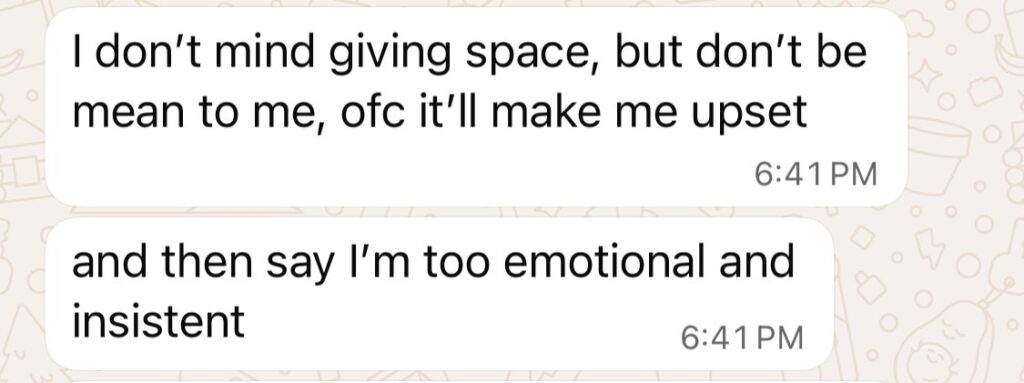
This is a friend complaining about her avoidant boyfriend. He was likely stressed and overwhelmed at the time. In fact, he keeps telling her, “I have a lot of problems to deal with”.
Texting avoidant types
Avoidant attachment style has two subtypes:
Fearful-avoidant (FAs)
Dismissive-avoidant (DAs)
Fearful avoidants experience high anxiety in relationships. They simultaneously want and fear close relationships. They tend to be people-pleasers with low self-esteem. Dismissive avoidants don’t experience a lot of anxiety in relationships. They deem close relationships as unimportant. They value independence more than connection. They tend to have high self-esteem.
Besides the points mentioned above for avoidants in general, you have to keep certain things in mind when texting FAs specifically.
1. Texting a lot
If an FA engages in a lot of texting, they’re probably more anxious than they are avoidant. In this case, their behavior is similar to that of the person with an anxious-preoccupied attachment style- the all-day texters whose connection needs are extreme.
You need to be on your toes with them and respond as much as possible. If you can’t keep up, let them know so they can dial down their texting and meet you in the middle.
2. Texting rollercoaster
They will sometimes text you a lot, and at other times they’ll text you infrequently or not at all. This is their typical hot-and-cold behavior manifested in texting. Their texting frequency depends on their emotional state. Since they tend to have a chaotic emotional life, their texting seems chaotic too.
You’ll feel the knock-on effects if they experience stress in other areas of their lives. When they’ve withdrawn after what seemed like a great texting session, hold back the texting and let them work through their emotions. They’ll have that amazing conversation again later.
"Hey, what happened? We had such a good conversation yesterday. Did I say something wrong?" ❌
I didn’t include the right way to text here because it is simply to let time pass.
3. Avoid FA triggers
FAs withdraw intensely when they experience relational stress, i.e., when their partner says or does something that triggers them. Common triggers for FAs are behaviors that show a lack of trust and criticism. When texting an FA, avoid being secretive or vague, as that suggests you don’t trust them enough to be clear.
"I want to tell you something, but I can’t right now." ❌
"I want to talk to you about this problem I'm facing at work." ✅
When you make plans with them, they’ll get annoyed if you give them vague answers. They’ll insist on a clear “Yes” or a “No”. They’ll want to know the exact time you’re meeting and not “in a few hours”.
4. Waiting for a text back
Waiting for a text back can hurt an FA in a new relationship. If they don’t get a text back immediately, they’ll interpret the situation according to their “I am betrayed” subconscious wound. They’ll accuse you of texting someone else or tell you that you don’t really like them. Give them a good reason why you didn’t instantly text back to soothe their fears.
Texting a DA
All the general points for the avoidant attachment style apply. Plus, you need to keep in mind some specific things when texting a DA:
1. Texting infrequently = Default mode
Texting infrequently or not at all is the default mode of existence for DAs who value independence more than connection. They’ll rarely make attempts to reach out. They don’t have the same connection needs as people with other attachment styles. Try not to take their minimal reaching out personally. It’s just the way they are, and it doesn’t necessarily mean they’re not interested.
2. Frequent texting
Texting too much can quickly overwhelm a DA. They tend to have a low opinion of people who prefer texting all day and believe they have nothing better to do. DAs focus on themselves a lot, and texting others (focusing on others) comes in the way of focusing on themselves. Their independence gets threatened, and they pull away. Avoid bombarding them with texts at all costs, no matter their current emotional state.
3. Slow to text back
Dismissive avoidants don’t like instant back-and-forth texting unless it’s urgent or they’re really interested. Their typical response is to take their time when replying to texts. To them, it doesn’t matter when you text back as long as you do text back. If a DA takes too long to text back, avoid personalizing it. They will eventually respond if you mean anything to them at all.
4. Indirect texts
DAs will hardly make any plans, even with their romantic partners. To them, wanting to make plans with someone equals needing them. To them, needing someone equals weakness. It makes them vulnerable, opening them up to the possibility of rejection. If you make plans with a DA and ask them something like:
“Are we meeting on the weekend?”
You’ve just put them in a quandary. They tend to be direct in their communication but also avoid conflict. If they say ‘Yes’, it means they want to meet you. Weak. If they say ‘No’, you might get upset. Bad for the relationship. So, they give an indirect answer. Something like:
“I have to attend a seminar on Sunday.”
Saying something like this saves them from a ‘Yes’ or a ‘No’. It also lets them test if you’re serious about the meeting. Because if you are, you’ll insist upon the meeting. And when you’ve insisted, you’re the weak one. Not them.
5. Concise texts
DAs tend to be economical with their words. They don’t beat around the bush, even with indirect responses. So, texting someone whose communication style is all over the place can be frustrating for them. Get to the point, or don’t bother them with messages at all. As I said earlier, almost every text has to have a logical and practical purpose.
6. Ignoring their texts
What happens when you ignore a DA’s texts?
Unlike anxiously attached people, dismissive avoidants tend to be okay with others not replying immediately. This is their ‘normal’. They project their independence needs onto others and conclude something like:
“They must be busy.”
However, ignoring their texts completely and not responding at all will make them hate you and cut you off from their lives. They can be ruthless when they cut people off from their lives.
7. Answering part of the text
Since DAs mostly see texting as a waste of time, they’ll sometimes try to shortcut it by answering only part of the message. Usually, the part that doesn’t require a long reply. This can be frustrating for their partner, who feels invalidated. Instead of allowing this to be the norm, say something like:
“You haven’t answered X yet.”
Refuse to move forward with the conversation unless they answer X. Don’t let them dismiss you so easily.
Manage your emotional state
Understanding why avoidants text the way they do will help you avoid turning their negative behaviors personal. Usually, it’s not about you. It’s about them. They’re probably not consciously hurting you. They have a different model of how the world works or should work that is different from yours. Not getting a reply from them rarely means they’re not interested.
Such avoidance behaviors can make anyone upset but if you find that they completely destabilize you and fill you with crippling anxiety, you might want to heal your anxious attachment style.
Communication strategy
Your task is to convey how their behaviors affect you. Teach them about attachment styles if you have to. When you’ve clearly set your boundaries and expressed your needs, they’ll respect them if they care about you. Avoidants love logic and clarity. If you logically explain how their behaviors affect you, they’ll listen. It will shock their system, and they’ll be forced to self-reflect. It’ll put them on the path of healing. If you sprinkle in emotions, they’ll get defensive.
Disclaimer: This article is for informational purposes only and is not a substitute for professional help. If you’re struggling, consider reaching out to a qualified mental health professional.
Humans have a fundamental desire to be free and in control of their lives. They want to be able to do what they want with minimal restrictions on their freedom. A relationship tends to steal away some of that freedom because there is interdependence in a relationship.
One partner’s choices affect another. Each partner tries to influence the other.
There’s nothing wrong with influencing one another in a relationship but you can do it too much.
While some loss of freedom is expected in a relationship, if there’s too much loss, we have a problem. It indicates there’s no equality in the relationship. One partner is being controlled, and the other is controlling.
One partner loses more of their freedom than the other partner.
How do you know if you’re being controlled in a relationship?
It all starts with a feeling.
The feeling of being controlled, violated and exploited.
When your partner crosses a boundary or tries to exert control over you, you feel wronged.
It’s important to remember that feelings are not facts. You may be right in concluding that your partner has been controlling, or you may be wrong.
You can’t let yourself be swayed by your feelings. The next crucial step is to verify your feelings.
Emotions and feelings have a way of swaying us. When you feel wronged by your partner, emotional inertia kicks in, and you start to think about all the times in the past when they made you feel the same way.
You’re essentially trying to fit facts into your feeling. This can make you biased. You end up ignoring all those events where your partner didn’t violate your boundaries or where you were controlling.
But, but, but…
Just because your emotions make you weave a pattern doesn’t mean there is no pattern.
This is why figuring out whether or not your partner is controlling is a challenging hurdle you must overcome. Before taking steps to stop being controlled, you must ensure that you’re indeed being controlled.
Here’s a step-by-step guide to determining whether or not you’re being controlled in your relationship:
1. Acknowledge the feeling
Acknowledge that you feel controlled and wronged, but don’t easily give in to these feelings. We have more work to do.
2. Express the feeling
If you feel forced to do something, communicate it to your partner assertively. If they’re a good partner, they won’t dismiss your feelings. If they’re interested in controlling you, they’ll invalidate your feelings.
They may even feel bad for you feeling bad. This is manipulative and communicates:
“I don’t care about your feelings. But you should care about mine and comply with my wishes. If you don’t, I’ll feel bad.”
Or they may become more aggressive in pushing you to comply. They’ll say they won’t take “No” for an answer. But you’re supposed to take their “No”. When you say “No” to them, they’ll “No” your “No”, saying something like:
“No, no, no. You can’t say ‘No’ to me.”
3. Is this a pattern?
One or two such incidents where they push you to comply with disregard to how you feel are forgivable. It may be a misunderstanding. What you need to look for is a pattern of such behaviors.
If such a pattern exists, you’re likely being controlled in the relationship, and your feelings are correct.
Over-detection vs. under-detection of threats
This is an important concept to grasp before we discuss how to stop being controlled in a relationship.
That feeling of being wronged is essentially the detection of a threat. Because you think your partner is controlling you, you feel threatened.
Trying to verify these feelings is all about ensuring you’re not over-detecting threats.
Humans are emotion-driven species that are quick to detect threats. Over-detection of threats comes naturally to us, which is why it is essential that you take steps to verify that your feelings of being controlled are accurate.
If you over-detect being controlled in a relationship, you’re likely to blame your partner unfairly. As mentioned above, one way to overcome this problem is by communicating your feelings to your partner and seeing how they respond.
Another way is to try and see things from your partner’s perspective. Try and see where they’re coming from.
Say your partner asks you to do X. You don’t want to do X. You communicate to your partner that you don’t want to do X and why. If you do X, you’ll feel controlled.
Now, X may not be important to you, but it may be important to your partner. They’re trying to meet a need, but you see it as a threat. It’s up to them to communicate to you why X is important to them. If you’re understanding, you’ll understand.
Here, you need to use the filter of reasonableness and ask yourself:
“Is what they’re asking me to do reasonable?”
If you don’t think it’s reasonable, communicate it to your partner. If they’re not interested in controlling you, they’ll understand and try to reach a compromise.
You can also fall into the trap of under-detection of threats.
Your partner may be trying to control you, and you’ll feel controlled. But you’ll rationalize away those feelings. Here, you’re under-detecting being controlled. You don’t want to believe your partner is trying to control you.
If you don’t communicate to your partner that you feel controlled, you’ll end up bottling up your feelings. The resentment will slowly build up no matter how well you rationalize away your feelings.
The goal, therefore, is to detect a threat when there is an actual threat. Then, to communicate your feelings about being threatened assertively.
How to stop being controlled
I won’t go into why people are controlling in a relationship. There can be many reasons. The controlling person must work on themselves to uncover those reasons and change their behaviors.
Since many people aren’t willing to work on themselves, encouraging them to do so can be a waste of time.
Instead, I’ll focus on what you can do to stop being controlled in a relationship. You have full control over yourself but not over another person.
First, you must realize that you’ve been feeding a pattern. Your partner wouldn’t have become controlling if you hadn’t allowed it in the first place. Yes, you’re equally to blame for perpetuating the dynamic.
The thing about unhealthy relationship patterns that you get stuck in is that you can stop feeding those patterns anytime you want. All you have to do is figure out how you’re contributing to the pattern. And then stop doing it or do things differently.
In the controller-controlled relationship dynamic, you feed the pattern by giving up control- by allowing yourself to be controlled.
Crazy as it may sound, no matter how controlled you feel in your relationship you still have the power to refuse. You still have the power to say “No”. You still have a choice not to comply.
When you do that, be prepared to face some resistance from your partner. They’ve probably gotten used to controlling you. Your refusal to partake in the dynamic will be new for them. It’ll take them some time to wrap their heads around it.
In an equal relationship, both partners can say “No” to each other and take a stand for themselves.
Human societies are unequal. This is a natural consequence of some people being more valuable to society than others. Like any group, society values members who contribute to the group’s success.
You’ll be valuable and of high status, if you contribute greatly to society. If you don’t, your status will be low.
What do I mean by contributing to society’s success?
Mainly, it’s helping other members survive and achieve reproductive success. These are the core human needs. People who can meet these core needs or have the traits that put them in a good position to meet these needs are seen as having high status.
And those who can help others meet these needs are also high in status.
For instance, a doctor who helps others survive is highly respected and valued. Similarly, an entrepreneur who provides a livelihood to others is also highly valued.
High-status people are intimidating to low-status people because they have more power. Being high status means you’re in a dominant position, and being low status means you’re in a submissive position.
We see this dominance-submissiveness dynamic everywhere- from families to business organizations. It’s deeply embedded in human nature.
Since dominant and high-status individuals are powerful, they can easily control the less powerful, submissive, and low-status people. Often, high-status people have to do nothing to control low-status people.
When a low-status person comes across a high-status person, the former tends to kiss up to them. They automatically do things for the high-status person. They automatically go into submissive mode.
Think about how people treat rich men and beautiful women- arguably the most powerful people in society. A rich man stepping out of a fancy car makes heads turn. Security guards salute him. A beautiful woman usually has a fleet of people at her beck and call.
This iconic scene from the movie Malena provides an excellent example of a beautiful woman’s power:
Low-status people do things for high-status people because they’re intimidated. Whenever a low-status individual comes across a high-status one, the resulting status gap creates a feeling of intimidation in the low-status person.
This feeling of intimidation drives a low-status person to become submissive and comply with the wishes of the high-status person.
So, when someone tries to intimidate you by projecting themselves as having high status, they usually want you to comply somehow. The purpose of domination and intimidation is compliance.
Why would someone try to intimidate you?
To show you they’re superior to you, better than you, and higher in status than you.
Often, the goal is to intimidate you into compliance. Other times, they may do it because they’re intimidated by you.
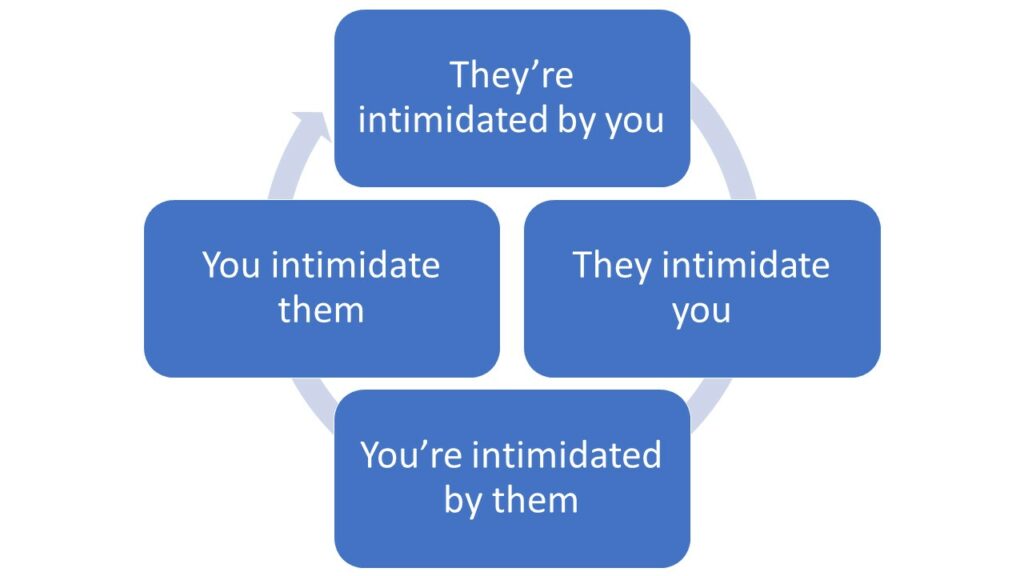
If you’re better than them in one or more areas, they may feel intimidated by you. Having been thrown to a lower position, they get desperate to shoot themselves up to a higher position. They do this by trying to intimidate you.
You may have intimidated them unintentionally, and now they’re intimidating you intentionally.
When you feel someone is trying hard to intimidate you, they’re probably intimidated by you and are engaging in ‘status climbing’ to make up for their status gap.
You’ve awakened their insecurities, and they’re now putting up a front to show you that they’re just as important as you.
The cycle of intimidation. Keeping up with the Joneses is a good example of this. Your neighbor gets something that’s better than what you have. You feel intimidated and get something that’s better than what they have, and so on.
Intimidating vs. trying to intimidate
You’re bound to feel intimidated if you come across someone better than you in an area you care about. It happens automatically. They don’t even have to do anything. They’re not trying to intimidate you.
When someone is actively trying to intimidate you, it’s a different story. You can feel the pressure on you to get intimidated and comply. They’re crossing a line. You can feel they’re exerting dominance and making you do things you don’t want to do.
You’ll feel it in your body when you get intimidated by someone trying to intimidate you. Your body language will change, becoming more submissive. You’ll find yourself complying with them in obvious and non-obvious ways.
Signs someone is trying to intimidate you
If someone is ‘trying’ to intimidate you, they may not have succeeded yet. You might still be in the initial stages of feeling intimidated. If you’re already intimidated, you might still be in the initial stages of compliance.
In any case, the sooner you nip the evil in the bud, the better. We’ll soon look at signs that show someone is trying to intimidate you. Knowing these signs can help you stop feeling intimidated. And if you’re already intimidated, minimize or eliminate compliance.
Most of these signs are part of non-verbal communication. A lot of power dynamics happen on a non-verbal level without the utterance of a single word. The good thing about non-verbal intimidation moves is that you can counter them non-verbally.
I’ve tried to eliminate the obvious ‘signs’ of intimidation, such as yelling, blaming, shaming, humiliating, and bullying.
1. Prolonged eye contact
When someone makes prolonged eye contact with you, they’re sizing you up like predators size up their prey. They’re sub-communicating:
“I’m not afraid to look at you and judge you.”
It’s a challenge of sorts:
“I’m looking at you, making you uncomfortable. What are you going to do about it?”
Submissive reaction:
When faced with prolonged eye contact, many people become submissive. They break eye contact and look away. They feel nervous and threatened. Their gaze becomes shifty as they look here and there, trying to scan their environment for more threats.
When that happens, the other person succeeds in their intimidation attempt.
Fixing submissive reaction:
The intimidator might be forced to look away if you stare right back at them. By doing so, you communicate:
“I’m not intimidated by you sizing me up. I can size you up too.”
If you don’t want it to turn into a staring contest, you can look away, but you must look away at something important.
For instance, a friend. You can’t look away from anything if you know what I mean. Looking away at nothing or having a shifty gaze tells them their intimidation attempt succeeded.
When you look away at a friend or some object you go on to engage with, you’re communicating:
“That friend or that object is more important to me than your intimidation nonsense.”
2. Avoiding eye contact
Avoiding eye contact can have multiple meanings in multiple contexts. In the context of status and power dynamics, when someone avoids making eye contact with you, they’re communicating:
“You’re so beneath me I don’t want to engage with you. We’re not equals.”
They come across as arrogant, aloof, and cold. They might be doing it deliberately to intimidate you.
Submissive reaction:
If you care about that person, you’re likely to become upset. You want to engage with them, but they don’t. You feel compelled to engage with them. But by doing so, you come across as lower in status than them.
You don’t lose status and power if they reciprocate your eye contact and engagement. If they don’t, you look like you’re kissing up to them. There’s a power imbalance. You’re exerting more effort than them.
Fixing submissive reaction:
If you feel someone is intentionally avoiding eye contact with you to feel superior, you shouldn’t make any attempts to make eye contact with them. Fight fire with fire.
3. Taking up space
In any room, the highest and most prominent spot is reserved for people with the highest status. Whenever there was a function in our school, the principal always sat in an oversized chair while the students sat in cramped chairs.
When someone tries to take up more space, they’re trying to show dominance. They’re being territorial and communicating:
“I own this chair, car, table, etc.”
“I’m the boss.”
Submissive reaction:
The common submissive reaction to this intimidation move is to let the other person take up space. By taking up less space than them, you accept your lower position compared to their higher position.
I know all this sounds petty, but humans are petty.
Fixing submissive reaction:
If they own the property, they can take up as much space as they want. If you can’t take up an equally large or larger space in the room, I’d suggest you leave the room. You don’t have to sit there being their disciple while they gloat in their power.
4. Standing up straight
I’m sure you’ve seen bodybuilders strutting around like peacocks. Their gait can look weird, but why do they do it?
It’s because they feel superior to others who don’t have the same physique as them. In other words, they’re trying to intimidate people.
Submissive reaction:
There can be many submissive reactions to this, but a common one is staring at the bodybuilder. Watching them in awe and validating their high status. Some people, intimidated by these strutters, look down and slouch their backs. A natural, submissive response.
Fixing submissive reaction:
Act unimpressed. If you want to make it worse, laugh at their ridiculousness. You could even mock them by walking like them. Don’t blame me if they come after you after that, though.
Jokes aside, standing up straight is a good body language tip everyone ought to follow. But there’s a difference between standing up straight and ‘trying’ to stand up straight. The latter looks unnatural and forced.
5. Moving you out of their way
Submissive, low-status people make way for high-status people. Think of a celebrity or a politician moving through a crowd. The crowd makes way for the high-status person by getting out of the way.
If someone forces you to move out of their way, they’re trying to intimidate you. They could’ve politely asked you to move, but they didn’t.
Submissive reaction:
The submissive reaction here is moving out of the way, of course. You may have noticed that people move out of the way very quickly, communicating:
“How dare I get in your way, boss? Silly me. I’m going to run away.”
Fixing submissive reaction:
You can refuse to get out of the way because you too need to get somewhere. You may be blocking them, but you may be doing something important too. Of course, you don’t want to start a fight. You can politely say:
“Could you wait for a minute?”
If you aren’t doing anything important and have no choice but to move away, do so very slowly. Take all the time you need. Don’t rush into submission.
If they ask you to move politely, you should have no problems with rushing. When there’s no intimidation, there’s no submission.
6. No facial expressions
This is again a disengagement tactic of high-status people, communicating:
“You’re so beneath me, I don’t want to engage with you emotionally.”
Submissive reaction:
The common submissive reaction to this is putting in extra effort to engage emotionally. Going out of your way to get an emotional reaction out of them. Getting upset would be another reaction.
Fixing submissive reaction:
Self-respecting people don’t engage emotionally with those who don’t want to engage emotionally with them. Healthy relationships are based on give-and-take.
7. Showing off
When you’re a high-status person, it’s tempting to show off. You want people to value, admire, and respect you. The dark side of showing off is that you also want to intimidate people. You want to show them you’re better than them.
People who show off mainly to intimidate others do it repeatedly and obnoxiously. People who show off in a socially healthy way try to tone down the intimidation part.
When someone tries to intimidate you by showing off, it’s easy to deny the intimidation part.
“They’ve worked hard. They deserve it.”
“If you got it, flaunt it.”
Despite saying these things, people feel something is off when someone shows off. Sometimes, they get confused about whether they should admire the showy person or despise them for trying to be superior.
Submissive reaction:
If you feel someone is showing off too much in your presence, they might be trying to intimidate you. The intimidation attempt is obvious when they highlight how they’ve got what you haven’t.
A submissive reaction to this can be feeling unworthy because you haven’t got what they have. This manifests in congratulating them without being happy for them.
Fixing submissive reaction:
People are good at detecting empty congratulations. They know when you’re happy for them and when you’re not. It leaks out in your body language.
If you’re not happy for them, you’re affirming their superiority and high status. Their achievement caused a dent in your world.
Instead, turn a blind eye to their achievements as if they don’t matter to you. Or, you can downplay their achievements by setting the bar higher.
For instance, if they say:
“I made 100 sales this month.”
You can say:
“That’s great, but 200 would’ve been impressive.”
Only do it when you can be sure they’re rubbing their success in your face. Not when you’re automatically intimidated by their achievements.
I’d never advocate downplaying the achievements of people you care about. I strongly believe in encouraging people. But those who show off to intimidate you and make you feel inferior don’t deserve your encouragement.
8. Controlling conversations
People can try to intimidate you via verbal communication as well. It’s mainly done by attempting to control conversational aspects like:
Who speaks first
Who ends the conversation
What topics to talk about
Who talks more
People usually try to intimidate you in conversations by talking over you. They want the conversational floor all for themselves. They’ll not let you make your point and interrupt you frequently.
Submissive reaction:
Letting people talk over you. When you do this, you communicate that what you have to say is unimportant. And, by extrapolation, you’re unimportant. You can always feel it when someone is trying to control a conversation.
Fixing submissive reaction:
What you say is important, and others should listen to you. If they don’t, leave the conversation.
You’ll notice that with power-hungry people, every conversation unnecessarily turns into an argument or debate.
Recently, I was having a ‘discussion’ with a relative. What I thought was a discussion soon started wearing the clothes of an argument.
They weren’t listening to what I had to say. They talked over me by vomiting out everything they knew about the topic in an unstructured way. I felt they were trying to show me they knew more than me.
When I realized this, I slowly ended the conversation. I refused to participate with equal intensity till the conversation dwindled on its own. I saw no point in continuing. While it may seem like I let them ‘win’ by letting them voice their opinions, I controlled the conversation by bringing it to a halt and disengaging.
As you’ve seen repeatedly in this article, disengagement is power.
Relationships take a lot of time and energy to maintain. People invest in relationships because the rewards they get from them in terms of happiness and satisfaction are worth it.
When people get the rewards they want, they continue the relationship. When they don’t, they end them.
However, there’s a middle ground between those two extremes- taking a break. When you want to take a break from a relationship, you seek a temporary separation. You’re aiming to increase distance.
If one partner has doubts about the relationship, they need time to re-evaluate their relationship. When you’re engaged in a relationship, you hardly get time to assess it.
Why it’s healthy:
Having doubts about your relationship is normal, and taking the time to reflect on it is critical. People enter relationships through choice, and it’s their choice to re-evaluate the relationship at any time they feel like it.
2. Ignoring your own needs
If you keep giving and giving in a relationship without taking care of your own needs, your needs will eventually catch up with you. This can lead to bitterness and resentment, causing significant damage to your relationship.
Why it’s healthy:
Just as a jar cannot fill other cups unless it’s full, you must be full before giving to others. If you’ve been ignoring your own needs for a long time, you’ll be doing yourself a huge favor by taking a break and re-focusing on yourself.
3. Constant conflicts
If your relationship is plagued by constant conflicts that never seem to end, you may want to step outside of the relationship for a while.
Why it’s healthy:
Relationship problems are wicked problems that are hard to solve. As with any other complex problem, it helps to take a step back and get a big-picture view of things. Taking a break also helps you calm down so you can look at your conflict patterns more objectively.
By doing that, you may get key insights into how you may be contributing to the conflicts.
4. Re-directing resources
You may need to deploy the time and energy you’re putting into your relationship elsewhere. For instance, you may be experiencing challenging times at work that require more of your attention, time, and energy.
Since these are limited resources, your relationship will definitely bear the brunt.
Why it’s healthy:
You know what your priorities are. If you need to prioritize another life area, it can be good to take a break from your relationship.
5. Test the relationship
Sometimes people wonder what it’d feel like to end their current relationship. But instead of breaking up with their partner, they decide to take a break. They want to see how they’ll feel without their partner.
Why it’s unhealthy:
This can only be healthy when it’s mutual. Usually, it’s not. You may be testing the relationship and exploring your feelings, but you’ll be making your partner feel unsafe and uncertain. They’ll feel you had no good reason to take a break and that you’re playing with them.
6. Exploring other options
When people get bored with their relationships or feel their relationship is going nowhere, it’s natural for them to wonder what else is out there. They may feel they’re forgoing better opportunities by staying in the current relationship.
Why it’s unhealthy:
Seeing other people when you’re in a relationship will make your partner feel insecure. If you want to date other people, have the courage to end your current relationship. Don’t leave your current partner hanging.
7. Softening the breakup
You really want to break up with your partner but feel it’ll be too hard on them. So, you take a break to take the edge off the eventual breakup.
Why it’s unhealthy:
Act on what you really want right away. Instead of making your partner go through the uncertain and confusing liminal phase between ‘being with you’ and ‘not being with you’, give them closure.
8. Identifying with your partner
When you don’t know who you are, you’re likely to identify with your partner. When you don’t know who you are, you derive almost all of your self-worth and happiness from your partner, and you become overly dependent on them.
This is why when people want a break, they often cite reasons like:
“I want to find myself.”
Why it’s unhealthy:
Not developing your identity independent of your relationship forces you to give your all to your relationship. When you do that, you have nothing left for yourself. A healthy relationship balances your own needs with the needs of your partner.
When breaks lead to breakups
Once the relationship re-evaluation period is over, you may decide it’s not worth continuing the relationship. You may have irreconcilable differences with your partner. Seeing other people during the break and finding them better than your current partner gives you further incentive to turn your break into a breakup.
When breaks lead to better relationships
If, after re-evaluation, you decide that the relationship is worth saving, you’ll try harder to resolve your differences. Reflecting on your relationship will help you realize what you’ve been doing wrong and where you need to improve.
This continuous tweaking, adjusting, and learning from mistakes is the foundation of healthy relationships.
You’ve probably gotten sick of motivational speakers and success coaches constantly saying things like:
“Failure is the stepping stone to success!” “Success is failure turned inside out!” “Don’t be afraid to fail!”
They keep repeating these messages because they’re telling the truth. Also, because they’re constantly up against a deep-rooted tendency of the human mind- the tendency to feel crappy when you fail.
Unless you’ve totally internalized positive beliefs about failure, you will feel bad when you fail. It’s going to happen. Sure, you’ll think about or listen to something motivational to recover, but there will be something to recover from.
Why failure feels bad
Humans are social and cooperative mammals. In any cooperative group, the worth of each member is determined by their contribution to the group. Hence, we derive our self-worth mainly from the value we add to society.
We don’t want to do anything that makes us look bad.
Failure makes us look bad. It communicates we’re incompetent. When others know of our incompetency, they value us less. When they value us less, we also value ourselves less.
All the advice and wisdom around failure must be repeated endlessly because your emotion-driven subconscious mind cares a lot about your social standing.
The loss of social status induced by failure is the main reason we feel bad when we fail. I mean, think about it: Would you feel like a failure and be ashamed of your failures if you lived alone on an island?
Why we feel like a failure: Core reason
Feeling like a failure is a whole package that comes with powerful emotions like shame, embarrassment, anger, disappointment, and fear– shame being the big one.
These feelings alert you to a loss of status that just occurred in your life. Your mind wants you to fix whatever it is that went wrong. More than that, it wants you to stop and quit embarrassing yourself.
And that’s what we do.
When we fail, we tend to stop doing what we’re doing almost immediately. Some people are so humiliated that they can’t wait to leave the scene.
When that happens, the work of ‘feeling like a failure’ is done. Further loss in status and respect has been curtailed. Now we can go back to the drawing board and figure out how to look good to people again.
I just gave you the psychological mechanism behind the hundreds of success stories you hear.
Failure: Trait or state?
The main problem people face when it comes to failure is identifying with their failures. When they fail, they think they’re at fault. Something is wrong with them.
When they fail over and over, they see failure as a stable trait, not a temporary state. This is at the root of why failure is so hard.
But why does it happen?
Well, because others do it too!
When you see someone fail, you’re likely to judge them and think they’re a failure. You may even judge them, but you don’t want to be judged when you fail. This ridiculous and hypocritical aspect of human nature goes back to how we’re social species.
Our ancestors had to make quick decisions about the value of their group members. If they took too long, for instance, to decide if someone was a good hunter or not, they wouldn’t survive.
If they bring meat
They good
If they attractive
They healthy
If they unattractive
They unhealthy
If they smile
They friendly
These judgments helped them make quick survival and reproduction-enhancing decisions. They couldn’t afford to waste too much time reasoning about these things. In fact, the rational part of the brain evolved much later.
Judging a book by its cover was a quick and valuable evolutionary strategy to prevent costly survival and reproduction mistakes.
Hence, people tend to attribute what’s really an event (failure) to personality. They take failure personally and make it a part of their personality.
Reasons for feeling like a failure
Some tendencies in people contribute to their feeling like a failure or make it worse. Let’s go over these tendencies and how to cope with them rationally.
1. Unrealistic expectations
In a desperate fit of trying to raise their social status to the moon, people often set unrealistic expectations for themselves. Worse, they set unrealistically high expectations for others too.
‘My son will be a doctor.’ – A parent ‘You’ll top this year, I’m sure.’ – A teacher
Can we stop for a moment and ask the kid what they want?
The poor kid grows up with this burden of others’ expectations and feels like a failure upon failing to meet them.
This also applies to adults.
New year comes, and people are like, ‘I’m going to conquer the world this year!’.
When we soon find out that we haven’t conquered the world, we feel like a failure.
How to cope:
You can have unrealistic dreams, but you have to have practical goals. If you set reasonable and achievable goals, you’ll be happy when you see evidence of progress.
Instead of aiming for six-pack abs next month, how about you set a goal of losing 10 pounds?
2. Perfectionism
Perfectionism is a cursed word in the world of entrepreneurship and for good reason. If you strive to make things perfect, you’ll waste time and may never get there. You’ll end up feeling like a failure.
How to cope:
Perfect is the enemy of the good, and all you need is good. Trying to be perfect is setting yourself up for failure. As successful podcaster John Lee Dumas said in a book, “You have to have disgust for perfectionism.”
3. Social comparison
Failing in front of others is not the only way to lose status. People lose status all the time when they’re comparing themselves to others. Even high-status individuals lose status when they get caught in the trap of comparing themselves to others.
Upward social comparison i.e. comparing yourself to others who are better than you comes naturally to humans. It is what drives the grass is greener syndrome and the emotion of jealousy.
Comparing yourself to others and being envious motivates you to get to their level. It’s not entirely a bad thing. But most people, instead of feeling inspired, feel jealous. Compared to their own, the other person’s high status makes them feel low status and powerless.
People engage in this status game all the time on social media. They see someone posting about their fabulous life. They feel less than and post something about their own incredible life.
It’s naïve to think that people only share their successes on social media to share their excitement or inspire others. There’s always this dark side of human nature that drives this behavior. The dark side that desires superiority over others and wants to make them look bad.
How to cope:
This game is never-ending because hardly anybody experiences the awesomeness of life all the time. We all go through the ups and downs of life. Also, nobody can be good at everything. Nobody can have it all.
No matter how good you are, there will always be someone better. You can’t compete with every single quality, hobby, or interest of every person you know.
Instead of falling into this comparison trap, how about we focus on ourselves and figure out what we need to do to get to the next level?
4. Rejection
When somebody rejects us, they don’t see us as valuable enough to be with us or do business with us. Value loss equals status loss, and we feel like a failure.
How to cope:
Success in any endeavor is a numbers game. You don’t need a million people to value you. That one person who chooses to be with you or that one person who does business with you can have life-changing consequences for you.
Getting rejected is a sign you’re trying which is better than not trying.
5. Imposter syndrome
Impostor syndrome occurs when you’re valuable to everyone around you except you. You feel like a fraud and worry that people will find out about you. You feel undeserving of the status and success you’ve reached.
How to cope:
Imposter syndrome is triggered when we exceed our own expectations. You have to remind yourself that if you were really undeserving, you wouldn’t be where you are.
6. Fighting against your nature
Human nature is powerful and shapes almost everything we do. It has millions of years of evolution behind it. Often, that’s impossible to overcome with mere willpower.
This is why bad habits are so hard to overcome. When we remain stuck in our bad habits, we feel like we’ve failed.
You know that chocolate chip cookie is terrible for you, but your mind simply can’t resist it. Your mind loves calorie-rich foods because they helped with survival in ancient times.
How to cope:
If you want to make a positive change in your life, you can leverage your powerful nature.
For example, you have to remove all unhealthy foods from your surroundings to eat healthy. It’s much easier to avoid temptation than to resist it.
Similarly, you can leverage your mind’s love for dopamine by rewarding yourself when you accomplish your goals.
7. Quitting too soon
Getting good at anything worth getting good at takes time. Many people keep trying different things without attaining mastery in any one of them. Being the Jack of all trades and master of none decreases confidence.
How to cope:
Master one or two things and learn the basics of other essential things. When you master something, you lift yourself above the crowd (status gain). Your confidence increases.
8. Being overwhelmed
When you have a lot to do, and there are hundreds of things pulling at your attention, you get overwhelmed. Overwhelm paralyzes you and makes you slip back into bad habits. It leads to losing a sense of control and feeling like a failure.
How to cope:
When you get overwhelmed, you need to step back from your life to get a big picture view of your life. You need to make adjustments and re-organize things. Instead of doing nothing, even a small act like making your bed can make you feel better.
That feeling of getting a small win will prevent you from feeling like a failure.
9. Limiting beliefs
A limiting belief is a belief that limits your potential, making you believe that you can’t do things. It stems from not doing things and from our past experiences.
Constant criticism and shaming from parents, teachers, and other authority figures can make you internalize limiting beliefs.
You can test whether or not you have limiting beliefs by stepping out of your comfort zone. When you do that, the voices of your limiting beliefs will haunt you:
“You can’t do that.” “Are you kidding me?” “Who do you think you are?” “You’re good for nothing.”
How to cope:
This is perhaps the hardest challenge to overcome on this list, but it can be done. The key to damping all those voices is to give your subconscious mind enough proof that they’re wrong.
The mere repetition of affirmations can’t overcome negative self-talk.
You have to step outside of your comfort zone and do the things that your limiting beliefs say you can’t do. That’ll work like pouring water on fire.
Analyze your failures
A great way to avoid taking failures personally is to analyze them. Analysis of failure is necessary if you are to learn from it. Otherwise, you won’t make progress.
Ask yourself what happened. Describe it in detail. Then ask why it happened. Often, you’ll find that the reason it happened had nothing to do with you as a person.
Projection in psychology means projecting your own mental states and traits onto others- traits that they don’t possess. Just as a movie projector projects moving images from a reel onto a screen, people project what’s going in their minds (reel) onto others (screen).
The screen itself is blank.
Projection is of two types:
A) Positive projection
When we attribute our positive traits to others, it’s a positive projection. When we positively project onto others, we attribute our good qualities to them that they actually lack.
An example of positive projection would be idealizing your romantic partner and believing they possess the good traits that you have, but they don’t.
B) Negative projection
When we talk about projection, we’re usually referring to negative projection. This type of projection is more common and can have drastic consequences.
Negative projection is when you attribute your negative qualities to others. For instance, denying a lack of responsibility in yourself while calling others irresponsible.
More examples of projection
To further clarify the concept of projection, let’s take a look at some more examples:
The cheating husband
If a husband cheats on his wife, he may accuse her of cheating. In this case, he’s projecting his behavior (being a cheater) onto his wife (who’s not a cheater).
The jealous friend
If your best friend is jealous of your new relationship, she may accuse your boyfriend of being jealous of your friendship with her.
The insecure mother
If you’re about to get married and are spending more time with your fiancée, your mother might feel insecure and exert greater control over you. Meanwhile, she may accuse your fiancée of being insecure and controlling.
What causes someone to project?
Being social species, humans need to look good to themselves and others. They highlight their positive traits and hide negative ones.
Projection is a means to hide your negative traits. When you project your negative traits onto others, the spotlight (and blame) shifts from you to them. They’re the villain while you’re a hero.
Projection is a denial of one’s dark side. It’s a defense mechanism of the ego. Admitting your flaws and negative traits hurts the ego.
Projection can be conscious or unconscious. Conscious projection is manipulation and is not very different from gaslighting.
Unconscious projection usually stems from past trauma.
For instance, if your father abused you as a child, you may experience problems with your social life when you grow up. You may find it hard to trust people.
Abuse creates shame in you, and you come to believe that something is wrong with you. As you grow up and your ego develops, you may find it harder and harder to admit your ‘flaw’. So, you project that ‘flaw’ onto others:
“I hate people. I don’t trust them. They’re flawed.”
Of course, there’s some truth to it. Nobody’s perfect. That’s a fact. But you use this fact not just to state a fact but also to stroke your ego and put a lid on your shame.
Signs someone is projecting
If you suspect someone you know is projecting, look for the following signs:
1. Over-reaction
If their anger and reaction are disproportionate to the situation, they’re likely projecting onto you. It may seem like they’re attacking you, but they’re really only fighting with themselves.
They’re embroiled in their inner conflicts, desperately trying to hide their dark side.
When they yell at you and say:
“WHY ARE YOU BEING SO MEAN?”
What they’re really saying is:
“I don’t want to accept that I’m mean.”
If their overreaction is recurring and follows the same pattern, you can almost be sure they’re projecting.
2. Blaming you unjustly
If you dare remove the lid and peek into the dark pit of their hidden negative qualities, you’re sure to face a backlash. They’ll grab you by the collar, pull you away, and slam the lid close.
When someone is projecting onto you, this is precisely what happens when they’re quick to blame you. They’re more interested in covering their lid than gathering facts.
They don’t stop to think that blaming you for the things that you didn’t do or the traits that you don’t have only makes things worse.
3. Living in a distorted reality
When someone is projecting onto you, their perception of reality gets distorted. They create their own fantasy world where you’re the guilty party. They throw their unjust accusations at you, and nothing seems to change their mind.
It’s hard convincing them to change their minds because they’re emotion-driven. They cannot be objective.
4. Playing the victim
Self-victimization is common in those who’re projecting. Often, it’s not enough to unjustly accuse you. They also want you to feel guilty for a trait you don’t have. So, they go on and on about what you’re (not) doing and how it affects them.
5. Ruining your mental health
If your mental health is never good when you’re with this person, chances are they’re projecting onto you. When someone projects onto you, your mental health can suffer for days.
If someone accuses you of doing something you did do, you can fight back and justify your actions or admit your mistake and apologize. You know what happened happened. The issue gets resolved quickly. You suffer mentally for some time and then bounce back.
But when they’re projecting onto you, the issue (non-issue) lingers. It lingers because you’ve been accused of something you didn’t do. You need time to process what’s going on. Your reality has been distorted.
You can’t focus on other life areas. Because to focus on something, you need a ‘self’, and your ‘self’ just got turned inside out.
Of course, it’s going to take longer to recover from that.
6. Changing you
When your ‘self’ gets turned inside out, it’s up to you to turn it outside in. It’s up to you to stick to the truth about who you are and what you have or haven’t done. It’s up to you to reclaim your identity.
If you don’t, there’s a possibility that your distorted self becomes your new self. You come to believe the false accusations.
“If they’re calling me stupid repeatedly, maybe I am stupid.”
This is as deadly as it gets. Advanced manipulation.
Since their projections are realities to them, they use them as a weapon to project again.
They’ll say something like:
“I told you your wife is an evil person. I’ve told you that three times already.”
They think that just because they repeated their projections, that makes their projections real. Yes, they said it three times, but they were wrong all three times. Saying the wrong thing over and over doesn’t make it true.
How to respond to someone who is projecting
First, make sure they’re really projecting by looking for the above signs. You don’t want to project your own projection onto them. It’s possible that you’re the one who’s projecting but are unjustly accusing them of it.
With that out of the way, you have to consider what type of person they are. If you think they’re smart and you can help them see reality, great. If they’re not as objective as you’d like, you need a different approach.
Try opening their lid gently. Tell them it’s okay for them to have their flaws. You have them too. Most of us have been hurt and are healing. We’re all works in progress.
Avoid anger as much as possible. You can’t fight with a person who’s not even in the same reality as you.
It’s frustrating when every conversation with your loved one turns into an argument. When you’re done arguing and finally get the time to reflect on what happened, you’re like:
“We fight over such minor and silly things!”
Arguing once in a while is typical for relationships, but when every conversation turns into an argument- when it becomes a repetitive pattern- things start to get serious.
In this article, I’ll attempt to deconstruct the dynamics of arguments in relationships so you can have a clear idea about what’s going on. Later, I’ll discuss some strategies to deal with arguments that you can try the next time you argue with a loved one.
I’ll also give you the best lines to end arguments that you can use when you have no clue what’s going on.
Why it happens
You could be talking about the most random topic with your loved one, and before you know it, you’re in the middle of an argument.
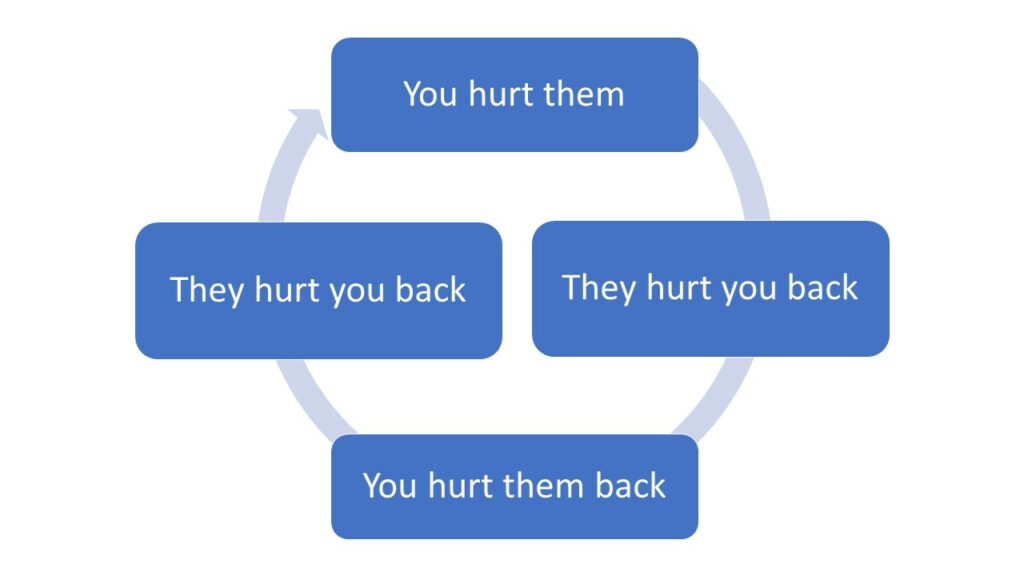
All arguments follow the same process:
You say or do something that triggers them
They say or do something to trigger you
You trigger them back
I call this the cycle of hurt. Once your partner feels hurt by something you say or do, they hurt you back. Defense is a natural reaction to being attacked. And the best way to defend is to attack back.
For instance, you say something disrespectful to them. They feel hurt and withdraw their affection as a punishment. They don’t pick up your call, let’s say.
You sense that they didn’t pick up your call deliberately and get hurt. So next time, you don’t pick up their call either.
You can see how this vicious cycle self-perpetuates once activated. It becomes a chain reaction of hurt.
The cycle of hurt in close relationships.
Let’s go back to the start. Let’s deconstruct what starts arguments in the first place.
There are two possibilities:
One partner intentionally hurts the other partner
One partner unintentionally hurts the other partner
If you intentionally hurt your partner, don’t be surprised if it activates the cycle of hurt. You can’t hurt your loved ones and expect them to be okay with it. Deep down, you know you messed up and are likely to apologize.
Partners will rarely start an argument by intentionally hurting each other, though. Intentional hurting occurs more once the cycle of hurt has been activated unintentionally.
What starts most arguments is the second possibility- one partner unintentionally hurts the other partner.
When this happens, the hurt partner accuses the other partner of intentionally hurting them, which isn’t true. Being falsely accused deeply hurts the accused partner, and they hurt the accusing partner back, this time intentionally.
We know what happens next- blaming, yelling, criticizing, stonewalling, and so on. All the things that make a relationship toxic.
What happens when you hurt them unintentionally?
Now, let’s dig into why someone misinterprets neutral words and actions as intentional attacks:
1. The closer the relationship, the more you care
Humans are wired to value their close relationships. After all, their intimate relationships help them the most to survive and thrive.
The more we care about maintaining a good relationship with someone, the more upset we get if we sense the other person doesn’t care about us. This makes us see relationship threats where there are none.
The mind’s like:
“I’m going to eliminate every possible threat to this relationship.”
In its desperation to preserve the relationship and defend against threats, it sees threats where they are none, so it doesn’t take any chances, and every possible threat is destroyed.
This ‘better be safe than sorry’ approach is deeply rooted in our psyche.
2. Poor communication skills
People communicate differently. How you communicate is primarily influenced by the people you hang around with.
Most of us learned to talk in the presence of our parents. We picked up how they communicated and made it a part of our communication style.
This is why people tend to talk like their parents.
If being blunt was the norm in your household while your partner comes from a more polite family, then your being blunt will get misperceived as rudeness.
Any aggressive communication style that makes the other person feel attacked is poor. It’s often more about how you say things than what you say.
3. Inferiority complex
People who feel inferior are always in defensive mode. They’re so afraid that others will know how inferior they are they feel compelled to show their superiority when they can. Freud called it reaction formation.
I’ve had a friend who always tried to prove to me how smart he was. He was smart, but his constant showing off started to irritate me. I couldn’t have a proper discussion with him.
Anything we talked about inevitably took the turn of “I’m smarter than you. You know nothing”. It was clear that instead of listening and processing what I had to say, he was more into flaunting his smartness.
One day, I’d had enough and confronted him. I hurt him back with my smartness, and it ticked him off. We haven’t talked since. I guess I gave him the taste of his own medicine.
Inferiority is triggered by upward social comparison– when you encounter someone better than you at something you value.
I was watching an interview of a super successful person in our industry. The interview was taken by a guy who wasn’t as successful as the interviewee. You could cut the inferiority complex in the room with a knife.
The interviewer was less interested in what the interviewee had to say and more interested in showing the audience that he was on par with the interviewee.
Because those who feel inferior have something to hide and prove, they easily misperceive neutral actions and words as personal attacks. Then they defend themselves to mask their inferiority.
4. High-conflict personalities
High-conflict personalities are prone to conflicts and seem to thrive on them. They develop a reputation for being quarrelsome. Since these people are actively looking to get into disputes, they don’t miss a chance to misperceive neutral actions or words as attacks- just so they can fight.
5. Displacing negative emotions
People often argue over minor and stupid things because they have other problems not related to the relationship.
For instance, a person may be stressed at a job, or their parent may be ill.
These adverse circumstances lead to negative emotions that seek expression. The person is looking for a reason to vent.
So, they pick a minor thing, misperceive it as an attack, and vent on their partner. Relationship partners often become punching bags for each other in this way.
6. Past resentments
Unresolved relationship issues lead to resentment. Ideally, one shouldn’t move forward in a relationship before past issues are resolved.
If your partner brings up your past mistakes during a fight, it means they haven’t resolved the issue. They’ll continue using that resentment as a weapon against you.
If you already resent your partner, it’s easy to misperceive neutral things as attacks and unleash the beast of your past resentments on your partner.
What to do?
Now that you have some insights about what goes on during arguments, let’s discuss the tactics you can use to prevent turning conversations into arguments:
1. Take a break
When the cycle of hurt is activated, you’re both angry and hurt. Anger throws us into ‘defend/attack’ or ‘flight-or-flight’ mode. Anything that you say during this emotional state isn’t going to be pleasant.
So, you need to stop the cycle before it perpetuates by taking a break. No matter who hurt whom first, it’s always up to you to take a step back and de-activate the cycle of hurt. After all, it takes two to quarrel.
2. Work on your communication skills
You may be unintentionally hurting your loved ones by the way you speak. If you’re blunt, tone down your bluntness with people who can’t take it well. Work on being an active listener and strive to talk politely.
These things are simple but very effective. Changing your communication style from aggressive to non-aggressive could be all you need to do to avoid relationship problems.
If your partner has poor communication skills, help them by letting them know how they speak affects you.
3. Their feelings are just as important as yours
Say you get unfairly accused by your partner of hurting them. You’re mad, okay, but why hurt them back and prove them right?
Acknowledge that something you did triggered your partner, even if you didn’t mean to. Validate their feelings first before you explain your stance.
Instead of using an accusatory tone and saying:
“What the hell? I didn’t mean to hurt you. Why are you taking it personally?”
Say:
“I’m sorry you feel that way. I seem to have unintentionally triggered you. Let’s explore what happened here.”
4. See things from their perspective
To validate their feelings, you need to see things from their perspective. We humans have a hard time seeing things from other people’s perspectives.
If you can see where they’re coming from, you’ll be able to empathize with them. You’ll no longer feel the need to fight and win the argument. You’ll look for ways to accommodate their needs and seek a win-win.
Just because you acknowledge their perspective doesn’t mean your perspective is less important. It’s not a “me vs. them”. It’s “understanding each other vs. not understanding each other”.
5. Don’t make your partner your punching bag
If you’re struggling in a life area, seek support from your partner instead of making them your punching bag. Instead of turning every conversation into an argument, talk about your problems and seek to resolve them.
Venting may make you feel better temporarily, but it doesn’t lead to a solution, and you end up hurting those around you.
Discussions vs. arguments
When exactly does a conversation turn into an argument?
It’s an interesting phenomenon. Since humans are emotional creatures, you really can’t expect them to have civilized and rational discussions.
I’ve had to come to terms with the fact that almost all discussions with people are doomed to turn into arguments. It’s rare that you’ll find a person with whom you can discuss anything without it turning into a fight.
Avoid discussions with argumentative people if you don’t want to turn every conversation into an argument. Find people who’re open to new ideas and can discuss things calmly.
Contrary to popular belief, you can have a heated discussion without it turning into an argument. The heat can come from your passion for the topic or your convictions. A heated discussion turns into an argument only when you veer off the topic and make personal attacks.
Best lines to end an argument
Sometimes you want to end an argument even if you don’t understand what’s going on. Arguments are a colossal waste of time and spoil relationships. The fewer arguments you get into, the better your overall quality of life will be.
Ideally, you want to develop the skill of seeing arguments in the seed before they sprout. It could be a random hurtful comment from someone or a conversation that increasingly takes a hostile turn.
When you sense an argument brewing, step back from it by using these lines:
1. “I understand what you mean”
Most arguments are fueled by the sense of being unheard or taken for granted. When people get taken for granted, they make their position stronger.
2. “I’m sorry you feel that way”
Even if you didn’t intentionally hurt them, this statement validates their feelings. They’re hurt that you hurt them. That’s their reality. You need to acknowledge their reality first and explore later.
3. “I see where you’re coming from”
You can use this sentence to help them gain insight into themselves in a non-aggressive manner.
4. “Tell me more”
This magical sentence kills three birds with one stone. It:
taps into their need to feel heard
gives them a chance to vent
helps in exploring the issue
5. “You have a point”
Nothing can calm an argumentative person more than acknowledging their complaints. After you’ve calmed them down, you can explore the issue further and explain your stance.
You’ve probably heard the saying, “If you love what you do, you don’t have to work a day in your life”. I’ve been loving what I do for a few years now and can attest to its truth.
It’s a weird mental state to be in, frankly. You work a lot, and that work disappears into thin air- poof! You wonder where all your work went. As a result, you sometimes feel guilty for not doing enough. Because work doesn’t feel like work, it’s confusing.
Confusing as it may be, I can imagine it’s way better than being stuck in a soul-crushing, mind-numbing job. Work that doesn’t engage you at all and sucks the life force out of you.
What makes this type of work different from the work you love?
It all boils down to the level of engagement. Nothing more. You’re more engaged in the work you find interesting and disengaged from the work you don’t care for.
What happens when you disengage from the work you don’t care for?
Well, your mind has to engage with something. It has to focus on something. So, it focuses on the passage of time. That’s when work takes ages to complete, the clock seems to run slower, and your day drags on.
The focus needle
To visualize what we’ve discussed so far, I want you to imagine that you have a focus needle in your mind. When you’re fully engaged with your work, this needle moves to the extreme right.
When you’re disengaged and paying more attention to the passage of time, the needle moves to the extreme left.
What can you do to shift the focus needle from left to right?
Two things:
Do work that you find engaging
Increase engagement in your current work
The first option may require quitting your job, and I know that’s not an option for many. So, we’ll focus on making your current work more engaging.
Negative emotions move the needle to the left
If you think about it, soul-crushing work, per se, can’t harm you. It has nothing against you. It’s just work, after all. What bothers you is how it makes you feel.
In truth, the real issues are negative emotions and moods such as boredom, exhaustion, overwhelm, stress, burnout, and anxiety usually caused by mind-numbing work.
So, to increase your engagement level in your present work, half the battle is combating these emotional states. These emotional states are designed to shift your focus from whatever you’re doing to them.
We feel a negative emotion when we’re under threat, and the mind can’t let us focus on work if it is under threat. This is so powerful that even if you love what you do, you find that when you’re under the grip of a negative mood, you just can’t focus.
Every minute feels like an eternity, and you say you had a ‘long’ day.
How to make work go by faster
Let’s discuss some things you can do to increase engagement in your current work, no matter how soul-crushing it may be:
1. Planning your work
When you plan what you’re going to do, it rids you of a lot of decision-making. Decision-making is not a pleasant mental state, and it can easily paralyze you. When you take a long time to make decisions, you feel time is moving slowly, and your productivity suffers.
When you plan out your work, you can get moving fast.
2. Time-blocking
Time-blocking is dividing your day into time segments that you can devote to specific tasks. Time-blocking is insanely useful as it helps you focus. It lets you schedule tasks instead of having a simple to-do list without time attached to it.
Not only does this help with productivity because what doesn’t get scheduled doesn’t get done, but it also makes work easier to tackle.
Instead of seeing work as this huge mountain you got to climb for eight hours straight, you give yourself small two-hour hills to climb.
When work becomes less daunting, you feel more confident and eliminate anxiety. Removing negative emotions like anxiety is excellent for increasing engagement levels.
3. Get into flow
Flow is a state of mind where you’re so engaged with what you’re doing time seems to fly by. You’re so immersed in what you’re doing you forget everything else. It’s a joyful state that’s easy to achieve when you love- or at least like- what you’re doing.
But you don’t have to like what you’re doing to get into flow.
To get into flow, all you need to do is make your work challenging. Not so challenging that you get overwhelmed and feel anxious but challenging enough to increase engagement.
4. Engage with something else
If you don’t find your work engaging, you can still raise your baseline levels of engagement by engaging with something else. For example, you can listen to music or podcasts while doing dull, repetitive work.
This can only work if your work isn’t too cognitively demanding and you have to work more or less like a machine. Examples of this type of work include doing repetitive work at a:
factory
warehouse
restaurant
call center
grocery store
When work becomes repetitive, your engagement level drops. The needle moves to the left, and you focus more on the passage of time.
Putting on something in the background raises your engagement level enough to not simply focus on the passage of time but not enough to distract you from the task at hand.
5. Gamify your work
If you can turn your tedious work into a game, that’d be awesome. We all love games as they give us instant rewards and whet our competitive spirits.
If you and a coworker each have a boring task to finish, you could turn it into a game by competing with each other.
“Let’s see who can finish this task first.”
“Let’s see how many e-mails we can send in an hour.”
If you have no one to compete with, you could compete with yourself. I compete with myself by looking at how I did last month compared to how I did in the current month.
Games are fun. Numbers are fun.
6. Make time for rest
If you work for many hours continuously, burnout is inevitable. And burnout is a negative state we’re trying to avoid because it makes time go slower. This applies even to the work you love. Do it too much, and you’ll start to hate it.
This is why you must take the time to rest. Make it a part of your routine.
Not only does rest and rejuvenation prevent burnout, but it also mixes up your day. It makes your day more colorful. It gives you time to take care of yourself. You can exercise, take a walk, engage in your favorite hobby, and the like.
If all you do is work, don’t be surprised if life becomes slow and dull.
7. Sleep well
What has sleep got to do with making your work more engaging?
A lot.
Poor sleep can put you in a bad mood throughout the day. It also impairs your cognitive abilities. If your work is cognitively demanding, you need proper rest.
8. Eliminate distractions
Distractions disengage you from the work you’re doing. The more distracted you are while you work, the more your focus needle moves to the left.
When you eliminate distractions, you can immerse yourself more deeply into your work. Even if you think your job sucks, you may stumble on an aspect of it that you find interesting.
But that can’t happen unless you do your work with complete focus and thoroughly, giving all of yourself to it.
9. Look forward to something pleasant
If you have something exciting to do after work, this can motivate you to finish the work as soon as possible.
When you’re thinking about something exciting, you’re more engaged. It increases your baseline level of engagement.
However, you can’t be too excited. If your excitement level is too high, you can start becoming anxious and impatient. You can’t wait for work to be over.
Now, the future consumes all your attention, and you can’t focus on the present work.
10. Shelf issues as they arise
This is a powerful technique to maintain high engagement levels at work. If an issue arises while working, you can easily get distracted.
A problem is a threat and being under threat generates negative emotions. You feel compelled to tackle the danger and rid yourself of the negative emotions.
You leave what you were doing and get side-tracked. This has happened to me so many times. It’s been my major productivity struggle.
The best way to deal with such situations is to ‘shelf your issues’.
The idea is you don’t have to deal with every issue that arises head-on. Most problems are not urgent, but they make you feel they are. If they’re unaddressed, the world will not end.
The problem is: When you’re under the grip of negative emotions, it’s hard to convince your mind that the issue isn’t urgent. The mind only cares about emotions.
Shelving the issue means acknowledging it and planning to tackle it later.
For example, if you put the task on your to-do list, your mind can rest assured that the problem will be taken care of. And you can continue working on what you were working on.
I know the mental state you’re in right now. It sucks to think you suck at everything. You feel like you’re the opposite of King Midas. Instead of gold, everything you touch turns to crap.
Being bad at things isn’t good. It leads to feelings of inferiority, insecurity, low self-esteem, and depression. It negatively impacts your overall mental health and impairs all areas of your life.
So what’s going on?
We think we suck at everything for different reasons. There are two main possibilities:
You think you suck at everything but don’t
You think you suck at everything because you do
These are separate issues that need to be addressed separately. Let’s address the first possibility:
When you fail at something, for instance, you tend to overgeneralize that failure. Instead of saying something like:
“I suck at coding.”
You say:
“I suck at coding. I suck at everything. I suck at life.”
This is also called all-or-nothing or either/or thinking. Either you’re a failure in everything or a success in everything. But the reality isn’t like that. You’re probably good at some things and bad at others.
Next time you fail at something, avoid overgeneralizing that failure to your entire life, as tempting as it may be. Instead of saying, “I suck at everything”, tell yourself, “I suck at this specific thing I just failed at.”
When you fail at something, your mind goes into this negative state where you feel low. The mind then tries to maintain this negative state by recalling all your past failures.
As a result, you’re blinded to the things you’re good at. It seems you’re bad at everything because you’re selectively focusing only on your past failures.
Then there’s what’s called the availability bias. We tend to be more aware of things that are recent in our memory.
You just failed at something, and this information is easily accessible to your mind. You miss the bigger picture. You miss the fact that you’re good at dozens of things and bad at only one thing you just failed at.
Another tendency that plays into this is the grass is greener syndrome. We’re wired to focus on what we lack, not on what we have. This tendency helped our ancestors to accumulate resources in their resource-scarce environments.
Today, it makes us focus on our weaknesses and failures instead of our strengths and successes.
Overcoming these faulty thinking patterns is just a matter of being aware of these human biases. You’ll find that you can avoid falling into their trap with practice.
2. You do suck at everything
If you think you suck at everything, you may be right.
Let’s explore why you’ve failed to get good at things and what you can do about it.
First things first: What does it take to get good at something?
Clearly, you’re not doing those things. To get good at the things worth getting good at requires paying a price.
What does that price look like?
Well, to get good at anything requires these key ingredients:
You need all these ingredients to get good at something. You can skip Information in the beginning, but it’ll take a long time for you to succeed if you do. With reflection, you’ll inevitably gain the right information to succeed.
To get good at things, you need to practice them. You need to put a lot of time and effort into them. You also need the right information and strategies to implement.
Without reflection, you won’t be able to course-correct. You may put in a lot of time and effort into something, but you won’t make any progress without reflection. More on this later.
Reasons why you suck at everything
If there are four key ingredients to get good at something and you’re missing any of them, it follows that you won’t get good at that thing. All the reasons we discuss next will be missing one or more of the above ingredients.
Let’s go over them one by one:
1. You’re lazy
If you’re a lazy person who hates to put effort into things, you can’t expect to get good at anything. You’ll keep looking for shortcuts that’ll only get you so far. For developing valuable skills, putting in enough time and effort is a requirement.
2. You’re afraid to fail
Sucking at something is the first step to getting good at something. Every person you admire sucked at first at what they’re now good at.
Because failure leads to frustration, pain, and disappointment, people shy away from failure to avoid experiencing these unpleasant emotions.
Failing at things and being okay with that is the first hurdle to overcome to get good at anything.
3. You give up too soon
You may have conquered your failure of failure, but having false expectations about how long it’s going to take can also stop you in your tracks. As mentioned before, getting good at something typically takes a long time.
You can get results faster with the proper guidance and knowledge, but it’s still going to take a while. Before you quit and decide it’s not working for you, you should always ask:
“Have I given this thing enough time?”
4. You’re arrogant
If you think you’re the most intelligent person in the room and don’t need to learn anything, you’re shooting yourself in the foot. In fact, if you are the most intelligent person in the room, you need to leave that room.
Having the right knowledge is a crucial ingredient to getting good at something and fast-track your success. Always be learning from people who’re more intelligent than you. This requires admitting that they’re smarter than you, which is difficult for many people.
People who are where you want to be have already done what you need to do. If you follow in their footsteps, you’re likely to end up where they are.
5. You lack patience
If you don’t have patience, you’ll only put in time and effort into your skill for so long. But this long may not be long enough. Getting good things requires being patient and sticking to a thing for a long time.
6. You’re blind to feedback
Reflection is a key ingredient to getting good at something. When you first try to get good at something, you’re likely to use the wrong approach because you lack information and experience.
Also, it’s hard to be your own best judge. You can only get objective feedback on what you’re doing from others.
Instead of being offended by every little criticism, think about how you can use the feedback in those criticisms to improve what you’re doing.
7. You’re ‘productive’
If you’re bad at everything, you’re probably trying to do everything. When you do everything, you fail to put enough time and effort into what you want to get good at.
Having a lot of things on your plate is an excellent way to fool yourself into thinking you’re being active or productive. In reality, you’re only spinning your wheels. You’re running on a treadmill and going nowhere.
Getting good at things is like mining. You have to put a lot of time and effort into one mine before you reach the gold of getting good at something.
If you mine for some time, get bored, and mine in another area, then another, you’ll end up with a lot of half-dug mines and no gold.
At the same time, thinking you only need to put in lots of effort, and you’ll get there is a grave mistake. You must reflect and course-correct. You must be willing to adapt and change your approach.
The comment below on a YouTube video sums up my point. It’s a response to a video that said we’re bad at things because of inexperience.
This guy or gal is the perfect example of Jack of all trades, master of none. They’ve been trying to get good at many complicated things at once. No wonder they don’t think experience is important.
The way to get good at many things is to get good at one thing at a time. When you’ve dug a mine deep enough to find gold, you know what it takes to reach gold. Only then can you repeat that process to find more gold.
Dangers of social comparison
Being social animals, humans can’t help but compare themselves to others. They try something for years and still suck at it. Then they see a guy attempting the same thing and succeeding at it in a year.
They think, “Maybe, I suck at this thing. Maybe, I suck at everything.”
They take it personally without taking into account a whole host of factors. What if that guy had the proper knowledge and guidance from the start? What if he had prior experience in that field? What if he used a different approach?
We’re all on our unique journeys. If comparing yourself to others doesn’t inspire you, avoid doing it. There’s no point beating yourself up over the fact that someone did it faster. What are you going to do now? Give up and waste all the time and effort you’ve put into this thing?
I don’t think so.
I’m not advocating you expend endless time and effort on something that isn’t working. But you need to put enough time, energy, and effort into something before you throw in the towel.
The ‘I’m bad at everything’ identity
When you’re bad at many things, you’re likely to develop the ‘I’m bad at everything’ identity. The danger with developing such an identity is that you try to maintain this identity. It becomes a part of who you are.
So, failing at those things helps you reaffirm your identity when you try new things. You can’t wait to prove to yourself that you’re indeed bad at everything. You reach that conclusion without even trying correctly because that conclusion feeds who you are.
You have to shed these unhelpful identities. Become a whole another person if you have to.