
Category: Tips and techniques

[rank_math_breadcrumb]

Learn how to use the knowledge of psychology to deal with your negative moods and emotions, feel good, be productive, handle people well, and reach your goals. Self-improvement and personal development are inevitable while you’re trying to understand how the mind works. It all starts and ends with the mind.

Top posts:

Recent posts:

  • How to get your life together (Step by step)

    How to get your life together (Step by step)

    Are you feeling overwhelmed and overburdened?
    Do you want to reorganize your life?

    We’ve all been there. I’ve been there countless times myself. If only I had a dollar every time I told my close friends that I wanted to get my life together. In this article, I want to share with you what I’ve learned about sorting your life out.

    Before we can talk about how to get your life together, we need to understand the phenomenon. What’s going on when we get that urge to get our life in order and why do we get it?

    Losing control

    When we feel overburdened, there’s this sense that we’ve lost control over our lives. Now there can be several reasons behind this loss of control.

    A common reason is procrastination. People often get the urge to get back control of their lives when they find themselves procrastinating. They’re not doing the important tasks that they should be doing.

    And why is that?

    Because chasing pleasure is a stronger motivation than chasing pain. Things we do when we’re procrastinating are often pleasurable. The important tasks we’re avoiding are often difficult or painful.

    Our motivation to chase pleasure is deep-seated in our brains. It’s how our ancestors survived for millennia. It’s hard for us to convince ourselves that our important but difficult tasks are more beneficial for us in the long run. It’s the job of a more recently-evolved, but weaker conscious part of the brain.

    Later, I’ll talk about how to win this battle against pleasure but there’s more to the story than procrastination.

    Having to do too much

    Yet another obvious reason for feeling overwhelmed is having too much on your plate. We humans are bad at multi-tasking. If you’re working on multiple projects at the same time, you’re likely to feel you’ve lost control over your life.

    Our brains evolved in Palaeolithic times where the demands on them were few and simple. Today, we juggle multiple complex things at the same time and expect our brains to be okay with it. It’s not going to be.

    Doing too much of one thing

    The desire to get your life together also surfaces when you’re doing too much of one thing. For example, during exams, students often devote almost all of their time to studying. They can’t wait for the exams to be over so they can get their lives together.

    So getting your life together isn’t only about focusing on productivity. Even if you’re super productive, you can still get this urge.

    As in the case of students, workaholics may also get thoughts like:

    “Once I get this project done, I’ll get my life together.”

    All this suggests that when we get the urge to get ourselves together, we’ve moved too much in one direction. Our mind is trying to pull us back.

    But why is that?

    The tanks model

    To get a clear idea of what’s happening, I’d like to present my very own ‘tanks model of happiness’. If you get this model, you’ll understand happiness. You’ll forget about all those silly ideas of ‘finding happiness within’.

    According to this model, your happiness is determined by how well the three main tanks of your life are filled- career, health, and relationships.

    Think of your career, health, and relationships as three water tanks- each with a leak at the bottom. To be happy, you have to maintain a sufficiently high water level in all three tanks.

    How do the tanks get filled?

    Imagine you just have one tap and the water flowing from it represents your time, effort energy, and attention. Your task is to keep moving the tap from tank to tank to re-fill the tank that needs to be re-filled.

    You can never really close the tap. It’s always running. Even when you’re sleeping, time is flowing. Your tap is running.

    Most people, when they’re young, focus on their career tank. They study and keep it filled. Many of them find they’ve been ignoring their health tank and relationships tank. So, at some point, they get the urge to get their life together. It’s basically their mind saying:

    “Hey, the water level in your health and relationships tanks has gone too low”.

    Similarly, some people spend too much time filling their relationships tank and ignore the other tanks. A point comes when they feel suffocated in their relationship. They feel their relationship hinders them from doing well in their career.

    Of course, there are times when you need to focus on one tank more. For example, the career tank during exams. That’s alright but you can’t let the other two tanks go too low. If you do, you’ll get the feeling of wanting to re-organize your life.

    If you exercise for just 15 minutes during your exams, you’ll have done something to fill your health tank. If you quit exercising entirely, you’ll be desperate for the exams to be over so you can get your life together (make a new exercising schedule).
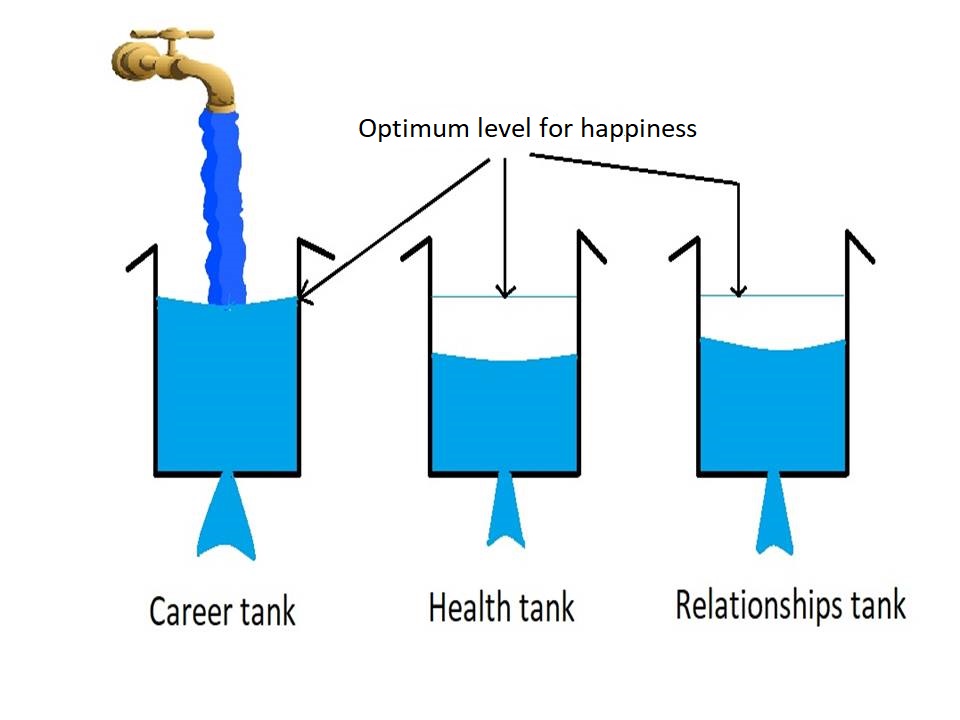
    the tanks model

    Washing yourself

    Occasionally, you might get under the tap and wash yourself. While this may not fill any tank, it’s still an important thing to do. It’s when you’re having a “me-time”. Things like indulging in your favorite hobby, reflecting on your life, having fun, etc.

    These things are best enjoyed when done moderately. If your career tank level is low and you spend your time having fun, your mind will keep warning you about the depleted career tank. This takes the fun out of having fun.
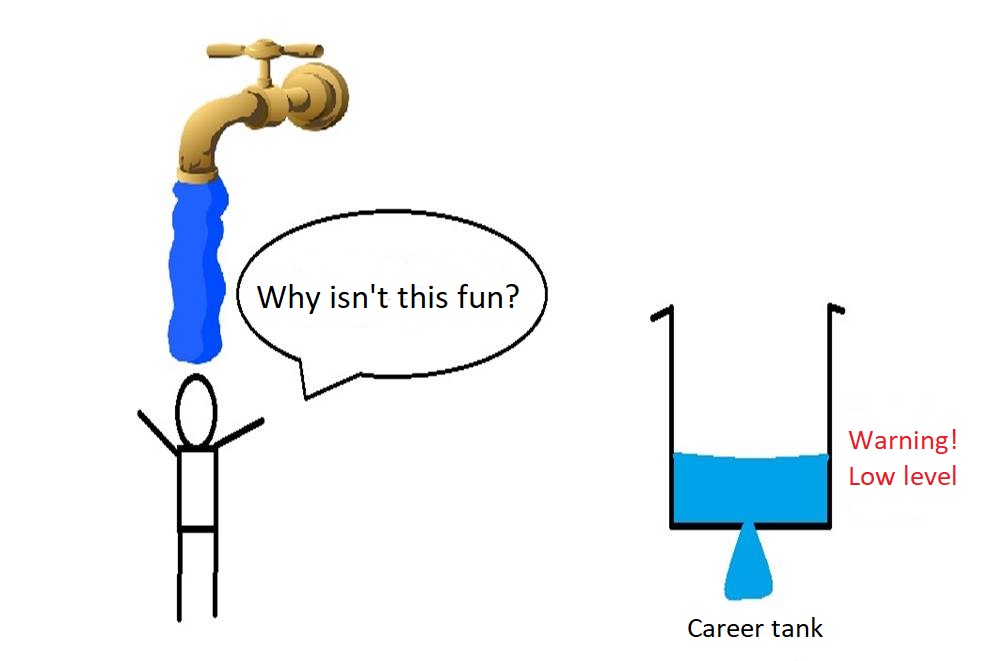
    washing yourself

    The less you have to worry about filling up the tanks, the less you’ll feel the need to get your life together.

    Getting a degree, for example, ensures that your career tank remains filled to a decent level. It fixes the leak partially. Eating healthy food fills your health tank and fixes the leak partially.

    I say partially because getting a degree isn’t enough to get a good career and eating healthy isn’t enough to be healthy. There are still things you need to keep doing, to keep the tap flowing. You need to keep working at a job and keep exercising.

    Still, closing the leak partially removes a lot of worry from your life.

    Similarly, you need to keep working on your relationships. You can never fix the leaks entirely but, over time, you find that you can better balance keeping the tanks filled.

    How to combat pleasure- biggest enemy of the tanks

    When you ignore one tank, you might be filling other tanks. That’s okay because at least some tank is getting filled. If you have to work but you decide to talk to your spouse you don’t feel bad because at least you’re building your relationship with your spouse (filling the relationships tank).

    The real trouble happens when you go overboard with washing yourself. Washing yourself is important but every time you do it you aren’t filling any tank. So it needs to be done sparingly or it’ll quickly overtake your life.

    If you have important work to do, but you watch a football game instead, your mind will be pissed. You’re not filling any tank, just washing yourself over and over unnecessarily. The mind cares the most about the tanks.

    If, instead of watching the game alone at home on TV, you decide to watch it live with a bunch of friends, you’d be washing yourself but also filling the relationships tank. Even if you have important work to do, you’ll feel slightly better than in the previous scenario.

    Be it having fun when you should be working, eating junk food, or cheating in a relationship, pleasure is the enemy of all the tanks. It depletes all the tanks.

    Your mind likes doing fun and easy things. You can use this to your advantage to overcome procrastination. Often, the reason we procrastinate is that our task is difficult and large. By making the task easy and small, you can overcome procrastination.

    You can do this by breaking your large task into several small steps and- this is important- making the first step super easy to do.

    For example, if you have to read a particularly difficult book, break the task down into several steps. It helps if you make a written checklist.

    Set the first step as something like ‘Open the book’ and check it off once you do it. There’s a sense of achievement that comes with checking things off. It is motivating and keeps you going. Once you’ve checked that first item off, you want to proceed to the next steps- ‘Read the first chapter’ and so on.

    Look at the systems and processes you have in place to reach your goals. Often, you’ll find that you get stuck in those steps that are too large and difficult. Break them down.

    Dealing with distractions

    We live in highly distracting times. It’s easier for us today to get side-tracked when we’re doing important work. When we’re working and experience the slightest discomfort, we can rush to our phones to get instant relief.

    We’re highly pleasure-driven beings and it often comes in the way of our trying to fill our tanks. There’s no way out of this except to eliminate all options of chasing pleasure when undesirable.

    Turn your phone off while you’re working or put it in another room. It’s going to be hard at first but, eventually, you’ll reap the rewards of greater focus. Don’t kid yourself that you’ll just check it once and be done with it. Recognizing you’re helpless before it is the only way to come out of its grips.

    Similarly, not buying any junk food at all is the way to go. If it’s not in your house, it’s not in your mind.

    Things you can’t control

    I’m against setting rigid schedules. If you do that, you set yourself up for failure. You’ll find you often have to get your life together because your rigid schedule falls like a house of cards in the face of the slightest crisis or emergency.

    Chaos is inevitable in life. You may come up with a beautiful plan for the day but something might happen that that’ll change your priorities. You don’t have control over everything.

    Instead, what I suggest is making a flexible, fall-back schedule. This is how you expect your day to turn out and if it doesn’t that’s okay because you can fall back to it later. Having a fall-back schedule is better than having no schedule at all.

    There’s being obsessive about scheduling and then there’s being too loose with it. You want to hit that sweet spot in the middle.

    Re-organization = learning

    While you don’t want to set rigid schedules that you have to re-organize often, this doesn’t mean you shouldn’t re-organize at all. You should re-organize when it’s useful to do so.

    In my own work, I often find that I need to re-organize when I learn new things. Re-organizing tells me that I’m incorporating what I’ve learned. I avoid re-organizing simply for the sake of re-organizing.

    When you’re learning, you’ll find that you need to re-organize a lot. Eventually, things will settle down and you’ll come up with robust systems and processes to reach your goals. You’ll find that you have to re-organize less often.

    Step by step guide to getting your life together

    When your life is all over the place, you have accumulated too many problems that are all demanding your attention. Your mind gets overburdened and you escape from it all by chasing pleasure, which itself becomes another problem for you to deal with.

    Here’s a step by step guide that you can follow to de-clutter your mind and get your life together:

    1. Write it all down

    The best way to unburden your mind is to dump it all on paper. You can also type things on your devices but there’s something cathartic with writing things down. Write down everything that’s bothering you. This gives you a chance to look at your life and mind objectively.

    It’s hard to deal with the things that are in your head when they’re in your head. Free your mind first.

    2. Make three columns

    These will be analogous to your tanks. Label them Career, Health, and Relationships. Almost all of your problems will fall under these three columns. Write your concerns about each of these life areas.

    3. Prioritize

    Some problems are immediate while others are not. Which ones do you want to tackle first? What goals would have the greatest positive impact on you? Have a system in place to deal with unimportant things. Jot down everything life throws at you in your to-do list so you can deal with it later. If it can be delayed, delay it.

    4. Set goals

    Goal setting is a skill you learn over time. Cliché as it may sound; you do need clear and specific goals. If you can’t see what you want to hit, you won’t hit it. Recognize that all goals take time to reach. Always think long-term when setting goals.

    5. Clear path to the goals

    Not only do you need well-defined and specific goals, but you also need a clear path to reaching those goals. Reaching goals is the process of moving from A to B over a period of time. You need to get clear about what you need to do to get from your current position (A) to a future, desirable position (B).

    As I pointed out in my article on overcoming challenges, you’ll often find that your initial theory about reaching a goal is wrong. That’s okay because you need to keep refining it till you learn what works. Try one thing. Fail. Try another thing. Fail again. Eventually, you will find what works.

    6. Track your goals

    I can’t stress this enough. Reaching important goals is always a long-term process. You can easily get side-tracked if you think your efforts aren’t bearing fruit. This is why tracking is important.

    If your initial theory about how to reach your goal is wrong, tracking will tell you that. If you’re on the right track, tracking will tell you that too and motivate you.

    Make your goals as measurable as possible, as mathematical as possible. I recently set a goal of losing weight. To make it specific and measurable, I decided to bring my body fat down to 12%. Last month it was 25%. So I had to move from A (25%) to B (12%).

    Of course, losing weight depends on your diet and exercise. I made a new exercise schedule and followed it for a month. This month, my body fat dropped to 22%. This tells me I’m on the right track. It also tells me that if I keep doing what I’m doing, I should reach B in about 3 months. Very motivating.

    7. Fill your tanks every day

    When you make your plan each day, make sure what you do fits well with your long-term goals. Don’t just think about today. Think about how your today connects with your future. Your tanks will take time to get filled to the desired level.

    A successful day is where you’ve filled the most important tank you wanted to fill, without ignoring the other tanks too much. An ideal day is where you fill each tank and also wash yourself satisfactorily.

  • Assertiveness training: Practical assertiveness guide

    Assertiveness training: Practical assertiveness guide

    I’ve covered assertiveness in two previous articles, but I felt like I haven’t given enough attention to assertiveness training. Many people know what assertiveness is, but when it comes to situations that call for assertive behavior, they get stuck and aren’t sure what may or may not work.

    If you’ve been a reader here, you know I like boiling things down to their essence. I strongly believe the little you have to remember, the better. That’s why this article will not be an information overload that only ends up overwhelming you.

    First, I’ll briefly explain what assertiveness means, and then I’ll dive into the underlying dynamics of assertive interactions. Understanding these dynamics will put you in a better position to be more assertive, and you’ll be able to naturally adjust your assertiveness to the demands of the situation.

    Assertiveness is a communication style

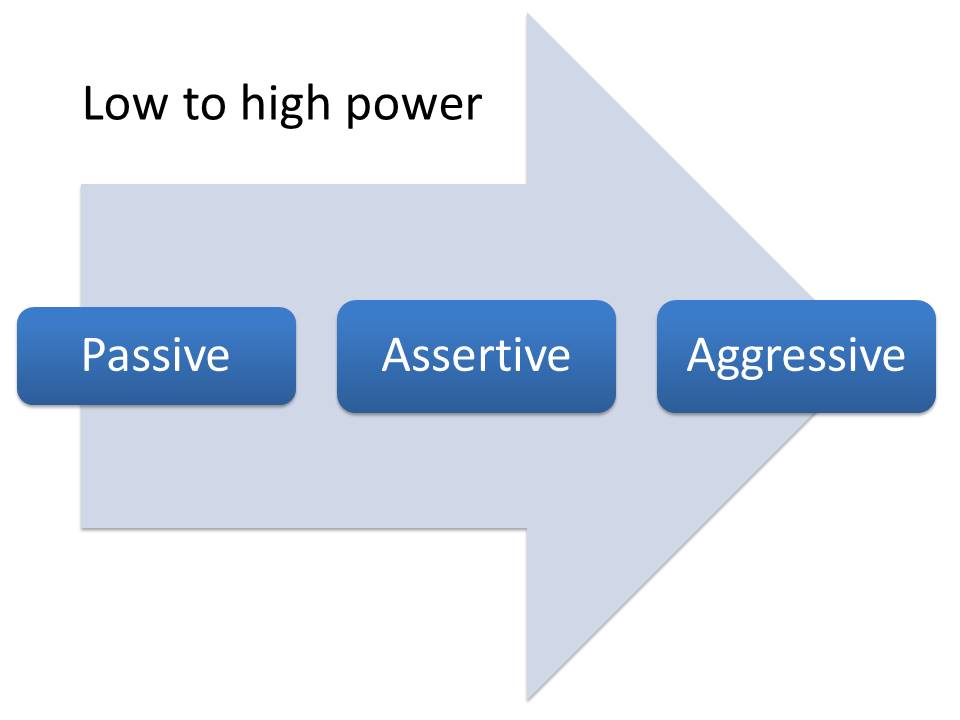
    Assertiveness is a communication style that lies midway between two other extreme communication styles- passiveness and aggressiveness. When you feel your rights have been taken away or that you’ve been dealt with unfairly, you can behave in one of the three ways:

    • Aggressively = Fix your situation by overpowering others.
    • Assertively = Fix your situation without overpowering others.
    • Passively = Do nothing to fix your situation.

    For example, if you feel like your boss isn’t paying you as much as you’re worth, you might yell at them and demand a raise (aggressive), or you can explain why you deserve a raise (assertive) or you can avoid asking for a raise (passive/submissive).

    Hence, being assertive is all about asking for your rights and what you want appropriately, without stomping on the rights of others.1 It’s the sweet spot between being aggressive and being passive.

    Of course, in some situations, being aggressive or even being passive might pay off (see my internship example). But in most conflicts, being assertive is the optimal strategy.

    Grasping the dynamics of assertiveness

    To get good at being assertive, you have to understand what dynamics operate underneath our social interactions. When we interact with people, we’re also assessing them as allies or enemies.2

    In an ideal world, people would deal with conflicts 100% objectively, removing themselves and others from conflict, focusing on the problem at hand, and arriving at a win-win solution. But that rarely happens in the real world. People’s egos, character, reputation, dignity all get mixed up in their conflicts.

    Therefore, when trying to behave assertively, you have to keep this basic thing in mind that individuals rarely approach conflict situations with 100% objectivity.

    The principal message of my previous article on assertiveness vs aggressiveness was that you should remove yourself and the other party from the problem at hand. I elaborated little on exactly how one can go about doing that.

    In this article, however, I want to paint a clearer picture of what goes on during conflict situations and how to choose more assertive ways of communicating.

    When you’re trying to be assertive, really the only enemy you have to fight is the other person’s perception that you’re stepping on their rights (i.e. you’re being their enemy). In other words, your goal is to change the other person’s likely perception that you’re somehow taking away their power.

    It all boils down to power. When you’re being passive or submissive, you give up your power. When you’re being aggressive, you gain power by taking away the other person’s power.

    Your task in being assertive is to behave in such a way that you don’t take their power and, at the same time, you don’t give away much of your own power.

    assertiveness power spectrum

    Why being assertive is tricky

    Being assertive is tricky, and there’s a fine line between assertiveness and aggressiveness. This is because assertiveness automatically increases your power.

    When you’re being assertive, you gain power, but not enough that you become aggressive. You feel you’ve been wronged i.e. someone took your power and put you in an inferior power position. In being assertive, you try to regain just that amount of power back that you feel you’ve lost.

    In gaining this slight power, you do take power away from the other person, but not so much that they’re brought down to submission.

    Hence, being assertive is this delicate power re-adjustment task that requires advanced social skills. It’s very much like walking on a tightrope. If your power re-adjustment attempt ends up creating a power imbalance, you trip and fall down. One party feels violated, and the conflict escalates.

    Assertiveness training: Practicing assertive behaviors

    So how do you go about doing this power re-adjustment?

    The risk in being assertive almost entirely lies in going too far and taking away too much of the other person’s power. All assertive behaviors are designed to put brakes on your power-seeking so you can regain just the right amount of power and not skid over to aggressiveness.

    Let’s now look at some real-life examples that call for assertive behavior:

    Example # 1 (Disagreements)

    Having disagreements is one of the most common situations that call for assertive behavior. When someone disagrees with you, they take some of your power. I know it sounds irrational, but it’s just the way the mind works. It’s why criticism feels bad and why one needs to do enough mental work before they can develop the ability to handle disagreements.

    Disagreements turn into arguments for precisely the same reason. It’s a power contest where each party tries to one-up the other by disagreeing with them, often harshly. Even if you can disagree politely, there’s still a chance that the other person will feel a tinge of loss of power and esteem, no matter how enlightened they claim to be.

    Your task in being assertive while disagreeing with someone is to make up for that slight power loss that they might feel.

    Say you’re working on a project and your colleague comes up with a bad idea. They seem excited about the idea, but you’re sure it won’t work. How do you express your disagreement?

    1. Laugh at their idea. (Takes their power)
    2. Say you disagree with their idea. (Takes their power slightly)
    3. Say you disagree with their idea + explain why you disagree. (Doesn’t take their power)    

    The first option is aggressive and you’ll likely spoil your relationship with them. The second option seems assertive. After all, you’re directly expressing how you feel, right? But it runs the risk of attacking them, i.e. taking away their power.

    Since you gave them no reason for your disagreement, they’ll probably think you have personal enmity against them (see fundamental attribution error).

    The third option is ideal because it takes care of the above risk. It removes their ego from the situation. They’re unlikely to think your disagreement had any ulterior motive (such as putting them down).

    Example # 2 (Ending conversations)

    Okay, this is a fairly common one. You’re talking to your relationship partner on the phone. It started as a conversation, but now they’re going on and on about something you don’t care about. You want to end the conversation, but you have no idea how.

    Here are the three possible things you might say in such a situation:

    1. “I have to go, bye.” (Takes their power)
    2. “I have to go, talk to you later.” (Takes their power slightly)
    3. “Can we talk later? I have some unfinished work left to do.” (Gives them slight power) 

    The first option is undesirable. You’re breaking off the conversation and taking their power to choose when to end the conversation. You’re imposing your decision on them. Your intention may not be to be aggressive, but it feels aggressive to the person on the receiving end.

    The second option is better. You’re imposing your decision on them but promising to make up for it later. Still, you’re the one who ended the conversation. It may not feel as bad as the previous option, but you took some of their power. It’s still risky.

    The last option is perfect and smooth. You want to end the conversation, but you let it be their decision. Not only are you not taking away their power, but you actually give them some power to make your decision for you.

    Of course, they can still say, “No, I want to continue talking” but because you were considerate enough not to overpower them, they’re much more likely to comply.

    Example # 3 (Demanding family member)

    This one’s similar to the previous example. You’re working from home and a family member suddenly asks you to do something for them. What do you tell them in this situation?

    1. “Can’t you see I’m busy?” (Takes their power)
    2. “I can’t help you. I’ve got my own stuff to deal with.” (Takes their power)
    3. “Shall I finish this task I’m working on first?” (Gives them power) 

    Option 1 is aggressive because you’re not only refusing but also accusing them of being stupid for not noticing that you’re busy. When you judge people negatively, you exert power over them.

    Option 2 is outright refusal which in itself disempowering. The next sentence is slightly rude and hence, even more disempowering.

    Option 3 is assertive and empowering because, as in the previous example, you give them power to make your decision for you.

    There’s still a chance the other person might think you’re putting your own needs before theirs, even if you give them the power to decide.

    To allay their fears, you can minimize your own work so it doesn’t appear to overwhelm their request. I like to call it task minimization. For instance, you can say something like:

    “Shall I finish this small task I’m working on first?”

    Or

    “Can I finish this little thing first?”

    Using words like “small” and “little” reassures them you aren’t throwing their request straight out of the window. Instead, you’re acknowledging it and even emphasizing it over your own “small” work.

    Make sure you do take on their work later or they’ll think you’re manipulative.

    This task minimization technique can also be very effective when you have to make assertive requests.

    For example, I used to share a room during my college days with a guy who had this annoying habit of listening to music without earphones. It was very distracting to me.

    I had a hard time believing someone could be this inconsiderate, and it took me a while to come up with a perfect assertive sentence. I really wanted to say something like, “You inconsiderate moron, don’t you have earphones?” but I knew that’d be aggressive. Instead, I told him, “Could you turn down the volume a bit?”

    Of course, I didn’t want him to turn the volume down only by “a bit”. I wanted him to turn it down fully, but minimizing my request made him more likely to comply. He turned the volume down significantly and a few minutes later, fully.  

    Sure, only saying, “Could you turn down the volume?” would’ve given him the power of choice, but he might still have considered it too big a favour. Task minimization took care of that.

    People do this all the time when they say, “I have a small favour to ask”. Whether the subsequent favour is actually small is a different story.

    Example # 4 (Boss who overburdens)

    Say you’re overburdened with work by your boss. While you’re working, he comes to your desk and assigns you another task. At this point, you’re angry and want him to know that you can’t take any more work.

    1. “I’m already stressed out by all this work you’ve given me. I can’t take up more work.” (Takes their power)
    2. “This is taking too much time. Let me finish this first.” (Takes their power)
    3. “This work will take a lot of time because…” (Doesn’t take their power)   

    The first option is not only accusatory, but it also signals you’re incapable of handling stress. In the most conventional sense, you’re being assertive in expressing how you feel, but in terms of power dynamics, you’re creating a power imbalance. By blaming your boss and refusing to take up more work, you’re taking away their power.

    The second option could be used as an indirect way to let your boss conclude that they gave you too much work. But it shows your incompetence. Why is it taking too much time? Are you incompetent? Saying “Let me finish this first” is not asking. It’s imposing your decision on them, which is disempowering.

    The third option works because it effectively removes you and your boss from the problem. You’re not showing that you’re incompetent (giving up your power) and you’re not accusing your boss (taking away their power). Instead, by providing reasons you make the problem 100% objective.

    How to say “No”

    I mentioned earlier that refusing to comply with someone is taking away their power. People don’t like to hear a “No”. Instead, giving reasons for your “No” is a better strategy. It removes you and the other party from the refusal.

    Since a “No” takes away their power, you can give them power in some other area. You can make it up to them somehow to restore the power balance.

    For example,

    “Are you down for coffee later?”

    “I enjoy having coffee with you, but I have other plans this evening.”

    Since refusal is inherently disempowering, you empower them in another way (compliment) to restore the power balance. As a bonus, you also give them a reason for your refusal, removing yourself and them from the equation.

    Appeal to their sense of fairness

    If you’ve been wronged, your task in being assertive is to show the other person how you’ve been wronged, not how they wronged you. The former appeals to their sense of fairness and the latter to their sense of competitiveness.

    And you can’t expect justice and fairness from someone you’re competing with.

    The idea is to show them how their behavior affected you without accusing them directly. This gives them space to realize and, hopefully, correct their mistake. When you attack someone, you attack their intentions without enough evidence.

    Maybe they had neutral or even good intentions when they did what they did. So it’s an excellent strategy to focus on their behavior and its effect on you than on their character. You let them know that their behavior affected you negatively.

    Now, it’s up to them, if they believe in fairness, to fix your situation. However, don’t beg for justice as that way you’ll lose your power, deepening the power gap, and giving them room to exploit you more if they’re evil.

    You simply have to give information. Show them how you’re being affected and how it’s not fair without giving away too much of your power. If they still don’t get it, you’re probably better off ending the relationship.

    What it all comes down do

    What you’ve learned so far are the underlying power dynamics of social interactions that can enable you to choose more assertive responses. However, long-lasting assertiveness can only be developed via long-term personality changes.

    Not all people know or understand social dynamics, yet they’re very assertive. It’s because they value themselves enough to value their own opinions, feelings, and needs. The degree of assertiveness shown by a person is proportional to their self-worth.

    This is why people naturally become more assertive as they grow older. Older people have more skills, achievements, and self-confidence to base their assertiveness on. Therefore, working on yourself is the best thing you can do to increase your assertiveness naturally.

    Unassertiveness is mostly bad

    Protecting the ego is an important task for the mind. If you don’t behave assertively when you should have, your mind will be mad at you. You’ll feel bad and think about how you should have behaved instead, sometimes even years later.

    Unassertiveness is associated with anxiety, especially social anxiety.3 Often, people are unassertive because they fear they’ll be judged negatively by others.4 The social dynamics you learned in this article should easily help you bypass this fear.

    Unassertiveness can lead to relationship dissatisfaction because you feel you’re giving more than you’re receiving. You don’t express your needs to your partner and feel subdued by them.

    Continuous unassertive behavior may even lead to depression.5

    The long-term solution to unassertiveness is to practice assertive behaviors while simultaneously working to increase your self-worth.

    References

    1. Alberti, R. E., & Emmons, M. (1995). Your perfect right. Impact Publishers.
    2. Cuddy, A. J., Fiske, S. T., & Glick, P. (2008). Warmth and competence as universal dimensions of social perception: The stereotype content model and the BIAS map. Advances in experimental social psychology, 40, 61-149.
    3. Morgan, W. G. (1974). The relationship between expressed social fears and assertiveness and its treatment implications. Behaviour Research and Therapy, 12(3), 255-257.
    4. Speed, B. C., Goldstein, B. L., & Goldfried, M. R. (2018). Assertiveness training: A forgotten evidence‐based treatment. Clinical Psychology: Science and Practice, 25(1), e12216.
    5. Ball, S. G., Otto, M. W., Pollack, M. H., & Rosenbaum, J. F. (1994). Predicting prospective episodes of depression in patients with panic disorder: A longitudinal study. Journal of Consulting and Clinical Psychology, 62(2), 359.
  • Why intrapersonal intelligence matters

    Why intrapersonal intelligence matters

    Why is it that some people can learn from their experiences, change, and become better individuals while others cannot?

    I’m sure many people you meet are essentially the same person they were a few years ago. They still think the same thoughts, have the same habits, responses, and reactions. But why?

    It’s probably because they have low intrapersonal intelligence, a term borrowed from Howard Gardner’s theory of Multiple Intelligences.1

    Intrapersonal intelligence (intra = within, inside) is the ability of a person to be aware of their own mental life- their thoughts, emotions, moods, and motivations.

    A person with high intrapersonal intelligence is in tune with their inner world. They’re highly self-aware people who can not only access their own emotions but understand and express them as well.

    Therefore, emotional intelligence is a large and critical part of intrapersonal intelligence. But intrapersonal intelligence goes beyond emotional intelligence. It’s not only the ability to understand one’s own emotions but also everything else that goes on in one’s mind.

    People with high intrapersonal intelligence understand how their thoughts work. They’re often clear and thinkers. Their words reflect the clarity of their thoughts.  

    By far, the biggest advantage people with high intrapersonal intelligence have is their ability to think deeply. It helps them analyze things and solve problems, and they enjoy doing so. These skills and attitudes are useful in many careers, especially research, writing, philosophy, psychology, and entrepreneurship.

    intrapersonal intelligence formula

    From understanding self to understanding the world

    People with high intrapersonal intelligence have a good understanding of not only themselves but also other people and the world. A natural consequence of being in tune with your own thoughts and emotions is to be in tune with others’ thoughts and emotions.

    It’s because we can only understand the world and other people using our thoughts. If you don’t understand your thoughts, you don’t understand how to use them to understand the world and those around you.

    While individual differences do exist, human beings are the same in many ways. So if you have a good understanding of how your own thoughts, emotions, and motivations, you’ll have a good understanding of others’ mental life.

    Hence, intrapersonal intelligence leads to social or interpersonal intelligence.

    People who know and understand themselves also tend to have a strong sense of self and purpose because they have analyzed themselves deeply. They know what their goals and values are. They’re aware of their strengths and weaknesses as well.

    While their personality is rooted in a strong core, they also learn and grow continually. They’re rarely the same person they were last year. They keep gaining fresh perspectives on life, people, and the world.

    The physical, the mental, and the social worlds operate according to some rules. These rules are generally not easy to figure out. To figure out these rules- and it’s a miracle that we can- you need to be able to look deeply into the world.

    Because self-aware people can look deeply within themselves, it gives them the ability to look deeply into the world. It’s rare to find a great historical figure who contributed significantly to humanity but wasn’t self-aware. No wonder they always have something wise to say.

    “Look deep into the nature and you’ll understand everything better.”

    – Albert Einstein

    Developing intrapersonal intelligence

    Given that intrapersonal intelligence has so many benefits, can it be developed?

    People who’re naturally introverted are likely to have high intrapersonal intelligence. They tend to have a rich mental life. They spend a lot of time hanging out in their own minds. This can often give them a feeling of ‘being too much in their heads’ but not out there in the world.

    Yet, if you are to better understand yourself and the world, you have to spend a lot of time in your head because that’s the only place where it can be done.

    Intrapersonal intelligence, like emotional intelligence, is a mental ability, not a trait.2 A trait such as introversion is a behavioral preference. While introverts are likely to have high intrapersonal intelligence, others can learn this ability too.

    If you’re a person who lacks intrapersonal intelligence, the most important suggestion that I can give to you is to slow down.

    We live in the age of distraction, where people hardly get time to think about their own thoughts and emotions. I’ve had people admitting to me they don’t like to spend time alone because they don’t want to face their own thoughts.

    While it sounds cliché that we shouldn’t run from ourselves, people underestimate the negative impact that a lack of pondering and deep self-reflection can have. When you can’t understand yourself, it’s difficult to understand others and the world. The consequences of not understanding yourself, others, and the world are myriad and unpleasant.

    People who run from themselves don’t give themselves time and chance to learn, to heal, and to grow. If you’ve gone through a bad or even a traumatic life experience, you need time for healing and self-reflection. This is the central theme of many of my articles and also of my book on depression.

    Several psychological problems, including depression, sometimes happen because people haven’t had the chance to process their negative experiences. No wonder the age of distraction has brought along with it the age of depression.

    Author William Styron, who wrote about his experience with depression in his book Darkness Visible, noted that it was seclusion and deep self-reflection that ultimately got him out of depression.

    Lack of intrapersonal intelligence often boils down to pain-avoidance. People don’t want to peek into their thoughts, emotions, and moods because they’re often painful. And people don’t want to think about the world deeply because it’s difficult to do that.

    People will go to any extent to escape their moods. While I understand that bad moods can sometimes be intolerable, you can’t miss out on the lessons they have the potential to teach you.

    Moods are in-built mechanisms that direct our attention to ourselves so that we can process our experiences, develop deep self-understanding, and take appropriate actions.3

    Let the moods do their work. Let them direct and guide you. You can regulate them all you want, but if you only take a moment to understand them, your intrapersonal intelligence will significantly increase.

    The complex problems of the world do not differ much from complex psychological problems. They require sustained analysis and deep reflection to solve.

    “No problem can withstand the assault of sustained thinking.”

    – Voltaire

    Meta-intrapersonal intelligence

    Many people don’t take intrapersonal intelligence seriously simply because they’re unable to see the value in it. They don’t have the intrapersonal intelligence to understand the value of intrapersonal intelligence.

    They can’t, in their own minds, understand how having intrapersonal intelligence can be beneficial to them. They just don’t see the connection because they have a habit of analysing things superficially.

    Most people want solutions to complex problems handed over to them on a platter. Even if they get them, they never benefit fully from them because they can’t see the value in them. Only the person who has done the mental work in trying to come up with a solution knows the actual value of that solution.

    References

    1. Gardner, H. (1983). The theory of multiple intelligences. Heinemann.
    2. Mayer, J. D., & Salovey, P. (1993). The intelligence of emotional intelligence.
    3. Salovey, P. (1992). Mood-induced self-focused attention. Journal of personality and social psychology, 62(4), 699.
  • Assertiveness vs aggressiveness

    Assertiveness vs aggressiveness

    When people are wronged, they commonly react in two ways. Either they react non-assertively and submissively, or they react aggressively and dominantly.

    Being non-assertive means you’re passive about your situation and don’t seek to remedy it in any way. Your desire to not offend others comes in the way of standing up for yourself.

    Aggressiveness, on the other hand, means you devalue, put down, or even harm the other person in an attempt to stand up for your rights.

    There’s a third, in-between strategy to deal with these types of situations. It’s called assertiveness, and it means standing up for your rights without hurting or offending the other person.

    Assertiveness differs from aggressiveness in the following ways:

    • Aggressiveness stems from the intention to hurt others and to violate their rights. In assertiveness, there’s no intention to hurt others or take their rights away.
    • Assertiveness may involve thinking win-win but never win-lose. Aggressiveness always involves the attitude of win-lose.
    • Assertive behavior is more effective because it produces more positive outcomes. Aggressive behavior, on the contrary, creates a cycle of aggression and counter-aggression.
    • Assertive behavior maintains the respect and dignity of the other individual while aggressive behavior does not.
    • Aggressive behavior often involves physical or verbal threats whereas assertive behavior does not.

    As you can see, assertiveness is a vital interpersonal skill to develop if you want to achieve your goals involving others whilst maintaining good relations with them. Clearly, assertiveness is a much better strategy to handle interpersonal conflicts than aggressiveness and non-assertiveness.

    What does assertive behavior entail?

    Researchers have found that assertiveness behavior comprises a set of responses.1 Specifically, assertiveness comprises the following abilities:

    • The ability to say ‘No’.
    • The ability to make requests.
    • The ability to express positive and negative feelings.
    • The ability to start, continue and end conversations.

    The right strategy depends on the situation

    As mentioned above, there are three strategies to handle interpersonal conflicts- aggressiveness, assertiveness, and non-assertiveness. You can handle most of your conflicts well by being assertive.

    However, in some situations, non-assertiveness or even aggressiveness may be viable strategies.

    For example, if your boss unnecessarily criticizes your work, you may adopt the strategy of non-assertiveness if you heavily depend on your job. If you know you’re going to have a hard time finding another job.

    If you’re being physically or verbally attacked, you may adopt aggressiveness to counter the situation.

    Therefore, the strategy you adopt will depend on the situation. You have to estimate the risks and benefits of a strategy in a particular situation.

    If you find yourself in conflict with a person but you don’t want to spoil your relations with them, assertiveness is the way to go. Assertiveness will bring you out of many difficult situations without risking your relationships.

    Why aren’t people assertive then?

    Humans are social animals. We’re designed to scan our social environment to detect potential enemies and friends. In a conflict situation, this psychological mechanism takes precedence over objectively resolving an issue.

    In other words, we jump to blame others when we’re wronged before we even get a chance to analyse the situation properly. This is why you’re more likely to think that a friend is ignoring you when you don’t receive a text from them than think they must be probably busy.

    In psychology, this tendency is aptly called the fundamental attribution error. It’s fundamental to human nature.

    When a conflict happens, many people don’t analyse the issue objectively. They don’t try to come up with a rational solution that may be acceptable to all parties. Instead, they engage in blame game.

    They think other people are out to get them and, therefore, behave aggressively and defensively. This is why, if you happen to objectively criticize your boss’s work, with no intention to put them down, they may still take it personally.

    The art of assertiveness

    Given how people make conflicts about them and others instead of objectively analysing the situation, the art of assertiveness is all about removing people and their egos from conflicts.

    When you’re trying to be assertive, convince the other person you don’t intend to blame them or put them down. In other words, you have to remove yourself and them from the problem at hand.

    Convince them that your demands are reasonable and devoid of any personal grudges or hostilities. Convince them you’re not trying to compete with them, just asking for your rights.

    Of course, given human proclivity to turn every conflict into a social competition, this isn’t easy to do. Hence, you don’t see many assertive people walking around. People either accept defeat passively or try to win aggressively. It’s a social competition for them in which you can only win or lose.

    How to remove people from conflicts

    Assertiveness often boils down to the way you speak when asking for your rights. If you calmly and politely explain your situation, the other person has no reason to think you’re being aggressive. It’s no longer about them or you and who wins or loses; it’s about the problem at hand.

    If they comply, it’s not because you ‘won’ and they ‘lost’. They have to comply willingly. If they don’t, they’re bound to think you scored a point over them. That is, you made them do something they didn’t want to do.

    You have to make them want to do it. Appeal to their reason. Nobody likes to be seen as unreasonable. If you convince them your demands are reasonable, you increase the odds of achieving your purpose.

    Remember, assertiveness isn’t just about removing the other person’s ego from the problem, but also your own. When we feel we’ve been wronged, it’s tempting to lash out and hurt the other person. We’re just as quick to make a problem about us (we’ve been intentionally hurt) as we are to make it about them (they intentionally hurt us).

    Sure, people do intentionally hurt each other, but you can’t really blame a person without enough evidence. You have to leave intentions aside and work to resolve the issue. Over time, intentions will inevitably reveal themselves.

    If a person doesn’t comply despite your best efforts to explain your situation and show no intention of helping you, it points to some personal hostility they may have against you.

    You may then take an extreme measure such as cutting them out from your life. But initially, you need to give yourself and the other person a chance to work things out, without worrying about intentions too much.

    An assertive person is not interested in quarrelling but in finding a solution that can be acceptable to all parties.

    Assertive behavior requires you to remove the temptation of ascribing intentions to people, you don’t make the problem about yourself or them, and you think about the consequences of your actions. Thankfully, assertiveness skills can be learned with practice.2

    When assertiveness gets mistaken for aggressiveness

    Non-assertiveness stems from the desire to maintain social relations and to not offend others. Aggressiveness offends others and hurts social relations.

    Aggressiveness is an extreme form of assertiveness involving devaluing the other person. Since assertiveness is very close in meaning to aggressiveness and people have a tendency to blame others, assertiveness can be easily confused for aggressiveness.

    You may, in your own mind, be able to successfully draw the line between assertiveness and aggressiveness, but others may not able to do so. So, while you think you’re being assertive, you may come across as aggressive.

    One study showed that while assertive behavior is seen as fair, non-revengeful, and friendly, it can also be seen as unsympathetic, dominant, and aggressive.3

    This is a risk you need to consider when you’re trying to behave assertively. As mentioned above, your whole task in being assertive is to convince the other party you’re not being aggressive. The above study also found that when people asserted themselves, others came up with counter-assertions.

    For example, if you refuse to comply with someone’s request politely, they’ll also refuse yours politely. This is a counter-assertion.

    Note how this behavior is similar to when people behave aggressively and others come up with counter-aggressions. If they throw counter-assertions at you when you’re trying to be assertive, it probably means they mistook your assertiveness for aggression.

    You failed to convince them of your non-aggressiveness. You failed to convince them that your intention wasn’t to harm them or score a point over them.

    I’d like to illustrate this with a common example.

    One of the ways to be assertive is to say ‘No’. You don’t think the other person is making a fair request so you blurt out a ‘No’. This will probably have a negative effect on the other person, and they’ll think you’re being aggressive.

    As I said before, people have a tendency to jump to the conclusion that others are intentionally harming them. Just saying ‘No’ with no explanation seems like you don’t want to help them. This classifies you as an enemy, a non-helper in their mind.

    The way to assuage this situation is to say ‘No’ and then provide reasons for your ‘No’. By providing reasons, you’re removing yourself from the situation. You’re placing the blame not on yourself, but on your reasons.

    In this case, the other person won’t blame you, but only your reasons. They’ll think you’d have helped them had it not been for your reasons.

    Thinking you don’t need to give any justification for your refusal is arrogant and aggressive behavior, not recommended if you care about your relationship with this person.

    There’s another subtle danger hiding in this dynamic we need to be careful of. Counter-assertions can be genuine too. The person may have good reasons to give you counter-assertions. You can be mistaken in thinking their counter-assertion was just their way of getting back at you.

    Again, it’d be better for them to provide reasons for their counter-assertions if they are to remove themselves from the situation.

    This is why I emphasize ignoring intentions at first when you’re trying to resolve conflicts. They’re difficult to figure out at first, but will eventually become clear.

    When you say ‘No’ to someone, always give reasons to remove yourself from the equation. When you behave assertively, do your best to convince the other person you have no ulterior motives. If you don’t, they’ll surely find them.

    References

    1. Lazarus, A. A. (1973). On assertive behavior: A brief note. Behavior therapy, 4(5), 697-699.
    2. Fornell, C., & Westbrook, R. A. (1979). An exploratory study of assertiveness, aggressiveness, and consumer complaining behavior. ACR North American Advances.
    3. Hull, D. B., & Schroeder, H. E. (1979). Some interpersonal effects of assertion, nonassertion, and aggression. Behavior Therapy, 10(1), 20-28.
  • 5 Steps to overcoming challenges

    5 Steps to overcoming challenges

    Wouldn’t it be great if we all became better at solving problems and overcoming challenges? Over the years, I’ve gained some insights into problem-solving, although I feel I still have much more to learn.

    In this article, I’d like to share with you what I’ve learned in over six years of blogging and two years of learning to play a musical instrument. No matter what challenge you’re trying to overcome, these insights and general principles should hold.

    What are challenges, anyway?

    A challenge you’re trying to overcome is a complex problem you’re trying to solve. A complex problem you’re trying to solve can be seen as a goal or outcome you’re trying to reach. Achieving goals is all about moving from point A (your current state) to point B (your future state).

    Some goals are easy to achieve. You can easily move from A to B. They’re not challenges. For instance, taking a walk to the grocery store. You know exactly what you need to do, and you’ve probably done it hundreds of times.

    When the goal you’re trying to reach seems distant and you don’t know exactly how to move from A to B, you’re facing a challenge. A challenge is a complex problem with no solution in sight.

    Overcoming challenges, thanks to their complex nature, often take considerable mental effort and time to solve. So the easiest and sane thing to do when faced with a challenge is not to expend all that effort- to quit.

    Why we’re tempted to quit when faced with a challenge

    Simply put, we humans didn’t evolve to solve complex problems that took a long time to solve. Throughout our evolutionary history, most of our problems needed solving in the here and now, as is the case with other animals.

    No food? Find food now and eat now. Predator charging towards you? Run to a tree now and climb it now.

    It’s not that we can’t plan or think long-term, but that the tendency to do so, being recently evolved, is weaker compared to dealing with the here and now. Also, we’re much more inclined to make long-term plans than to actually follow them through.

    The result of all this is that we have a tendency to view problems as tasks that need completing right now, so we can gain instant positive feedback and gratification. If you can’t solve something right away, it’s probably unsolvable. You don’t believe you can solve it, and so your mind asks you to quit.

    This is called negative feedback and animals have the mechanism too. If you give a fake, stuffed rat to a cat, she might smell it and try to eat it a few times. Eventually, she’ll quit because she can’t eat it. Imagine if the cat had no such negative feedback mechanism. She’d probably get stuck in the loop of trying to eat the fake rat.

    That temptation to quit that we get when facing a challenge is just your mind saying, “This can’t be done. It’s not worth it. You’re not going to reach point B anytime soon”.

    This tendency to solve problems in the now is also apparent in how people, when they face a difficult problem, often try to solve it in one go. Ever heard of the one-track mind? Once people dive into a problem, they can’t seem to let go until they’re done with it, if they believe they can solve it.

    If they find they can’t solve the problem because of its complexity, the rational thing to do then is to quit.

    I hope it’s clear at this point why complex problems are hard for humans to solve. By their very nature, complex or wicked problems, as they’re sometimes called, require tremendous investments of time and effort, something that doesn’t come naturally to humans.

    Yet humans have solved many complex problems in the past and continue to do so. While it may be difficult to overcome challenges, it’s not impossible.

    Steps to overcoming challenges

    In this section, I’ll discuss some key principles you need to be mindful of if you want to become a better problem-solver.

    1. Understand the problem thoroughly

    Someone has rightly said that ‘a problem well-defined is a problem half-solved’. Given that we have a tendency to solve problems right away, we’re tempted to jump right into them without understanding them thoroughly at first. Whenever you’re faced with a challenge, the first thing to do is to collect as much information about it as possible.

    Why is this important? To get crystal clear about what you need to do. When we decide to solve a problem, we have this theory in our mind about how the problem can be solved. I like to call it initial theory. The better our initial theory, the more likely we are to solve the problem.

    The only way to make our initial theory good is to clearly understand the problem and what we need to do. Some also call it ‘sharpening the ax’ before you cut a tree instead of smacking at the tree with a blunt ax endlessly.

    Of course, to do this, you need to overcome that initial tendency to jump into solving the problem right away. If you don’t understand your problem thoroughly, your initial theory will be weak and who knows how long it will take you to cut down the tree or reach point B.

    Note that your initial theory may not be perfect, but it needs to be strong. Of course, if the problem is solvable, there exists a perfect theory to reach point B that actually works. If you do this and this, you’re bound to reach B. Let’s call it actual theory. If there are multiple ways to solve a problem, multiple actual theories exist.

    The gap between your initial theory and an actual theory will determine how long you take to solve the problem. By understanding your problem as much as possible, you reduce the gap between your initial theory and an actual theory. This increases your problem-solving efficiency.

    Note that sometimes it may not be possible to come up with a strong initial theory. In such cases, you can jump into solving a problem with a weak initial theory. When you take action, your initial theory will get refined over time till it becomes an actual theory.

    In this way, when you’re solving a problem, theory and action keep feeding each other until you solve the problem. You should sharpen your ax whenever you can.

    initial to actual theory
    You’re likely to stumble on several refined initial theories before you hit on an actual theory.

    2. Break the problem down into small steps

    People jump into solving complex problems with weak initial theories, realizing the problem is harder to solve than they thought. Or they’re put off by the threatening complexity of their problem right away.

    Once you’ve understood your problem thoroughly and have developed a good initial theory about how you can solve it, you’re in a position to break the problem down. Why is it important to break the problem down? Again, it’s because our minds like to solve small problems in the here and now.

    By breaking the problem down into small, manageable steps, you change the threatening nature of your complex problem. Before, the problem was this enormous mountain you were attempting to climb, all in one go. Now, you only need to take the first step. Something you can easily handle.

    Your mental resources are limited. It’s unrealistic to think you can throw a big problem at your mind that it’ll somehow be able to solve. We simply don’t have that many mental resources. You have to give your mind something it can work with. You have to solve your problem one small step at a time.

    Eventually, when you find you’ve solved your problem, it doesn’t feel like you solved a big, scary problem. You solved a series of small problems.

    4. Get clear on what you can and can’t do

    Okay, you’ve understood the problem well, come up with an initial theory, and broken the problem down into steps. At this point, you have to assess your abilities to carry out the steps. You have to know what you can and can’t do.

    Of course, it’s hard to know without trying. You can learn everything on your own or you can ask for help. If you’re pressed for time, it’s better to ask for help. However, if you struggle with the problem yourself, you’ll learn much more.

    Running to people for help at the slightest inconvenience creates a dependency on them. The ultimate goal should be to develop your own mind so you can handle your future challenges well. Only when you feel you can’t really do something and have exhausted all your options, should you seek help.

    When you seek help from people, you get a chance to refine your initial theory. Who knows, someone who’s knowledgeable enough may say something that’ll close the gap between your initial theory and an actual theory. It could be just one thing that someone says, and it all starts to make sense. Every piece in the puzzle fits.

    5. Keep testing and collecting data

    A reliable way to close the gap between initial and actual theory is by collecting data. When you set out to solve the problem with your initial theory, you’re bound to hit obstacles because your initial theory isn’t perfect. It isn’t an actual theory.

    This is why it’s important to collect data and test whether your actions and solutions are working. Otherwise, how do you know you’re going in the right direction? Without feedback from data, you really have no way of knowing.

    To give you a simple example, say you need to solve the complex problem of losing weight. If you’ve tried several ways to solve this problem without success, it’s likely you jumped into solving this problem with a bunch of weak initial theories.

    Say you tried a novel approach this time. You come up with an initial theory that diet X will help you lose weight. You believe you’ve done your research and that your initial theory is strong.

    However, one month into following diet X, with everything else being constant, you see no changes in your weight. Your data just showed you that your initial theory was weak or wrong.

    You do more research. You come up with a new initial theory- diet Y works. You test it out. It fails too. You do more research. You come up with a new initial theory- diet Z works. You test it out and it works! You notice significant changes in your weight in a month.

    This time, you closed the gap between your initial and an actual theory. Your initial theory was perfect. Now, you can continue implementing it and reach point B- your desired level of body weight.

    Data collection not only helps you refine your initial theory, it helps you track progress, and progress is motivating.

    6. Taking a step back

    When you’re solving a complex problem, you’ll often find that you’re stuck and can’t take the next step. Why does this happen?

    Here, I want to introduce you to a concept called bounded awareness. It states our awareness is bounded by what we can see and what we know.

    You came up with an initial theory, nice. When you try to solve the problem, you’ll see the problem from the lens of that initial theory. This is called bounded rationality. Bounded awareness leads to bounded rationality. Your rationale to solve the problem is limited by your initial theory.

    When you’re stuck, you’ll keep doing the same thing again and again, or you’ll go into the hit-and-trial mode.

    Hit-and-trial rarely works, and it’s a bad strategy. You’re basically throwing things blindly at a wall and seeing what sticks. In hit-and-trial mode, you drop your initial theory and you become desperate. A better strategy at this point is to take a step back.

    To illustrate bounded awareness and bounded rationality, say you open a fridge and begin looking for an item. You search every shelf but can’t find it anywhere. You shout at your spouse, asking them where they’ve put the item. They yell back, saying it’s on the fridge. You take a step back and look on top of the fridge. There it is.

    You could’ve found the item yourself if you’d taken a step back. But you didn’t because your awareness was bounded by the inner contents of the fridge. The only rational way to find the item was to search the inner shelves and containers of the fridge.

    When you take a step back from your problem, you can see the problem with fresh eyes and gain new perspectives on it. You can try to link what you’re trying to do now with the bigger picture and see if it makes sense.

    You can even leave the problem and do something else. Programmers do this often. This way, the problem marinates in your subconscious. Your subconscious will even work on the problem while you’re asleep, and you may find yourself waking up with new ideas that you can’t wait to implement.

    Preserving the belief

    This is perhaps the most important aspect of solving problems and overcoming challenges. Without this one piece of the puzzle in place, you’re likely to quit.

    Since our natural tendency is to solve problems in the here and now, we need to train ourselves to believe we can solve long-lasting, complex problems.

    I know many gurus say you should ‘see challenges as opportunities’ but it’s easier said than done. You can’t really develop this mindset unless you actually prove to yourself that staying with problems longer is worthwhile.

    In other words, you have to overcome a decent number of challenges to begin seeing challenges as opportunities for growth.

    Einstein said, “It’s not that I’m so smart. It’s just that I stay with problems longer”. This quote highlights the importance of delaying gratification and overcoming the tendency to solve problems only in the here and now.

    Once you develop the belief that you can indeed stay with problems longer and solve them, you need to preserve and solidify that belief by taking up more challenges.

    Another effective way to preserve this belief is to watch other people do what you intend to do. When you see others overcoming the challenges you’re facing, you’re inspired and your belief that the problem is solvable is reinforced.

  • How to cope with loneliness

    How to cope with loneliness

    Loneliness is an emotional state caused when people perceive themselves to be isolated from other people. Loneliness is painful and the person experiencing loneliness often shows signs of depression.

    However, loneliness differs from a depressed mood in one important way- loneliness also makes a person feel unsafe.

    Other effects of loneliness include increased stress, decreased immunity, and disrupted sleep.1 Loneliness puts your body into a high-alert mode, making you hypervigilant to environmental threats, particularly social threats.

    Loneliness also impairs higher-order cognitive functioning, meaning you’re less likely to score well on a mentally demanding task when you’re feeling lonely.

    What causes loneliness?

    Okay, loneliness feels bad and makes us dumb but why do we experience it? It’s a universal feeling and this suggests that loneliness must have had some advantages over evolutionary time.

    To understand the purpose of loneliness we need to start with the fact that humans are social mammals.

    Sticking together has helped human tribes survive for thousands of years so it’s not surprising that we have psychological mechanisms geared toward assessing our social life. How good or bad our social life was in ancestral environments could’ve easily meant the difference between life and death.

    An ancestral human separated from his or her tribe couldn’t survive for long.

    We still have these mental adaptations that motivate us to gauge the state of our current social life. If our social life is thriving, we feel good and if we find ourselves lonely, we feel bad.

    The bad feelings of loneliness are there to motivate us to seek social connection. The depressive symptoms that accompany loneliness reflect in our facial expressions and body language, which may motivate others who see us in this state to connect with us.2

    Therefore, the antidote to loneliness is social connection. As soon as your mind finds that your social life is back on track, it’ll stop sending you the feelings of loneliness.

    overcome loneliness

    The challenge in coping with loneliness

    Of course, lonely people know that they need to seek social connection to end their bad feelings. Yet, they keep struggling with the feelings of loneliness. They keep struggling when trying to form social connections. But why?

    I’m sure you’ve noticed that we tend to get along with people who’re like us, who’re, at least in part, our reflection. Like attracts like. We like hanging out with people who share our thoughts, beliefs, interests, and values. Friendships with people who’re like us seem to emerge naturally without much effort.

    By liking what you like, they signal to you, “I like what you like. Therefore, I like you.” In this way, people with whom we develop social bonds help us validate our life choices, tastes, and interests- they validate who we are. It feels good. It gives a boost to our self-worth when we find that other people like what we like.

    Thus, our social connections become a well of self-worth and self-esteem for us to keep drawing from. We value ourselves because others value us.

    Of course, the downside of all this is that we tend to become dependent on others to feel good about ourselves. We are caught in an endless cycle of trying to gain and maintain their approval. We do have the social life that we want, and we don’t experience loneliness but our sense of worth is heavily reliant on others.

    People naturally become friends with those who’re like them and approve of them. But some people realize that they need to stop caring what others think of them. They realize they can’t base their self-worth on such a fragile thing as others’ approval.

    So, they decide to derive their sense of worth from within and try to do things that impress them, not necessarily others. They achieve great things in life, build their character and personality, and develop an identity of their own.

    However, they soon realize that to develop an identity of their own, they increasingly need to break off from people who don’t match up to their newly-built identity. One by one, they lose their social connections.

    They realize that in the process of getting rid of their previous approval-seeking personality, they’ve thrown away the baby with the bathwater. They feel lonely and miss the social life they once enjoyed.

    The challenge for them now is to seek social connection again, but without losing the identity and personality they’ve worked so hard to build.

    The first and foremost thing that they can do is realize that others have identities of their own that don’t have to correspond to theirs. Sure, it’s hard being friends with those who’re not like you but the alternative is loneliness.

    The way out is to realize that others have a right to their own identity. You can’t go about changing them if you want them in your life. If you do, they’ll lose themselves and end up resenting you.

    Yet, people do the opposite of this when they enter friendships and relationships. In an attempt to seek approval and validation, they impose their own identity- their likes and dislikes- onto others. This is the shortcut to loneliness and eliminating people from your life.

    Instead, when you form a relationship with someone, you should see them for who they are. You should be like, “Okay, person X has these positive traits and these negative traits. Their positive traits are amazing and their negative traits are tolerable. I’m glad to have X in my life.”

    Also, “X likes some things that I don’t like and I like some things that X doesn’t like. That’s okay. There are also things that we both like and dislike.”

    This is a more rational and balanced approach to relationships than trying to convert every other person into you. This approach will bring more people into your life. You’ll acknowledge their positive and negative traits and find a common ground to build the relationship on.

    Quality vs. quantity of relationships

    You can have hundreds of people in your life and still feel lonely. If you’re accumulating more people into your life without developing a meaningful relationship with them, you put yourself on the path to loneliness.

    The strategy I described in the previous section will open you up to more people but you’ll have to filter out most people, retaining those few gems you want to form lasting relationships with.

    These few, lasting relationships can be more satisfying than hundreds of superficial relationships.

    What constitutes lasting, satisfying relationships?

    Well, the relationships where other people allow you to express who you really are, and you do the same. These are the people you don’t have to hide from, with whom you share your deepest joys and concerns.

    They understand you and you understand them. There’s a harmony between you two and no one’s trying to radically change anyone.

    Romantic relationships overcome loneliness

    Sure we feel good when we have friends and relatives to talk to and hang out with. But nothing beats entering a romantic relationship when you’re trying to cope with loneliness.

    This is because romantic relationships tend to have a higher degree of intimacy attached to them. Evolution ultimately only cares about reproduction. Being in a romantic relationship means an opportunity to pass on your genes and your brain rewards you for it.

    Often, when people worry about loneliness, they don’t worry about not having friends as much as they do about not being in a romantic relationship.

    When people enter romantic relationships, they tend to spend less time with their friends because now, evolutionarily speaking, they’re after a more important goal.

    ‘I hate people’ may mean ‘I am lonely’

    As discussed earlier, loneliness makes people feel unsafe. They become hypervigilant to potential social threats in the environment. This can lead them to perceive even harmless social situations and events as harmful. They view others negatively and recall events and instances that confirm their perception.3

    This is a useful behaviour when the lonely person is, in fact, in a hostile situation but more often than not, they fabricate hostile situations in their minds. This is essentially a defence mechanism to protect themselves from the ‘hostile’ others.

    References

    1. Cacioppo, J. T., Hawkley, L. C., Crawford, L. E., Ernst, J. M., Burleson, M. H., Kowalewski, R. B., … & Berntson, G. G. (2002). Loneliness and health: Potential mechanisms. Psychosomatic medicine, 64(3), 407-417.
    2. Cacioppo, J. T., Cacioppo, S., & Boomsma, D. I. (2014). Evolutionary mechanisms for loneliness. Cognition & emotion, 28(1), 3-21.
    3. Duck, S., Pond, K., & Leatham, G. (1994). Loneliness and the evaluation of relational events. Journal of Social and Personal Relationships, 11(2), 253-276.

  • Emotional appeal in advertising: Why it works

    Emotional appeal in advertising: Why it works

    Advertisements generally have two kinds of appeal- rational appeal and emotional appeal. Using rational appeal in advertising means giving your target audience a logical reason to buy from you. Using emotional appeal in advertising involves creating an emotional connection between your brand and your target audience.

    An advertisement- any advertisement- is an offer made by a brand to provide value to its intended audience. The word ‘value’ is the most important term in Marketing. Everything revolves around it.

    An ad is successful when it convinces the ad viewer of its value proposition. Through the ad, the ad viewer becomes familiar with the brand and the value that it offers.

    Next time the ad viewer feels a need for a product or service that this successful ad promised to offer, they’re more likely to buy from the brand. This is, in short, the purpose of advertising: to communicate to your potential customers that you have what they need.

    Buyer behaviour is one of the most researched areas of Consumer Behaviour for good reasons. It’s not just a simple matter of liking an ad and then purchasing the product advertised. There are other factors involved. But it all comes down to a potential customer’s value perception.

    Value is defined as:

    Value = Benefits – Cost

    The value of Value in the above equation should be positive (preferably large) if we are to increase the probability of a potential customer buying our product.

    This is why advertisers often highlight, and sometimes exaggerate, the benefits of a product or service they’re offering. They’re trying to increase the Benefits-perception of their potential customers to make Value as large as possible.

    On the other hand, Cost in the above equation is mainly the monetary price that consumers pay. The advertisers try to diminish Cost as much as possible to ensure that Value is as large as possible. This is usually done by offering price discounts.

    When you see a price discount on an item you know can benefit you, you’re swung into action and you instantly make the purchase. This is because you perceive the benefits of the purchase to be very high compared to the costs. You’re offered more Value.

    Other ways advertisers reduce the perceived costs for potential customers is by explaining how their product or service can save time, effort and energy.

    Consider what would happen if advertisers offered the same set of Benefits at a higher Cost in the pursuit of making more profits.

    The Value offered to the potential customer will get closer and closer to zero, making them unlikely to buy. If the potential customers perceive the Cost to be higher than the Benefits, Value will be negative and they’ll avoid the product like a plague.

    Now, what should advertise do if they want to increase the price of their products so they can earn more profits? Of course, they should promise more Benefits to maintain a large Value.

    But, sometimes, companies can get away with charging a premium for their products without adding significant benefits.

    For instance, Apple has been releasing iPhone models that don’t offer significant benefits over previous models. Yet, consumers keep buying the latest models at higher prices. Why?

    It’s not that the above equation has failed in this case. It’s just that the functional benefits of a product are not the only benefits that consumers appreciate. They’re also sensitive to the psychological benefits of owning certain products, being associated with, and having an emotional connection with certain brands.

    These things maintain a large Value despite a significant increase in Cost.

    Unsurprisingly, research shows that consumers having an emotional connection with a brand are less price-sensitive. They’re willing to pay a premium as long as the brand continues to emotionally satisfy them.1

    How emotions influence buying behaviour

    The importance of trust

    In a perfectly rational world, you see a product or service offering you significant value (many benefits, fewer costs), you make the purchase. Who the seller is, your past experiences with them or your friend’s attitude towards them shouldn’t matter. But we don’t live in a perfectly rational world and these things matter.

    The key thing that many business owners don’t seem to understand is that it’s difficult for potential customers to trust the advertiser’s message right away. So they have to rely on other social cues to decide whether or not they should make the purchase decision.

    This is why companies use what’s called social proof to convince their potential customers that they’re good to do business with. They show off the number of customers they already have and other well-known brands they’ve worked with. This creates trust and security.

    We may have evolved out of caves and tribal living, but our need to rely on others for making decisions is still strong.

    Our ancestors who lived in tribes had to form close associations with their kin and friends to survive. They also needed to be wary of rival tribes that were bent on raiding and exploiting them.

    It’s for this reason that people don’t just buy valuable products from anyone; they buy them from the brands they like and trust. Showing your potential customer that your product has this, this and this benefit is not enough. You have to give them a reason to like and trust your brand.

    Therefore, advertisements, which are usually the first contact between potential buyers and a brand, should not only have rational appeal but also emotional appeal. The audience should like and trust the brand and its message.

    Why do you think people say things like, “That company has been around for a decade” or “This brand has won several awards”? These things increase the trust-perception of the brand. These phrases are usually uttered to people who’re on the fence about buying from a particular brand.

    Later in the article, I’ll throw more light on the customer decision-making process.

    Power of emotional appeal in advertising

    Another important aspect of brand perception is what emotions a brand triggers in us. As some wise fellow has pointed out, humans are creatures of emotion, not reason. Rational thinking, critical thinking, planning, evaluating benefits and costs before decision-making are not things that come easily to people.

    All these advanced cognitive tasks take up lots of mental resources. Therefore, our emotions typically override these processes in decision-making.

    Ask yourself: Is it easier to rationally count your calories and maintain a calorific deficit to lose weight or to succumb to the temptation offered by fast food?

    The ‘ease of processing’ that emotions provide us helps us make decisions (including buying decisions) quickly, overshadowing reason and rationality in the process.

    Research shows that marketing campaigns containing purely emotional content perform twice as well compared to campaigns containing rational content.2

    Emotions and memory

    If I ask you to recall an event from your past, you’ll likely recall an event that holds an emotional significance for you. This shows that strong emotions and memories are intertwined.

    Now, if you were shown an ad without an emotional message and an ad with an emotional message, which one do you think you’re likely to remember in the future?

    Why is it important that advertisers ensure that their ads are recalled by potential customers?

    Well, the longer an ad lingers in the mind of a potential customer, the more likely it is that they will consider the brand when making a purchase decision.

    A common way advertisers ensure that their target audience remembers their ad is by showing the ad repeatedly. Familiarity breeds likeability, and sometimes contempt as well. But the thing is, repeat exposure pulls a brand out of the limitless, dark ocean of the ‘unknown’ into the realm of the ‘known’.

    How many times have you come across a brand whose offer attracted you, but you stopped short of buying because you hadn’t heard of them? You asked your friend about them and they hadn’t heard of them too. Unfamiliarity breeds mistrust, always.

    On the contrary, a brand you’ve known, or at least heard about, generates some level of trust in you and nudges you toward giving them a try. This is why advertising is a thing. It works. It’s especially important for new brands trying to carve a space in the minds of their target audience.

    Positive and negative emotions

    Now that you know how effective emotional appeal is in advertising, the next important question is: What type of emotions should ads seek to trigger?

    Emotions are broadly classified into positive and negative emotions that vary in intensity. Generally, it’s a better strategy to evoke positive emotions through ads, even though both positive and negative emotions can create lasting impressions.

    Positive emotions let audiences create positive associations with the brand, which, in turn, lead to positive brand attitudes.

    However, going overboard with trying to elicit strong positive emotions is not a good strategy. Studies show that a mild, pleasant emotional tone elicits the strongest attitude toward the brand, and intention to share the message of the brand.3

    Evoking negative emotions via advertising can backfire. When Nationwide, a US-based insurance company, aired this ad during the Superbowl sporting event, it resulted in a backlash:

    https://www.youtube.com/watch?v=Bpl10G6O_lI

    While the ad had an important message, it was disturbing to many people- some even called it depressing. I, sitting here in my room with a neutral emotional state, found nothing discomforting about it.

    But when you’re attending a huge sporting event in a festive mood with your friends and family, and thousands of people, I can see how this ad can be incongruous and distressing. It’s the same reason why cracking jokes at a funeral is socially unacceptable. You can’t go against the general mood of the crowd.

    Consumer decision-making process

    The generic consumer decision-making process that Marketing students are taught in universities looks something like this:

    emotional appeal in decision-making process

    The above model is pretty straightforward and doesn’t require elaboration. The third stage of the model i.e. Evaluation of Alternatives is where emotional advertising influences the consumer decision-making process. This is the stage where the consumer evaluates the available alternatives, choosing one that provides maximum perceived value.

    The role of advertising is to make a brand and its offer more valuable to the potential customer.

    When you think of buying something, you often have a list of brands in your mind that you know can potentially satisfy your needs. This list is formed by your experiences, information search, and exposure to advertising. As you evaluate these alternatives, you narrow down the option that offers you the greatest perceived value.

    Advertising not only makes you recall a brand and its offer, but also makes you attach a value to the advertising message. This value can be in the form of product benefits, unique features, discounts, and, sometimes, emotional connection. 

    If an ad successfully evokes positive emotions in you, you associate the brand and its offer with these positive feelings. These positive feelings attach additional value to the brand and its offer during your purchase decision, making you opt for the brand over other available alternatives.

    As discussed earlier, you’re more likely to recall memories with an emotional tinge. Therefore, emotional advertising that shows a brand in positive light succeeds on two fronts during the Evaluation of Alternatives stage- creating positive brand associations and improving recall.

    You’re more likely to buy from a brand you like and can recall quickly when making a purchase decision.

    Other than using emotions, advertisers also use things like creativity and humour to stand out from the rest and improve brand recall.

    Let me give you a real-life example of a brand that used emotional advertising to reach its marketing goals:

    The case of John Lewis

    John Lewis is a UK-based department store that offers a wide range of products. They published a paper for the Institute for the Practitioners in Advertising (IPA), detailing the marketing campaign that they carried out from 2012 to 2015 (you can access the paid case study here).

    Gift-purchase during the Christmas season comprised a large share of their revenue each year. Christmas enabled John Lewis to pay bonuses to its employees every year. But things were not going well lately in the UK retail scene. John Lewis’ sister retailer Waitrose had been generating low profits. Many stores in the UK had run out of business.

    The store set a goal to generate more sales that would help pay employee bonuses. The plan was to leverage the upcoming Christmas season to increase sales and market share. They designed an advertising campaign with the goal of ‘getting more customers to spend more’ by ‘increasing the propensity to shop at John Lewis for Christmas gifts’.

    Their IPA paper specifically mentions that John Lewis had two goals in mind:

    1. Salience

    John Lewis should spring to mind as the first port of call (recall).

    2. Emotional connection

    John Lewis needs to feel special, a destination shop (positive association).

    John Lewis had focused on what they call the ‘thoughtful gifting’ strategy. As with any marketing campaign, the first step is defining your target market. John Lewis appeals to educated and affluent customers who put more thought into buying gifts for their loved ones.

    John Lewis adopted an Integrated Marketing approach to their advertising. They used both traditional and digital media to run their advertising campaign.

    Their core campaign consisted of running a Christmas film on TV and the internet. The ad film was packed with emotion, reminding people how special their loved ones were to them.

    It’s called The Journey. Check it out:

    The ad did three things: First, having emotional content, it made a lasting impact on the viewers’ minds. Second, it featured snowmen. Snowmen are symbols of Christmas and are loved by everyone. Third, the ad was creative in how it gave life to a lifeless snowman who even undertook a journey for his beloved snowwoman. This gives the ad that magical and special quality. It’s creative and distinct.

    The ad campaign increased John Lewis’ Christmas sales by 44%. They ran similar emotionally charged ads in the following years with similar results. They made eight times the money from sales that they spent on advertising.

    Once they occupied a place in the minds of viewers, John Lewis continued to immerse them in their ad story through multiple touch-points.

    They created ad-themed books, merchandise, micro-sites, in-store experiences, apps and even social media accounts dedicated to characters featured in their ads. The songs featuring in the ads played on radio throughout Christmas, serving as gentle reminders of the ad and the brand.

    Doing all these things enabled John Lewis to create top-of-mind awareness for their brand in potential customers. Also, people associated the good feelings they experienced while watching the ads with the John Lewis brand. These emotions helped them recall John Lewis easily when they thought it was time to purchase a gift for their loved ones.

    References:

    1. Panda, T. K., Panda, T. K., & Mishra, K. (2013). Does emotional appeal work in advertising? The rationality behind using emotional appeal to create favorable brand attitude. IUP Journal of Brand Management, 10(2), 7.
    2. Dooley, R. (2009). Emotional Ads Work Best. Neuromarketing. July, 27.
    3. Eckler, P., & Bolls, P. (2011). Spreading the virus: Emotional tone of viral advertising and its effect on forwarding intentions and attitudes. Journal of Interactive Advertising, 11(2), 1-11.
  • List of leadership styles and definitions

    List of leadership styles and definitions

    Leadership styles are the various ways in which leaders in a social setting, such as a business or a political organization, interact with their followers and make decisions.

    Typically, a leader utilizes a combination of different leadership styles, depending on the situation and the organization’s goals.

    Imagine you’re an employee who has just joined an organization. Your boss’s leadership style will likely be a combination of two or more of the following:

    1. Autocratic leadership style

    If your boss makes all the decisions on their own with no feedback from you or other employees, this is called the autocratic leadership style. Autocratic leaders don’t care about their employees at all and are only interested in performance outcomes.

    2. Bureaucratic

    If your organization is old and traditional, your boss’s leadership technique will likely be bureaucratic. Bureaucratic leaders prefer to ‘go by the book’ and expect their employees to strictly follow the organization’s rules and regulations.

    3. Charismatic

    If your boss has a charming personality, gives eloquent speeches, and is able to convince others of their ideas, their leadership style is charismatic. Charismatic leaders can be very motivating because they can convince their followers to believe in their goals.

    4. Coach

    If your boss invests a lot of time in you, guides you, helps you develop your strengths, and motivates you to work on your weaknesses, this is known as the coach leadership style. Coach-style leaders take great care of every employee and are attentive to their unique needs.

    5. Democratic

    If your boss asks you and your colleagues for input and feedback to aid their decision-making, this is the democratic leadership style. When employees have a say in organizational decision-making, they feel important and more connected to their organization.

    6. Laissez-faire

    If your boss is chill and gives you and your colleagues all the freedom you could ask for, it’s called the Laissez-faire leadership style. Laissez-faire is a French term that literally translates to “let do”. Your boss is letting you do whatever you want, however you want.

    7. Negative

    If your boss believes that by punishing you your productivity level will rise, this is known as the negative leadership style. Negative leaders try to dominate their followers and force them to perform.

    8. Pacesetter

    In this leadership style, your boss sets high standards for you and your colleagues. Pacesetter leaders are focused on performance and driving fast results for the organization.

    9. Paternalistic

    When your boss is like a father figure to you and your colleagues, it is the paternalistic leadership technique in action. Paternalistic leaders take care of their followers just as a parent would, protecting and nurturing them. They earn their followers’ loyalty in return.

    10. Positive

    When your boss motivates you with rewards such as financial rewards, education, or new experiences, this makes them a positive leader. A positive leader is the opposite of a negative leader.

    11. Servant

    When your boss acts like your servant and places your needs before everything else. Servant leadership style works because it satisfies people. Satisfied people are more likely to perform well. Leaders who put their followers first gain respect.

    12. Strategic

    When your boss plays a key role in growing the organization and moving it forward, this is called the strategic leadership style. Strategic leaders actively look for growth opportunities whilst keeping the organization’s current activities stable.

    13. Supportive

    If your boss not only supervises you but also gives you all the support you need, this is known as the supportive leadership style. Supportive leaders help employees solve problems and develop skills so that the latter can solve problems on their own.

    14. Transactional

    When your boss focuses on nothing but your performance, gives you incentives for success, and punishes you for failure, this is called the transactional leadership style. This leadership technique is a combination of positive and negative leadership styles.

    15. Transformational

    When your boss is focused on motivating you to set and achieve organizational goals, this is called the transformational leadership style.

    Transformational leaders seek to transform the organization, not only its day-to-day functioning but also the thought process and core values of its members.

    16. Visionary

    If your boss is innovative and encourages new ideas, this is called the visionary leadership style. Visionary leaders are not loath to disrupt the status quo if it means the organization is going to grow by leaps and bounds.

    Personality and leadership technique

    It is important that the personality of a leader matches what the organization is trying to achieve. The most desirable personality trait of leaders is their ability to change their leadership styles and techniques according to the needs of the organization.

    After all, an organization is a dynamic entity, and a leadership style that worked in the past may not necessarily work in the future.

  • How to spot a liar with body language and words

    How to spot a liar with body language and words

    Wouldn’t it be nice to be able to know how to spot a lie and be like walking lie detectors who can never be deceived? The truth is, no magic formula can help you with detecting a lie every single time. What you can do, however, is increase your chances of detecting a lie.

    Your strongest clues, when it comes to detecting lies, primarily lie in the other person’s body language. Studies show that people are better at detecting lies when they look at non-verbal behavioral cues.1 This is because our body language is often an honest expression of our emotional state. 

    Also, people are better at detecting lies from emotional cues than unemotional cues.2 This means that our chances of detecting a lie increase when liars generate an emotional response in us. In short, if you want to successfully detect lies, reading nonverbal behavior is your best bet.

    Can’t rely on a single gesture

    Many experts advise not to rely on a single gesture but look for gesture clusters when detecting lies. While it’s perfectly sound advice, the truth is that some gesture clusters can be present even when the person isn’t lying. They might just be nervous.

    For example, when a person touches their face, fidgets, and breathes quickly, this cluster of gestures does not necessarily indicate lying. It could be that the person is just nervous or anxious.

    Instead of focusing on gestures separately and getting lost in the process, I want you to focus on the categories of gestures. When you observe two or more of these categories in a person at the same time, the chances that they’re lying to you are pretty high.

    These categories depend on two assumptions that we make about a liar. First, a liar will not be open and connected to you in the conversation. When we’re trying to deceive somebody, we ‘close’ ourselves, disconnect with them, and try to avoid them. We do this subconsciously to protect ourselves and avoid getting caught. 

    This closure, disconnection, and avoidance manifest in a liar’s body language.

    Second, since liars are usually afraid of getting caught, they feel stressed, and this stress can leak out in their facial expressions and body language.

    Category 1: ‘Closed’ body language

    The liar will ‘close’ their body to you. They might cross their arms or legs if they’re seated. Or they might erect a barrier between you two using some physical object, such as a cup or a handbag. They might make themselves smaller by shrugging their shoulders, becoming squirmy, and pulling their body inward in an unconscious attempt to avoid being seen.

    This ‘closure’ of theirs might also manifest in their eyes. Their blink rate might increase, or they might shut their eyes completely. Increased blink rate is often observed in situations where the person doesn’t like what they see or hear. Eyes are often completely shut when a person feels a strong emotion (such as while kissing or trying a very tasty food). 

    Look at the context of their behavior to eliminate these alternate possibilities.

    Category 2: Lack of ‘open’ body language

    If a person is an experienced liar or has read articles such as this one about detecting a lie, they may not assume the obvious ‘closed’ body language gestures. They have two other choices then- either display neutral body language, or if they’re highly skilled liars, they’ll assume ‘open’ body language to fool you.

    Assuming that most liars are not highly skilled, if you fail to see ‘open’ body language gestures, chances are they’re deliberately maintaining a neutral and controlled body language to avoid giving away their deception.

    If you don’t see open body language gestures like showing palms, their body turned towards you, eye contact, and reasonable proximity, there is cause for concern. Proximity is important as proximity signals connection. A liar believes they’re deceiving you, and so cannot connect with you. 

    Hence, they usually have to maintain a distance when they talk to you.

    Picture a scene from a romantic movie where the two lovers are in each other’s arms. This isn’t a position to be in when you want to lie to someone or deceive someone. Too much proximity and connection. 

    Imagine the woman asking the man where he had been last night. Say the man cheated on her last night. What does he do? He’ll likely move out of the woman’s arms, take a few steps back, and face away from her. Having physically distanced himself from her, he then tries to fabricate a perfect lie.   

    I’m not saying this will always happen in such a situation, but it’s highly likely to happen if the man hasn’t rehearsed his lie. The point is: physical proximity and deception rarely go hand in hand.

    detect a lie tv show
    The TV show Lie to Me is the only one I’ve come across that’s about detecting lies from nonverbal behavior. It started out well but deteriorated toward the end. Still, it’s worth a try. 

    Category 3: Avoidance body language

    As described in the example above, turning away from the person you’re lying to is a good example of avoidance body language. Another example is looking away while facing the person and not being able to maintain eye contact.

    These can also be signs of shyness devoid of any lying, but if you know that the person isn’t shy around you or has no reason to be, you can eliminate these possibilities.

    Also, look at their feet. Are they pointed toward or away from you? Are they pointed toward the exit? In social interactions, we point our feet to where we want to go. 

    Category 4: Nervous body language

    Bad liars often betray their lies with their nervous body language. Their breathing rate increases in an obvious manner, they look down and away, and engage in self-soothing gestures like touching their hands, swallowing, and clearing their throat. They make manual mistakes like dropping the cup that they were holding, slipping, tipping over, or falling down. 

    Preoccupied with the nervousness and anxiety of getting caught, they focus less on the things they’re doing.

    If you observe two or more of these categories when you’re talking to someone, you have reason to investigate more. Test people by moving closer to them and check if they feel intimidated and move further away.

    Encourage them to assume open body language gestures and see if they resist and close up. Offer to hold their bag if you think they’ve used it as a barrier, and check if they immediately assume the arms-crossed gesture to re-construct the barrier.

    Using these types of tests frequently can enable you to be fairly confident in your judgments.

    Spoken words

    The first thing you should do is check whether what they’re saying is in alignment with their body language. If someone crosses their arms and tells you that they like you, you may find it hard to believe.

    Similarly, if a person says something affirmative, such as, “Yes, I want to go to the picnic” but their head is shaking side-to-side in a “No”, then they mean the opposite of what they’re saying.

    If they say they feel a certain way but show absolutely no sign of emotion in their facial expressions and body language, then they’re probably lying.

    The speed of talking is also important. Liars tend to talk faster in an attempt to ‘get it over with’ as soon as they can. They also tend to speak in a low voice, particularly toward the end of the sentence, again, as an attempt to ‘hide’ from what they’re saying. 

    A liar may either reveal no additional details about the lie (because they don’t want to further complicate the lie), or they may give additional, detailed information about the lie (trying extra hard to convince you). This paradox can be resolved by asking yourself, “Did I ask them to give the details?” 

    If you did ask them for the details and they didn’t provide you with any but kept repeating what they said, that’s a false flag. If you didn’t ask for any additional details, but they did provide extra, unnecessary information, it’s a strong indication of a lie.

    Liars may end the conversation abruptly with a lie. This is because lying makes them uncomfortable, and they’d rather get away from you, after they’ve dropped the lie bomb on you, than stay engaged with you. 

    If you change the topic of conversation, notice if they experience relief. Believe in their lie and tell them that you want to go get something from the other room.

    Look at them secretly from the other room and watch if they breathe out a huge sigh of relief or have a wicked smile on their face, glad that they were able to fool you. Paul Eckman, the author of Telling Lies, referred to this happiness of a successful lie as ‘duping delight’.3

    Establishing the baseline

    It can be easier to catch a known person lying than a stranger. This is because you’re familiar with the known person’s baseline behavior- how they behave in normal situations. When they lie, you notice a discrepancy from their baseline behavior.

    On the other hand, you might end up falsely accusing a stranger of lying who has autism because autistic people tend to be fidgety. So, remove these possibilities by collecting as much information about the stranger, whom you suspect of lying, as you can. Also, remember that people have idiosyncrasies and sometimes differ in the ways they express their emotions. 

    Never accuse them of lying

    Even if you’ve observed many of their body language and verbal signs that point to a lie, there’s still a chance you could be wrong.

    Therefore, it’s never a good idea to accuse someone of lying. They’ll get defensive and reassert the lie, and if they’re telling the truth, they’ll stop trusting you, and your relationship with them will get sprained.

    Instead, keep testing your judgments. Eliminate all other possibilities before you can safely conclude that they’re lying. Once you’re fairly confident that they’ve lied, make them admit it by asking more questions. 

    Show them what they’re saying is inconsistent with facts. Better yet, agree with their lie and move forward from there to see how far you can go. Most lies will soon collapse because they’re not well- thought out. Make them fall into their own trap. 

    Detecting a lie with a lie

    One good technique to make a person admit their lie is to lie to them. For instance, if someone says they were at a restaurant yesterday, and you have good reason to believe they’re lying, tell them that the restaurant was closed yesterday.

    Tell them confidently that you called up the restaurant yesterday, but no one picked. Tell them that after doing that, you tried another number, which happened to be the manager’s number, and he personally told you that they were not doing business that day.

    By adding these details, your story will become credible, and the liar will be cornered and forced to admit their lie. If they still won’t admit their lie, then they were probably telling the truth, and you’ll just end up embarrassing yourself. But hey, anything for wanting to detect lies.

    References

    1. Forrest, J. A., & Feldman, R. S. (2000). Detecting deception and judge’s involvement: Lower task involvement leads to better lie detection. Personality and Social Psychology Bulletin, 26(1), 118-125.
    2. Warren, G., Schertler, E., & Bull, P. (2009). Detecting deception from emotional and unemotional cues. Journal of Nonverbal Behavior, 33(1), 59-69.
    3. Ekman, P. (2009). Telling lies: Clues to deceit in the marketplace, politics, and marriage (revised edition). WW Norton & Company.
  • Understanding the psychology of weight loss

    In this article, we explore the psychology of weight loss, with a focus on why some people lose the motivation to lose weight and what motivates others to carry on.

    Most people know the basics of losing weight- that it’s all a game of energy. In order to lose weight, you have to burn more energy than you consume. You do that by getting more exercise and eating less food, avoiding foods with high caloric content.

    Yet, most people struggle with losing weight. Some even say it’s the hardest thing to do. Why is that?

    The answer lies in the fact that weight loss, as any experienced fitness trainer will admit, has a lot to do with psychology. In order to lose weight, you have to maintain a caloric deficit over a sustained period of time.

    The problem is: human motivation levels keep fluctuating and this prevents many people from sticking to their goal of losing weight.

    Once you understand how your mind works when you’re trying to lose weight, you can use that information to aid you in your efforts. 

    Psychology of weight loss and fluctuating motivation levels

    We often decide to lose weight when we’re highly motivated, like when it’s the start of a new year, a month, or a week. You promise yourself that you’ll stick to a diet and follow your workout regimen religiously. You do just that for maybe a week or two. Then your motivation fades and you quit. Then when you’re motivated again, you make plans again… and so the cycle continues.

    It may sound counter-intuitive but you don’t necessarily need to be motivated all the time to lose weight. Motivation may get you started but you never know when it’ll ditch you so you cannot rely on motivation alone.

    Of course, there are always methods you can try (e.g. listening to motivational songs) to keep your motivation levels up but when you’ve had a particularly bad day, that kind of stuff isn’t likely to work.

    Why we go off track

    We lose motivation for numerous reasons but a major cause of a loss of motivation is feeling bad. When you’re feeling bad on a bad day and you don’t want to work out, your mind’s like, “Hah?! Exercise? Are you kidding me? We got more important things to worry about right now.”

    These more important things could include anything- ranging from worrying about a project that you’ve been procrastinating on or being disappointed that you just binge-ate 10 donuts.

    Your mind is more interested in fixing these issues than in trying to motivate you to move your limbs in the gym to reach a goal that you can’t even see on the horizon. 

    This is why sometimes you have workout days where you don’t pay full attention to what you’re doing and feel like you didn’t get the best out of the session, even if you did speaking strictly in terms of the number of calories burnt. 

    weight loss psychology demotivation

    You don’t go to the gym which makes you feel bad because you’re now one step farther from your weight loss goal. To feel better you may then eat junk food which makes you feel worse eventually and now you believe you’ve completely fallen off the track.

    That’s where the entire problem lies: believing you can’t reach your goal just because you’ve had a bad day.

    Here’s the thing: even if you consistently have one bad day per week where you don’t exercise or eat healthy, you can still lose significant weight if you eat properly and work out for the rest 6 days of the week. Continue this for 6 months and you might be very proud of what you see in the mirror.

    Bad days are normal and while they may demotivate you for a day, this doesn’t mean you should be demotivated for weeks. It certainly doesn’t mean that you’ve fallen off the track and should call it quits. 

    Losing weight is often a continuous cycle of motivation and demotivation. You only need to make sure that on most days of a week or a month you’re doing the right things. A drop of honey in a sea every once in a while isn’t going to make the whole sea sweet. Eating cookies or pizza every once in a while isn’t going to bloat your belly.

    Why you shouldn’t go on diets

    Losing weight should never feel like work. There are many unrealistic and impractical things that people do when they’re trying to lose weight. They count their calories, keep weight loss journals, go on meticulous meal plans, and follow carefully planned workout schedules.

    Since losing weight is considered to be hard, they think that only if they’re super-disciplined and meticulous will they achieve their goal.

    While being disciplined is not a bad thing, you can sometimes overdo it. Life is constantly changing and on some days you’ll be forced to forego your diets, workouts, and maintenance of journals.

    If you started out believing that doing these things is important for weight loss then you’ll quickly lose motivation when you’re unable to keep up. A better strategy is to be flexible and not be strict about anything at all. 

    As long as you maintain a caloric deficit on most days, you’ll lose weight no matter how you do it. A good way to know that you’re maintaining a caloric deficit is by checking if you feel at least a slight pang of hunger before your major meal. If you do, it’s a good sign and if you don’t feel hungry at all, it probably means that the body has more energy than it requires.

    Incorporating more movement into your day-to-day activities is an effective strategy. For example, just going out and taking a walk for lunch instead of ordering food online could make a big difference in your weight over time when you do it every single day.

    Progress = Motivation

    When you know that the changes you’ve made to your lifestyle have worked and begin seeing the results, you’ll be motivated to continue doing those things. Even if it’s just small progress that you’ve made, knowing that one day you’ll reach your desired weight level can be very motivating.

    Again, don’t over-rely on motivation because it keeps fluctuating but do motivate yourself whenever you can. Click pictures of yourself frequently to keep track of your progress.

    It can be way more motivating than maintaining a weight loss journal because we’re visual animals. Sharing your weight loss goals with others can also help.1 

    They can give you the support you need and you can hang out with like-minded people who won’t let you lose sight of your goal.

    Ultimately, losing weight boils down to how psychologically stable you are and how well you manage your stress and bad feelings.2

    Invest in weight loss

    Investing in your weight loss psychologically and financially can be helpful. After all, when you’ve paid a large sum of money for your gym subscription or for buying whole foods, you’re like, “I better get the most out of it. I better make this sacrifice worth it.” 

    In one super interesting study, participants were told that in order to lose weight they have to go through a therapy that involved doing hard cognitive tasks requiring a lot of mental effort.

    The therapy was bogus and unrelated to any theoretical framework supporting weight loss. The participants who did the tasks ended up losing weight and even maintained a reduced weight after a year.3

    The authors of the study concluded that the phenomenon was the result of something called justification of effort. 

    When the participants did the excruciating tasks that they thought would make them lose weight, they had to justify all that effort to reduce the cognitive dissonance that would’ve ensued if they didn’t lose weight still. So they ended up doing all the right things to lose weight.

    Note how the exertion of cognitive effort, in this case, was only a one-time thing. Had they been required to do it consistently over a period of time, they’d probably have deemed all that effort not worth it and called it quits. Exactly what people do when they believe they need to do exceptional things to lose weight.

    References

    1. Bradford, T. W., Grier, S. A., & Henderson, G. R. (2017). Weight Loss Through Virtual Support Communities: A Role for Identity-based Motivation in Public Commitment. Journal of Interactive Marketing, 40, 9-23.
    2. Elfhag, K., & Rössner, S. (2005). Who succeeds in maintaining weight loss? A conceptual review of factors associated with weight loss maintenance and weight regain. Obesity reviews, 6(1), 67-85.
    3. Axsom, D., & Cooper, J. (1985). Cognitive dissonance and psychotherapy: The role of effort justification in inducing weight loss. Journal of Experimental Social Psychology, 21(2), 149-160.