

You text your avoidant partner, waiting and hoping for a quick text back. Hours pass, then days. No reply. You wonder if they’re really interested in you. You second-guess your sense of self-worth and pester your friends trying to decode what their last message meant.
You’re not alone.
Attachment styles: Brief introduction
Attachment styles shape the way we connect with others, especially romantic partners. They’re shaped in early childhood and are reinforced throughout life. A person can develop a secure or insecure attachment style based on early childhood interactions with primary caregivers.
People with a secure attachment style can form healthy relationships with others and themselves. Those with insecure attachment styles endured childhood trauma and neglect. They find it difficult to form healthy relationships with others and with themselves.
Insecure attachment style has two types:
- Anxious
- Avoidant
Anxiously attached individuals depend on their relationships for their self-identity and fulfillment. They experience a high degree of anxiety and closeness in relationships. It’s rooted in fear of abandonment.
Avoidant individuals, on the other hand, tend to avoid close relationships. They tend to withdraw from relationships. As a result, their partners find it hard to connect deeply with them, negatively affecting their relationship. They have no or low connection needs and derive little satisfaction from relationships.1Power, A. (2018). Avoidant people in relationships: Why would they bother? How do partners fare?. In Attachment and the Defence Against Intimacy (pp. 37-68). Routledge.
Avoidant texting patterns
Avoidants have a strong need for independence, and they guard their personal space by building walls that keep them from emotionally connecting with others. They get triggered by pressure and demands that threaten their autonomy. They get triggered by criticism and blame, which activates their inner shame wound. This core psychological wound makes them want to hide from others and fear vulnerability.2Domingue, R., & Mollen, D. (2009). Attachment and conflict communication in adult romantic relationships. Journal of Social and Personal Relationships, 26(5), 678-696.
They’re disconnected from their own emotions, which leads them to be emotionally disconnected from others. Usually, their intellectual side is overdeveloped and their emotional side is underdeveloped. So they prefer talking about intellectual topics and connecting intellectually.3Castro, D. R., Kluger, A. N., & Itzchakov, G. (2016). Does avoidance‐attachment style attenuate the benefits of being listened to?. European Journal of Social Psychology, 46(6), 762-775. They get triggered by overwhelming emotions and don’t know how to deal with them.
In summary, the avoidant triggers are:
- Pressure and demands
- Threats to personal space
- Blame and criticism
- Emotional overwhelm
- Vulnerability
All of this is reflected in how they communicate, whether in person, by phone, or by text.4Bradnam, J. (2017). Text messages and romantic relationships: An investigation of mobile communication technologies, attachment processes, and relationship quality (Doctoral dissertation, Bond University). Their messages tend to be short and direct, not long and emotional. Their texts tend to be practical and always have a logical purpose. It’s hard for them to text you just to connect. If they do want to connect when whatever’s left of their desire for connection outweighs their fear of it, they’ll do it under the guise of a non-vulnerable message like sending you a meme.
Principles for texting an avoidant
If you want your texting to go well with avoidant people, the general rule is to do your best to sidestep their triggers. If your texting with them has gone bad, it’s likely because you activated one or more of their triggers.
1. Texting frequency
During the initial stages of getting to know someone, avoidants typically avoid texting. They’re not heavy texters anyway.5Morey, J. N., Gentzler, A. L., Creasy, B., Oberhauser, A. M., & Westerman, D. (2013). Young adults’ use of communication technology within their romantic relationships and associations with attachment style. Computers in Human Behavior, 29(4), 1771-1778. They need time and space to get to know you before they can text you more freely and openly. The irony is that they can’t know you if they don’t communicate with you. The critical thing here is that they have their own pace of connecting, and it’s likely to be slower than yours, unless you’re an avoidant yourself.
So avoid bombarding them with texts during this stage. Try to match their pace or find a middle ground. If you prefer texting daily and them once a week, aim for once every 3-4 days. They’ll see this as you respecting their pace.
"Why are you taking so long to reply?" ❌
"How often would you like us to text?" ✅
If they mention a frequency you’re not okay with (like once a year), tell them you’re not cool with that. Again, seeing you willing to make adjustments will encourage them to do the same.
2. Directness
Avoidants tend to be direct in their communication as long as it’s logical and practical. When communication gets emotional, though, they’ll be less direct to avoid conflict and the emotional overwhelm that often accompanies it.6Chen, Y. A., Peebles, A. L., & Lu, R. M. (2025). “Anyway, I love you, text me please”: Exploring attachment, affordances, and support-seeking via texting. Journal of Media Psychology: Theories, Methods, and Applications.
They don’t sugarcoat things; they’ll tell you exactly what they think. This can come across as impolite sometimes. They’ll let you know whether or not they’re interested in getting to know you early on. They might not say it, but they’ll do it with their actions.
When texting them, try to be as short and direct as possible. This reduces their cognitive and emotional load. If you know your text is going to be laden with emotion, call or meet them to see if they’re in the headspace for it. Their emotional bandwidth is limited. They need to free mental resources to process emotions. If they’re mental resources are occupied elsewhere, expect them to avoid, dismiss, or minimize emotions. Expect them to disengage.7Chansiri, K., & Wongphothiphan, T. (2025). Effectiveness of Trauma-Informed Messaging Among Women Experiencing Intimate Partner Violence with Adverse Childhood Experience-Related Comorbidities. Journal of Interpersonal Violence, 08862605251365652.
"You won't believe what my mom said to me! I was helping my sister with her homework, and she said You don't do much around the house! Can you believe it?! It made me so angry! I'm the one who cleans up after everyone. My younger siblings are so irresponsible. It just makes me sad." ❌
"Hey, do you have a minute? I wanted to talk about something that's been going on with my mom." ✅
When you send that second text, they’ll instantly know it’s going to be an emotionally-heavy session. They’ll check if they have the mental resources to deal with that at the moment. If you send the first text and they’re not ready, they’ll likely ignore you. If you send the second, they’ll let you know when they can talk.
3. Relationship stage
While avoidants avoid communicating during the initial stages of getting to know someone, they might engage in a lot of texting when they sense mutual interest. As the relationship progresses, they’ll again text infrequently for either of the following reasons:
a. The relationship has gotten too close, and they feel the need to withdraw
In this situation, try not to text them as much. Give them time and space to process their fears. If they’re open enough with you to express their concerns, try helping them overcome their fears about connecting.
b. They’re comfortable in the relationship and don’t feel the need to reach out as much
Not texting as much becomes a new normal in the relationship, and it’s okay. Infrequent texting won’t bother you if you’re securely attached. If you’re an anxiously attached person, however, you may feel that your need for connection isn’t getting reciprocated. In that case, it’s best to communicate your needs to your partner and find common ground.
4. Texting back
Avoidants tend to be slow to respond to texts, except when they’re interested. When their guard is down and they experience safety in a relationship, they’ll text back more often and quickly.
If they don’t text you back, don’t immediately assume they’re uninterested. They may be analyzing you. Reach out more so they can open up. Over time, if they keep avoiding you and don’t open up at all, that shows disinterest. What I’m saying is that they like to be passive participants in a relationship, hoping you’ll do the emotional work for both of you.
5. Stress
Avoidants withdraw from their partners when they’re stressed. This means they won’t text their partner as much, or at all, during stressful times. If you sense that an avoidant is under stress, do not text them.
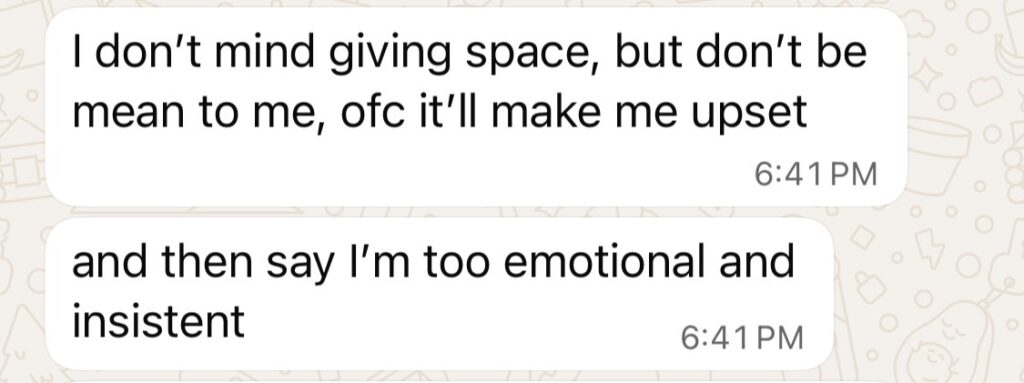
Give them time and space to work through their stress. If they reach out to you for comfort, comfort them, but avoid overloading them with information or emotions. If you do, they can get very mean and impolite. They expect you to automatically understand their need for space because it’s ‘normal’ for them. They don’t get that it’s not your ‘normal’.
Texting avoidant types
Avoidant attachment style has two subtypes:
- Fearful-avoidant (FAs)
- Dismissive-avoidant (DAs)
Fearful avoidants experience high anxiety in relationships. They simultaneously want and fear close relationships. They tend to be people-pleasers with low self-esteem. Dismissive avoidants don’t experience a lot of anxiety in relationships. They deem close relationships as unimportant. They value independence more than connection. They tend to have high self-esteem.
Related: Fearful-avoidant vs. dismissive-avoidant
Texting an FA
Besides the points mentioned above for avoidants in general, you have to keep certain things in mind when texting FAs specifically.
1. Texting a lot
If an FA engages in a lot of texting, they’re probably more anxious than they are avoidant. In this case, their behavior is similar to that of the person with an anxious-preoccupied attachment style- the all-day texters whose connection needs are extreme.
You need to be on your toes with them and respond as much as possible. If you can’t keep up, let them know so they can dial down their texting and meet you in the middle.
2. Texting rollercoaster
They will sometimes text you a lot, and at other times they’ll text you infrequently or not at all. This is their typical hot-and-cold behavior manifested in texting. Their texting frequency depends on their emotional state. Since they tend to have a chaotic emotional life, their texting seems chaotic too.
You’ll feel the knock-on effects if they experience stress in other areas of their lives. When they’ve withdrawn after what seemed like a great texting session, hold back the texting and let them work through their emotions. They’ll have that amazing conversation again later.
"Hey, what happened? We had such a good conversation yesterday. Did I say something wrong?" ❌
I didn’t include the right way to text here because it is simply to let time pass.
3. Avoid FA triggers
FAs withdraw intensely when they experience relational stress, i.e., when their partner says or does something that triggers them. Common triggers for FAs are behaviors that show a lack of trust and criticism. When texting an FA, avoid being secretive or vague, as that suggests you don’t trust them enough to be clear.
"I want to tell you something, but I can’t right now." ❌
"I want to talk to you about this problem I'm facing at work." ✅
When you make plans with them, they’ll get annoyed if you give them vague answers. They’ll insist on a clear “Yes” or a “No”. They’ll want to know the exact time you’re meeting and not “in a few hours”.
4. Waiting for a text back
Waiting for a text back can hurt an FA in a new relationship. If they don’t get a text back immediately, they’ll interpret the situation according to their “I am betrayed” subconscious wound. They’ll accuse you of texting someone else or tell you that you don’t really like them. Give them a good reason why you didn’t instantly text back to soothe their fears.
Texting a DA
All the general points for the avoidant attachment style apply. Plus, you need to keep in mind some specific things when texting a DA:
1. Texting infrequently = Default mode
Texting infrequently or not at all is the default mode of existence for DAs who value independence more than connection. They’ll rarely make attempts to reach out. They don’t have the same connection needs as people with other attachment styles. Try not to take their minimal reaching out personally. It’s just the way they are, and it doesn’t necessarily mean they’re not interested.
2. Frequent texting
Texting too much can quickly overwhelm a DA. They tend to have a low opinion of people who prefer texting all day and believe they have nothing better to do. DAs focus on themselves a lot, and texting others (focusing on others) comes in the way of focusing on themselves. Their independence gets threatened, and they pull away. Avoid bombarding them with texts at all costs, no matter their current emotional state.
3. Slow to text back
Dismissive avoidants don’t like instant back-and-forth texting unless it’s urgent or they’re really interested. Their typical response is to take their time when replying to texts. To them, it doesn’t matter when you text back as long as you do text back. If a DA takes too long to text back, avoid personalizing it. They will eventually respond if you mean anything to them at all.
4. Indirect texts
DAs will hardly make any plans, even with their romantic partners. To them, wanting to make plans with someone equals needing them. To them, needing someone equals weakness. It makes them vulnerable, opening them up to the possibility of rejection. If you make plans with a DA and ask them something like:
“Are we meeting on the weekend?”
You’ve just put them in a quandary. They tend to be direct in their communication but also avoid conflict. If they say ‘Yes’, it means they want to meet you. Weak. If they say ‘No’, you might get upset. Bad for the relationship. So, they give an indirect answer. Something like:
“I have to attend a seminar on Sunday.”
Saying something like this saves them from a ‘Yes’ or a ‘No’. It also lets them test if you’re serious about the meeting. Because if you are, you’ll insist upon the meeting. And when you’ve insisted, you’re the weak one. Not them.
5. Concise texts
DAs tend to be economical with their words. They don’t beat around the bush, even with indirect responses. So, texting someone whose communication style is all over the place can be frustrating for them. Get to the point, or don’t bother them with messages at all. As I said earlier, almost every text has to have a logical and practical purpose.
6. Ignoring their texts
What happens when you ignore a DA’s texts?
Unlike anxiously attached people, dismissive avoidants tend to be okay with others not replying immediately. This is their ‘normal’. They project their independence needs onto others and conclude something like:
“They must be busy.”
However, ignoring their texts completely and not responding at all will make them hate you and cut you off from their lives. They can be ruthless when they cut people off from their lives.
7. Answering part of the text
Since DAs mostly see texting as a waste of time, they’ll sometimes try to shortcut it by answering only part of the message. Usually, the part that doesn’t require a long reply. This can be frustrating for their partner, who feels invalidated. Instead of allowing this to be the norm, say something like:
“You haven’t answered X yet.”
Refuse to move forward with the conversation unless they answer X. Don’t let them dismiss you so easily.
Manage your emotional state
Understanding why avoidants text the way they do will help you avoid turning their negative behaviors personal. Usually, it’s not about you. It’s about them. They’re probably not consciously hurting you. They have a different model of how the world works or should work that is different from yours. Not getting a reply from them rarely means they’re not interested.
Such avoidance behaviors can make anyone upset but if you find that they completely destabilize you and fill you with crippling anxiety, you might want to heal your anxious attachment style.
Communication strategy
Your task is to convey how their behaviors affect you. Teach them about attachment styles if you have to. When you’ve clearly set your boundaries and expressed your needs, they’ll respect them if they care about you. Avoidants love logic and clarity. If you logically explain how their behaviors affect you, they’ll listen. It will shock their system, and they’ll be forced to self-reflect. It’ll put them on the path of healing. If you sprinkle in emotions, they’ll get defensive.
Disclaimer: This article is for informational purposes only and is not a substitute for professional help. If you’re struggling, consider reaching out to a qualified mental health professional.