
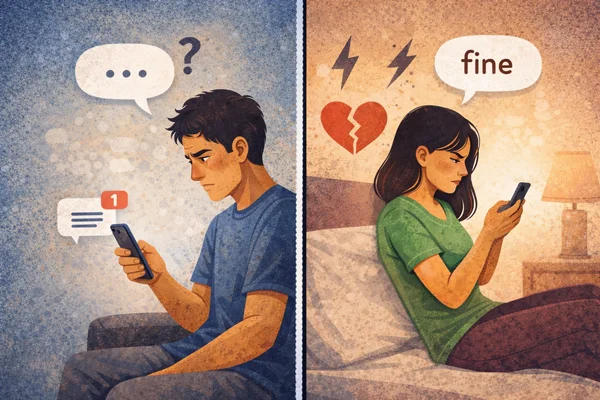
When a person feels attacked, their fight-or-flight response gets activated. This response isn’t restricted to life-threatening dangers, such as from a predator; it also activates during interpersonal threats.1MacDonald, G., & Leary, M. R. (2005). Why does social exclusion hurt? The relationship between social and physical pain. Psychological bulletin, 131(2), 202. When you feel socially threatened, you might avoid the person (flight) or attack back (fight), leading to an attack-defend cycle that escalates conflict.
- Low-cost hostility
- Look for patterns
- Examples
- 1. Backhanded compliments
- 2. Sarcasm
- 3. Negative tone
- 4. Verbal-non-verbal mismatch
- 5. Silent treatment
- 6. Distancing
- 7. Withholding affection
- 8. Guilt-tripping
- 9. Jealousy induction
- 10. Subtle criticism
- 11. Social exclusion
- 12. Mixed signals
- 13. Task resistance
- 14. Sabotaging your goals
- 15. Being late
- 16. Wrecking positive moments
- 17. Hurting by proxy
- 18. Backstabbing
- 19. Deliberate triggering
- 20. Information control
Low-cost hostility
Escalated direct and overt interpersonal conflicts are costly for both parties. You risk bringing significant harm to yourself and/or to the other party. Getting caught in the attack-defend cycle for prolonged periods of time can destroy a relationship.
To avoid such drastic consequences of relational conflicts, humans also have a different, indirect, and covert mode of being aggressive, of communicating hurt feelings: Being passive-aggressive. That is, you defend yourself by showing aggression in indirect ways. It’s a low-cost hostile behavior.
Those on the receiving end of passive-aggressive behavior can sense something’s off. But they can’t put a finger on it because it’s covert. They have nothing to attack back. So they feel frustrated and confused. They think maybe they’re imagining things. That’s exactly the goal of passive-aggressive behavior- to psychologically destabilize you. It’s psychological warfare. Your relationship partner is getting back at you by inducing psychological instability in you.
Passive aggressors often attack you subtly in a way that lets them have plausible deniability. Since the attack is confusing and unclear, they can easily deny or defend it.
Look for patterns
Isolated and infrequent events of passive-aggressive behavior in relationships are normal. However, if your partner shows passive-aggressive behavior frequently, that’s concerning because it can have a significant impact on your mental health. You’ll find that you’re always trying to decode their behavior. Living in a constant state of confusion, frustration, and low mood will wear you down and suck the life force out of you. It’s emotional abuse.2Harrn, A. (2011). What is passive aggressive behavior. Counselling Directory, 13.
To ensure it’s indeed passive-aggressive behavior and not your misinterpretation or imagination, look for patterns instead of isolated events. Never ignore red flags. Make a mental note of them and notice if they get louder with time. The unmistakable negative vibes you get from a person will tell you everything you need to know before the rational part of your brain has time to make sense of things. That said, it’s always a good idea to back up your intuition with data and reasoning before you make big decisions.
Examples
1. Backhanded compliments
These are compliments designed to subtly put you down.
“You actually did a great job this time.”
In many passive-aggressive comments like this, the attack is not in what’s being said but in what’s implied. The above statement implies that you usually do a poor job.
“Wow, you finally lost weight. Congratulations!”
The implication is that you’re bad or incompetent for taking so long to lose weight. Backhanded compliments don’t feel good. They sting. You feel judged, and your self-esteem can take a hit.
2. Sarcasm
Sarcasm is when a person says one thing but means the opposite. The opposite meaning (attack) may or may not be conveyed by a hostile tone.
“Oh, you’ve never created problems for me. That’s right.”
“I was just joking.”
If a joke hurts you, it’s likely a hostile joke. Hostile jokes communicate anger, jealousy, and resentment without accountability. They can always deny and dismiss it as a joke.
3. Negative tone
Sarcasm is one example of using a negative tone. One can also be passive-aggressive by saying something neutral in a negative tone.
“Do whatever you want.”
When said in a cold tone, the above comment communicates apathy. It tells you that you don’t listen anyway, so it’s pointless to talk.
“Must be nice having all that free time.”
This line passive-aggressively communicates that they are superior to you, busier, and more important than you. They have better things to do with their time than you do. They may be trying to put you down for having hobbies, for instance.
4. Verbal-non-verbal mismatch
They say one thing, but their body language and facial expressions communicate another thing.
“I’m fine.”
Said in an angry tone, it’s a classic case of passive-aggressive behavior.
“I’m happy for you.”
When you share good news with someone, you expect them to be happy for you. Or at least neutral. The above sentence, in response to your good news, is usually delivered in a disinterested, dismissive, or even slightly angry tone. Watch out for the facial signs of anger when you hear this response.
5. Silent treatment
It’s withholding communication to punish or control. For example:
- Ignoring texts or calls
- Hanging up mid-conversation
- One-word replies
No response is a response. By cutting off or cutting short the communication, they’re communicating that they don’t want to talk to you. When someone does that to you, you feel unheard, rejected, and devalued.
The goal might be to force you to chase them or apologize.
6. Distancing
Distancing can be physical, emotional, or both. For example:
- Leaving the room abruptly
- Acting like you don’t exist (Invisible treatment)
Their goal is to express anger through withdrawal. This behavior makes you feel abandoned.
7. Withholding affection
They may not physically or emotionally distance you. They’ll talk to you but withhold intimacy and affection. Still a cold and hurtful behavior. For example:
- Avoiding physical intimacy after conflict
- Becoming unaffectionate when you say “No” to them
Again, the goal is to punish without confrontation. The behavior makes you feel rejected and abandoned.
You can be emotionally close to someone yet not be affectionate.
8. Guilt-tripping
Playing the victim, then indirectly blaming you for it.
“I guess I’ll just do everything myself.”
They might say this when you refuse a request and ask them to do it instead. They frame it as if you asked them to do everything. Which isn’t true. The goal is to induce guilt and shame in you so you take back your request.
“Don’t worry, I’m used to being ignored.”
An indirect way to communicate that they feel ignored by you. They’re hoping you crumble under the burden of guilt, apologize, and change your ways.
9. Jealousy induction
Making you feel insecure on purpose. For example:
- Talking about others flirtatiously
- Comparing you to someone else
They’re indirectly communicating:
“I have other options.”
Flaunting your options directly or indirectly to your relationship partner is an unhealthy behavior likely motivated by insecurity. They want you to feel insecure as well. Or they might be indirectly communicating:
“If you don’t comply with me, I have others who will.”
It’s a control tactic to induce fear, anxiety, and jealousy. So you can comply with their wishes and demands.
10. Subtle criticism
It’s all about attacking your self-esteem in indirect ways. For example:
“Are you sure you can handle that?”
The implication here is that you’re incompetent and incapable of handling the situation or challenge.
“John gifted her wife diamond earrings.”
While this may seem like a harmless way of expressing a desire, it’s not. It’s designed to make you think you’re not a good partner just because you don’t comply with every demand.
11. Social exclusion
Wanting to be included is an innate human need. So, making you feel excluded can be an effective passive-aggressive method to subtly attack you. For example:
- Not inviting you to plans
- Ignoring your presence
By excluding you, they communicate:
“You’re not important to me.”
This may also occur in reverse when they cancel plans that you make, unreasonably. Although the behavior is reversed, the effect on you is the same- you feel unimportant, excluded, and hurt.3MacDonald, G., Kingsbury, R., & Shaw, S. (2013). Adding insult to injury: Social pain theory and response to social exclusion. In The social outcast (pp. 77-90). Psychology Press.
12. Mixed signals
When you receive mixed signals from someone, your mind’s likely to be in chaos and confusion. That’s what the passive-aggressive person wants: your mental instability.
For example:
- Hot-and-cold behavior
- Changing the topic mid-conversation
13. Task resistance
When they don’t want to do something that you ask them to do, but don’t want to refuse directly. This typically manifests in 5 ways:
a. Deliberate procrastination
When you ask them to do something, and they delay it instead of directly telling you that they don’t want to do it. By delaying, they’re exercising power and control over you and the situation.
b. Deliberate forgetfulness
Another form this manifests in is deliberate forgetting, where they say that they forgot to do it. The reality is that they remembered but didn’t want to do it. Saying that they forgot gives them plausible deniability. You can’t prove they didn’t forget.
c. Weaponized incompetence
They do the task poorly, making you think they’re incapable of doing it. So you don’t ask them to do it next time, which was their whole goal to begin with.
d. Undermining agreements
They agree to do something but not do it later. Satisfying you in the moment by giving you their agreement, but later doing what they want.
e. Complication
They’ll pretend the task is too complicated for them, even though you may have laid out everything clearly. Or they’ll deliberately bring unnecessary complications to the task so it’s left unfinished.
14. Sabotaging your goals
If you made the mistake of sharing your goals with them, they’ll sabotage them by saying things to induce doubt in you. They might deem the goal impossible/difficult to reach. For example, if you say you want to publish a book, they might say:
“Good luck with that! No one reads these days.”
That may seem like a genuine point because the attention span of people has reduced. But books still get read by people who are into them.
If you make progress in losing weight, they might say:
“You’ve lost too much weight. That’s not healthy.”
Even though you got your Body Mass Index checked, and it’s in the normal range for you. They’ll dismiss your BMI if you mention it because their goal is to sabotage you, not pay heed to facts that may encourage you.
15. Being late
Consistently disrespecting your time without acknowledgment or apology. Again, the pattern matters more than isolated events. When someone makes you wait, they have an upper hand on you. They’re sub-communicating:
“I’m more important than you. Spend your time waiting for me.”
This is why waiting too long for someone feels disrespectful and disempowering. They’re effectively controlling what you do with your time when you wait. Subtle power move.
16. Wrecking positive moments
Emotional withdrawal and putting you in a bad mood hits the hardest when they make you feel good first. The higher you climb, the harder you crash. For instance:
- Starting an argument during a happy moment
- Becoming cold during intimacy
17. Hurting by proxy
Hurting someone or damaging something important to you. For example:
- Being rude to your friends or family
- Harming your pet
- Damaging your musical instrument
18. Backstabbing
Expressing negativity behind your back instead of directly. For example:
- Complaining about you to others
- Undermining your reputation
Such behavior makes you feel betrayed, and you lose trust in your partner.
19. Deliberate triggering
Arguably, one of the most harmful passive-aggressive behaviors. It’s when they know what triggers you, and then they deliberately push those buttons. You may have revealed your triggers to them in a moment of vulnerability, and then they use them against you.
For example:
- Mocking your deepest insecurities
- Bringing up your past mistakes, you feel shame about
20. Information control
It’s causing you harm or putting you at a disadvantage by not sharing important information with you. Or it may take the shape of sharing information selectively with you. Not telling you the whole story. When you confront them about it, they may say:
“I thought you knew.”
“Wasn’t that obvious?”
They’re assuming you should have concluded B from A, even though it’s a jump of logic. You get confused and think maybe they think that way. Maybe it’s easy for them to conclude B from A. Maybe they’re stupid. They’d much prefer you think they’re stupid than understand their intentions.