Category: Psychological phenomena

[rank_math_breadcrumb]

Read about and understand the various psychological phenomena you observe in your day-to-day life. Get answers to common curiosities about everyday behavior. Understanding the root causes of your behaviors and those of others will greatly improve your understanding of human psychology. No human behavior, however small, is insignificant.

Top posts:

Recent posts:

  • 14 Signs your body is releasing trauma

    14 Signs your body is releasing trauma

    Trauma usually occurs in response to a seriously threatening event. Trauma is likely to happen when stress is intense or chronic, and a person cannot cope with that stress.

    Humans, like other animals, have three main responses to threats or stressful events:

    When we fight or take flight in response to a stressor, the event gets quickly resolved or processed in our minds. Both strategies are ways to avoid danger.

    For example, if the place you’re in right now catches fire and you manage to escape (flight), you’re unlikely to get traumatized by the event. You responded to the danger appropriately.

    Similarly, if you get mugged and manage to overpower the mugger (fight) physically, you’re unlikely to get traumatized by the event. You managed to avoid the danger. You may even feel good about doing so and tell everyone how bravely you faced the situation.

    The freeze response, on the other hand, is different and is usually responsible for trauma. The freeze response or immobilization allows an animal to avoid detection or ‘play dead’ to fool the predator.

    In humans, the freeze response causes trauma to linger in the psyche and the body. It often becomes an inappropriate response to danger.

    For example, many who were abused in childhood remember being ‘frozen with fear’ when the abuse was happening. Some even feel guilty that they could do nothing.

    They did nothing because they couldn’t do anything. Fighting the abuser could prove to be dangerous, or it was simply impossible. And escaping wasn’t an option either. So, they just froze.

    When you freeze in response to danger, you trap the energy the body had prepared for fight or flight. The stressful event shocks your nervous system. You detach from the painful emotion or dissociate to cope with the situation.

    This trapped traumatic energy lingers in the mind and the body because the dangerous event is unresolved and unprocessed. To your mind and your body, you’re still in danger years later.

    Trauma gets stored in the body

    Just as there’s a mind-body connection, there’s also a body-mind connection. Chronic stress leading to physical ailments is an example of a mind-body connection. Exercise leading to a good mood is a body-mind connection.

    Seeing the mind and body as separate, independent entities isn’t beneficial most of the time.

    Our feelings and emotions generate physical sensations in the body. That’s how we know we’re feeling them.

    Trauma-induced fear and shame may, therefore, get stored in the mind and the body.

    This is evident in the body language of people struggling with trauma. You’ll often see them avoiding eye contact and hunched over as if trying to protect themselves from a predator. The predator is their trauma.

    Body-first approach to healing

    The way to heal trauma is to resolve it mentally. This requires a lot of inner work, but it’s effective. When you resolve or heal your trauma, you feel better.

    The reverse approach would be to heal the body first and then the mind. That means releasing tension from the body. If we can move a person from a trauma-induced tense state to a relaxed state, they may be in a better position to do the cognitive work required to heal trauma.

    With the help of relaxation techniques, a person can slowly release the tension stored in their body.

    Peter Levine, the developer of somatic experiencing therapy, explains it well:

    Signs your body is releasing trauma

    1. You feel your emotions deeply

    Shutting down emotions is often how the mind copes with the pain of trauma. When you’re releasing trauma, you’ll find that you can feel your emotions more deeply. You’re able to label your feelings and acknowledge their complexity.

    You appreciate the guidance systems emotions can be without judging them or trying to get rid of them forcefully.

    2. You express your emotions

    Emotional expression is a common way for people to release their trauma energy.

    Emotional expression helps a traumatized person make sense of their trauma. This completes the incomplete traumatic event in their psyche. Emotional expression can take the form of:

    • Talking to someone
    • Writing
    • Art
    • Music

    Some of the greatest artistic and musical masterpieces were created by people trying to resolve their traumas.

    3. You cry

    Crying is the most conspicuous acknowledgment of pain and sadness. When you cry, you let go of the energy with which you bind your trauma in your psyche. That’s why it can be so relieving. It’s the opposite of repression.

    4. Movements make you feel great

    Humans are designed to move. We feel good when we move our bodies. But a person who’s struggling with trauma will feel even better when they move because they’re releasing extra energy.

    If movements make you feel great that’s a sign your body is releasing traumatic energy. Movements like:

    • Dancing
    • Yoga
    • Walking
    • Martial arts
    • Boxing

    People who get into martial arts or boxing are often those who were traumatized in the past. You can tell they’re carrying a lot of anger. Fighting is a great release for them.

    5. You breathe deeply

    It’s common knowledge that deep breathing has relaxing effects. People don’t say “Take a deep breath” to someone stressed out for nothing. Deep abdominal breathing reduces stress and anxiety.

    Small, everyday stressors can be thought of as minor traumas. They cause a build-up of energy that the body releases by sighing or even yawning.

    6. You shake

    The body releases the energy build-up of trauma via shaking. Animals do it instinctively. You’ve probably seen animals after a fight ‘shake it off’ literally. Humans are also told to shake it off when they get uptight about something.

    Look how this animal engages in deep breathing and shaking after a freeze response:

    https://www.youtube.com/watch?v=Ox7Uj2pw-80

    7. Your body language is relaxed

    Tense body language where the situation can’t explain the tenseness is likely a sign of unresolved trauma. Shame from past trauma weighs a person down, which is reflected in their body language.

    A person with open and relaxed body language has no trauma or has healed.

    8. You’re healthy

    Stress and trauma weaken the immune system. When you heal mentally, your immune system recovers, and you’re less likely to have physical health issues.

    9. You feel freer and lighter

    Trauma weighs you down mentally and physically. Trauma is bound energy. It takes considerable mental energy to bind energy.

    Trauma can direct a lot of your mental resources and energy to itself. Once you’re healed, all that energy can be freed up and allocated to worthy pursuits. Healing your trauma is the best productivity hack there is.

    10. You’re less resentful

    Trauma-induced anger and resentment make up the stored energy traumatized individuals carry in their psyche.

    If your trauma was caused by another human being, forgiving them, taking revenge, or understanding why they did what they did can help release that built-up energy.

    11. You don’t overreact

    You’re releasing your trauma and healing if you no longer overreact or react very little to situations that previously triggered you.

    12. You accept love

    Childhood trauma and emotional neglect affect our ability to form healthy and secure relationships as adults. When you release trauma, you find yourself more and more receptive to love, affection, and belonging.

    13. You make good decisions

    Emotions, in general, and trauma, in particular, can cloud decision-making. Trauma distorts our perception of reality. It tells us stories about the external world that aren’t necessarily true.

    When you heal trauma, you ‘fix’ your perception of reality. This helps with being a realistic and rational decision-maker.

    14. You don’t self-sabotage

    Trauma-induced shame can lead to limiting beliefs that limit your potential in life. You’ve probably met people who seem to sabotage their success as soon as they taste it.

    Their limiting beliefs have created a glass ceiling for what or how much they can achieve.

    A massive sign that you’re healing from trauma is that you no longer sabotage your successes. You feel worthy of accomplishment.


  • 10 Signs of trauma bonding

    10 Signs of trauma bonding

    A trauma bond is formed in abusive relationships. An abusive relationship is one where there’s a major power imbalance between the partners. The abusive partner exercises power control over the other partner- the victim of abuse.

    In a healthy relationship, the two partners have more or less equal power distribution.

    A trauma bond is formed when there’s a cycle of abuse in an abusive relationship. There are moments of connection mixed with moments of fear (abuse). If the relationship were entirely abusive, it’d be easy for the victim to leave.

    The positive moments in the relationship give the victim hope that the relationship can turn out well or that they can change the abuser.

    A trauma bond is characterized by periods of extreme highs (connection) and lows (fear). A healthy relationship, in contrast, may have extreme highs and lows initially, but it stabilizes over time.

    Signs of trauma bonding

    Let’s dive into the ten powerful signs that show you’re likely in a trauma bond. There are a lot of similarities between a trauma bond and a normal relationship. I eliminated those similarities and narrowed the list to items that only apply to a trauma bond.

    1. Love-bombing

    When a trauma bond begins to form, the abuser bombards the victim with love and affection. The relationship moves at a faster pace than usual.

    Note that different people have different expectations of how fast a relationship should move. If there’s good chemistry between two people from the start, that relationship can move fast as well.

    What distinguishes love bombing from a relationship with good chemistry is that the former is one-sided. It’s only the abuser who bombards the victim with love, not the other way around.

    In a relationship with good chemistry, both partners typically shower each other with love.

    2. Unable to leave

    A trauma bond can feel like a tight grip you can’t escape. The extreme highs and lows make the relationship unpredictable, leading to addiction. Even though you might realize that the relationship is toxic, you may be unable to leave.

    3. Making excuses for the abuser

    This is a huge one.

    Since you’re hooked on the relationship, you can go to any length to stay addicted. You defend, justify, and rationalize the abuser’s behavior.

    You may deny or minimize the severity of abuse. You may even blame yourself for the abuse.

    You may falsely think that the abuser is responsible for everything good in the relationship while you’re responsible for everything wrong.

    We have a strong psychological need for consistency. If someone is not being consistent with their love, we tend to think it must be our fault.

    The fact that the abuser in a trauma bond gives and withdraws love is hard for your mind to grasp. It creates a cognitive dissonance that you resolve by self-blame and giving the abuser the benefit of the doubt.

    4. Fixating on the positives

    The mind prioritizes survival and reproduction over everything else.

    Therefore, even though a trauma bond contains a mix of positive and negative moments, your mind over-focuses on the positive moments. The mind likes to cling to whatever little hope there is.

    Because if it doesn’t, it may lose a chance to survive little and/or reproduce. The cost of not clinging to the crumbs of hope is too high.

    5. Persistent loyalty

    Addiction plus fixating on the positives generates an unwavering loyalty to the abuser, even in the face of danger. Sometimes the need to reproduce trumps the need for survival. So even if the relationship borders on being life-threatening, the victim may stay loyal to the abuser.

    To an outsider looking at the abusive relationship, it doesn’t make sense. They think it’s ridiculous that the victim is staying in the relationship. They may even engage in victim-blaming. Of course, they have no clue what’s going on in the victim’s mind.

    6. Walking on eggshells

    The abuser makes sure they have power over you. This means they’ll stifle your every attempt to regain power.

    You’ll find that you have to walk on eggshells around them. You don’t know what behavior on your part might trigger them. Often their ‘getting triggered’ is an overreaction to maintain power and control by instilling fear.

    7. Doubting yourself

    Gaslighting is a common tactic used by abusers to distort their victims’ reality. They dismiss or deny your version of reality and impose their own.

    If you say, “I felt offended when you said that”, they’ll say, “Oh, you’re imagining things. I never said that.”

    If this continues, you come to a point where you start losing your sanity. You second-guess everything and over-rely on the abusive partner to interpret reality for you.

    8. Losing yourself

    Gaslighting erodes self-esteem and self-identity over time. People trapped in a trauma bond don’t have much of an identity, to begin with. That is, their low self-esteem makes them likely to become a victim of abuse.

    Their low self-esteem and lack of self-identity get wiped out in a trauma bond as they get enmeshed with their abuser. There are no boundaries between them and their abuser. They adopt the worldviews and feelings of their abuser.

    9. Isolation from friends and family

    To carry out the abuse unscathed, the abuser has to isolate the victim from their friends and family. This is because if something’s wrong with the relationship, family and friends would be the first to raise an alarm.

    10. Having no choice

    One of the solid early signs of a trauma bond is that you have no say in the relationship whatsoever. You feel like your partner makes all the decisions. This is when the abuser starts to establish a power imbalance in the relationship.

    Compare this to a healthy relationship where both partners have a say in relationship decisions based on the more or less equal power distribution.

    Think you might be trauma bond? Take our trauma bonding test to find out.

  • ‘I hate talking to people’: 6 Reasons

    ‘I hate talking to people’: 6 Reasons

    Hatred motivates us to avoid pain. When we experience hatred, we distance ourselves from what causes us pain.

    So, if you hate talking to people, then ‘talking to people’ is a source of pain for you.

    Note that “I hate talking to people” is not necessarily the same as “I hate people”. You may be okay with texting them but not with talking to them on the phone or one-on-one.

    At the same time, it could also be that you hate talking to someone because you hate them as a person.

    Whatever the reason, when you avoid talking to people, there’s always some pain or discomfort that you’re trying to avoid.

    Let’s look at some specific reasons why you hate talking to people. Some of these overlap, of course. The goal of forcefully separating them out is to help you pinpoint the reason(s) that apply to your specific situation.

    1. Avoiding pain

    This is the reason behind every other reason why you hate talking to people. If you hate talking to people, you may be trying to avoid the pain of:

    • Being judged
    • Being misunderstood
    • Getting rejected
    • Feeling embarrassed
    • Getting ridiculed
    • Arguments
    • Drama
    • Poor communication skills

    Most of these are ‘bad’ behaviors on the part of others that motivate you to avoid talking to them. You’re trying to avoid external sources of pain.

    If you get easily embarrassed when you make a mistake, your source of pain is internal. But it’s pain nonetheless. Same for poor communication skills. You may be lacking them or the one you hate talking to, or both of you.

    2. Social anxiety

    Anxiety is fear of the near future. Socially anxious people want to connect with others but are afraid they’ll mess up. Their source of pain is internal- their anxious thoughts before a social event.

    They hate talking to people because they don’t like dealing with their anxious thoughts and feelings, which can be highly uncomfortable.

    3. Introversion

    Many who hate talking to people are introverts.

    Introverts are people with rich inner lives who are internally stimulated. They don’t need a lot of external stimulation. They get easily overwhelmed by constant external stimulation, like talking to people for hours.

    They’re deep thinkers who spend most of their time in their heads. They recharge by spending time alone.

    Usually, introverts don’t hate people. They only hate talking to people. Talking to people forces them out of their heads, and being out of their heads isn’t familiar territory.

    They may be okay with texting because texting allows them to jump back into their head and think deeply amidst a conversation.

    Since they like thinking and talking about deep topics, small talk is a nightmare for them. They struggle with exchanging pleasantries with people. They tend to be economical with their words and get straight to the point.

    4. Depression

    Depression occurs when you’re facing a serious life problem. Your problem is so big that your mind deviates all your energy from other life areas and re-directs it to the problem.

    This is why people who get depressed withdraw into themselves and enter into reflective mode. Ruminating over a problem makes you more likely to solve it. Almost all your energy is spent on rumination.

    You have little social energy left. So, you hate talking to anyone- including family and friends.

    5. Avoidant attachment

    You may have an avoidant attachment style if you hate talking to people. Our attachment styles are formed in early childhood and play out in our closest relationships.

    Those with avoidant attachment styles pull away from relationships when things get too close for their comfort. A big part of that “pulling away” is not talking.

    6. Resources management

    You may not be depressed, socially anxious, avoidant, or introverted. Your interactions with people may be smooth and pleasant. They may not have given you any reason (bad behavior) not to talk to them.

    Yet, you hate talking to them.

    In this case, the reason may be that you want to manage your time and energy resources efficiently.

    If the people you don’t talk to are not adding value to your life, it’s reasonable not to speak to them. If you talk to them, you’ll hate that you wasted so much time and energy on them. They drain your energy.

    Of course, they don’t do it deliberately. It’s not their fault. It’s just how you feel after interacting with them.

    This is common in social interactions forced upon you, like having to talk to relatives or co-workers you don’t feel like talking to.

    The guilt of not connecting to others

    We’re social species, and the desire to connect to others is at the very base of our nature.

    Modern times have created a unique situation that our minds find challenging.

    On one hand, our social circle has expanded. Every day, we come in contact with more people than ever.

    By ‘come in contact’, I don’t just mean people you see and talk to in the real world. I also mean the people you text, whose emails you read, and whose posts you ‘like’ and comment on.

    At the same time, many experts claim that we’re lonelier than before.

    What’s happening here?

    Our ancestors lived in small, closely-knit tribes, much like how many tribal societies live today. Village life comes close, but city life is a bit removed from the social context our minds evolved in.

    We have a deep-rooted need to connect with the members of our tribe.

    No matter how good your long-distance online relationship is and how many incredible people you interact with in online communities, you’ll still feel the urge to connect with people in 3D.

    You’ll feel the urge to connect with your neighbor, the shopkeeper on your street, and the people you see in the gym.

    To your subconscious, those are the members of your tribe because you see them in 3D, and they’re in close physical proximity to you.

    Your subconscious doesn’t understand the online world. It can’t derive the same fulfillment from texting as talking to someone and connecting in person.

    People = investments

    Think of your social energy as water and the people in your life as buckets. You have limited water.

    When you fill a bucket fully, it fulfills you.

    When you give enough social energy to the people that matter to you, you feel fulfilled.

    If you have too many buckets, you’ll partially fill them and end up dissatisfied.

    Some buckets are dear to you that you want to keep fully filled. Some buckets you can only partially fill. Other buckets you need to kick away. No point in holding empty buckets. They’ll pull on your attention and beg to get filled, but you can’t afford to fill them.

    Remember this bucket analogy to deal with the guilt of not connecting with those you consciously don’t want to connect to but are subconsciously nudged to connect to.

    Put your subconscious desires to rest by reminding yourself that you have limited water.

    Get clear on who you are and who you want to be. Let it override your unhelpful subconscious desires. Get clear on your boundaries. Every person in your life is an investment. If they’re not yielding decent returns, drastically reduce the investment or cut it out completely.

  • How to get rid of a fetish: A psychological guide

    How to get rid of a fetish: A psychological guide

    The word ‘fetish’ comes from the Portuguese feitico, meaning ‘spell’, which in turn comes from the Latin facticius, meaning ‘artificial’ or ‘made up’. Someone with a fetish has sexual interests so deviant that they seem artificial or made up.

    Fetishism is indulging in a fetish, and a fetishist is a person having a fetish. Fetishism belongs to a category of sexual behaviors termed paraphilia, from the Greek para, meaning ‘beside, aside’, and philos, meaning ‘loving’. Paraphiliacs indulge in sexual behavior that is beside the norm. Fetishism is a type of paraphilia where the fetishist derives sexual arousal and pleasure from objects, non-sexual body parts, or particular behaviors and situations.

  • How to get rid of a fetish
  • Common fetish objects

    Anything that can get fetishized is referred to as a fetish object. Although one can have a fetish for any object or a non-sexual body part, clothing items are the most common type of fetish object.1Wiederman, M. W. (2003). Paraphilia and fetishism. The Family Journal, 11(3), 315-321.

    Common fetish objects include:

    Fetishes are not limited to inanimate objects and body parts. Any stimulus (information) that can be sensed or thought about can develop into a fetish. Besides things and non-sexual body parts, activities, images, concepts, or situations can also get fetishized.

    For example, it turns out that many adults who have a fetish for diapers really have a fetish for being treated like babies. It’s a situation fetish.

    Sexual preferences vs. fetishes

    A sexual preference is not the same as a fetish. Sexual preferences are specific ways individuals seek to gratify themselves, usually with a sexual partner. A fetish may or may not involve another partner.

    Fetishes tend to be stronger and more deviant than sexual preferences.

    Most people have standard sexual preferences. Some have specific fetishes. Very few have a fetishistic disorder where their fetish overtakes their sexual preferences and causes them significant distress.

    Most people who have fetishes tend to have harmless fetishes that don’t interfere with other areas of their lives. They do not require indulging in their fetish to get sexually aroused. Though they report fetish sex as more satisfying than non-fetish sexual activity.3Rees, G., & Garcia, J. R. (2017). All I need is shoe: An investigation into the obligatory aspect of sexual object fetishism. International Journal of Sexual Health, 29(4), 303-312.

    On the other hand, people with fetishistic disorder need fetishism to get sexually aroused. They may not be able to experience sexual arousal in the absence of the fetish object.

    fetishistic disorder curve
    Very few fetishists harm themselves or others.

    Harms of fetishism

    It’s not hard to see how over-reliance on a fetish object for sexual gratification can create problems for an individual.

    What causes fetishism?

    Many explanations have been put forth to explain fetishism. Let’s dive into a few that make the most sense:

    1. Learned response

    If people are not biologically wired to find objects sexually arousing, then it must be a learned response. Learning by classical conditioning is the best and most widely accepted explanation of fetishism.

    If you’re new to classical conditioning, here’s a one-paragraph summary of how it works:

    When two events occur together, our brains link them. This is because our brains are associating machines. We associate co-occurring things to learn their relationship.

    Pavlov’s dogs and cartoons

    You must have heard of Pavlov’s dogs. Pavlov’s dogs salivated (biological response) when presented with food. When he rang a bell and presented the food simultaneously a few times, the dogs associated salivation with the bell. Learning by association is strengthened by repetition.

    So, when he rang the bell without food, the dogs salivated. Salivation (a biological response) was paired with something that doesn’t typically cause salivation (ringing a bell).

    Sexual arousal is a biological response, too. If something causes sexual arousal that doesn’t typically cause sexual arousal (e.g, a fetish), we can reasonably assume there’s classical conditioning going on.

    Fetishes tend to develop in childhood and adolescence when people first explore sex and sexual arousal.4Wise, T. N. (1985). Fetishism—Etiology and treatment: A review from multiple perspectives. Comprehensive psychiatry, 26(3), 249-257. Many people can trace the development of their fetishes and fantasies to their earliest intense sexual arousal experiences.

    When they first experienced sexual arousal, something in the environment got paired with the biological response and developed into a fetish. Such that exposure to the fetish object led to sexual arousal subsequently.5Larva, M. A., & Rantala, M. J. (2024). An evolutionary psychological approach toward BDSM interest and behavior. Archives of sexual behavior, 53(6), 2253-2267.

    Many fetishes stem from cartoon characters, which isn’t all that surprising since children spend a lot of time watching cartoons.

    Our brains are highly impressionable during childhood and early adolescence. Any learning through classical conditioning occurring during this time may become deeply ingrained in the psyche.

    Fetishes tend to be specific

    Classical conditioning explains how almost any stimulus can become a fetish. The fact that fetishes tend to be specific rather than generic lends strong support to the conditioning theory. Instead of fetishizing shoes in general, the fetishist fetishizes a particular brand, shape, color, size, or texture of shoes that got linked to arousal thanks to their specific experience.

    Behavior that gets rewarded gets repeated. If a fetishist indulges in their fetish and gets aroused (reward), the fetish feeds itself. So, fetishes are a lot like habits and addictions in this regard.

    2. Past unmet needs

    Adolescents find themselves in many situations where they get sexually aroused but can’t achieve sexual satisfaction. This creates psychological tension in them that can persist into adulthood.

    For instance, if a boy liked a girl with ginger hair in school but couldn’t pursue her, this desire may get stuck in his psyche (Zeigarnik effect) and develop into an unmet need in adulthood. In adult relationships, he may prefer ginger-haired women or ask his partners to paint their hair ginger.

    Sometimes a fetish may help the fetishist satisfy a non-sexual unmet need.6Munroe, R. L., & Gauvain, M. (2001). Why the paraphilias? Domesticating strange sex. Cross-cultural research, 35(1), 44-64. There’s this guy who liked being tied to a leash. Upon introspection, he realized that it helped him feel cared for. His parents physically abandoned him as a child.

    3. Re-enacting trauma

    Traumatic experiences make people feel powerless. They think they can’t control the source of their trauma.

    This feeling of a loss of control over their source of trauma can force them to try to regain control over it later in life. They may do this by re-enacting the trauma in safer situations, such as having sex with a trusted partner.

    For example, if someone was physically abused as a child, they might like getting physically abused during sex. They’re re-creating their childhood trauma in a safe space so they can get a chance to process it.

    I searched a few forums for examples like this, and here’s what people had to say:

    Real-life example 1

    fetish example 1

    Example 2

    fetish example

    It seems that both classical conditioning and trauma re-enaction were at work here.

    Example 3

    fetish example 3

    A good example of a behavior fetish. This excerpt was taken from this Vice article.

    4. Sexual imprinting

    Konrad Lorenz found that when ducklings and geese hatch, the first thing they see they think is their mother. He had them following him wherever he went, like they would their actual mother. This phenomenon is called imprinting. What many people don’t know is that those baby birds also made sexual advances towards Lorenz when they grew up.

    This behavior was labelled sexual imprinting. Sexual imprinting is a well-established phenomenon in animals. It can be defined as a process by which sexual preferences are acquired through early experience with parents and siblings.7Aronsson, H. (2011). Sexual imprinting and fetishism: An evolutionary hypothesis.

    In other words, the early contact an animal has with parents and siblings teaches it what its future potential mates should look like. This could explain why so many people are attracted to potential mates who look or behave like their parents.

    Where does fetish come in all this?

    You must have noticed that almost all common fetishes involve the human body in some way. It could be that during their early contact with caregivers, the fetishist thought that the footwear, clothing, or accessory of the caregiver they sexually imprinted on was part of their body.

    For example, a fetishist may fetishize a particular type of sock simply because their mother always wore that sock. His developing infant brain thought the sock was part of her mother, her body.

    How to get rid of a fetish

    If you feel your fetish is harming you or those around you, you might want to minimize its hold on your life, if not get rid of it completely.

    1. Unlinking

    If your fetish is a classical conditioning response, you can unlink your fetish object from sexual arousal. To do that, you can resist the urge to indulge in your fetish the next time you’re exposed to your fetish object. When you don’t give in to the desire, you’ll make the urge weaker over time.

    Eventually, thinking about or getting exposed to the fetish object may no longer produce the unwanted biological response.

    You can also reverse it and try to pair sexual arousal with normal sexual stimuli. Through fantasizing, you can train your mind to get aroused by normal sexual stimuli.8Wong Sarver, N., & Gros, D. F. (2014). A modern behavioral treatment to address fetishism and associated functional impairment. Clinical Case Studies, 13(4), 336-351.

    2. Aversion training

    You pair your fetish object with something disgusting or fear-inducing. It’s recommended that you do this in a controlled environment with a counselor or a therapist. This method is not for everyone, but it can work.

    3. Cognitive approach

    The cognitive approach to overcoming fetishism involves using your own thoughts of shame and guilt. If you’re ashamed of your fetish, you can think things like:

    “What will my colleagues think when they get to know about my fetish?”

    “What will my spouse or children think?”

    Shame is a powerful emotion that prevents many people from doing harmful things. Get realistic about your fetish’s time, energy, and relational costs, and you’ll see that the costs outweigh the benefits. You’ll consciously choose not to engage in fetishistic behaviors.

    4. Alternate processing

    If your fetish stems from childhood trauma, you can find alternative ways to process your trauma. For instance, reliving your trauma in the safe space of a therapeutic setting can help you process it. So can talking about it to a trusted romantic partner or a friend.

    5. Counter-intuitive approach

    If your fetish stems from a past unmet sexual need, you may be able to get over it by indulging in it more. The Zeigarnik effect seems to play a role in the development of fetishes. It states that we keep thinking about unfinished business.

    Part of the appeal of fetishes may come from how difficult it can be to indulge in them. Many fetishes remain in the realm of fantasy and never materialize. So, fetishes tend to have this ‘out of reach’ quality that makes fetishists obsess over them.

    If you indulge in a fetish easily and often, the unfinished business in your mind becomes a finished business. You may find that your fetish no longer holds the same charm after you’ve normalized it. Also, once rewards are obtained, they tend to lose value. A fetish is also a reward.

    If your fetish is the result of sexual imprinting, there might be nothing you can do about it. Sexual imprinting is irreversible. While the desire will remain, you can control behavior.

    Disclaimer: This article is for informational purposes only and is not a substitute for professional help. If you’re struggling, consider reaching out to a qualified mental health professional.

    References

  • ‘Why do I feel like everything is my fault?’

    When things go wrong in your life, do you find yourself thinking:

    “Everything is my fault.”
    “I always mess everything up.”

    If you do, chances are you’re over-blaming yourself. Over-blaming or taking more than your fair share of responsibility for things can be just as bad as under-blaming.

    Things go wrong every once in a while in life. Knowing when to blame yourself, when not to, and to what degree to blame yourself in a given situation is a master skill. If you haven’t worked on developing this skill, you risk bouncing between under-blaming and over-blaming yourself.

    When you under-blame yourself, you’re not taking responsibility for things you ought to take responsibility for. Or you’re taking less than your fair share of responsibility. This is a sign of immaturity, arrogance, and egotism.

    When you over-blame yourself, you take responsibility for things you have little control over or are outside your control.

    Excessive and irrational self-blame leads to negative self-talk and feelings of guilt. You over-apologize and are likely to become a people-pleaser so you can make up for the ‘wrongs’ you did to them.

    over-blaming spectrum
    The spectrum of responsibility.

    Behavioral vs. characterological self-blame

    There are two types of self-blame, and both are observed in over-blaming yourself:

    1. Behavioral self-blame

    “Everything is my fault. I did very bad.”

    The person blames their behavior for things going wrong. When you blame your behavior, you do that from a position of power. You believe that had you acted differently, things would be different.

    This is a healthy way to think, but only when you’re appropriately blaming yourself. When you’re over-blaming yourself, this way of thinking isn’t helpful at all.

    2. Characterological self-blame

    It’s the deadlier version of self-blame that has been linked to depression.1Peterson, C., Schwartz, S. M., & Seligman, M. E. (1981). Self-blame and depressive symptoms. Journal of personality and social psychology, 41(2), 253.

    It says:

    “Everything is my fault. I am a bad person.”

    The person blames their character for things going wrong. When you blame your personality, you do that from a position of powerlessness.

    People generally perceive their character as more rigid than their behavior. It’s hard to change who you are. Which means you’ll keep messing things up. That’s just who you are and what you do.

    Why you feel like everything is your fault

    Regardless of the type of self-blame you engage in, the reasons you do it are several and interesting. If you can pinpoint what motivations are driving you to blame yourself unnecessarily, you can begin to change your faulty ways of thinking.

    1. All-or-nothing thinking

    Also called black-and-white thinking, it’s a pervasive cognitive bias. Reality is complex, with lots of grey in between the black and the white. But we’re prone to see things as either black or white.

    If you look again at the above spectrum of responsibility, you’ll see that the opposite extremes of the spectrum are all (over-blaming) and nothing (under-blaming). Either everything is your fault, or nothing is.

    All-or-nothing thinking is the default mode of thinking. It’s rare to see people who accept a 30% or 70% fault for things. It’s mostly either 0% or 100%.

    2. Avoiding change

    Self-blame, particularly characterological self-blame, can be a way to maintain the status quo. Maintaining the status quo is the most comfortable situation for humans to be in. Changing and growing takes energy and is uncomfortable.

    If you believe that bad things happen to you because you’re a bad person, there’s nothing you can do about it. With over-responsibility, you avoid personal responsibility. You give up the power and necessity to improve yourself.

    Fear of changing for the better is associated with low self-worth. You don’t feel worthy of becoming a better version of yourself because you don’t believe there can be a better version of yourself.

    3. Actor-observer bias

    This is another default way of thinking that causes many problems for people. The actor-observer bias is our tendency to only see things from our perspective while ignoring the perspectives of other people.

    It leads to over-attributing agency to yourself and under-attributing it to external factors.

    If something goes wrong in your life, you perceive it happening to you. You barely perceive it happening to others. Their contribution to the situation is vague, while your contribution is clear as the sky.

    You have more information about what you did wrong than what they did wrong. So, blaming yourself comes naturally.

    4. Anxiety

    We feel anxious when we’re unprepared for an upcoming, usually novel, situation.

    Anxiety makes you hyper-self-aware. Your self-consciousness and actor-observer bias gets magnified. It creates a cycle of self-blame and more anxiety.

    Say you have to give a public speech. You’re worried you won’t do well.

    You’re likely to blame yourself if something goes wrong during the speech because you were already anxious. You were expecting to make a mistake. You feel more anxious next time because you know you tend to mess things up.

    All this, even if what went wrong was hardly your fault. Maybe the audience was tired after a long day of listening to speeches, and you thought you were boring them. Maybe the subject matter given to you to speak on was uninteresting. You get the idea.

    5. Depression

    Most self-blame in depression is justified. You feel depressed when you fail to accomplish an important goal repeatedly.

    However, depression can also trap you in unjustified self-blame. Thinking about a genuine problem over and over can force you to see issues where there are none. This is connected to all-or-nothing thinking.

    In life, you mostly move to and fro between two mental states:

    “Everything in my life is good.”
    “Everything in my life is bad.”

    Even if there’s just one thing in one life area that is bad. Like happiness, depression related to one life area can spill over into other life areas.

    6. Childhood trauma

    Your excessive self-blaming may have been shaped during your formative years. It’s well-known that going through abuse can make the victims of abuse blame themselves.

    “It happened to me; therefore, it must be me.”

    Children are especially prone to such ways of thinking because their minds can’t yet comprehend the complexity of reality. Everything is about them, including abuse.

    Childhood abuse can create a sense of shame that lingers for years into adulthood. If the child gets blamed for everything that goes wrong and has anything remotely to do with the child, self-blame becomes habitual.

    For instance, a parent, trapped by their own bias, will likely blame their child for spilling a cup of milk than admit they bought a slippery cup.

    7. Quick resolution

    Humans tend to quickly resolve complex life situations- to explain the unexplainable promptly.

    Blaming yourself as soon as something terrible happens can be a way to avoid further analysis of the situation.

    Why would a person want to avoid further analysis of a situation?

    Maybe they don’t realize how complicated reality can be. They just can’t grasp it. They’ve been fed easy answers all their lives, and they’re content with them.

    Or maybe they don’t want something dark about themselves to surface. Better to blame yourself quickly and get out of the pickle than give others a chance to peek into your closet.

    8. Gaining attention and sympathy

    Some people can do anything to gain attention and sympathy. What happens after a person excessively blames themselves?

    Sympathies pour in. The excessive self-blamer feels special and cared for. It’s fishing for sympathy.

    9. Gaining trust

    When people apologize for their mistakes, they win our trust and empathy. This effect is also observed in case of unnecessary apologies.2Brooks, A. W., Dai, H., & Schweitzer, M. E. (2014). I’m sorry about the rain! Superfluous apologies demonstrate empathic concern and increase trust. Social Psychological and Personality Science, 5(4), 467-474.

    If people apologize for their mistakes, we feel good about them. We’re blown away if they apologize for something that isn’t even their fault. It shows they care a lot about us.

    Hence the expression:

    “I’m sorry for your loss.”

    I’ve always wondered why we say it. After all, it wasn’t me who caused your loss, so why should I apologize?

    It’s a non-apology. It’s just a way to show empathy and care.

    10. The illusion of control

    This applies more to behavioral than characterological self-blame.

    When people overestimate their control over situations, they’re likely to engage in self-blame.3Davis, C. G., Lehman, D. R., Silver, R. C., Wortman, C. B., & Ellard, J. H. (1996). Self-blame following a traumatic event: The role of perceived avoidability. Personality and Social Psychology Bulletin, 22(6), 557-567.

    “I could have avoided it.”

    Could you really have avoided it?

    Or are you just giving yourself a false sense of control because you’re not willing to accept that some aspects of reality are outside your control?

    11. Denying vulnerability

    This one is also linked to wanting to be in control.

    Some people don’t like to think that external factors can harm them. They want to believe they have complete control over their lives.

    So, when someone does harm them, they twist around the situation to make it seem like it was their own fault. They weren’t hurt. They’re too clever to get hurt. Others don’t have the power to harm them. Only they can harm themselves.

    12. Decreasing social friction

    Humans are social species. To us, maintaining social cohesion can sometimes precede accurately perceiving reality.

    It could be that our ‘all-or-nothing’ thinking bias stems from our need to maintain good relations with our kin.

    It seems that we have a built-in program that says:

    “If something goes wrong, try not to blame your relatives.”

    If we blame our close genetic relatives for every little thing that goes wrong, we risk spoiling our relations with them.

    Of course, this effect diminishes as genetic relatedness decreases because maintaining good relations with distant relatives or non-relatives doesn’t impact survival and reproduction too much.

    Getting out of the mess of thinking you mess up everything

    It starts with using self-awareness to overcome default ways of thinking.

    Whenever something goes wrong, try not to blame yourself automatically. It’s not fair. Instead, analyze the situation thoroughly and think about who or what else contributed to it and how much.

    An exercise called responsibility pie can help you do this. When something goes wrong, you draw a pie and assign appropriate shares of responsibility to external factors contributing to the situation by drawing sections.

    When you’re done, the remaining section is your responsibility.

    I tried it but found the exercise hard to do. It’s hard to divide a circle into sections of responsibility.

    What’s easier is making what I call ‘The blame list’.

    When something goes wrong, and it’s not obvious what went wrong (perfect recipe for self-blame), list everything you think contributed to the situation. All the external factors first- the people and other environmental factors.

    Imagine moving out of your body and looking at the whole situation from above.

    When you’re done listing all the factors, assign a percentage of blame to each. When you’re done, the remaining portion is how much you should blame yourself.

    For example, if you spill a cup of tea, instead of blaming yourself immediately for it, list down the contributing factors as under:

    Contributing factorBlame percentage
    Distraction from a neighbor using the drill50%
    A family member poured too much milk into the cup10%
    Slippery cup without a handle (bought by family)20%
    The noise made by children5%
    Boss stressed you out at work, so you were thinking about that5%
    You heard shocking news and had to drop whatever you were holding
    (as in movies)
    0%
    Your fault (You should’ve been more careful but you were too distracted by the music you chose to play)10%
    In this example, your neighbor using the drill is more to blame than you.


    People go around in circles, blaming this and that when something terrible happens. It’s because they don’t usually factor in how much a thing or person is to blame. When you have the blame list, you can blame things more systematically and avoid going in circles.

    Here’s another resource, a responsibility flowchart that can help you work through difficult situations and avoid excessive self-blame:

    responsibility flowchart

    References

  • Why are people intimidated by me?

    Why are people intimidated by me?

    As much as well-intentioned people try to create an equal society, it simply cannot happen. People organize themselves into status hierarchies wherever they are. Some people are more valuable and, therefore, higher in status than others.

    What determines who is valuable/high status and who isn’t?

    You and I don’t make these rules. It’s not up to governments, political parties, or judicial bodies to decide who’s high status and who isn’t. Thanks to millions of years of evolution, these rules have been passed down to us in our genes.

    People who possess qualities that can enhance their chances of survival and reproductive success are valuable members of any society. A rising tide usually lifts all boats. Highly valuable members of a society are more likely to improve the odds of survival and reproduction of other members.

    For example, a millionaire entrepreneur can employ hundreds of people and provide them with a means of livelihood. Hence, society values and gives high status to this person. And it happens unconsciously and automatically.

    People don’t usually look at a successful person and go like:

    “Okay, this guy has worked hard for his success. He’s benefiting not only himself but many others around him. Therefore, he’s a high-status person.”

    No, they instantly see successful people as high status. Our ancestors needed to figure out who was high in status quickly. Because by associating with those people, they could gain essential benefits. They couldn’t afford to waste time thinking if the high-status people were self-made or not. Or how they got access to resources. It didn’t matter.

    As a result, people today have become status-detecting machines. They can deduce the status of a person from minimal information. Sometimes, just by their looks. For instance, ‘if someone is well-dressed, they must be high-status’ is a judgment we all tend to make.

    Status gap

    If humans are status-detecting machines, they’ll inevitably compare their status with those they come across. People have a strong need to know where they lie in the status hierarchy of society. And the best way to do that is through social comparison.

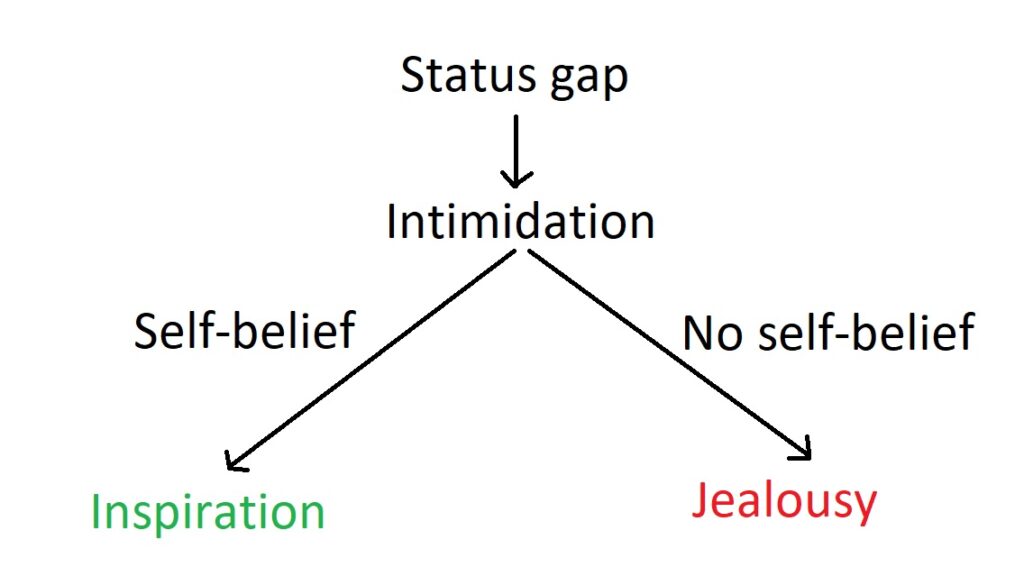
    When there’s a vast status gap between the observer and the observed, the observed being of higher status creates feelings of intimidation in the observer. The observer feels inferior, and their insecurities are awakened.

    Why intimidation, though? Why not any other feeling?

    For a long time in human evolutionary history, status hierarchies have essentially been dominance hierarchies. As is true for most animals today, the way to rise in status is to exert dominance. Of course, when you’re dominating someone, you’re intimidating them. When they become timid, they’re more likely to comply and avoid conflict. The whole purpose of domination is to make others comply.

    So, intimidation is a natural response to being dominated.

    The thing is, in modern human societies, dominance can be exerted in a variety of ways. Hence, there are several ways in which humans feel intimidated. This article will later list almost all of those ways.

    The critical thing to remember is that all dominance-intimidation human interactions revolve around survival and reproduction. When one human tries to dominate another, they’re essentially saying:

    “I’m better at surviving and reproducing than you.”

    Reasons you might be intimidating

    The following list will help you understand why you’ve been, intentionally or unintentionally, intimidating people. I’ll briefly explain why each reason is intimidating.

    1. You’re good-looking

    Physical attractiveness is one of the strongest factors that help a person attract a mate and reproduce. Society values reproducing members more than non-reproducing members. Like a bacterial colony, a human society wants to expand so it can gain more resources and self-sustain. So, good looks equal high status.

    Related: Signs someone is intimidated by your looks (Apply to other intimidation factors as well)

    2. Successful

    Success, in any shape or form, shows people you’re a competent person. You have the ability to accomplish your goals. Many people lack that ability. Success of any kind places you ‘above’ a lot of people.

    3. Famous

    The more followers you have, the higher your status. If you’re loved and respected by many, you’re a celebrity. Perhaps celebrities are called ‘stars’ because they’re so high above the common folk, like stars in the sky. Think about how your friend might behave if you became a star overnight. They’ll likely feel intimidated and start to consider themselves as ‘beneath’ you making it hard for them to continue the friendship.

    famous woman
    Looks, success, riches, and fame skyrocket your status.

    4. Strong

    Physically as well as mentally. Displaying physical strength is the ancient, animalistic way to exert dominance. People can’t help but feel intimidated by big and physically strong people. Mental strength seems more attainable than physical strength. So, it tends to evoke more admiration than intimidation.

    In evolutionary terms, physical and mental strength gave men more of an advantage than women so these traits are highly valued in men. If, as a man, you’re tall and have a large chest size you likely come across as intimidating.1McCarty, K., Leslie, C., Anguera de la Rosa, A., Saxton, T. K., & Cornelissen, P. L. (2025). Perceiving intimidation through kinematic cues in men’s gait. Scientific Reports, 15(1), 33489.

    5. Intelligent

    One way to display dominance is by showing intellectual superiority. In modern times, might isn’t always right. People can significantly raise their status and gain access to resources by being intelligent.

    6. Wise

    Wisdom is a rare quality and is only gained after years of experience. Being wise raises your status because people value wisdom. If you’re wise, people listen to you, and you can help many people.

    7. Rich

    When you’re rich, you have what people desperately need- access to resources. Since being resourceful helps men more with reproductive success than it helps women, men are more intimidated by rich men than by women.

    8. Confident

    Confident people are liked, admired, and respected. When people sense you’re more confident than them, intimidation is inevitable. When I say confidence I mean true confidence which is correlated with power and status. Confidence and feeling good about yourself goes hand in hand with high power and high status.2Keltner, D., Gruenfeld, D. H., & Anderson, C. (2003). Power, approach, and inhibition. Psychological review, 110(2), 265.

    9. Independent

    Independent people are more likely to become leaders. They don’t follow anyone. They get followers. Being an independent thinker attracts followers like bees to nectar. Humans have evolved to blindly follow high-status leaders. This likely ensured the survival enough for it to now be a part of our psychology.

    10. Charismatic

    Being charismatic is a common quality of successful leaders. Charisma comes down to the ability to genuinely express how you feel. Few people can pull that off. So, it’s a valuable trait to have. Almost all the cult leaders tend to be charismatic.

    11. Knowledgeable

    To figure out what traits and qualities society values, you sometimes have to look at how people devalue others. One way people do that is by saying something like:

    “Oh! You know nothing.”

    What they’re really saying is:

    “Your lack of knowledge makes you low status. I can’t take you seriously.”

    Knowledge is power, and power is status. Knowledge can help a person help themselves and others. In our modern knowledge-based economy, knowledge is more valuable than ever.

    Similarly, if you use big words, you can come across as intimidating. You’re showing you know more and better words than them. Being a Grammar Nazi is another way to display intellectual dominance.

    12. Positive personality traits

    Positive personality traits like courage, altruism, honesty, decency, and modesty can also intimidate people. It sounds counter-intuitive because we’re taught to cultivate these traits all our lives.

    It’s a rude awakening for many when they put in a lot of effort to develop these traits, only to find that they’re intimidating people with these traits. People are more concerned about their status than about pleasantness in others’ personalities.

    13. Masculinity

    A man with masculine traits threatens men who don’t have such characteristics. They’re better able to attract women and inspire other men. Tallness, broad shoulders, and a deep voice can trigger intimidation. So can masculine personality traits like ambition and aggression.

    14. Femininity

    More feminine women have more power than less feminine women. So, more feminine women have a higher status in society. They’re better able to attract men and inspire other women. A beautiful, feminine woman can intimidate women as well as men.

    Masculine women can be intimidating, and not in a good way, for the same reason as feminine men are. They're too different and violate people's expectations of gender-appropriate behaviors.

    15. Being too different

    Feminine men and masculine women intimidate people because they’re too different from ordinary people.

    People find strange and unfamiliar people and objects intimidating. This tendency is deep-rooted in humans and probably has its evolutionary roots in our reptilian brains. Reptiles use smell to detect genetically unrelated reptiles.3MacLean, P. D. (1990). The triune brain in evolution: Role in paleocerebral functions. Springer Science & Business Media.

    We rely more on our visual systems to detect genetically unrelated people. This is the mechanics behind racism, nationalism, prejudice, and discrimination:

    “People who’re not like us are unrelated to us and therefore a threat.”

    This applies not only to looks but also to personality. If you have a unique personality, people get intimidated and have a hard time thinking about you as one of them.

    16. Healthy

    The most important thing for your survival is your health. If you’re in shape and eat healthy, you can intimidate others. First, you’re doing something they want to do but won’t or can’t. Second, health-conscious people are rare in our society, to the point that they come across as strange. People say, “He’s health conscious” as if not being health conscious is the normal, sane thing to do.

    17. Social life

    We’re social species and crave human companionship. Some more than the others. But we all do. Having strong social support may not be as critical for survival in modern times but it was in ancestral times. Therefore, it’s still important for our well-being and confers status. If you have a decent social life, it can intimidate those who don’t.

    Related: Attachment style test

    18. Hobbies

    How dare you take the time to enjoy hobbies? How dare you take time out for yourself and your mental health?

    Many people don’t pay attention to their physical health, let alone mental health. They’re overworked and overstressed. They wish they could develop a hobby too, but they don’t make time for it. Worse, they get intimidated by those who do. Like no one’s stopping you.

    19. Travel

    People use traveling as a way to display status. It’s becoming increasingly common thanks to the proliferation of photo and video-sharing social media platforms. The weird thing about using travel as a status display is that the further you travel from your hometown, the higher your status.

    You could have a wonderful location 5 miles from your home with everything you need to relax. But no, that’s not worth showing off. What’s worth showing off are far-away and exotic locations. When you travel to faraway locations, you’re indirectly showing that you have a lot of resources (money and time) to spend, so it’s a higher-status thing to do.

    20. Opinions

    Expressing opinions is a high power behaviour because it shows you value your opinions enough to express them. You expect others to value them too, while having the courage to risk disapproval. As a general rule, expression is a high power behavior and lack of expression is a low-power behavior.4Morrison, E. W., & Rothman, N. B. (2009). Silence and the dynamics of power. Voice and silence in organizations, 6(5), 111-134.

    When people say, “He was dumbstruck” they don’t say that in an admiring way. Phrases like “He could barely muster enough courage to say a word” show talking/expression is an inherently high-power behavior.

    When you don’t mean to intimidate

    People who don’t understand what we’ve been discussing so far are often confused when they realize they’ve been intimidating others:

    “But I wasn’t trying to intimidate him.”

    That’s the thing about intimidation: You don’t have to actively intimidate others, even though you can (e.g. showing off). People get intimidated automatically when they notice a huge status gap between them and you- when they deem you better than them in an evolutionarily important area.

    For instance, when you become successful, you may want to share the good news with family and friends. You think that, being your well-wishers, they’d rejoice in your victories. You’re unaware or forget that they’re status-detecting machines. Anything you do that makes them look bad compared to you will intimidate them.

    When people show off, they’re deliberately trying to intimidate others. Internally, they’re like:

    “Hey! Look! I’m better than you. Haha.”

    This gives them a rush- a feeling of being powerful. It makes them feel superior. Like they’ve crushed other people.

    And yes, other people do feel crushed.5Muller, D., & Fayant, M. P. (2010). On being exposed to superior others: Consequences of self‐threatening upward social comparisons. Social and Personality Psychology Compass, 4(8), 621-634. Feeling inferior is one of the worst feelings one can experience. This is why many well-meaning people advise avoiding social media, which is a hub for status displays.

    While you may get a kick by making others feel inferior, you have to realize that by doing so you’re also alienating them. You’re highlighting the status gap between you and them. You’re communicating:

    “We’re not equals.”

    This is why people don’t like braggarts and tend to stay away from them. No one wants to feel intimidated constantly.

    Intimidation and admiration go hand in hand

    You have to admire someone to feel intimidated by them. Give me a list of all the admirable qualities you have, and it will be a list of all the ways you intimidate people. Intimidation turns to inspiration when people believe they too can become admirable. Intimidation turns to jealousy when people don’t believe they too can become admirable.

    intimidation, inspiration and jealousy

    References

  • Psychology of not responding to text messages

    Psychology of not responding to text messages

    Technology has revolutionized how people communicate. We take for granted the fact that we can instantly drop a message to anyone anywhere in the world. And they can reply to it in an instant as well. People used to travel long distances to deliver messages, sometimes dying on the way. Those days are gone.

    Despite its boons, technology is a double-edged sword. It has its cons. Calls and text messages may be instant, but they’re not as effective and fulfilling as face-to-face communication. Non-verbal communication is a big part of communication, and that context gets removed from texting, and to some degree, in calls. No amount of emojis can fully compensate for this loss.

    The result?

    Miscommunication, which is the breeding ground for conflict in a relationship.

    People are addicted to people

    Many people say that people are addicted to their devices nowadays. Everywhere you go, people seem to be hooked to their phones. This wasn’t normal twenty or even ten years ago. But now, it’s normal. In fact, a person not hooked to their phone comes across as strange.

    The devices are not to blame.

    People are addicted to people, not to devices. We’re social animals. We crave validation from other humans. When you see someone with their face buried in their phone, they’re likely not using Calculator or Maps. They’re probably watching a video of another human or texting one.

    Getting messages from others is validating and rewarding. It makes us feel valued and gives us a sense of belonging. Not getting messages has the opposite effect: We feel invalidated, unimportant, rejected, excluded, or even depressed.1Slavich, G. M., O’Donovan, A., Epel, E. S., & Kemeny, M. E. (2010). Black sheep get the blues: A psychobiological model of social rejection and depression. Neuroscience & Biobehavioral Reviews, 35(1), 39-45. In ancestral times, social exclusion meant death more often than not. So we’re wired to feel bad when we’re excluded.2Lutz, S., & Büttner, C. M. (2025). “This Message was Deleted”: The Psychological Consequences of Being Out of the Loop During Messenger Use. Media Psychology, 1-25. The bad feelings motivate us to seek social inclusion. When we do, we feel good, and the bad feelings go away.

    Even though texting is a modern invention, we still expect people to respond to our texts immediately as we would expect immdediate responses in face-to-face interactions. Because the mind didn't evolve in the texting era so it has no concept of delayed responses. It gets uncomfortable if a response is not received as soon as the message is seen by the Receiver.

    Reasons for non-response

    Let’s examine the possible psychological reasons someone didn’t respond to your text message. I won’t talk about practical reasons, such as them being busy or their phone’s battery being dead, only the psychological stuff.

    1. Personality differences

    Attachment styles

    One’s attachment style can influence how they communicate, generally, and text, specifically. Avoidants may not respond to your texts when the conversation is getting too intimate, emotional, and personal. If you send a highly confrontational text to a dismissive-avoidant, in particular, they may not respond to avoid conflict. While those with the anxious attachment style desire constant connection, they may sometimes delay responding because they’re thinking about the ‘right’ thing to say that won’t harm the relationship.

    Fearful-avoidants, in particular, are known for hot and cold behavior. One moment they're fully present and responding immediately, and another, they're gone, and you get no response or a delayed response.

    Texting anxiety, introversion & narcissism

    Some people don’t prefer texting. Just as some people have phone anxiety, others have text anxiety. They’ll see your message and think:

    “I’ll call them later.”

    Or:

    “I’m going to see him on Monday anyway. I’ll catch up with him then.”

    Others are introverts and communicate less in general. Their online behavior is a reflection of their offline behavior. Extroverts, in contrast, are more likely to engage in all forms of texting.3Schroeder, B. L., & Sims, V. K. (2018). Texting as a multidimensional behavior: Individual differences and measurement of texting behaviors. Psychology of Popular Media Culture, 7(3), 361.

    Narcissistic individuals are highly self-focused and lack empathy. Responding requires empathy and consideration for others. So it’s not surprising that they can be prone to not responding to texts or picking up calls.

    2. Mental and emotional states

    Mental health issues

    If someone is struggling with their mental health, it might be hard for them to respond. Depression and PTSD can make a person withdraw socially, and that can show in their texting behavior as well. Those with ADHD are prone to distractions and forgetfulness. They may see your message and genuinely forget to respond.

    Those with BPD and bipolar disorder go through intense mood swings. They might respond when they’re feeling good, but they can disappear when they’re feeling low.

    Emotional regulation

    Responding to texts requires mental and emotional energy. Some texts require more mental energy to process than others. If you send a complex, long-winded text to someone, you can’t expect them to respond immediately. They need time and energy to process what you said, formulate their response, and respond.

    There are times when people cannot expend that much mental energy.4Agarwal, N. K., & Lu, W. (2020). Response to non‐response: How people react when their smartphone messages and calls are ignored. Proceedings of the Association for Information Science and Technology, 57(1), e260. Maybe they’re overloaded with responsibilities or information. Perhaps they’re overwhelmed at work. They have little or no mental energy left to allocate to responding.

    3. Intentional communication choices

    Lack of interest

    Humans engage with what they’re interested in. They’re interested in what they find valuable. If someone is consistently not responding to you, it could be a sign that they’re not interested in talking to you. They probably won’t tell you that overtly to protect your feelings, but are letting you know subtly and politely with their non-responses.

    Power dynamics

    Establishing dominance

    There are power dynamics in every human social interaction because humans are hierarchical animals with a hierarchical mentality. What that means is that power is often distributed unequally among the participants in any social interaction. As a general rule, people try to gain power over others in social interactions.

    One way this is done is by ignoring messages. When a power-hungry person ignores your message, they’re communicating:

    “You’re not worthy of my response. I’m superior to you and you’re beneath me.”

    Have you noticed how people respond promptly to their superiors at work or someone they have a crush on? Your boss and your crush exert power over you. You put them on a pedestal. It’s much easier to ghost a random stranger on the internet and gain power over them. And that’s what happens. Their presence or absence in your life doesn’t affect you much.

    Triggering to chase

    Those who chase have less power than those who get chased. People chase valuable things. If someone triggers you to chase them, they gain power over you. So when someone doesn’t respond to your text, they might be wanting you to chase them. If you double or triple text them, you’re now the chaser and they are the chased.

    If you get tired of chasing, they’ll give you enough attention (e.g., drop a text, send a meme, like a post) to trigger your reciprocity and make you chase again:

    “Hey, where have you gone? Why are you not chasing me?

    Punishment tactic

    People can’t tolerate their power being taken away from them. As soon as they feel a loss of power in the interaction, they do what they can to regain power, even if it involves punishing you. One way of gaining power in an interaction is to be the one who ends the interaction. If you’re the one who ends the conversation, it’s implied that you need the other person less and therefore have power over them.5Agarwal, N. K., Mitiku, T., & Lu, W. (2022). Disconnectedness in a connected world: why people ignore messages and calls. Aslib Journal of Information Management, 74(4), 650-672.

    “No you don’t get to end the conversation. I do.”

    Real-life example 1

    Recently, a person replied to my story on a social media platform. I responded normally. It was the usual “Hi’s and Hello’s”. I asked them a question and they responded with a voice message. A voice message is a huge investment, especially at this beginning stage of the relationship. Because people are reciprocal, I knew they were expecting me to respond with a voice message as well.

    But I tend only to send voice messages when I have something long and detailed to say. So I responded to their voice message with a text message. I knew in that moment that they must have felt a loss of power. I knew they’d try to regain power as soon as possible, even though this was a small thing. A few days after that, I asked them a question and they didn’t reply. I was laughing so hard internally because I knew what was going on.

    Real life example 2

    There’s this other person on my WhatsApp who rarely replies to my stories, like once in 2-3 months. Recently, they replied, and we started a conversation. I noticed that they replied late, but I didn’t take ‘revenge’ by replying late as well. I replied when I could. But I did suspect their late reply was a power move, as it usually is. I ended the conversation, not because I wanted to gain power but because I had nothing more to say.

    However, I sensed they might have suspected I deliberately ended the conversation to gain power. Since they were feeling a power loss, I knew they’d do something to regain it. But I didn’t know what. Funnily enough, they replied to the very next story I posted.

    This was unusual because they had never responded to two of my stories in a row. I knew they were trying to regain power, so I gave them the chance to do it and test my prediction. Indeed, they left the conversation when I asked a question. I hope they’re happy with the power they regained. I hope it was worth it, and they feel a sense of achievement.

    “Think about me.”

    Another insidious power move is ignoring you so that you’re confused. When someone ignores your text most confusingly when you least expect it, they may be trying to ensure that you keep thinking about them. They know violating expectations triggers your evaluation mode, where you keep thinking about them:

    “Does she like me? Why is she doing this if she likes me?”

    They probably think about you more than you do. That puts them in a ‘low-power’ position. If you think about them more than they do, they’re now in a ‘high-power’ position.

    There’s a difference between ignoring someone to hurt them and ignoring them because you don’t think they’re worth your time. The former is a game of power and control. The latter doesn’t have any malicious intent. For example, when someone gets a message from a telemarketer, they don’t respond because they’re not interested in doing business with the telemarketer. They don’t necessarily hate the telemarketer.

    Coping strategies

    Consider the context

    Since humans are primarily emotion-driven creatures, we’re quick to assume that people have malicious intent toward us. You’re likely to pick an emotional reason when someone doesn’t respond to your texts.

    “She must hate me.”

    “He disrespected me.”

    You’re more likely to personalize it than you are to make it about them. Knowing this should help you be careful when you’re quick to blame others. You want to first eliminate all the other possibilities before you decide they’re deliberately ignoring you.

    If someone ignores your messages once, but they’ve never done it before, you have to give them the benefit of the doubt. Avoid accusing people of ignoring you based on a single data point. But you ought to take the hint when someone ignores you twice or thrice in a row. You’re free to cut them off from your life.

    Dealing with conversation-enders

    If it doesn’t make sense for the conversation to be over, i.e., you feel like they ended the conversation abruptly, it’s likely there was malicious intent. Ending the conversation whenever you feel like it, regardless of whether the other person is ready to disengage, can be a way to feel superior, as discussed above.

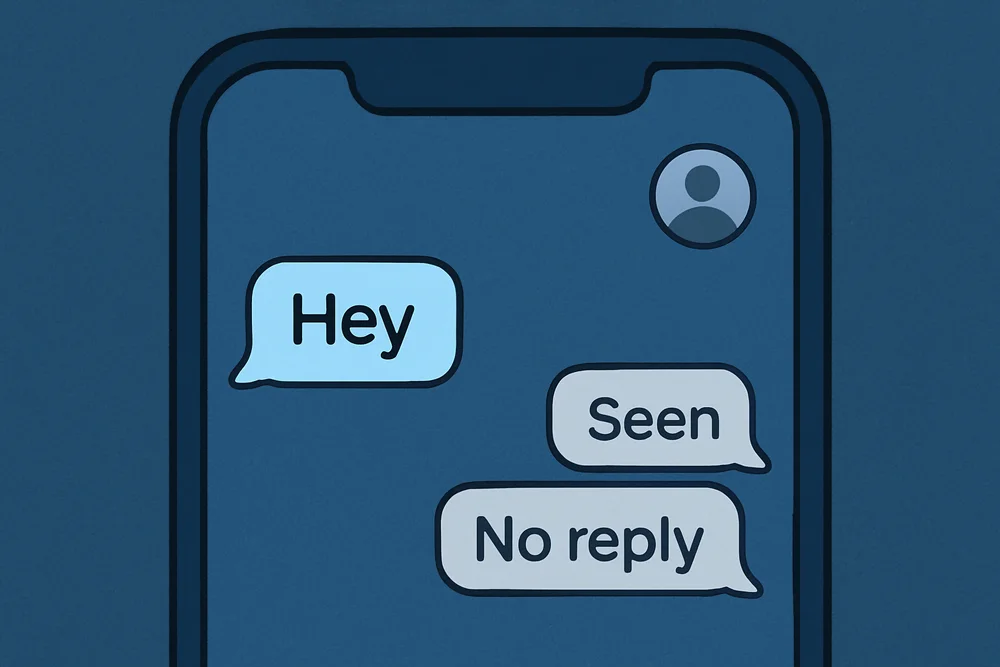
    texting with a conversation ender
    Not responding when someone has asked a question is ultimate disrespect. There’s no ambiguity here. These people shouldn’t be on your Contacts list.

    I’d suggest that you don’t take any immediate revenge against people who leave you in the dust by not responding to your question. Do nothing. If you’re not that close to them, avoid bringing it up or arguing over it. Carry on with your life and forget their existence. You don’t want to give them the satisfaction that you got emotionally impacted by them.

    I went a step further with the person who sent me a voice message in Real life example 1 above. I occasionally liked their posts and stories even after they left me in the dust. It must have confused them like crazy. They deserved it.

    When enough time has passed, you can quietly remove them and have one less nuisance in your life.

    Avoid chasing and over-investing

    I have already explained why chasing is a ‘low-power’ behavior. If you’re interested in someone, approach them or start a conversation by all means. But pay attention to how they reciprocate.

    • Do they reciprocate at all?
    • Do they make you feel like a fan who should feel lucky talking to them, a celebrity?

    If you asked a question, it’s their turn to respond. Let them respond, or not, whatever they prefer. Don’t ask:

    “Hey, where have you gone?”

    “Did you see my message?”

    “Why are you not responding?”

    When you can’t respond

    If you’re someone who doesn’t respond to texts, try to communicate the reason you’re not responding if you care about that person. Even short messages like these are helpful and can put their concerns to rest:

    “Having dinner. TTYL.”

    “With family.”

    References

  • The psychology of changing your name

    The psychology of changing your name

    A person’s name and face are their most distinguishing features. Name more so than face. Even identical twins who look the same are given different names to let the world know they’re separate people. 

    Our names are attached to our identities. They’re a big part of who we are. Unfortunately, people don’t have any control over what names they’re assigned, like gender.

    Parents do their best to give their children a good name. They want to ensure they give their kids the best possible identities. Almost all the names, therefore, have positive meanings. They represent desirable qualities. No parent names their kid something that means ‘criminal’.

    Yet, despite parents’ best intentions and hopes, some people deviate from the identities bestowed upon them via their names and become criminals.

    So, it’s not like a kid will always live up to their name. Yet, when people hear a good name with a nice meaning, they’re thoroughly impressed. As if it’s a guarantee that the child will live up to the name.

    Still- being part of your identity- your name does affect you psychologically.

    Names, identity, and ego

    Have you come across a single person who doesn’t know the meaning of their name?

    I haven’t.

    This goes to show how special their own names are to people. If you like your name, the way it sounds, and what it means, you feel proud of it. As someone rightly said, hearing your name is one of the sweetest sounds, especially when uttered by special people.

    Anything that makes us proud involves our ego.

    You can hurt someone’s ego if you mispronounce their name or make fun of it.

    When I was in college, we had a professor who rejected assignments because students forgot to write his name on the assignment in a prominent way. To me, that behavior was ridiculous and childish on the part of the professor. No different than how school kids write their names on benches and tables.

    When you care about your name too much as an adult, it tells me you derive much of your self-worth from a mere utterance your parents assigned you at birth.

    Names and prejudice

    Being social species, humans are wired to gather as much information on other people off of as little information as possible. Sometimes, a person’s name can tell a lot about them. Other than communicating positive qualities, a name can also communicate:

    • Ethnicity
    • Gender
    • Religion

    Also, based on expectations people form from their experiences, some names get attached to certain personality types. This is why you hear people say things like:

    “Ruth is an aunt’s name.”

    “Ashley is a pretty girl’s name.”

    People have come across too many aunties named “Ruth” and too many pretty girls named “Ashley”. So, when they hear such names, they have expectations.

    The problem with assuming things about people based on just their names is that you become prone to prejudice and discrimination. Through a person’s name, you have limited information about them as an individual but enough information about the group to which they belong.

    And if you happen to hate their group, you’re likely to assign them the qualities stereotypical of that group and hate the individual as well.

    Reasons for name change

    Now that we know names have psychological significance let’s see why people choose to change their names.

    1. Not liking your name

    If you don’t like how your name sounds or how it spells, it can be embarrassing to introduce yourself. Introducing yourself can quickly become a burden if you meet new people regularly.

    So, people sometimes change their names to get better-sounding and easy-to-remember names.

    2. Too common

    We all want to feel special and unique. If your parents gave you a name that’s too common, it’s hard to feel so unique. When people come across someone with the same name as them, they feel like something has been taken away from them.

    So, people switch to more unique names to feel unique and to communicate their uniqueness.

    3. Name-personality mismatch

    It happens when you don’t have the personality that your name reflects. When people who know you ask what your name means, and you reply, the confusion on their faces is unmistakable.

    “You’re the complete opposite of that”, they tell you.

    It’s not a pleasant feeling when you have a name-personality mismatch. So, people switch their names to something that more accurately reflects who they are.

    4. Name-identity mismatch

    While personality is about stable traits, identity can be much more fluid. Identity can evolve and change faster than one’s personality. Since names represent identity, when identity evolves, the name no longer reflects that identity. To reflect the new identity, a new name is needed.

    This is why people who join cults are often given new names so they can fully embrace their new cult identity.

    Name-identity mismatch can also surface when you go through significant life changes. Major life changes have the potential to change your identity.

    5. Discarding old identity

    Sometimes people change their names to discard a previous identity they don’t like.

    For instance, if your abusive father named you and you’ve cut ties with him, your name will likely remind you of him. By discarding your name, you’re discarding your past.

    Similarly, some people no longer want to identify with their families or social groups. Changing their names helps them dissociate from these groups.

    6. Escaping prejudice

    If you’re a minority in a country plagued with prejudice and discrimination, you know what a burden your name can become.

    To escape these problems, some people change their names to make them more majority-sounding.

    What’s in a name? Much ado about nothing?

    There’s no denying that names carry psychological weight. But if your identity evolves continuously, your name occupies only a tiny corner of your identity room.

    You realize you’re so much more than what your name reflects. It’s impossible to find a name that does justice to the multitudes that you are.

    At this point, you don’t take your name too seriously. You don’t think about it too much. It was random like your gender. You don’t think it’s worth it to go through the pain of changing it. And you certainly don’t rebuke college students for not emboldening it on their assignment covers.

  • The psychology of saying “I love you” too much

    The psychology of saying “I love you” too much

    Everyone likes to hear those three magical words. They make you feel special, wanted, important, and loved. But is there a thing as saying ‘I love you’ too much? What happens when you say ‘I love you’ too much in a relationship?

    People often say ‘I love you’ in a relationship when they feel and mean it. The hearer of these words can usually tell when they are meant and when they’re not. The hearer is expected to reciprocate by saying those words and meaning them.

    Ideally, both partners should mean and feel it when they verbally declare their love for each other. But there’s more to the story. When you focus on the mental states of the speaker and the hearer of those words, you realize how complicated it can quickly get.

    Why saying it too much may not be ideal

    Different mental states

    People know that you can’t feel strong emotions all the time. Emotions fluctuate. They rise and fall like ocean waves. When you’re in love, you may constantly feel the need to declare your love for your partner. You mean it, and you feel it. Your partner reciprocates because they mean it and feel it too.

    But they’re intuitively aware that you can’t feel strong emotions all the time. So, saying ‘I love you’ too much, even if you mean and feel it, can come across as insincere or even manipulative. It also puts the hearer under pressure to reciprocate. Sure, they may love you, but they may not be feeling what you’re feeling in the moment. They may not feel the need to say it. An increase in ‘felt love’ does not always translate to an increase in expressing it.1Williams, L., Kim, S. H., Li, Y., Heshmati, S., Vandekerckhove, J., Roeser, R. W., & Oravecz, Z. (2025). How much we express love predicts how much we feel loved in daily life. PloS one, 20(7), e0323326

    Hence, they’re forced to say ‘I love you’ back even when they don’t feel it or feel it but don’t want to express it. It doesn’t mean they don’t love you. It probably means they don’t feel much love right now. They don’t feel it enough to say it back. Their current mental state is different than yours.

    Compare this to moments when you both feel it and say it. You both mean it. There’s no pressure of any kind. It comes out naturally.

    Taking it for granted

    Another problem with saying ‘I love you’ too much is that it can quickly become a routine. When something becomes routine, we take it for granted. When you get a new phone, you value it highly. You’re careful not to break or drop it. A few months later, you throw it around and drop it often. You don’t value it as much.

    In psychology, getting used to things this way is called habituation. It happens with everything, including the words you like to hear. The more you have something, the less you value it. In contrast, the scarcer something is, the more you appreciate it.

    At the same time, you don’t want to keep those words so scarce that your partner feels unloved or has doubts about the relationship. You have to hit that sweet spot between saying it rarely versus saying it too often.

    saying i love you

    Individual differences

    If you overuse “I love you”, how your partner takes it also depends on their attachment style. Anxiously attached individuals, particularly women, tend to be more emotionally expressive and often express their feelings more frequently in relationships.2Wilkins, R., & Gareis, E. (2006). Emotion expression and the locution “I love you”: A cross-cultural study. International Journal of Intercultural Relations, 30(1), 51-75. They’re likely not to mind because they express it too much and probably expect to hear it too much as well. Keep the concept of habituation in mind and know that there’s a limit.

    In contrast, avoidants generally express less affection and expect the same from others. They may feel uncomfortable when you say it to them too much. Interestingly, once they’re in love, they’re able to overcome the psychological barriers to expressing love. They express it, and expect it to be expressed, more often.3Dillow, M. R., Goodboy, A. K., & Bolkan, S. (2014). Attachment and the expression of affection in romantic relationships: The mediating role of romantic love. Communication Reports, 27(2), 102-115.

    Reasons for overusing “I love you”

    What drives someone to say ‘I love you’ constantly? Other than feeling the need to say it, the following are possible reasons for this behavior:

    1. Seeking reassurance

    People sometimes feel insecure in relationships, even if they don’t have an inherently insecure personality. Saying ‘I love you’ too much can be a way to seek reassurance that your partner loves you too. When your partner repeats it back to you, you feel more secure in the relationship. Again, those with the anxious attachment style, because of their deep fears of abandonment, say those words often.

    2. Fear

    When you’re afraid of losing your partner, you may say ‘I love you’ often to reel your partner back in. Your partner may have done something that made you feel jealous. Overly saying ‘I love you’ in this case is a way to grab their hand and pull them back to you figuratively. Clingy partners often say ‘I love you’. It’s the anxiety of losing their partner that makes them say it more than love. 

    3. Buttering

    People know it feels good to hear those words. So, your partner may try to make you feel good by saying those words. They may do this because they have bad news for you and want to soften the blow. Or because they feel guilty and want you to lessen the punishment. In worst-case scenarios, it can be a manipulative tactic to distract you from their mistake or to gain something from you. We’re more likely to comply with requests and demands when we feel good.

    Narcissists and psychopaths may overexpress their love when they're love-bombing their partners during the initial stages of the relationship.

    People don’t value FREE!

    People like free stuff, but they don’t value it. I’ve downloaded numerous PDFs to my computer for free from various websites on the internet. I hardly look at them. But the books I buy, I read. When you pay for stuff, you have more skin in the game. You want to make your financial sacrifice worthwhile.

    Similarly, saying ‘I love you’ too freely reduces its value. It’s no longer powerful and magical. To keep it magical, you must ensure that it hits hard when you say it.

    The simple rule to remember is to say it when you feel it. Since we don’t experience strong emotions 24/7, this will automatically prevent you from overusing it. Saying it when you both feel it is much better, but it’s not always easy to gauge your partner’s emotional state. 

    To keep those magical three words magical, you have to say them unexpectedly and in creative ways. Avoid turning declaring your love into a routine.

    Scarcity = value (Real-life example)

    I have a friend on Facebook who’s very intelligent. He constantly criticizes my posts. I would’ve dismissed him as some hater, but I didn’t because his critiques were thoughtful. I hardly got any validation from him, and I thought I didn’t care about his validation at all. But boy, was I wrong!

    He praised one of my posts for the first time, and let me tell you, that hit hard. Like really hard! I was shocked. I thought I didn’t care if he liked or didn’t like my stuff. But I enjoyed his validation. Why?

    It’s because he made his validation so rare. In fact, invalidation or criticism was his default. I hated my mind for loving the validation. It was embarrassing. But the mind wants what it wants and loves what it loves. 

    Now, I’m not suggesting you invalidate your partner. Some dating gurus preach that. It can’t work unless your partner respects you in some way. Remember, I considered my Facebook friend intelligent. That’s a big reason why his invalidation-invalidation-invalidation-validation sequence worked. Had I thought of him as some dumb hater, I don’t think I would have cared about his validation at all.

    References

  • 14 Signs someone has given up on life

    14 Signs someone has given up on life

    We all have goals and dreams. Many of these goals, like being in a good relationship, are genetically programmed into us. So for the most part, we don’t even get to choose our goals. They come with the genetic package we’re born with.

    Broadly speaking, people have goals in three major life areas– career, health, and relationships. When we reach our goals in all three areas, we maximize our chances of survival, reproduction, joy, and happiness.

    However, excelling in these areas of life is anything but easy. There are lots and lots of challenges and obstacles along the way.

    obstacles toward a goal

    Facing a minor setback in trying to reach our goals doesn’t usually bother people much or make them hopeless. But when an obstacle or challenge becomes overbearing, people start to lose hope. That’s when they feel like giving up on life. They don’t think they can make it.

    Why give up, though?

    If a person can’t reach the goals they’re genetically programmed to reach, what’s the point of carrying on?

    Our ancestral environments had scarce resources. If a family member couldn’t survive and reproduce, that family member was a drain on the family’s resources. Keeping that person alive was costly and came at the expense of the reproductive success of other family members.

    Evolution had to figure out a mechanism by which the ‘loser’ of the family could give up hope and contemplate eliminating themselves. This is the psychology behind suicidal ideation.

    While not everyone who gives up on life considers ending their life, they’re pretty close to it psychologically. They may have some hope left or be too afraid to end it all.

    Events that trigger the feeling

    Major setbacks in trying to achieve your career, health, and relational goals can make someone want to give up on life. Feeling like giving up on life equals hopelessness, a major symptom of depression. So, people who feel like giving up on life are likely to be depressed.

    A major setback in one life area can affect other life areas. As they say, misfortunes never come singly.

    For instance, if a person loses their job, they may also lose their relationship. If they lose their relationship, they may also stop caring for themselves and lose their health. Such a total catastrophe can quickly drive people to the point of giving up on life and contemplating ending it all.

    Signs

    Let’s now learn how to recognize the signs of giving up on life in someone:

    1. They’ve failed to meet their expectations

    As kids, we have huge expectations for our lives. By 20, I’ll do this. By 30, I’ll do that. We daydream of extreme success in every life area. The mind does this so we can be hopeful about the future, continue to survive, and be excited about life.

    However, as people grow old, many realize that they’ve fallen behind on their dreams. Our current reality doesn’t match our prior expectations. This can be highly demotivating and force someone to give up on life.

    2. They have no hope left

    Often, the only thing that pushes us to work towards our goals is hope. When that hope is gone, the effort we put towards our goals goes with it. There’s no point in trying.

    All worthy goals in life are long-term goals. When working on long-term goals, you have to count on hope because you don’t see any immediate progress.

    3. They’ve stopped dreaming

    One can get to a point where they see no point in dreaming about the future. It’s a silly thing that they did as kids. They ought to be more practical and realistic now. This thinking can be detrimental to progress.

    4. They feel they can’t control life

    If someone suffered a significant setback in life, especially one they had no control over, they’re likely to believe they can’t control their life. When one thinks they have no control over their life, they let life slip away from their hands.

    They’re like:

    “Screw it! I’m done trying to control life.”

    5. They’ve lost excitement for life

    With all the dreaming and hoping for a better future comes excitement. A person can’t wait to step into your glorious future where they’ve reached their goals. No excitement means having no goals to look forward to. People with goals have a spark in their eyes that those without goals who’ve given up on life are missing. The latter lack energy, enthusiasm, and a zest for life.

    6. They don’t take care of themselves

    Have you noticed how people take good care of themselves when they’re doing well? Doing well in one life area gives a person hope and energy to improve other areas. If one gets promoted, for instance, they may want to start hitting the gym. Things look positive.

    Except when they don’t.

    As soon as they hit a setback in one life area, other areas get affected too. They don’t feel like taking care of themselves anymore. There’s no hope. What’s the point?

    It’s like when you eat one piece of cake and break your rule of avoiding junk food. You’re like:

    “I’ve already messed up. What’s the point? Let’s eat the whole thing.”

    7. They constantly compare and feel miserable

    As social species, humans can’t help but compare themselves to others. When things are not good for them, they’re especially vulnerable to comparison-driven misery. They compare themselves to others who are doing better than they are and feel miserable.

    8. They no longer laugh as much

    Laughing and making others laugh is often a by-product of a good mood and happiness. If someone’s not in a good mood, it’s hard for them to laugh and make others laugh. When you’ve hit rock bottom in life, the last thing you want to do is crack jokes.

    Although some people do use humor to cope, they’re rare.

    9. They’re overwhelmed and burned out

    When a person is mired in the obstacles on the path toward their dreams, it’s easy to get frustrated, overwhelmed, and burned out.

    10. They carry past baggage

    Past emotional baggage and unresolved traumas can seriously slow down progress. The only reason people want to resolve traumas is so they can move forward. If traumas didn’t impede our ability to reach our goals, no one would care about resolving them.

    Traumas interfere with our relational goals the most. If you’re single, you’re yet to see the devastating effects that past baggage can have on a relationship.

    11. They feel worthless

    We reach our goals by helping others reach theirs. So, the more a person excels in life, the more likely it is that they’re helping others excel, too. When people contribute to society in significant ways, their self-esteem increases.

    When they don’t, they feel worthless. This is why you come across people who seem to be living decent lives, but deep down, they’re unsatisfied. Because they feel they haven’t reached their potential or made a significant impact.

    12. They’re socially withdrawn

    Feeling worthless makes a person avoid putting themselves out there. They feel like people have no reason to like or value them.

    13. They’re apathetic

    When someone has lost everything, nothing matters. They become apathetic because they have nothing to lose. They have nothing to care for.

    14. They’re negative about everything

    They become negative about themselves, others, and the world. They blame external forces for the way their lives have turned out. If anyone tries to help them or give advice, they immediately shut them down with an “It won’t work”.