Take some of the most reliable tests in psychology to understand yourself better. The tests are free to take with instant results, no personal information collection, and no hidden charges. Quizzes are an effective way to quantify what you’re going through. By seeing how you score on them, you can be strategic about what things you can work on in your personal development journey.
The male hierarchy, or the socio-sexual hierarchy, is a way of categorizing heterosexual men in human society. Like many other animals, there’s a dominance hierarchy of males in humans. Both men and women are sensitive to cues of social status. Men’s value in society is primarily determined by their status, and vice versa- the value …
Autism or Autism Spectrum Disorder (ASD) is a neurodevelopmental disorder in which a person experiences difficulty expressing themselves and navigating social interactions. The condition develops very early in life (2-3 years), but many people go undiagnosed because the symptoms can be confusing and sometimes overlap with normal behavior. 3 Main symptoms of autism ASD is …
We don’t hear the word “hyper-independence” often in everyday conversations. Is it even possible to be too independent for your own good? It is. “Excess of everything is bad”, the saying goes. It applies to everything in life, including a seemingly positive trait like independence. Hyper-independence is over-reliance on oneself to the point where it …
Kleptomania (from Greek kleptein = “to steal” + mania = “madness”) is a rare mental health condition in which a person feels compelled to steal. A kleptomaniac feels a recurring, uncontrollable urge to steal. After indulging in the urge, a kleptomaniac feels relieved. Kleptomania has been classified as an impulse control disorder. It probably stems …
Passive-aggressiveness is a communication style in which a person expresses anger or hostility indirectly. Active aggression would be expressing anger directly. Passive-aggressive people tend to be conflict-avoidant and rarely express anger. This doesn’t mean they’re not hurt, though. They’ll get back at those who hurt them in subtle ways. Since passive-aggressive people cannot talk about …
Thought disorder, also called formal thought disorder or disorganized speech, is when a person’s thoughts become incoherent, illogical, and disorganized. This is reflected in how the person expresses themselves in speech and writing. Thought disorder is the main symptom of schizophrenia, dementia, and psychotic disorders. Of course, normal people also experience disorganized thoughts when they’re …
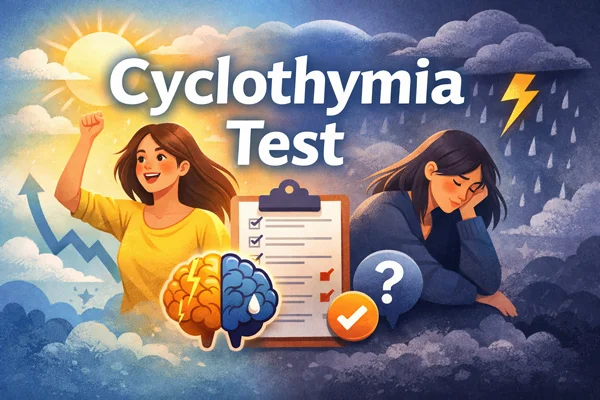
This test is based on the following validated scales, recommended by researchers to assess cyclothymia: Disclaimer: This quiz is for awareness only and does not diagnose or replace professional advice. If you suspect you may have Cyclothymia or your symptoms affect daily life, consult a qualified mental health professional. What is cyclothymia? The term ‘cyclothymia’ …
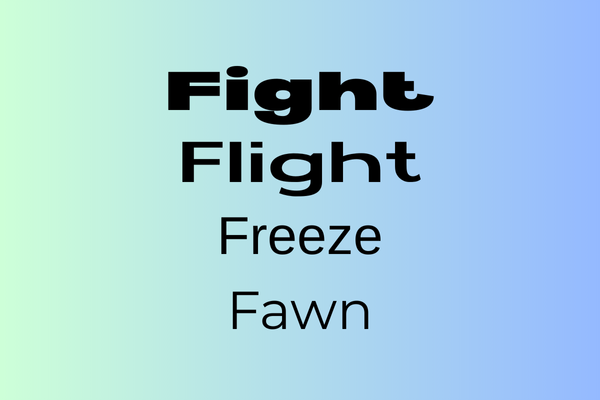
Trauma and trauma response Trauma is typically caused by a survival and/or reproduction-threatening event that the mind sees as dangerous. While daily life problems cause mild levels of distress, a traumatic event typically significantly decreases our odds of survival and reproduction. Traumas are out-of-the-ordinary stressors that have low: Since our minds and bodies are built …
Narcissism is of two types: When we think of narcissists, we usually think of overt narcissists (ON). Overt narcissists openly display their narcissism. They’re usually extroverted, have high self-esteem, and are the loudest person in the room. They tend to be: Covert/vulnerable narcissists (CN) also desire to be superior to others, but they subtly accomplish …
Hypervigilance is derived from the Greek ‘hyper’, meaning ‘over’, and Latin ‘vigilantia’, meaning ‘wakefulness’. Hypervigilance is a mental state where a person scans their environment for potential threats. A hypervigilant person notices the slightest change in their environment and perceives it as a potential threat. Hypervigilance and anxiety go hand in hand. Anxiety stems from …